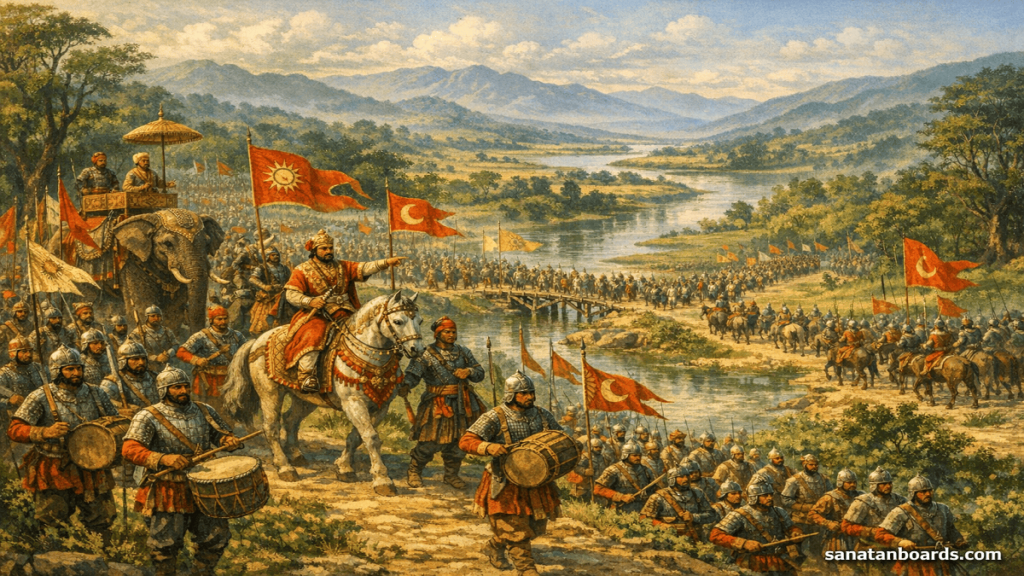
The Maratha Empire, led by the visionary rulers Chhatrapati Shivaji Maharaj and later Chhatrapati Shahu, remains a remarkable chapter in Indian history. Founded in the 17th century by Shivaji Maharaj, the empire emerged as a symbol of resistance against the Mughal Empire, emphasizing strategic warfare, naval strength, and administrative excellence. Shivaji Maharaj was not only a formidable warrior but also an enlightened administrator who established a decentralized system of governance, ensuring justice and prosperity for his subjects.
After Shivaji’s demise, Chhatrapati Shahu ascended the throne, further consolidating Maratha power through the appointment of capable Peshwas, such as Balaji Vishwanath and Baji Rao I. Under their leadership, the Maratha Empire expanded across vast territories in India, becoming a dominant force in the 18th century. The Marathas were known for their valor, disciplined armies, and unique guerrilla warfare tactics, which challenged even the most powerful empires of their time.
This legacy of governance, courage, and cultural pride left a lasting imprint on India’s history. Understanding the Maratha Empire through the lives of Shivaji Maharaj and Shahu provides students and enthusiasts a comprehensive view of leadership, strategy, and nation-building.
What Is Maratha Empire – Chhatrapati Shivaji Maharaj, Chhatrapati Shahu ?
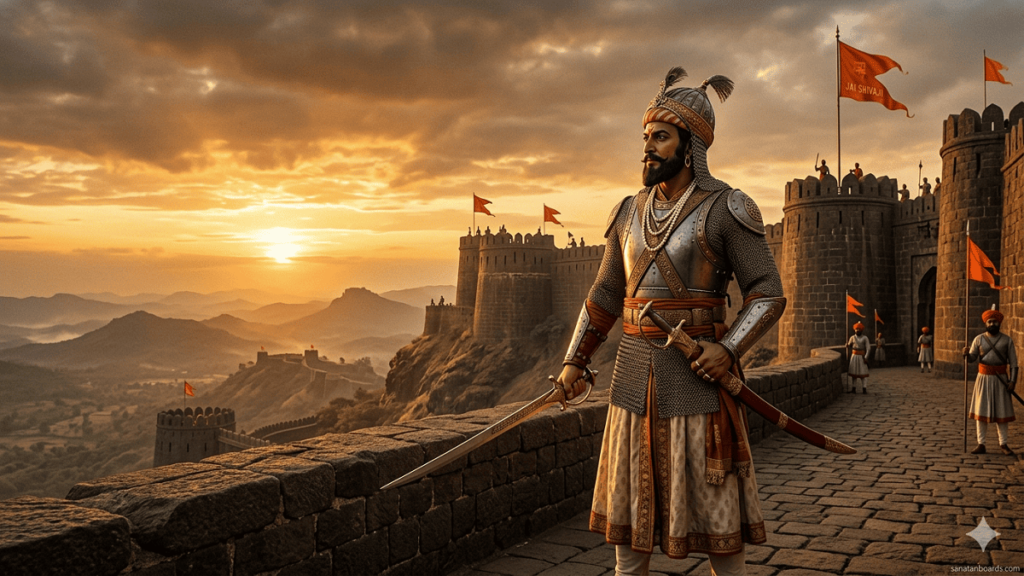
The Maratha Empire – Chhatrapati Shivaji Maharaj, Chhatrapati Shahu refers to the powerful Indian kingdom that played a crucial role in shaping India’s history during the 17th and 18th centuries. The empire was founded by Chhatrapati Shivaji Maharaj, a visionary leader who emphasized self-rule, military strategy, and social justice. Shivaji’s innovative military tactics, such as guerrilla warfare, allowed the Marathas to defend their territory effectively against larger and better-equipped forces, particularly the Mughal Empire.
Shivaji Maharaj also established a strong administrative system, dividing his kingdom into provinces called Swarajya, with local governors responsible for efficient governance. His reign laid the foundation for an independent Indian polity based on meritocracy and fairness. Shivaji’s vision extended beyond warfare; he encouraged trade, cultural growth, and religious tolerance, making the Maratha Empire a thriving and respected kingdom.
After Shivaji’s death, Chhatrapati Shahu, his grandson, ascended the throne and expanded the empire through political acumen and delegation. Shahu’s rule marked the era of the Peshwas, who became the de facto administrators of the empire, furthering Maratha influence across India. Under Shahu, the Marathas extended their control to vast regions, from the Deccan to northern India, establishing a federated empire.
The Maratha Empire under these leaders symbolized strength, strategy, and visionary governance. It contributed significantly to India’s political landscape by resisting external domination and promoting indigenous administration. Today, learning about the Maratha Empire – Chhatrapati Shivaji Maharaj, Chhatrapati Shahu provides valuable lessons in leadership, military strategy, and nation-building.
Who Is Required Maratha Empire – Chhatrapati Shivaji Maharaj, Chhatrapati Shahu ?
The study of MARATHA EMPIRE – CHHATRAPATI SHIVAJI MAHARAJ, CHHATRAPATI SHAHU is required for a wide range of individuals seeking educational growth, historical insight, and strategic understanding. Primarily, students of Indian history, political science, and governance must study the Maratha Empire to understand the evolution of regional powers in India and their influence on national politics. Shivaji Maharaj’s innovative military strategies and administrative reforms provide critical lessons for those studying leadership, defense planning, and organizational management.
Historians and researchers require knowledge of the Maratha Empire to analyze India’s resistance against Mughal dominance, the expansion of regional powers, and the sociopolitical changes in the 17th and 18th centuries. Similarly, civil service aspirants find the empire’s administrative structure and governance practices particularly relevant for understanding decentralized systems, taxation policies, and law enforcement in historical contexts.
The empire also holds cultural significance. Scholars of Indian culture, literature, and art examine the Maratha era to trace developments in Marathi literature, forts, architectural styles, and social reforms. Furthermore, the empire’s emphasis on religious tolerance and equitable governance serves as an inspiring model for modern leaders and policymakers.
Educators and history enthusiasts are also encouraged to study the lives of Chhatrapati Shivaji Maharaj and Chhatrapati Shahu to draw lessons on resilience, strategic thinking, and nation-building. Military strategists, in particular, can benefit from analyzing guerrilla warfare tactics, fort architecture, and cavalry strategies implemented by the Marathas.
Finally, general readers interested in Indian heritage, regional pride, and leadership excellence can gain a comprehensive understanding of India’s diverse historical narratives by exploring the Maratha Empire. Thus, the study of MARATHA EMPIRE – CHHATRAPATI SHIVAJI MAHARAJ, CHHATRAPATI SHAHU is required for students, historians, policymakers, military analysts, and cultural scholars alike, making it an essential component of educational learning and knowledge dissemination.
When Maratha Empire – Chhatrapati Shivaji Maharaj, Chhatrapati Shahu Is Required ?
The study of MARATHA EMPIRE – CHHATRAPATI SHIVAJI MAHARAJ, CHHATRAPATI SHAHU is required when one seeks to understand the historical, cultural, and political evolution of India during the 17th and 18th centuries. It is particularly necessary when analyzing the rise of regional powers following the decline of the Mughal Empire. During this period, India was a mosaic of kingdoms, each competing for influence, wealth, and territory. The Maratha Empire’s ascension under Shivaji Maharaj and later consolidation under Chhatrapati Shahu provides a clear timeline of strategic leadership, administrative reforms, and military innovation.
Studying the Maratha Empire is required when exploring the concept of decentralized governance in pre-modern India. Shivaji Maharaj’s vision of Swarajya involved dividing territories into smaller, manageable regions with local administrators, ensuring efficiency and accountability. This governance model is studied when analyzing the evolution of Indian political systems and how regional autonomy functioned alongside a central authority.
It is also required when evaluating military strategy and defense mechanisms. Shivaji Maharaj’s guerrilla tactics, fortifications, and naval advancements set a precedent for unconventional warfare in Indian history. Military scholars and students of strategy examine these techniques to understand how a relatively smaller kingdom could successfully resist larger empires.
Moreover, the study is required when looking at cultural and social developments. The Maratha Empire encouraged literature, education, and religious tolerance, fostering a sense of regional identity and cultural pride. Festivals, Marathi literature, and fort architecture from this period are essential topics in cultural studies and historical education.
Finally, knowledge of the Maratha Empire is required when analyzing leadership qualities and decision-making skills. Both Shivaji Maharaj and Chhatrapati Shahu exemplify vision, courage, diplomacy, and administrative acumen, serving as a model for leaders in contemporary contexts.
Where Maratha Empire – Chhatrapati Shivaji Maharaj, Chhatrapati Shahu Is Required ?
MARATHA EMPIRE – CHHATRAPATI SHIVAJI MAHARAJ, CHHATRAPATI SHAHU is required in multiple contexts, locations, and disciplines due to its historical, cultural, and strategic significance. Geographically, it is primarily required in regions that were part of the Maratha Empire, such as Maharashtra, Madhya Pradesh, Karnataka, Gujarat, and parts of northern India. These areas still host forts, monuments, and historical sites associated with Shivaji Maharaj and Chhatrapati Shahu, making local educational and heritage studies dependent on understanding the empire.
Academically, it is required in schools, colleges, and universities offering courses in Indian history, political science, military studies, and cultural research. History departments focus on the Maratha Empire to analyze the dynamics between regional powers and the Mughal Empire, while political science programs study the administrative structure and decentralized governance implemented by Shivaji Maharaj.
The study is also required in museums, heritage centers, and historical preservation projects. For example, forts like Raigad, Sinhagad, and Pratapgad are vital for research and tourism, where understanding the Maratha Empire enhances the interpretation of these sites. Cultural festivals, commemorations, and exhibitions related to Shivaji Maharaj and Chhatrapati Shahu also require accurate historical knowledge.
Professionally, it is required in military academies and leadership training programs. Shivaji Maharaj’s military strategies, including guerrilla tactics and fort defense, are studied in defense courses to teach principles of strategy, resource management, and tactical innovation. Leadership seminars often cite the decision-making and governance models of Chhatrapati Shahu to illustrate effective delegation, crisis management, and vision-oriented administration.
Additionally, the study is required in publishing, media, and educational content creation. Documentaries, articles, and educational blogs focusing on Indian history rely on detailed knowledge of the Maratha Empire for accuracy and context.
How Maratha Empire – Chhatrapati Shivaji Maharaj, Chhatrapati Shahu Is Required ?
MARATHA EMPIRE – CHHATRAPATI SHIVAJI MAHARAJ, CHHATRAPATI SHAHU is required through various methods, approaches, and educational strategies to ensure a comprehensive understanding of its historical, cultural, and strategic significance.
Primarily, it is required through academic study and research. Students and scholars analyze historical texts, administrative records, letters, and biographies of Shivaji Maharaj and Chhatrapati Shahu. Research papers often focus on military campaigns, governance systems, and cultural contributions, providing a structured method to understand the empire’s influence.
It is required through field visits and heritage exploration. Studying forts like Raigad, Pratapgad, and Sinhagad provides practical insights into the empire’s military strategies and architectural innovations. Experiencing these historical sites firsthand allows learners to understand how geography, terrain, and fort design contributed to Maratha defense mechanisms.
The study is also required through literature and cultural analysis. Marathi literature, poetry, folk tales, and contemporary writings from the Maratha period highlight social, cultural, and religious aspects of the empire. This approach is essential for understanding the values, customs, and everyday life of the people under Shivaji Maharaj and Chhatrapati Shahu.
It is required through digital learning and multimedia resources. Documentaries, online courses, interactive maps, and simulations enable learners to explore battles, governance structures, and historical events efficiently. Modern educational tools make the empire accessible to students worldwide, providing a visual and engaging method of learning.
Additionally, the study is required through case studies and leadership analysis. By examining Shivaji Maharaj’s military tactics and Shahu’s administrative strategies, learners develop skills in decision-making, crisis management, and strategic thinking, which are applicable in contemporary organizational and military contexts.
Finally, it is required through collaborative learning and discussion. Seminars, workshops, and conferences on Maratha history allow historians, students, and enthusiasts to share insights, debate interpretations, and deepen understanding.
Case Study On Maratha Empire – Chhatrapati Shivaji Maharaj, Chhatrapati Shahu
Introduction
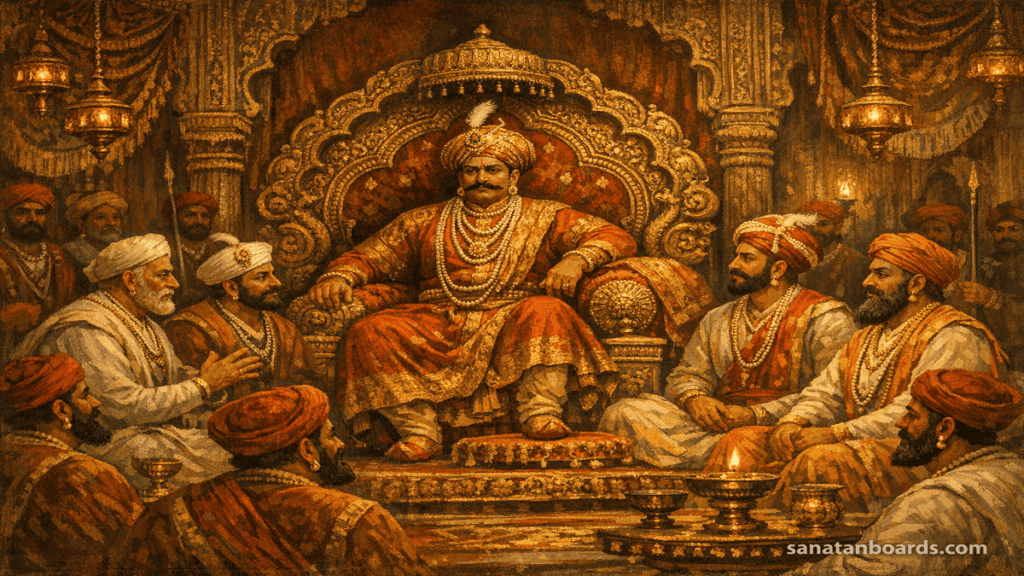
The MARATHA EMPIRE – CHHATRAPATI SHIVAJI MAHARAJ, CHHATRAPATI SHAHU serves as a prime example of leadership, governance, and strategic military innovation in pre-modern India. This case study examines the foundation, expansion, administration, military strategies, and cultural contributions of the Maratha Empire, highlighting the roles of Shivaji Maharaj and Chhatrapati Shahu. The study emphasizes lessons for leadership, governance, and organizational strategy, making it relevant for educational and research purposes.
Foundation and Rise of the Empire
The Maratha Empire was founded by Chhatrapati Shivaji Maharaj in the mid-17th century in western India, primarily in Maharashtra. Shivaji was born in 1630 into the Bhonsle Maratha clan. Observing the weakening Mughal control and the oppression of local populations, he envisioned an independent Maratha kingdom, known as Swarajya. Using innovative guerrilla warfare tactics and fortification strategies, Shivaji successfully resisted larger Mughal and Bijapur forces.
Shivaji Maharaj’s administration emphasized decentralization. Territories were divided into provinces, or Swarajya divisions, managed by trusted local officials. This system ensured accountability, efficiency, and the welfare of citizens. Shivaji also promoted trade, agriculture, and religious tolerance, which fostered loyalty among his subjects.
Expansion Under Chhatrapati Shahu
Following Shivaji’s death in 1680, his son Sambhaji ruled briefly, but the empire faced instability. Eventually, Chhatrapati Shahu ascended the throne, marking a period of consolidation and expansion. Shahu delegated authority to capable Peshwas, such as Balaji Vishwanath and Baji Rao I, whose military campaigns extended Maratha influence across northern and central India.
Under Shahu’s leadership, the Marathas became a federated empire, managing multiple territories while maintaining allegiance to the central authority. This model allowed the Marathas to dominate the subcontinent, challenging Mughal supremacy and shaping the political landscape of 18th-century India.
Military Strategy
A key strength of the Maratha Empire was its military strategy. Shivaji Maharaj pioneered guerrilla warfare, utilizing knowledge of the Western Ghats’ terrain to outmaneuver larger armies. Maratha cavalry and infantry were highly mobile, capable of rapid strikes and retreats. Fortifications such as Raigad, Pratapgad, and Sinhagad served as defensive hubs and command centers.
Under Shahu and the Peshwas, the army adopted disciplined formations, efficient supply lines, and strategic alliances. The Marathas’ naval forces, initiated by Shivaji, secured western coastal trade routes, protecting economic interests and expanding influence.
Governance and Administration
Both Shivaji and Shahu emphasized merit-based governance. Shivaji implemented efficient tax systems, judicial reforms, and local administrative structures. Chhatrapati Shahu reinforced these practices, delegating authority to Peshwas who managed civil administration, diplomacy, and revenue collection. The empire balanced centralized oversight with regional autonomy, ensuring political stability and economic growth.
Cultural and Social Impact
The Maratha Empire promoted Marathi language, literature, and arts. Forts, temples, and monuments built during this period continue to symbolize Maratha heritage. Religious tolerance was a hallmark of Shivaji Maharaj’s rule, fostering unity among diverse populations. Festivals, folk arts, and literature flourished, leaving a lasting cultural legacy.
Lessons and Significance
This case study of MARATHA EMPIRE – CHHATRAPATI SHIVAJI MAHARAJ, CHHATRAPATI SHAHU illustrates how visionary leadership, #marathaempirechhatrapatishahumaharajinmumbai strategic planning, and decentralized governance can establish a resilient and influential empire. For students, historians, and leaders, the Maratha Empire #marathaempirechhatrapatishahumaharajinpune provides insights into military innovation, administrative efficiency, and cultural integration.
White Paper On Maratha Empire – Chhatrapati Shivaji Maharaj, Chhatrapati Shahu
Executive Summary
The MARATHA EMPIRE – CHHATRAPATI SHIVAJI MAHARAJ, CHHATRAPATI SHAHU represents a seminal period in Indian history, illustrating the convergence of military strategy, governance, and cultural development. This white paper examines the empire’s formation administration, military innovations, economic policies, and long-term impact on India’s political and social fabric. It serves as a resource for educators, policymakers, military analysts, and researchers seeking to understand historical leadership and empire-building.
Introduction
The Maratha Empire, founded by Shivaji Maharaj, emerged in the 17th century amidst a fragmented India. The empire later expanded under Chhatrapati Shahu and the Peshwas, becoming a dominant political and military power. Shivaji’s vision of Swarajya established a decentralized yet cohesive governance system, blending local autonomy with central oversight.
Governance Model
Shivaji Maharaj’s governance emphasized efficiency, accountability, and public welfare. Revenue collection, judicial reforms, and administrative decentralization were central to the model. Provinces were divided into manageable units, and officials were appointed based on merit. Chhatrapati Shahu expanded this system, delegating responsibilities to the Peshwas who managed diplomacy, finance, and military coordination.
Military Innovations
Military strength was a defining characteristic. Guerrilla warfare, rapid cavalry movements, and well-planned fortifications allowed Marathas to challenge larger empires. Shivaji’s navy secured trade routes along the western coast, ensuring economic stability. Under Shahu, disciplined formations, strategic alliances, and expansion campaigns strengthened Maratha influence across India.
Economic and Cultural Policies
The Marathas promoted trade, agriculture, and regional crafts, fostering prosperity. Cultural contributions included Marathi literature, temple architecture, and religious tolerance. These policies built loyalty, civic pride, and social cohesion.
Strategic Significance
The Maratha Empire played a pivotal role in ending Mughal dominance, shaping the political landscape of 18th-century India. Lessons in leadership, strategic planning, and governance from this period are relevant for modern administration, defense planning, and organizational management.
Conclusion
The MARATHA EMPIRE – CHHATRAPATI SHIVAJI MAHARAJ, CHHATRAPATI SHAHU exemplifies strategic leadership, administrative foresight, #marathaempirechhatrapatishivajimaharajinmumbai and cultural stewardship. Its legacy continues to inform #marathaempirechhatrapatishivajimaharajinpune historical research, education, and leadership studies.
Industry Application On Maratha Empire – Chhatrapati Shivaji Maharaj, Chhatrapati Shahu
Introduction
Although historical, the MARATHA EMPIRE – CHHATRAPATI SHIVAJI MAHARAJ, CHHATRAPATI SHAHU provides lessons applicable across modern industries. Leadership strategies, governance structures, and operational efficiency during the Maratha period can inform management practices, military strategy, cultural preservation, and education sectors today.
Leadership and Management
The Maratha model under Shivaji Maharaj and Shahu demonstrates the importance of vision-driven leadership. Modern industries can learn from their merit-based administration, delegation of authority, and crisis management. Peshwas acted as CEOs of their provinces, optimizing operations while maintaining alignment with the central authority.
Strategic Planning and Operations
Guerrilla tactics and logistical management in Maratha warfare have parallels in project management, supply chain operations, and risk management in industry. Rapid mobilization, adaptive strategies, and resource optimization are key takeaways for modern businesses facing dynamic market conditions.
Governance and Corporate Structure
The Maratha decentralized governance system can inspire organizational hierarchies and corporate structures. Regional autonomy combined with central oversight mirrors modern multinational management models, enhancing efficiency and accountability.
Cultural and Heritage Industries
Maratha contributions to literature, architecture, and fort preservation inform cultural tourism, heritage management, and educational content industries. Companies can leverage historical research to design immersive experiences, educational programs, and content-based marketing strategies.
Education and Training
Military academies and leadership training programs can adopt case studies from Shivaji Maharaj and Shahu’s strategies. Lessons in negotiation, crisis management, and strategic expansion are relevant for defense training, corporate leadership courses, and executive education.
Conclusion
The MARATHA EMPIRE – CHHATRAPATI SHIVAJI MAHARAJ, CHHATRAPATI SHAHU demonstrates that historical leadership and governance principles #sanatandharmaaccreditationboardsinmumbai have enduring relevance. Industries in management, #sanatandharmaaccreditationboardsofmaratha defense, cultural preservation, and education can draw actionable insights from Maratha administration and military strategy.
source : Gaurav Thakur
ASK FAQ
Who was Chhatrapati Shivaji Maharaj?
Chhatrapati Shivaji Maharaj was the founder of the Maratha Empire in the 17th century, known for guerrilla warfare, forts, and a decentralized governance system called Swarajya.
What role did Chhatrapati Shahu play in the Maratha Empire?
Chhatrapati Shahu, Shivaji’s grandson, expanded the Maratha Empire through capable Peshwas, consolidating territories, and strengthening administration and military influence.
When did the Maratha Empire exist?
The Maratha Empire rose in the mid-17th century under Shivaji Maharaj and reached its peak in the early 18th century under Chhatrapati Shahu.
Where was the Maratha Empire located?
The Maratha Empire was primarily in western and central India, covering Maharashtra, Madhya Pradesh, Gujarat, Karnataka, and northern regions during its peak.
Why is the Maratha Empire important in Indian history?
The Maratha Empire is important for its military innovations, administrative reforms, cultural contributions, and role in resisting Mughal dominance in India.
Table of Contents
Disclaimer
This content on MARATHA EMPIRE – CHHATRAPATI SHIVAJI MAHARAJ, CHHATRAPATI SHAHU is created solely for educational and informational purposes. It is based on historical research and publicly available knowledge to promote learning about India’s history, leadership, and governance. The information provided does not represent any political, religious, or commercial viewpoint. Readers are encouraged to cross-check historical facts from credible sources when using this content for study, research, or publications. All interpretations aim to preserve the historical context of the Maratha Empire and its rulers accurately, without bias or personal opinion.