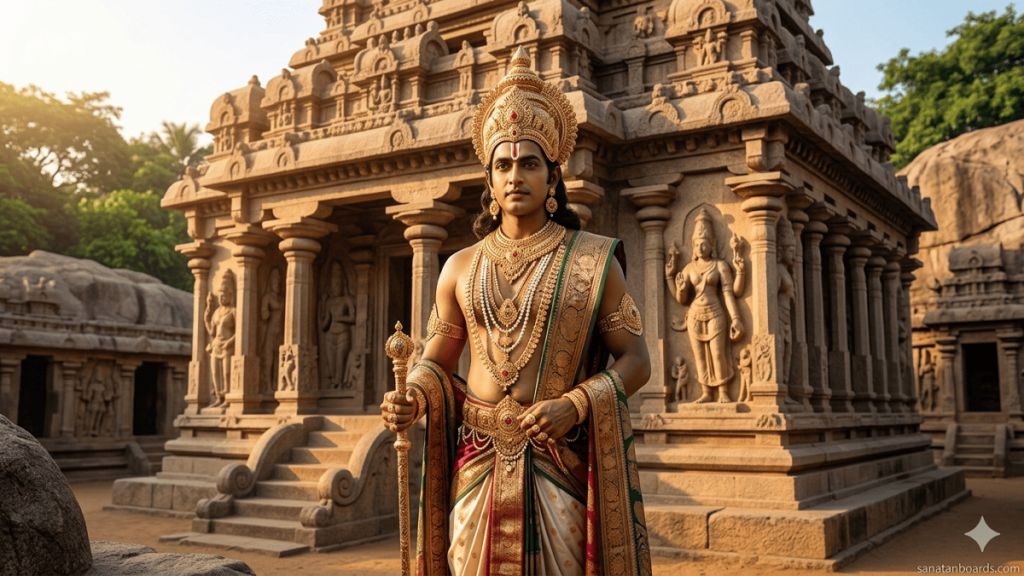
Mahendravarman I, often referred to simply as Mahendravarman (Pallava), was a distinguished king of the Pallava dynasty, one of the most influential ruling families in ancient South India. He reigned approximately from 590 to 630 CE, with his capital at Kanchipuram in what is now the Indian state of Tamil Nadu.
The Pallava dynasty was a powerful South Indian kingdom that rose to prominence between the 4th and 9th centuries CE, known for pioneering rock‑cut architecture, temple art, literature, and cultural innovation. Mahendravarman I was among the most notable rulers of this dynasty, remembered for his multi‑faceted talents as a king, artist, scholar, poet, and builder.
Unlike many rulers whose identities were limited to warfare or governance alone, Mahendravarman blended intellectual and artistic passion with political leadership. Initially trained in Jainism he later became a devotee of Shaivism, reflecting religious dynamism in his era.
Mahendravarman’s reign marked a cultural and architectural renaissance. He initiated the earliest known rock‑cut cave temples in South India, setting architectural standards that reached full glory under later Pallava rulers. These temples were carved directly from stone hills and displayed intricate artistry and devotion to Hindu deities.
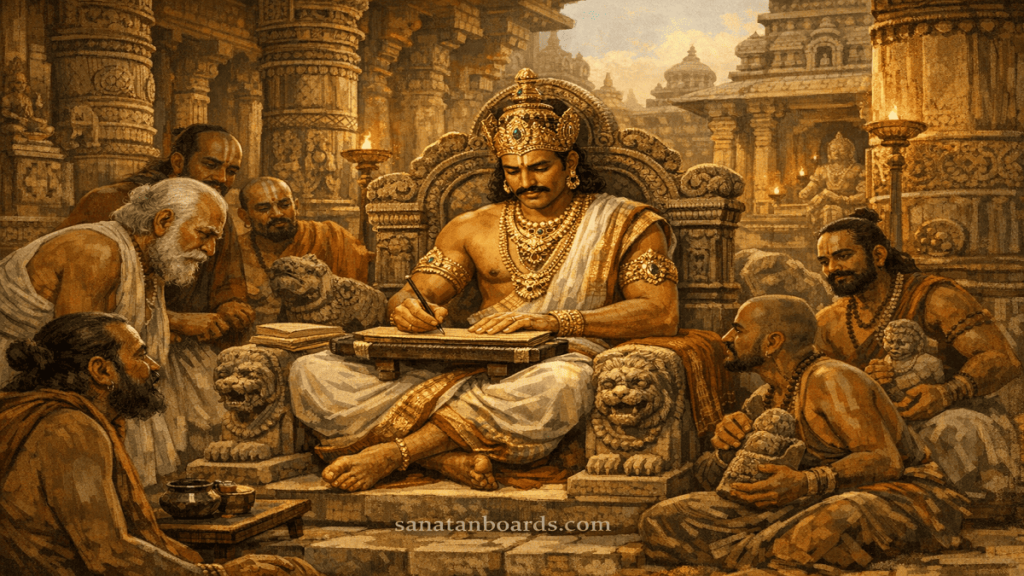
He was also a creative writer and is traditionally credited with composing the Sanskrit satire Mattavilasa‑prahasana, blending humor with social commentary.
In essence, Mahendravarman (Pallava) represents a blend of scholarship, artistic innovation, architectural vision, and dynamic leadership that laid foundational cultural elements of classical South Indian civilization.
What Is Mahendravarman (Pallava) ?
Mahendravarman (Pallava) was a major early king of the Pallava dynasty, ruling large parts of southern India in the early 7th century CE.
Born into a royal lineage, he succeeded his father Simhavishnu and inherited a kingdom that was growing in power and influence. His reign is significant for the transition from lesser temple traditions to sophisticated rock‑cut architecture, especially in the regions around Mamallapuram (Mahabalipuram) and Kanchipuram.
Historically, Mahendravarman is known for:
- Architectural innovation: He began the tradition of rock‑cut cave temples that became hallmarks of Pallava artistry. These temples include those at Mandagapattu, Mahendravadi, Vallam, and Siyamangalam.
- Literary works: He is attributed with writing Mattavilasa‑prahasana, a Sanskrit drama that uses satire to critique ascetics and religious sects of his time.
- Cultural influence: His court supported scholars, poets, and craftsmen, fostering literature, music, painting, and temple sculpture.
- Military leadership: Mahendravarman dealt with constant threat and warfare, particularly with the Western Chalukya king Pulakeshin II, who invaded Pallava territories during his reign.
Mahendravarman’s religious outlook was dynamic; though he began as a follower of Jainism, later he embraced Shaivism, influenced by the rising Bhakti movement.
Who Is Required Mahendravarman (Pallava) ?
The phrase “Who is required Mahendravarman (Pallava)” can be interpreted in an educational or historical sense as who benefits from studying or understanding Mahendravarman (Pallava) and why knowledge about him is significant.
Primarily, historians, researchers, and students of ancient Indian history require detailed knowledge about Mahendravarman because he was a pivotal ruler who influenced politics, culture, and art in South India. Understanding his reign helps scholars trace the evolution of the Pallava dynasty, which in turn sheds light on the political dynamics of early medieval South India, including relationships with neighboring dynasties like the Chalukyas.
Art and architecture enthusiasts are another group that requires knowledge of Mahendravarman (Pallava). His reign marked the beginning of Pallava rock-cut temple architecture, including the earliest cave temples at Mandagapattu and Mahendravadi. These innovations influenced subsequent South Indian temple architecture, making Mahendravarman an essential figure for students of archaeology, architectural history, and cultural studies.
Literature scholars and Sanskrit enthusiasts also require insights into Mahendravarman’s contributions, especially his authorship of Mattavilasa‑Prahasana, a Sanskrit satire. The work provides a window into societal norms, humor, and religious debates of the time, making it relevant to those studying classical Indian literature and linguistics.
In addition, educators and cultural curators require knowledge of Mahendravarman (Pallava) to illustrate examples of integrated leadership — combining governance, religion, art, and literature — which can serve as lessons in holistic development and cultural preservation.
In summary, those who are required to study or understand Mahendravarman (Pallava) include:
- Historians and researchers of South Indian history
- Students and academicians of ancient political systems
- Architects and art historians studying temple evolution
- Literature scholars exploring Sanskrit works
- Educators and cultural heritage specialists
Mahendravarman’s life and reign continue to serve as an educational model, connecting leadership, creativity, and cultural legacy, making his study necessary across multiple disciplines.
When MAHENDRAVARMAN (PALLAVA) is required ?
Understanding when Mahendravarman (Pallava) is required focuses on the historical, cultural, and educational contexts in which his reign and achievements are relevant. Mahendravarman ruled during the early 7th century CE (circa 590–630 CE), a period marked by political consolidation, artistic experimentation, and religious transitions in South India. Knowledge of his era is essential for anyone studying early medieval Indian history or Pallava cultural development.
The study of Mahendravarman is particularly required when examining the evolution of South Indian architecture. He is credited with initiating rock-cut temples, a technique that became foundational for later architectural achievements in Mahabalipuram and Kanchipuram. These temples were not only religious centers but also artistic and social hubs, making his reign a key reference point for understanding the timing of cultural innovations in South India.
Mahendravarman’s rule is also required to be studied when exploring religious dynamics. Initially a follower of Jainism, he later embraced Shaivism, reflecting the broader religious shifts of the time. This period is crucial for understanding early Bhakti movements and the interaction between different religious communities in the Pallava kingdom.
From a literary perspective, knowledge of Mahendravarman’s era is required when analyzing classical Sanskrit drama and satire. His play Mattavilasa‑Prahasana illustrates the social, political, and religious milieu of the time, highlighting how literature was used to comment on contemporary society.
Military historians also find studying his period required when evaluating conflicts with the Western Chalukyas under Pulakeshin II. These conflicts defined territorial boundaries and influenced the political map of South India, helping scholars place regional power struggles in chronological perspective.
In modern educational contexts, Mahendravarman is required when teaching integrated leadership models, demonstrating how a ruler balanced governance, cultural patronage, and religious responsibilities. His reign provides a temporal benchmark for understanding when significant advances in art, architecture, and literature occurred during early medieval India.
Where Mahendravarman (Pallava) Is Required ?
Where Mahendravarman (Pallava) is required refers to the geographical, cultural, and institutional settings in which his influence and study are relevant. Geographically, his kingdom was centered in Kanchipuram, the Pallava capital, and extended across northern Tamil Nadu. His architectural contributions, especially rock-cut temples, are primarily found in locations such as Mandagapattu, Mahendravadi, Vallam, and Mamallapuram (Mahabalipuram). These sites are where Mahendravarman’s influence is physically required for study, as they provide tangible evidence of his cultural and religious contributions.
Culturally, knowledge of Mahendravarman is required where the history of South Indian art and architecture is explored. Museums, archaeological sites, universities, and art institutes in India and abroad need his legacy for educational exhibitions, research, and comparative studies. His reign is a focal point in discussions about rock-cut architecture, temple sculpture, and religious iconography, making these locations and institutions the key “where” for understanding his contributions.
In literature and theater studies, Mahendravarman is required where Sanskrit and Tamil literary traditions are taught. His play Mattavilasa‑Prahasana is performed, analyzed, and referenced in universities and drama schools, particularly those specializing in classical Indian literature and theatre.
Religious and pilgrimage sites also require attention to Mahendravarman’s contributions. Temples he commissioned or influenced, especially early Shiva temples, continue to attract pilgrims, historians, and art enthusiasts, making these spiritual spaces essential for on-site learning.
Finally, modern cultural institutions, heritage sites, and historical archives across India require knowledge of Mahendravarman (Pallava) to preserve, interpret, and teach South Indian heritage. These “where” aspects are crucial because they connect students and researchers directly with the physical and historical legacy of his reign, ensuring the survival and relevance of Pallava cultural contributions.
How Mahendravarman (Pallava) Is Required ?
How Mahendravarman (Pallava) is required refers to the methods and approaches through which his contributions are studied, applied, and preserved. His legacy is required through historical research, architectural studies, literary analysis, and cultural preservation, among other methods.
- Historical Research: Scholars require Mahendravarman’s reign to analyze political, social, and economic structures of early 7th-century South India. Historians use inscriptions, temple records, and contemporaneous literature to reconstruct his administration and policies.
- Architectural Study: Mahendravarman’s rock-cut temples are required through field studies, on-site surveys, and architectural documentation. Modern techniques like 3D scanning and heritage mapping help researchers preserve and understand his architectural innovations.
- Literary Analysis: His play Mattavilasa‑Prahasana is required through textual study and performance analysis, illustrating early medieval satire, social commentary, and religious discourse. Students and literary scholars study its language, themes, and historical context.
- Cultural Preservation: Museums and heritage bodies require Mahendravarman through conservation programs and educational exhibitions. His artifacts, sculptures, and inscriptions are carefully maintained to educate future generations.
- Education and Curriculum: In schools and universities, Mahendravarman is required through the inclusion of his life and works in history, literature, and art curricula, ensuring a multidisciplinary understanding of his contributions.
- Technology Integration: Modern applications also include digital archives, virtual tours, and interactive models of his temples, allowing wider access to his legacy.
- Performing Arts: His literary work is required through stage productions, scholarly readings, and workshops, which help audiences understand the social and cultural milieu of Pallava times.
Case Study On Mahendravarman (Pallava)
Introduction
Mahendravarman (Pallava) serves as an exemplary figure for a case study in early medieval South Indian leadership, culture, and architectural innovation. His reign, approximately 590–630 CE, provides a unique lens through which historians, architects, and literary scholars can examine the interplay between political authority, religious patronage, and cultural advancement.
Historical Context
The Pallava dynasty was a dominant force in northern Tamil Nadu, with Kanchipuram as its capital. Mahendravarman inherited a politically stable kingdom from his father, Simhavishnu, but his period faced significant external threats, notably from the Western Chalukya king Pulakeshin II. These challenges necessitated strategic military planning, fortification of territories, and diplomatic engagement with neighboring kingdoms.
Architectural Innovation
One of Mahendravarman’s most enduring legacies is his pioneering of rock-cut temple architecture. Sites like Mandagapattu, Mahendravadi, Vallam, and Mamallapuram (Mahabalipuram) showcase temples carved directly into solid rock. This innovation marked a transition from perishable materials like brick and wood to enduring stone structures.
- Mandagapattu cave temple: Earliest known Pallava rock-cut temple, featuring inscriptions detailing the king’s contributions.
- Mamallapuram monuments: While later rulers expanded them, Mahendravarman initiated the trend of sculptural rock temples that blend religious devotion with artistic expression.
These architectural achievements not only served religious functions but also established visual markers of Pallava authority, reinforcing the king’s political and spiritual legitimacy.
Literary Contributions
Mahendravarman (Pallava) is also notable as a literary figure. His Sanskrit play Mattavilasa‑Prahasana exemplifies satire and social critique, lampooning pseudo-saints and fraudulent ascetics. Through this work, he highlighted societal issues and demonstrated the importance of humor in intellectual discourse.
Religious and Cultural Influence
Initially a follower of Jainism, Mahendravarman later embraced Shaivism, reflecting a period of religious evolution in South India. He patronized scholars, poets, and artisans, establishing Kanchipuram as a cultural hub. The king’s role as both a spiritual and political leader illustrates how religious devotion and statecraft were intertwined in Pallava society.
Military Strategy
During his reign, Mahendravarman faced repeated invasions by Pulakeshin II. Though often defending his territory, he implemented fortifications, troop mobilization, and strategic diplomacy to maintain sovereignty. This aspect of his reign highlights early medieval military strategy in South India.
Impact and Legacy
Mahendravarman’s reign laid the foundation for his successor, Narasimhavarman I, who expanded Pallava influence and completed major monuments at Mamallapuram. His innovations in architecture, literature, and religious patronage created a lasting cultural template, making his rule a model for integrated governance and cultural leadership.
Conclusion
The case study of Mahendravarman (Pallava) demonstrates how a ruler can simultaneously manage political threats, foster cultural development, and leave a legacy of artistic and literary innovation. His reign provides a comprehensive example for understanding South Indian history, art, architecture, and literature, making him a pivotal figure in India’s early medieval period.
White Paper On Mahendravarman (Pallava)
Executive Summary
This white paper examines Mahendravarman (Pallava), highlighting his significance as a pioneer of rock-cut architecture, literary innovator, and influential ruler of the Pallava dynasty. His reign (circa 590–630 CE) demonstrates the integration of political authority, cultural patronage, and religious engagement, offering insights for historians, educators, and heritage conservationists.
Introduction
Mahendravarman’s era was a transformative period in South India. Unlike rulers whose contributions are limited to military or administrative achievements, he blended intellectual pursuits, artistic innovation, and state governance. This white paper identifies key aspects of his legacy, outlines research opportunities, and discusses the relevance of his reign to contemporary studies.
Cultural and Architectural Contributions
Mahendravarman initiated rock-cut temple architecture, exemplified by early Pallava caves at Mandagapattu, Mahendravadi, Vallam, and other sites. These constructions:
- Introduced durable stone structures replacing temporary brick or timber temples.
- Demonstrated innovative use of space and sculptural design, influencing subsequent Dravidian temple architecture.
- Functioned as both religious and social centers, reinforcing the king’s political and spiritual authority.
Literary Contributions
His Sanskrit satire Mattavilasa‑Prahasana provides:
- Insight into social hierarchies, religious debates, and cultural humor of the era.
- A foundation for later classical Sanskrit and Tamil literary works.
- Material for understanding the integration of intellectual critique into leadership.
Religious Influence
Mahendravarman’s religious trajectory—from Jainism to Shaivism—reflects dynamic religious engagement and patronage. His reign facilitated:
- Support for emerging Bhakti movements.
- Establishment of temples and cultural hubs in Kanchipuram and surrounding regions.
- A model for rulers balancing personal belief with public religious leadership.
Political and Military Context
The white paper highlights Mahendravarman’s strategic responses to Western Chalukya incursions, illustrating:
- Defensive strategies and fortification measures.
- Diplomatic negotiations to maintain Pallava sovereignty.
- The role of cultural legitimacy in reinforcing political power.
Relevance for Modern Research
Mahendravarman’s reign is critical for:
- Historians tracing early medieval South Indian political structures.
- Architects and heritage specialists studying the evolution of Dravidian temple design.
- Literary scholars analyzing Sanskrit satire and classical forms.
- Cultural educators promoting awareness of integrated leadership models.
Recommendations
- Enhance digital documentation of Pallava temples.
- Include Mahendravarman in multidisciplinary curricula.
- Support field studies in Kanchipuram and Mamallapuram for architecture and archaeology students.
- Encourage literary performances of Mattavilasa‑Prahasana to maintain cultural continuity.
Conclusion
Mahendravarman (Pallava) exemplifies a ruler whose influence spans architecture, literature, religion, and governance. Understanding his reign is #Sanatandharmaaccreditationboardsinvasai essential for preserving South India’s cultural heritage and studying historical models of integrated leadership
Industry Application On Mahendravarman (Pallava)
The reign of Mahendravarman (Pallava), although rooted in the 7th century CE, continues to have a remarkable impact on modern industries. His contributions to architecture, literature, religion, and culture provide practical insights for tourism, education, digital media, design, and heritage management. By analyzing his legacy, industries today can blend historical understanding with contemporary innovation, ensuring cultural preservation while creating economic and educational value.
1. Heritage and Tourism Industry
Mahendravarman’s architectural innovations — including the earliest rock-cut temples at Mandagapattu, Mahendravadi, Vallam, and Mamallapuram — form the cornerstone of heritage tourism in South India.
- Tour Operators and Travel Agencies: These sites attract domestic and international tourists, creating opportunities for curated historical tours, guided cultural experiences, and educational trips.
- Hospitality Industry: Hotels, restaurants, and cultural resorts near historical sites benefit from the influx of heritage-focused visitors, linking tourism with regional development.
- Cultural Festivals and Performances: Annual festivals or dramatizations of Mahendravarman’s Mattavilasa‑Prahasana can engage tourists, merging entertainment with historical education.
2. Architecture and Design Industry
Mahendravarman’s rock-cut temples and spatial planning serve as case studies for architects, urban planners, and structural engineers.
- Inspiration for Modern Design: His temples exemplify harmonious integration with natural landscapes, inspiring contemporary sustainable architecture and landscape design.
- Restoration and Conservation Projects: Experts studying his techniques apply them in preservation projects, particularly when using stone carving, traditional scaffolding, and structural reinforcement.
- Interior Design Influence: The symmetry, motifs, and sculptural detailing from Pallava architecture influence interior and thematic design in luxury hotels, museums, and public spaces.
3. Education and Academia
- History and Archaeology: Universities and schools include Mahendravarman’s reign in curricula, exploring early medieval South Indian political systems, temple architecture, and religious history.
- Literature and Performing Arts: His play Mattavilasa‑Prahasana provides material for Sanskrit studies, theatrical productions, and comparative literature research, bridging historical study with performing arts.
- Cultural Studies Programs: His religious patronage and integration of art, politics, and society are used as a model for leadership courses and cultural management studies.
4. Digital Media and Technology Industry
- Virtual Reality and 3D Modeling: Mahendravarman’s temples and sculptures are digitized to create virtual tours, VR educational experiences, and 3D interactive platforms for global audiences.
- Documentary and Film Production: His life and architectural achievements provide content for historical documentaries, feature films, and animated educational series.
- Digital Archives and E-Learning: Online platforms host interactive maps, timelines, and educational resources that help learners explore Pallava culture remotely.
5. Heritage Conservation Industry
- Archaeological and Museum Applications: Mahendravarman’s inscriptions, sculptures, and temple structures guide restoration projects, museum curation, and artifact preservation.
- Policy and Planning: Knowledge of Pallava governance and temple construction helps policymakers in protecting archaeological sites and developing sustainable tourism strategies.
- Community Engagement: Local communities are encouraged to participate in cultural preservation programs, creating jobs and promoting social awareness of heritage.
6. Creative and Entertainment Industries
- Performing Arts: His satire provides material for dramas, stage adaptations, and radio/television programming, showcasing historical humor and societal commentary.
- Art and Sculpture Education: Art schools and workshops use his rock-cut techniques and sculptural motifs to teach traditional South Indian sculpting methods, influencing contemporary art forms.
7. Interdisciplinary Applications
- Leadership and Management Studies: Mahendravarman’s integrated approach to governance, culture, and religious patronage serves as a case study in modern leadership programs.
- Cultural Entrepreneurship: Entrepreneurs leverage his legacy to develop cultural products, educational tours, and creative workshops, linking heritage to economic development.
- Sustainability Studies: His architecture demonstrates efficient use of local resources and environmentally adaptive design, relevant to sustainable construction and urban planning today.
Conclusion
The industry applications of Mahendravarman (Pallava) span tourism, architecture, education, digital technology, conservation, performing arts, and cultural entrepreneurship. His contributions are not just historical artifacts; they actively inform #Sanatandharmaaccreditationboardsinmumbai modern professional practices, economic strategies, and creative initiatives. By studying his legacy, industries can merge historical insight with innovation, ensuring cultural heritage continues to inspire economic, academic, and creative growth.
source : Fenugilasi
ASK FAQ
Who was Mahendravarman (Pallava)?
Mahendravarman (Pallava) was a 7th-century king of the Pallava dynasty, known for pioneering rock-cut temple architecture, composing Sanskrit plays, and promoting arts and culture in South India.
When did Mahendravarman (Pallava) rule?
He ruled approximately from 590 CE to 630 CE, overseeing a period of cultural innovation and defending the kingdom from invasions by the Western Chalukyas.
What are the key contributions of Mahendravarman (Pallava)?
His key contributions include rock-cut temples at Mandagapattu and Mamallapuram, the Sanskrit satire Mattavilasa‑Prahasana, promotion of Shaivism, and fostering literature and arts.
Where can Mahendravarman (Pallava)’s temples be found?
His architectural works are mainly in Kanchipuram, Mamallapuram (Mahabalipuram), Mandagapattu, Vallam, and Mahendravadi in Tamil Nadu, India.
Why is Mahendravarman (Pallava) important today?
He is important for heritage tourism, architectural studies, cultural education, literature, performing arts, and digital preservation of South Indian history, inspiring modern industries and scholarship.
Table of Contents
Disclaimer
This content is intended for educational and informational purposes only. All historical interpretations are based on available scholarly research, inscriptions, and archaeological findings. While every effort has been made to ensure accuracy, historical records may be subject to revision based on new evidence.