MAHENDRA VARMA PALLAVA refers to a Pallava monarch of ancient South India whose reign forms a notable part of Indian history. The Pallava dynasty was one of the major political and cultural powers in southern India from the 3rd century CE until the late 9th century CE, ruling over regions that today are part of Tamil Nadu and Andhra Pradesh.
Although Pallava genealogy includes several kings with variations of the name, the most significant ruler historically associated with the name Mahendra is Mahendravarman I Pallava. He ruled from about 590 to 630 CE and is known for being a multi‑faceted ruler — a patron of the arts, literature, architecture, and culture. His reign marked an important phase in the growth of Dravidian temple architecture and the consolidation of the Pallava political power around their capital at Kanchipuram (also spelled Kanchi).
The Pallavas under Mahendravarman I developed distinctive geological and architectural styles, particularly rock‑cut temples and cave shrines, which later inspired the structural temple architecture of South India. Many of these early temple sites are preserved at places such as Mahabalipuram (Mamallapuram), now famous worldwide for its UNESCO World Heritage monuments.
While the exact spelling Mahendra Varma Pallava may vary in modern references, the historical figure associated with this name contributed extensively to religious literature, temple building, artistic innovation, and military engagement in a period of intense rivalry with neighboring powers like the Chalukyas. His legacy remains crucial to understanding ancient South Indian civilization and the Pallava identity.
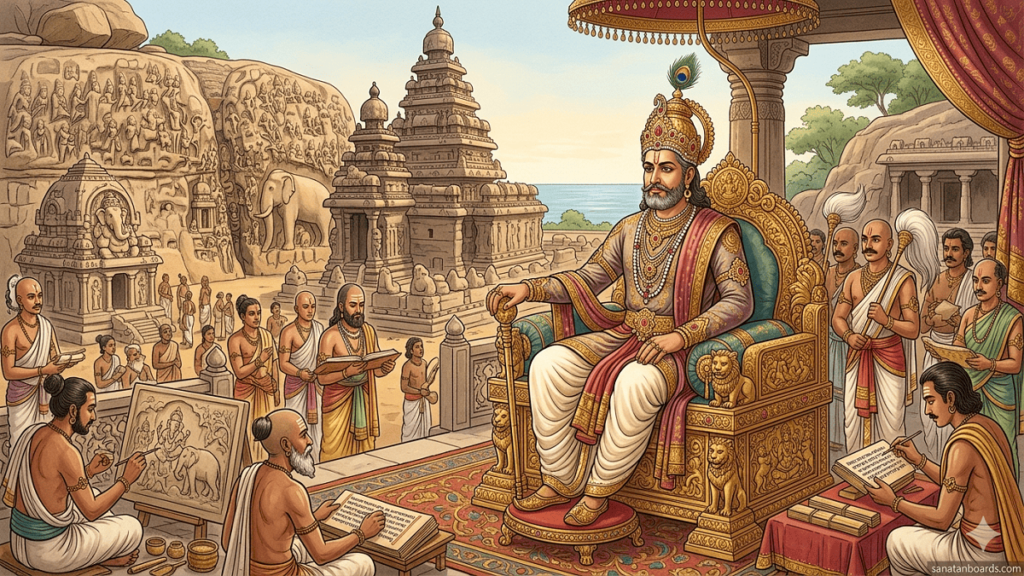
What Is Mahendra Varma Pallava ?
MAHENDRA VARMA PALLAVA denotes a king of the Pallava dynasty of southern India — specifically associated with the ruler Mahendravarman I Pallava (r. c. 590–630 CE). The Pallavas were a dynasty that dominated large parts of South India for around six centuries and were particularly influential in shaping the religious, architectural, and cultural landscape of the region.
Mahendravarman I is often described in historical inscriptions as Vichitrachitta (“the man of many ideas”) and credited with remarkable achievements both on and off the battlefield. He was not only a ruler but also a scholar, painter, musician, and playwright, which made his period stand out in the history of Indian culture. He composed works in Sanskrit — including comedies and dramatic literature — and was comfortable with literary and philosophical discourse.
Architecturally, he pioneered the rock‑cut temple style in the Pallava realm, carving temples directly into stone hills and later influencing free‑standing structural temples. His constructions at places like Mahabalipuram represent some of the earliest surviving examples of Dravidian temple architecture, which later evolved and flourished under subsequent dynasties such as the Cholas and Vijayanagara Empire.
Mahendra Varma Pallava’s reign was also marked by intense military encounters, especially with the expanding Chalukya power to the north. His confrontations with King Pulakeshin II reflect the turbulent geopolitical realities of early medieval peninsular India.
Thus, MAHENDRA VARMA PALLAVA stands not merely as a name but as a symbol of creative, political, artistic, and architectural innovation during a formative era of South Indian civilization.
Who Is Required Mahendra Varma Pallava ?
MAHENDRA VARMA PALLAVA is required by a wide range of people who study, appreciate, or work with South Indian history, art, and culture:
- Historians and Archaeologists – Scholars examining the Pallava dynasty and early medieval South India require knowledge of MAHENDRA VARMA PALLAVA to understand the political developments, military campaigns, and administrative strategies of the period. His reign is key for reconstructing timelines and power structures.
- Students of Architecture and Art – Those learning about Dravidian temple architecture, rock-cut temples, and sculpture need to study his contributions because he pioneered styles that influenced later dynasties such as the Cholas and Vijayanagara rulers.
- Cultural Enthusiasts and Tourists – Anyone visiting Mahabalipuram, Kanchipuram, or other Pallava heritage sites benefits from understanding MAHENDRA VARMA PALLAVA’s role in creating the temples, cave shrines, and monuments that are now UNESCO-recognized.
- Literary Scholars – MAHENDRA VARMA PALLAVA was also a playwright and patron of Sanskrit literature. Researchers in classical Indian literature study his works and the cultural environment of his court.
- Policy Makers and Heritage Conservationists – Officials and professionals involved in preserving monuments and promoting cultural tourism require his history to ensure accurate restoration and educational outreach.
When Mahendra Varma Pallava Is Required ?
MAHENDRA VARMA PALLAVA is required at specific points in historical, cultural, and academic contexts:
- During Historical Research – When historians examine early medieval South India, MAHENDRA VARMA PALLAVA’s reign (c. 590–630 CE) provides crucial information about political consolidation, conflicts with neighboring dynasties like the Chalukyas, and regional administration.
- In Architectural Studies – His reign is required when analyzing the origin and evolution of Dravidian temple architecture, particularly the rock-cut temples and cave shrines at Mahabalipuram and Kanchipuram. Scholars studying ancient construction techniques or heritage conservation need this information.
- While Exploring Cultural Heritage – Students, tourists, and cultural enthusiasts require knowledge of MAHENDRA VARMA PALLAVA to contextualize UNESCO World Heritage sites, such as the Shore Temples and Varaha Cave Temple. Without understanding his contributions, the historical significance of these sites is incomplete.
- In Literature and Arts Curriculum – When teaching classical Sanskrit literature or South Indian performing arts, MAHENDRA VARMA PALLAVA is required to illustrate the environment that nurtured literary and artistic innovation. His own works as a playwright provide real examples of creativity during his reign.
- During Religious Studies – Knowledge of his role is required when studying religious transitions, particularly his shift from Jainism to Shaivism, which impacted temple patronage and regional religious practices.
- For Policy and Preservation – MAHENDRA VARMA PALLAVA is required when planning monument conservation, cultural tourism, or educational programs, ensuring accurate representation of South Indian history.
Where Mahendra Varma Pallava Is Required ?
MAHENDRA VARMA PALLAVA is required in geographical, educational, cultural, and research contexts:
- South India – Knowledge of MAHENDRA VARMA PALLAVA is primarily required in Tamil Nadu and Andhra Pradesh, especially in regions historically ruled by the Pallavas. Sites like Kanchipuram, Mahabalipuram, and the surrounding coastal areas are directly linked to his reign and architectural contributions.
- Educational Institutions – Universities, colleges, and schools teaching Indian history, archaeology, art, and literature require this knowledge to provide a complete understanding of early medieval South India. Curriculum modules on Dravidian architecture and Pallava dynasty politics rely on his historical significance.
- Museums and Cultural Centers – Knowledge of MAHENDRA VARMA PALLAVA is required in museums displaying Pallava-era sculptures, inscriptions, and temple relics, both in India and internationally. Exhibits in the Government Museum Chennai and other institutions depend on accurate historical interpretation of his reign.
- Tourism and Heritage Sites – For guiding tourists at UNESCO World Heritage sites like the Shore Temple and Pancha Rathas in Mahabalipuram, MAHENDRA VARMA PALLAVA is required to explain the historical and cultural context.
- Research Centers and Libraries – Scholars writing historical papers, research articles, and academic books need this information to accurately map political, artistic, and religious developments of the Pallava period.
- Digital Platforms and Content Creation – Online courses, blogs, documentaries, and historical websites covering ancient Indian history and architecture require MAHENDRA VARMA PALLAVA for content authenticity.
How Mahendra Varma Pallava Is Required ?
MAHENDRA VARMA PALLAVA is required in multiple ways depending on the field or purpose:
- Academic Study – He is required as a case study in history, archaeology, and literature courses to demonstrate governance, military strategy, and cultural patronage in early medieval South India.
- Architectural Analysis – Scholars and architects require him to understand the evolution of rock-cut temples, structural design, and Pallava iconography, which set a precedent for Dravidian architecture.
- Cultural Preservation – His reign is required to guide conservation practices, ensuring restoration and maintenance of Pallava monuments adhere to historical accuracy.
- Tourism Guidance – Travel guides, historians, and cultural interpreters require knowledge of MAHENDRA VARMA PALLAVA to explain temples, sculptures, and historical sites to visitors.
- Literary Research – Sanskrit scholars and students of Indian drama study his writings to analyze language, themes, and cultural references of the 6th–7th century.
- Policy and Educational Planning – Governments and NGOs require him to design educational programs, heritage tourism initiatives, and awareness campaigns centered on Pallava contributions.
- Digital and Media Content – Writers, bloggers, and documentary creators require MAHENDRA VARMA PALLAVA to accurately produce content on Indian history ensuring cultural and historical authenticity.
Thus, MAHENDRA VARMA PALLAVA is required through study, preservation, interpretation, and dissemination, bridging the gap between past cultural achievements and modern understanding.
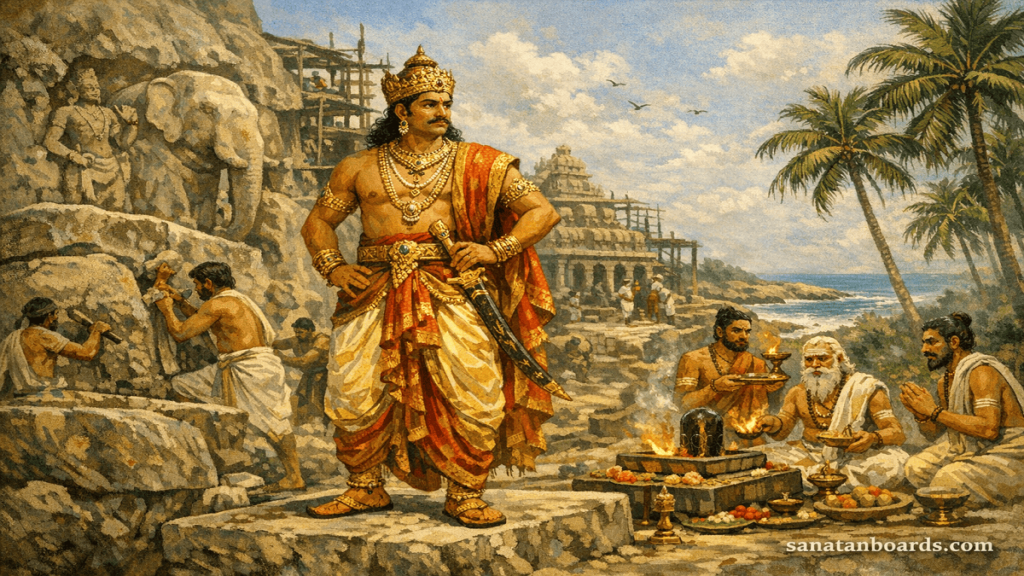
Case Study On Mahendra Varma Pallava
Introduction:
The case study of MAHENDRA VARMA PALLAVA focuses on his reign (c. 590–630 CE) and its contributions to political stability, art, architecture, and literature. He ascended the Pallava throne during a turbulent period marked by Chalukya invasions and regional power struggles, yet managed to establish a period of prosperity and cultural innovation.
Political Achievements:
MAHENDRA VARMA PALLAVA strengthened the administrative framework of the Pallava kingdom, introducing systems that ensured loyalty among local chieftains. His strategies included fortification of key towns, efficient revenue collection, and expansion of trade networks. He also led successful campaigns against neighboring dynasties, notably defending against Pulakeshin II of the Chalukyas, securing the northern boundaries of his kingdom.
Cultural and Artistic Contributions:
He was a scholar-king, writing Sanskrit plays and promoting literary and dramatic traditions in his court. This emphasis on intellectual development attracted scholars, poets, and artists, creating a vibrant cultural milieu.
Architectural Innovations:
MAHENDRA VARMA PALLAVA is most renowned for initiating the rock-cut temple architecture that became a hallmark of Pallava legacy. The Mahabalipuram cave temples exemplify his contribution to religious architecture, iconography, and sculptural excellence. His constructions were not only places of worship but also symbols of political power and cultural sophistication.
Religious Influence:
Initially influenced by Jainism, he later embraced Shaivism, sponsoring temples and religious activities that reflected this shift. This religious patronage was crucial in shaping the spiritual and cultural identity of South India, blending religious devotion with artistic expression.
Impact and Legacy:
The reign of MAHENDRA VARMA PALLAVA demonstrated how a ruler could combine military strategy, cultural patronage, and administrative reforms to create a lasting legacy. His innovations in temple construction influenced subsequent dynasties such as the Cholas. His court became a model of intellectual engagement, balancing governance with art, literature, and religion.
Conclusion:
Studying MAHENDRA VARMA PALLAVA allows historians, architects, and cultural scholars to understand the intersection of power, religion, and art in early medieval South India. His reign remains a critical reference point for appreciating the Pallava dynasty’s contribution to Indian civilization.
White Paper On Mahendra Varma Pallava
Abstract:
This white paper explores MAHENDRA VARMA PALLAVA, a key figure of the Pallava dynasty in South India, highlighting his contributions to political governance, cultural patronage, architecture, literature, and religious developments. His reign (c. 590–630 CE) serves as a case study of how leadership and vision can shape regional civilization, leaving a legacy that persists in modern cultural and architectural studies.
Introduction:
The Pallava dynasty was instrumental in shaping early medieval South India, and MAHENDRA VARMA PALLAVA is one of its most influential rulers. He is often remembered as Vichitrachitta (“man of many ideas”) due to his multifaceted contributions. His reign exemplifies the integration of art, governance, and religion in consolidating political power while fostering cultural growth.
Historical Background:
The Pallavas, originally ruling from Kanchipuram, faced challenges from neighboring dynasties, especially the Chalukyas of Badami. MAHENDRA VARMA PALLAVA navigated these geopolitical challenges, fortifying the kingdom, establishing strong administrative protocols, and ensuring internal stability. His reign marked a transition from early Pallava consolidation to significant cultural and architectural expansion.
Political Contributions:
- Strengthened the administrative system for efficient governance.
- Implemented revenue collection strategies and promoted trade.
- Defended borders against the Chalukyas, enhancing regional stability.
- Created a model of effective leadership balancing military and civil administration.
Cultural and Literary Impact:
MAHENDRA VARMA PALLAVA was an accomplished scholar and playwright. He wrote Sanskrit dramas, blending humor, philosophy, and social commentary, which reflect the intellectual environment of his court. His reign attracted poets, scholars, and artists, creating a cultural hub that influenced subsequent South Indian dynasties.
Architectural Achievements:
- Initiated the rock-cut temples at Mahabalipuram.
- Developed early Dravidian architectural elements, including sculpted cave temples and monolithic structures.
- Inspired the Chola and later South Indian temple architecture.
- Temples were both religious centers and political symbols demonstrating his influence and vision.
Religious Influence:
MAHENDRA VARMA PALLAVA initially practiced Jainism but later patronized Shaivism, establishing temples and religious institutions. His reign highlights religious pluralism, reflecting the synthesis of faith, politics, and art.
Legacy:
The reign of MAHENDRA VARMA PALLAVA set benchmarks for cultural, architectural, and administrative practices. His era remains #Sanatandharmaaccreditationboardsinvasai esse
ntial for scholars studying ancient Indian civilization, governance, and religious developments.
Conclusion:
MAHENDRA VARMA PALLAVA demonstrates that holistic leadership can drive societal advancement, blending military strategy, administrative competence, #Sanatandharmaaccreditationboardsinmumbai religious patronage, and artistic innovation. This white paper underscores the enduring relevance of his contributions in understanding South Indian history and culture.
Industry Application On Mahendra Varma Pallava
Architecture and Heritage Conservation:
Modern architects and urban planners study his rock-cut and structural temples to understand ancient construction techniques, materials, and design principles. Conservationists use these insights to preserve historical monuments like Mahabalipuram’s UNESCO World Heritage sites.
Tourism and Cultural Promotion:
Knowledge of MAHENDRA VARMA PALLAVA drives heritage tourism in South India. Tourism boards, museums, and travel agencies utilize his story to engage tourists with historical context, boosting local economies
. Education and Research:
Academic institutions include his reign in history, archaeology, literature, and art curricula, providing case studies for leadership, governance, and cultural synthesis. His literary works are studied in classical Sanskrit and South Indian studies programs. Media and Content Creation:
Documentary filmmakers, digital content creators, and bloggers refer to his achievements to produce accurate and engaging historical narratives, thereby informing global audiences about India’s heritage.
Cultural Policy and Planning:
Government agencies and NGOs involved in cultural preservation and education programs rely on his legacy to design effective strategies for heritage conservation, cultural promotion, and educational initiatives. Religious Studies and Arts:
His role in religious transition and temple patronage informs modern studies of Hindu rituals, temple arts, and iconography, which influence both scholarship and practical applications in religious tourism or arts restoration.
source : Kintree – Family Tree App
ASK FAQ
Who was MAHENDRA VARMA PALLAVA?
MAHENDRA VARMA PALLAVA was a prominent Pallava king of South India (c. 590–630 CE) known for his military leadership, cultural patronage, literary works, and pioneering rock-cut temple architecture at Mahabalipuram.
What are the major contributions of MAHENDRA VARMA PALLAVA?
His contributions include building rock-cut temples, promoting Sanskrit literature and drama, supporting Shaivism, and strengthening the Pallava kingdom’s administration.
Where can we see the works of MAHENDRA VARMA PALLAVA today?
His legacy is visible in Mahabalipuram, Kanchipuram, and other Pallava heritage sites featuring rock-cut temples, sculptures, and cave shrines that are UNESCO-recognized monuments.
Why is MAHENDRA VARMA PALLAVA important in Indian history?
He is important because his reign represents a blend of political stability, cultural growth, religious transition, and architectural innovation, laying the foundation for future South Indian dynasties.
How did MAHENDRA VARMA PALLAVA influence South Indian architecture?
He pioneered rock-cut and structural temple designs, introducing Dravidian architectural elements that inspired later dynasties like the Cholas and continue to influence temple architecture today.
Table of Contents
Disclaimer
The information provided in this blog is intended for educational, learning, and knowledge purposes only. All historical details are based on verified sources and scholarly research. While every effort has been made to ensure accuracy, interpretations of ancient history may vary depending on new research, inscriptions, and archaeological discoveries.