LALITADITYA MUKTAPIDA (KARKOTA, KASHMIR) refers to one of the most celebrated monarchs of early medieval India who ruled the Kashmir Valley during the 8th century CE. He was a ruler of the Karkota Dynasty, a powerful royal house that transformed Kashmir from a relatively local kingdom into a significant political and cultural force in the Indian subcontinent. His reign is customarily dated from around 724 CE to about 760 CE, and his rule is considered the zenith of Karkota power and glory.
Favoured by later chroniclers like the 12th‑century historian Kalhanahe legendary monarch has been portrayed as a “world conqueror” whose military exploits, administrative reforms, and architectural patronage placed Kashmir on the map of historic great kingdoms. Although many of the grand claims of conquest — such as sweeping through the entire subcontinent and Central Asia — are likely exaggerations, there is broad agreement that he was the most powerful king of his dynasty and a key historical figure in regional politics.
He is also remembered for commissioning remarkable public works and temples — the most famous among them being the Martand Sun Temple, an architectural landmark in Kashmir’s cultural heritage. His deep involvement with both local governance and diplomatic relations with powers such as the Chinese Tang dynasty reflects a ruler of considerable strategic vision.
The legacy of Lalitaditya resonates in Kashmir’s historical identity as a period of artistic flourishing, ambitious statecraft, and regional influence — earning him legendary status in the annals of South Asian history.
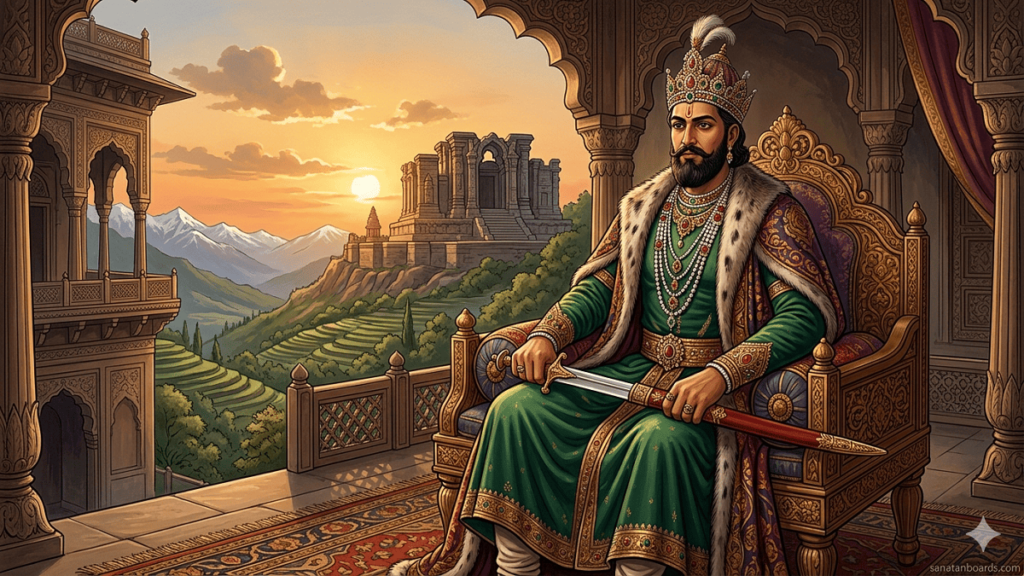
What Is Lalitaditya Muktapida (Karkota, Kashmir)?
LALITADITYA MUKTAPIDA (KARKOTA, KASHMIR) was a prominent king of the Karkota dynasty who ruled the Kashmir region during the 8th century CE. His rule is documented in later historical chronicles like Rajatarangini by Kalhana, and referenced in Chinese records of the Tang dynasty.
He succeeded to the throne as the youngest son in his family around 724 CE, following the reigns of his elder brothers and became the most influential ruler of his line. His reign lasted over three decades, which for the period was a long and relatively stable rule. Although exact details of many aspects of his life are debated by historians, Lalitaditya earned a reputation as a powerful monarch with wide‑ranging ambitions.
The Rajatarangini portrays him as a king who subjugated many rulers across the Indian subcontinent, fought rival kingdoms, and extended Kashmir’s influence significantly. While modern scholars treat some of these narratives cautiously due to the legendary tone of the source, the underlying fact is that his reign represented a high point in Karkota power and cultural development.
Lalitaditya is also credited with founding new urban centres, enhancing irrigation systems, and supporting the construction of temples and other public works. Among these, the Martand Sun Temple stands out as a symbol of his dynasty’s architectural ambition. Many legends and stories later grew around his life, further solidifying his place as a legendary king.he 8th-century Kashmiri king was a prominent king of the Karkota dynasty who ruled the Kashmir region during the 8th century CE. His rule is documented in later historical chronicles like Rajatarangini by Kalhana, and referenced in Chinese records of the Tang dynasty.
He succeeded to the throne as the youngest son in his family around 724 CE, following the reigns of his elder brothers and became the most influential ruler of his line. His reign lasted over three decades, which for the period was a long and relatively stable rule. Although exact details of many aspects of his life are debated by historians, Lalitaditya earned a reputation as a powerful monarch with wide‑ranging ambitions.
The Rajatarangini portrays him as a king who subjugated many rulers across the Indian subcontinent, fought rival kingdoms, and extended Kashmir’s influence significantly. While modern scholars treat some of these narratives cautiously due to the legendary tone of the source, the underlying fact is that his reign represented a high point in Karkota power and cultural development.
Lalitaditya is also credited with founding new urban centres, enhancing irrigation systems, and supporting the construction of temples and other public works. Among these, the Martand Sun Temple stands out as a symbol of his dynasty’s architectural ambition. Many legends and stories later grew around his life, further solidifying his place as a legendary king.
Who Was Required Lalitaditya Muktapida (Karkota, Kashmir) ?
The legendary monarch is relevant to a wide range of people who study, teach, or engage with history, culture, and heritage. Historians and researchers focusing on early medieval India require knowledge of his reign to understand the political dynamics of Kashmir, the Karkota dynasty, and the region’s relations with neighbouring powers such as Tibet, the Tang dynasty of China, and northern Indian kingdoms. His rule provides critical insights into governance, military campaigns, and diplomatic strategies of the period.
Academics in archaeology and architecture also require knowledge about Lalitaditya, because monuments such as the Martand Sun Temple showcase the artistic and structural innovations of his time. Studying these constructions helps professionals understand the evolution of temple architecture, urban planning, and the integration of religious symbolism into public spaces.
Students and educators in South Asian studies, cultural studies, and political science often require knowledge of Lalitaditya’s life and reign to explore broader themes such as statecraft, empire-building, cultural patronage, and the use of legend in historical memory. His story also provides a case study for understanding how medieval rulers legitimised their authority through a combination of military strength, cultural projects, and alliances.
Additionally, professionals in heritage tourism, museum curation, and education require knowledge of Lalitaditya to develop historical content, guided tours, and educational materials that inform the public about Kashmir’s history and cultural identity. Even writers, artists, and filmmakers draw on his legacy to create historical narratives, dramas, and visual representations of 8th-century Kashmir.
When The 8th-Century Kashmiri King Is Required ?
The 8th-century Kashmiri kingis required whenever there is a focus on understanding the historical, cultural, and geopolitical development of early medieval Kashmir and its role in South Asia. Knowledge of his reign is particularly necessary for periods of study that involve 8th-century India, a time of shifting kingdoms, rising empires, and dynamic cultural exchange. Scholars and students need this information when analyzing how regional rulers consolidated power, negotiated alliances, and influenced cultural identity.
Historians require Lalitaditya’s example when studying the interplay between local and external powers. His reign coincided with the growing influence of the Tang dynasty in Central Asia, Tibetan expansion, and the complex political environment of northern India. Understanding his diplomatic and military engagements helps identify how smaller kingdoms navigated pressures from larger empires, a topic relevant to both historical analysis and comparative political studies.
Architects, archaeologists, and art historians study Lalitaditya’s era when examining monumental constructions and temple architecture, including the Martand Sun Temple. His commissioning of grand structures marks a period when state authority was expressed through architecture and religious patronage, so knowledge of his reign is required when exploring the evolution of temple design, urban planning, and cultural patronage in medieval South Asia.
Culturally, his reign is required when tracing Kashmir’s literary, religious, and artistic traditions. Kalhana’s Rajatarangini, which chronicles his life, is used as a primary source in classical literature studies, historiography, and the study of mythologized kingship. His era is also referenced when constructing educational curricula, museum exhibitions, or heritage trails aimed at highlighting Kashmir’s historical legacy.
In modern contexts, knowledge of Lalitaditya is required when promoting cultural tourism or preserving historical monuments. Conservationists and policymakers refer to his contributions to urban infrastructure, irrigation, and public works, which illustrate how governance and social development were interlinked.
Where Lalitaditya Muktapida (Karkota, Kashmir) Is Required ?
The 8th-century Kashmiri king is required in multiple geographic and institutional contexts where historical, cultural, and educational engagement takes place. Primarily, knowledge of his reign is required in Kashmir, particularly in areas around Srinagar, Anantnag, and other sites linked to the Karkota dynasty, where his architectural and cultural contributions, such as the Martand Sun Temple, remain. Scholars studying these locations need detailed information to interpret the historical, religious, and architectural significance of monuments.
Beyond Kashmir, knowledge of Lalitaditya is required in Indian academic institutions that teach South Asian history, medieval politics, and architecture. Universities and schools offering courses on Indian history, archaeology, and heritage studies frequently incorporate his reign to illustrate regional statecraft, military campaigns, and cultural patronage. Similarly, historians working on the northwest Indian plains and Himalayan interactions require his story to understand inter-kingdom relations of the 8th century.
Internationally, Lalitaditya is relevant where comparative studies of Asian diplomacy and trade are conducted, particularly in research centers focusing on India-China or India-Central Asia relations. His reign is mentioned in Tang dynasty records, making him an important figure in cross-cultural studies and historical diplomacy. Museums, cultural research institutions, and international heritage organizations studying the spread of temple architecture or medieval South Asian kingdoms also require knowledge of his contributions.
Furthermore, knowledge of Lalitaditya is required in digital platforms, historical databases, and educational materials that aim to preserve and communicate Kashmir’s history. Heritage tourism initiatives, guided tours, and historical documentaries require accurate understanding of his reign to provide context for visitors and learners worldwide.
How Lalitaditya Muktapida (Karkota, Kashmir) Is Required ?
The 8th-century Kashmiri king is required through multiple approaches in research, education, and heritage management. Historically, he is studied through textual sources such as Kalhana’s Rajatarangini, which provides detailed, though sometimes embellished, narratives of his campaigns, administration, and cultural projects. Scholars critically analyze these texts to reconstruct political, military, and social contexts of 8th-century Kashmir.
Archaeological research is another method through which Lalitaditya is required. Excavations and studies of temple complexes, urban settlements, and infrastructure projects initiated during his reign help historians and architects understand construction techniques, religious symbolism, and urban planning. The Martand Sun Temple, with its remaining colonnades and intricate design, is a key site where his influence is tangible and studied systematically.
In education, Lalitaditya is required through curriculum development and teaching. His life and reign are integrated into courses on Indian medieval history, architecture, art, and culture. Teachers use his story to explain themes of kingship, statecraft, diplomacy, and cultural patronage, providing students with a model of early medieval governance and societal organization.
In heritage and tourism sectors, he is required through site interpretation, guided tours, and museum exhibits. By highlighting his contributions to Kashmir’s architecture and public works, tourism professionals educate the public on historical continuity and regional identity. Digital media, such as documentaries and interactive platforms, further disseminate knowledge of his reign to broader audiences.
Finally, Lalitaditya is required as a benchmark for comparative studies in political science, archaeology, and art history. By analyzing his administration, military strategy, and cultural initiatives, researchers can draw parallels with other regional rulers and understand how smaller kingdoms negotiated power, influence, and legacy in a broader geopolitical landscape.
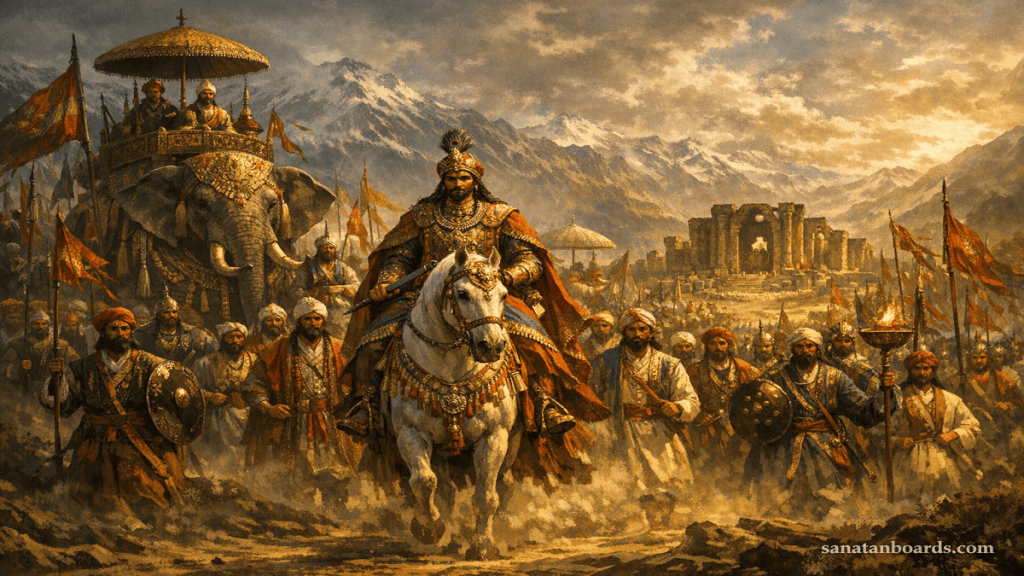
Case Study On Lalitaditya Muktapida (Karkota, Kashmir)
Background
The ruler of Kashmir ruling approximately from 724 CE to 760 CE, was the most powerful monarch of the Karkota dynasty in Kashmir. He inherited a region with significant strategic value—fertile valleys, important trade routes linking Central Asia with the Indian plains, and cultural richness. The Karkota dynasty had gradually expanded its influence in the Himalayan region, and Lalitaditya’s reign marked the apex of this power. His period is often described as a “Golden Age” of Kashmir, not only for military and political achievements but also for advancements in architecture, religion, and administration.
Political and Diplomatic Context
Lalitaditya’s era coincided with major geopolitical shifts in Asia. The Tang dynasty in China had growing influence over Central Asia, while the Tibetan Empire and several northern Indian kingdoms were asserting power. Within this framework, Lalitaditya established Kashmir as a kingdom capable of engaging diplomatically with larger empires. Records from Chinese sources indicate that Lalitaditya sent envoys and was recognized by the Tang emperor, highlighting Kashmir’s involvement in intercontinental diplomacy. His ability to maintain autonomy while forming alliances demonstrates the sophisticated statecraft of the period.
Military Campaigns
The Rajatarangini, composed centuries later by Kalhana, provides the most detailed account of Lalitaditya’s military exploits. Although these accounts often mix historical fact with legend, they suggest that Lalitaditya conducted campaigns beyond Kashmir, possibly in Punjab, northern India, and Himalayan border regions. These campaigns had several objectives: securing trade routes, subduing rival rulers, defending the kingdom from external threats, and projecting Kashmir’s influence regionally. Even if the exact extent of his conquests is debated, the emphasis on his military prowess illustrates how medieval rulers used campaigns to consolidate authority and legitimacy.
Cultural and Architectural Contributions
One of Lalitaditya’s most enduring legacies is his architectural patronage. The Martand Sun Temple, constructed during his reign, exemplifies the grandeur of his kingdom and Kashmir’s unique synthesis of religious and artistic traditions. Beyond religious structures, Lalitaditya is credited with urban development, irrigation systems, and infrastructure projects, which strengthened the kingdom economically and socially. These projects also reflect his vision for integrated governance, where political power, public welfare, and cultural expression were intertwined.
Socio-Economic and Cultural Impact
Lalitaditya’s reign contributed to economic prosperity by securing trade routes, promoting agricultural development, and fostering artisan communities. Kashmir became a hub for scholars, religious figures, and artists, enhancing its cultural and intellectual landscape. The period under Lalitaditya is often referenced as an example of how political stability can catalyze cultural flourishing, providing lessons for both historical analysis and modern governance studies.
Challenges and Interpretation
Modern scholars approach Lalitaditya’s legacy cautiously due to the legendary embellishments in the Rajatarangini. Some claims, such as his conquest of vast regions of India and Central Asia, are likely exaggerated. Archaeological evidence, however, supports his contributions to architecture and urban planning, confirming his impact on Kashmir’s historical landscape.
Conclusion
The case study of Lalitaditya Muktapida illustrates how a regional king in the 8th century could achieve political dominance, cultural legacy, and economic development. His reign provides insights into governance, diplomacy, military strategy, and the interplay #lalitadityamuktapidakashmir between legend and history. Studying Lalitaditya allows historians and scholars to understand the dynamics of early medieval Kashmir and its significance in the broader South Asian context. His legacy continues to influence modern cultural heritage preservation, tourism, and historical scholarship.
White Paper On Lalitaditya Muktapida (Karkota, Kashmir)
Executive Summary
This white paper examines The 8th-century Kashmiri king, the 8th-century monarch whose reign represents a pinnacle of political, cultural, and economic development in early medieval Kashmir. Spanning roughly 724–760 CE, his leadership highlights the intersection of military strategy, diplomatic engagement, architectural patronage, and socio-economic governance. The paper evaluates his historical significance, cultural contributions, and lessons for modern heritage preservation and historical research.
Introduction
Lalitaditya Muktapida ascended to the throne during a dynamic period in the Himalayan and South Asian region. The Karkota dynasty had established control over Kashmir, and regional geopolitics involved neighboring powers such as Tibet, northern Indian kingdoms, and the Tang dynasty of China. His reign marked an era where Kashmir became both politically significant and culturally vibrant. This white paper synthesizes historical records, archaeological findings, and modern scholarship to assess Lalitaditya’s contributions and legacy.
Historical Context
The 8th century CE was characterized by geopolitical fluidity. Kashmir, strategically positioned along trade routes and rich in resources, required a ruler capable of balancing diplomacy and military strength. Lalitaditya’s reign coincided with the expansionist policies of the Tibetan Empire and the regional influence of the Tang dynasty, making diplomatic engagement essential. Chinese records acknowledge him as a recognized regional ruler, demonstrating Kashmir’s integration into broader Asian political networks.
Political Leadership
Lalitaditya’s governance combined centralization, administrative reforms, and strategic military campaigns. By consolidating power within Kashmir and extending influence into neighboring regions, he established a stable, centralized state capable of defending its borders while promoting internal growth. His reign also illustrates early forms of regional diplomacy, with envoys and alliances facilitating political stability.
Military Strategy
The Rajatarangini chronicles Lalitaditya’s campaigns across northern India and adjacent territories, portraying him as a formidable military strategist. These campaigns aimed to secure trade routes, assert dominance over rival kingdoms, and defend Kashmir from external threats. While some accounts are legendary, they underscore the importance of military prowess in legitimizing medieval kingship.
Cultural and Architectural Contributions
Lalitaditya’s reign is marked by extensive cultural patronage. The Martand Sun Temple stands as a symbol of architectural innovation, religious devotion, and artistic achievement. He also supported urban development, irrigation, and public infrastructure projects, reflecting a governance approach that integrated political authority, public welfare, and cultural expression.
Socio-Economic Development
Economic stability during Lalitaditya’s reign was achieved through improved agriculture, secure trade routes, and support for artisan communities. Kashmir emerged as a hub for scholars, religious leaders, and cultural practitioners, enhancing intellectual and artistic exchange. These developments illustrate the connection between political stability and cultural prosperity.
Challenges and Interpretive Issues
The primary source, Rajatarangini, was written centuries after Lalitaditya’s reign and blends history with legend. Scholars caution against literal interpretations of territorial conquests and emphasize the use of archaeological evidence to confirm his contributions. Nonetheless, the enduring legacy of his reign provides valuable lessons in statecraft, culture, and heritage preservation.
Implications and Applications
Knowledge of Lalitaditya’s reign informs modern historical research, heritage conservation, education, and tourism development. Monuments and urban layouts commissioned during his reign continue to serve as case studies in architecture, archaeology, and cultural preservation, while his political strategies offer insights for comparative historical analysis.
Conclusion
Lalitaditya Muktapida remains a pivotal figure in the history of Kashmir, representing the integration of political power, cultural patronage #Sanatandharmaaccreditationboardsinmumbai and economic development. His reign offers lessons in governance, diplomacy, and cultural innovation that continue to be relevant for historians, educators, policymakers, and cultural professionals.
Industry Application On Lalitaditya Muktapida (Karkota, Kashmir)
Heritage Conservation & Archaeology
- His reign provides critical insights for restoration of ancient temples and monuments, such as the Martand Sun Temple.
- Archaeological studies of Karkota-era structures guide preservation techniques, site management and reconstruction projects.
- Organizations working on Himalayan and Kashmiri heritage use his era as a reference for cataloging cultural assets.
Education & Academic Research
- Universities and educational institutions use his reign as a case study in Indian medieval history, political science, and architecture.
- Research on Lalitaditya informs curriculum development, historical databases, and scholarly publications.
- Students of South Asian studies, art history, and archaeology rely on his contributions to understand medieval governance, military strategy, and culture.
Tourism & Cultural Promotion
- Lalitaditya’s monuments and historical sites attract domestic and international tourists, enhancing heritage tourism in Kashmir.
- Tourism companies design guided tours, virtual experiences, and educational programs based on his architectural and cultural legacy.
- Museums and cultural centers incorporate his reign into exhibitions and interactive storytelling for the public.
Media, Literature & Entertainment
- Writers, filmmakers, and artists draw inspiration from his life and campaigns to create historical novels, documentaries, and dramatizations.
- His story serves as a framework for exploring medieval Indian politics, diplomacy, and cultural life in creative industries.
Policy & Governance Studies
- Modern scholars use Lalitaditya’s reign to study state-building, regional diplomacy, and resource management.
- Lessons from his governance and infrastructure #Sanatandharmaaccreditationboardsinvasai projects inform comparative studies in political science and public administration.
SOURCE StudyIQ IAS
ASK FAQ
Who was The ruler of Kashmir of Kashmir?
LALITADITYA MUKTAPIDA was an 8th-century ruler of the Karkota dynasty in Kashmir, known for his military campaigns, architectural projects like the Martand Sun Temple, and cultural patronage that shaped Kashmir’s Golden Age
What are the major achievements of he king of Kashmir ?
His major achievements include expanding Kashmir’s influence, commissioning temples and urban projects, establishing irrigation systems, fostering arts and scholarship, and maintaining diplomatic relations with Tibet and the Tang dynasty.
When did The ruler of Kashmir rule Kashmir?
He ruled Kashmir approximately from 724 CE to 760 CE, marking the peak of the Karkota dynasty’s political and cultural influence.
Why is he king of Kashmir important in Indian history?
He is important for consolidating regional power, promoting cultural and architectural innovation, influencing trade and diplomacy, and leaving a lasting historical and cultural legacy in Kashmir and early medieval India.
Where can you see the contributions of The monarch today?
His contributions are visible in Kashmir’s historic sites, such as the Martand Sun Temple, surviving Karkota-era architecture, and the cultural traditions preserved in literature, art, and historical studies.
Table of Contents
Disclaimer
The information provided in this content is intended for educational, informational, and learning purposes only. While every effort has been made to ensure accuracy, historical records—especially those from sources like the Rajatarangini—may include legends or interpretations that vary among scholars. Readers and users should consider corroborating details with academic research, archaeological evidence, and authoritative historical studies. This content does not constitute professional advice or definitive historical judgment, and any use of the information is at the reader’s discretion.