Lack Apex Sanatan Board Institutions Framework
Lack of apex sanatan board institutions framework for sanatani worldwide
Hinduism (Sanatan Dharma) is one of the world’s oldest and most profound spiritual traditions. However, unlike Christianity (Vatican) or Islam (OIC, Madrasas, and Waqf Boards), Sanatanis lack a centralized global institution to protect, promote, and unify Hindu society. This results in disorganization, weak political influence, and lack of structured support for Hindu communities worldwide.
1. The Problem: Lack of a Unified Hindu Institutional Framework
A. Absence of a Central Hindu Authority
- No Single Global Apex Body: Unlike the Vatican for Catholics or the Organization of Islamic Cooperation (OIC) for Muslims, Hindus do not have a centralized religious and administrative body.
- Temples Operate Independently: Hindu temples worldwide lack unified coordination and do not collectively work for Hindu interests.
B. Weak Representation in Global Affairs
- No Hindu Voice at International Forums: Unlike Islam and Christianity, which have strong institutional representation at the United Nations, UNESCO, and international policy-making, Hindus have no such structured advocacy.
- Lack of Hindu Think Tanks & Research Institutions: There are very few academic and strategic institutions dedicated to Hindu interests, history, and policy-making.
C. Hindu Organizations Work in Silos
- No Unified Hindu Funding & Support System: Islamic Waqf Boards and Christian Missionary Funds provide structured financial aid, but Hindus lack a centralized financial institution to support temples, religious education, and social service.
- Fragmentation Among Hindu Sects: Various sects (Vaishnavism, Shaivism, Shaktism, etc.) function independently without a common Hindu institutional umbrella.
- Political and Ideological Divisions: Hindu groups often lack coordination due to political differences and lack of collective leadership.
D. Neglect of Hindu Religious Education & Missionary Efforts
- No Apex Body to Promote Hindu Religious Education: While Islam has Madrasas and Christianity has Missionary Schools, Hinduism lacks a structured educational system to teach Hindu scriptures, history, and philosophy.
- No Global Hindu Conversion & Protection Strategy: Other religions actively convert followers, but Hindus lack a unified institutional approach to prevent conversions and reconnect lost Hindu communities.
2. Effects of the Lack of an Apex Sanatan Board
A. Weak Protection for Hindus Worldwide
- Hindus facing persecution in Bangladesh, Pakistan, Afghanistan, and other regions do not have a global Hindu institution to protect them.
- Many temples and religious sites are attacked, but no central authority raises these concerns internationally.
B. Loss of Hindu Identity & Conversions
- Millions of poor Hindus are converted to Christianity and Islam due to lack of missionary efforts, financial aid, and organized religious education.
- Hindu diaspora faces identity loss due to lack of Hindu cultural institutions in foreign countries.
C. No Hindu Economic or Financial Backbone
- Other religions have structured funding systems (Church donations, Zakat, Waqf boards), while Hindu temple wealth is often taken over by governments.
- No Hindu Banks, Funds, or Business Networks exist to financially support the community.
3. Solution: Establishing a Global Sanatan Board & Institutional Framework
A. Formation of a Central Hindu Governing Body
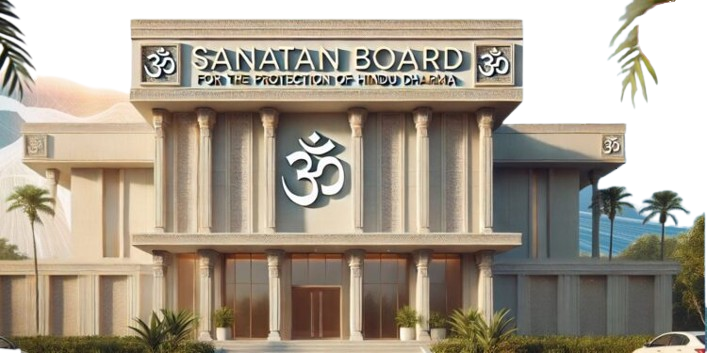
- Apex Sanatan Board (ASB): A global institution like the Vatican or OIC to protect and promote Hindu interests.
- Council of Hindu Religious Leaders & Scholars: A panel of Hindu Acharyas, Swamis, and intellectuals to create a global Hindu policy framework.
- Hindu Global Parliament: A structured decision-making body representing Hindus from every country.
B. Establishment of Hindu Educational & Financial Institutions
- Hindu Religious Universities: Create modern Gurukuls and Hindu universities worldwide to teach Hindu scriptures, Vedic sciences, and spiritual philosophy.
- Global Hindu Financial Fund: A structured Hindu economic system to fund temples, religious education, and social service projects.
- Hindu Business & Entrepreneurship Network: Encourage Hindu-owned businesses to support the Hindu economy.
C. Strengthening Hindu Representation Worldwide
- Permanent Hindu Representative at the UN: Advocate for Hindu human rights, temple protection, and religious freedom.
- International Hindu Media & Think Tanks: Establish global news outlets and research centers to counter anti-Hindu propaganda.
- Global Hindu Helpline & Legal Support System: A worldwide legal team to defend Hindu rights and fight against discrimination.
D. Protection & Expansion of Hindu Influence
- Reconversion & Hindu Awareness Programs: Support reconversion of Hindus who were forcibly converted to other religions.
- Temple Protection Committees: Create a worldwide Hindu temple management system to safeguard Hindu religious places.
- Strategic Alliances with Pro-Hindu Countries: Collaborate with nations that support Hinduism, such as India, Nepal, and Southeast Asian Hindu-Buddhist countries.
4. Conclusion
Hindus must unite under a centralized institutional framework to protect their religion, culture, and global presence. A Global Sanatan Board is essential to strengthen Hinduism, protect temples, prevent conversions, and create a strong Hindu identity worldwide.
Executive Summary
Hinduism, or Sanatan Dharma, represents one of humanity’s oldest continuous spiritual traditions, encompassing profound philosophical systems, diverse practices, and a rich cultural heritage spanning millennia. Despite its antiquity and depth, Sanatan Dharma lacks a unified global institutional framework comparable to those of other major world religions. This institutional vacuum has resulted in fragmented representation, diminished political influence, inconsistent religious education, inadequate protection for persecuted Hindu communities, and a weakened global Hindu identity. This document presents a comprehensive analysis of this structural deficit and proposes a detailed blueprint for establishing a Global Sanatan Institutional Framework—an ecosystem of interconnected organizations designed to preserve, promote, and unify Hindu society worldwide while respecting its inherent diversity.
Part I: The Current Landscape—Diagnosing the Institutional Void
1.1 The Historical Context of Hindu Organization
Unlike the Abrahamic traditions that emerged with prophetic founders and subsequent institutional consolidation, Sanatan Dharma evolved organically across the Indian subcontinent. Its strength has historically been its philosophical depth, pluralistic acceptance, and decentralized, guru-shishya parampara (teacher-disciple tradition). This very decentralization, while preserving diversity, has become a liability in the modern nation-state system and globalized world where organized institutional presence translates to influence and protection.
Historically, Hindu society was supported by structures like the sabhas and samitis of ancient India, the temple-university complexes of Nalanda and Vikramshila, the guilds (shrenis) that supported temple construction, and the royal patronage systems. The colonial period systematically dismantled many of these structures, severing temple management from community control through acts like the 1863 Hindu Religious Endowments Act and its successors in independent India, which placed thousands of temples under government control.
1.2 Comparative Analysis: Institutional Frameworks of Other Major Religions
A. Christianity: The Papacy and Transnational Networks
- The Vatican: A sovereign city-state with permanent UN observer status, diplomatic relations with 183 states, a centralized hierarchy, and a global governance structure (dioceses, parishes).
- Global Financial Networks: The Institute for the Works of Religion (Vatican Bank), massive charitable organizations (Caritas Internationalis), and wealthy denominations with integrated investment portfolios.
- Educational Evangelism: Network of universities (e.g., Georgetown, Notre Dame), seminaries, and missionary schools worldwide.
- Unified Doctrinal Authority: The Magisterium interprets doctrine, while ecumenical councils (like Vatican II) set global direction.
B. Islam: Caliphates, OIC, and Waqf Systems
- Organization of Islamic Cooperation (OIC): A 57-nation bloc with a collective voice at the UN, issuing resolutions on issues affecting Muslims globally.
- Legal and Financial System: Sharia courts in many nations, global Zakat collection and distribution networks, and the enduring Waqf (endowment) system that manages vast real estate and financial assets for religious and charitable purposes.
- Educational Systems: From local Madrasas to international Islamic universities (e.g., Al-Azhar, International Islamic University Malaysia).
- Transnational Movements: Groups like the Muslim Brotherhood and Tablighi Jamaat operate as informal global networks.
C. Buddhism: More Decentralized but Structured
- While decentralized, there are unifying institutions like the monastic Sangha orders (Theravada, Mahayana, Vajrayana), international associations (World Fellowship of Buddhists), and the symbolic role of the Dalai Lama for Tibetan Buddhism.
The Hindu Contrast: No equivalent apex body exists. Institutions like the Vishva Hindu Parishad (VHP), Bharat Sevashram Sangha, or the Ramakrishna Mission have significant reach but are either geographically focused, sect-specific, or lack formal global ecclesiastical authority. The Shri Mata Vaishno Devi Shrine Board or the Tirumala Tirupati Devasthanams (TTD) are wealthy and influential but are individual temple trusts, not global representative bodies.
1.3 The Multi-Dimensional Problem: A Detailed Breakdown
A. Governance and Authority Vacuum
- No Final Arbiter: No single body can resolve doctrinal disputes, issue authoritative interpretations applicable to all traditions (Shaiva, Vaishnava, Shakta, Smarta), or represent Hinduism in interfaith dialogues.
- Temple Fragmentation: Tens of thousands of temples operate independently. In India, many are controlled by state governments, not religious authorities, leading to mismanagement and diversion of funds. Overseas, temples often struggle due to volunteer-run models and lack of professional management.
B. Political and Diplomatic Insignificance
- No Seat at the Table: Hinduism has no permanent, recognized voice in international forums like the UN, UNESCO, or the WHO. Issues like the preservation of sacred sites, protection of Hindu minorities, or the accurate representation of Hindu philosophy are rarely advocated systematically.
- Reactive, Not Proactive: Hindu advocacy is often crisis-driven (responding to attacks on temples or communities) rather than strategically shaping global narratives on ecology (cf. Hindu concepts of Prakriti), pluralism (Vasudhaiva Kutumbakam), or wellness (Yoga, Ayurveda).
C. Financial and Economic Disorganization
- Wealth Without Power: Hindu temples collectively manage billions in donations and assets, but these resources are fragmented. There is no “Hindu Development Bank” or consolidated investment fund to support global Dharma projects.
- No Unified Charity Framework: While countless Hindu charities exist, there is no equivalent to the centralized Catholic Charities or the systematic Zakat collection of Islamic nations, leading to duplicated efforts and gaps in coverage.
- Diaspora Philanthropy Misdirection: Generous diaspora giving often flows to building physical temple structures rather than endowed chairs in Hindu studies, global media initiatives, or strategic advocacy.
D. Educational and Intellectual Fragmentation
- Formal Religious Education Gap: While pathshalas and gurukuls exist, there is no standardized, globally recognized curriculum for Hindu religious education from primary to doctoral levels, unlike the Madrasa or Sunday School systems.
- Loss of Sanskrit and Scriptural Literacy: The link to primary source texts (Vedas, Upanishads, Puranas, Itihasas) is weakening.
- Lack of Intellectual Infrastructure: Few world-class, endowed research institutes focus on strategic Hindu studies, translating and interpreting Dharma for contemporary global challenges (AI ethics, biotechnology, climate change).
E. Social Services and Crisis Response
- No Centralized Crisis Response: When Hindu communities face persecution in Pakistan, Bangladesh, or elsewhere, response relies on ad-hoc NGO efforts, not a coordinated, well-funded international intervention body.
- Weak Reversion/Reconciliation Framework: No organized, sensitive global program exists to welcome back those who wish to return to Hindu fold or to provide counter-narratives to targeted proselytization among vulnerable Hindu populations.
Part II: The Consequences of Institutional Absence
2.1 Vulnerable Communities and Unprotected Faithful
- Persecution Without Recourse: Hindu minorities in Pakistan, Bangladesh, Afghanistan, and parts of Southeast Asia face violence, forced conversions, and temple destruction with no powerful international body to apply diplomatic or legal pressure.
- Legal Challenges in the Diaspora: Hindu communities in the West frequently face hurdles in temple zoning, religious attire in schools, and misrepresentation in educational curricula without the backing of a strong legal defense fund.
2.2 Erosion of Identity and Demographic Shifts
- Conversion of the Vulnerable: Systematic missionary activity, coupled with humanitarian aid, leads to large-scale conversions among socio-economically disadvantaged Hindus, with no equivalent structured Hindu social welfare safety net.
- Diaspora Assimilation Pressures: Second and third-generation Hindus abroad often experience identity fragmentation due to the lack of deep, engaging, and intellectually robust global Hindu community structures.
2.3 Cultural and Intellectual Appropriation/Distortion
- Yoga, Ayurveda, Mindfulness: Core Hindu-derived practices are commercialized and severed from their philosophical roots, with no central institution to assert intellectual and cultural provenance or ensure their authentic transmission.
- Academic Misrepresentation: Hindu narratives in Western academia are often filtered through colonial or reductive sociological lenses, with no coordinated, well-funded effort to support scholarship from within the tradition.
2.4 Economic Disempowerment
- Temple Funds Misused: In several Indian states, temple revenues are diverted to government coffers and used for non-Dharma purposes, a practice that would be unthinkable for state-controlled churches or mosques.
- Missing Economic Ecosystem: The absence of Hindu-based ethical banking, investment networks, and business chambers limits the community’s ability to leverage its economic strength for collective good.
Part III: Blueprint for a Global Sanatan Institutional Framework (GSIF)
This proposal outlines a confederated model—a “network of networks”—that respects Hindu diversity while creating synergistic, centralized functionalities where needed. It is not a papacy but a democratic, representative ecosystem.
3.1 The Apex Sanatan Board (ASB): The Central Coordinating Council
- Function: Serves as the primary representative, diplomatic, and strategic coordinating body for global Hindu affairs.
- Structure:
- General Assembly: A deliberative body comprising representatives from every member organization (temple networks, sampradayas, academic institutions, diaspora groups) weighted by membership and contribution.
- Executive Council: A 21-member elected body from the General Assembly, with reserved seats for major traditions (Vaishnavism, Shaivism, Shaktism, Smartism) and geographic regions.
- Office of the Acharya Sabha: A consultative panel of 50-100 revered spiritual leaders and scholars from all lineages, providing theological and dharmic guidance without executive power.
- Key Roles:
- Obtain UN Observer Status or similar formal recognition.
- Issue statements on global issues from a Dharmic perspective.
- Facilitate mediation in intra-community disputes.
- Serve as the primary diplomatic interface for governments and interfaith bodies.
3.2 Pillar I: Governance & Legal Empowerment
- Global Temple Trust (GTT): A voluntary federation of temples worldwide. Provides shared services: professional management training, financial auditing, insurance, architectural conservation expertise, and a global “Hindu Sacred Sites” registry for UNESCO nomination.
- Dharma Raksha Legal Network (DRLN): A global consortium of lawyers and legal firms specializing in religious freedom, temple rights, and anti-discrimination cases. Maintains a 24/7 helpline and rapid response fund.
- Hindu Arbitration Council (HAC): Offers voluntary arbitration for civil and family disputes within Hindu communities based on Dharmic principles, recognized under national arbitration laws.
3.3 Pillar II: Education & Intellectual Leadership
- Sanatan Vidya Parishad (SVP): The Global Hindu Education Board.
- Curriculum Development: Creates a modular, age-appropriate global curriculum for Hindu studies (scriptures, history, philosophy, languages, arts).
- Accreditation: Accredits gurukuls, pathshalas, and study programs worldwide.
- Teacher Training: Certifies Hindu religious educators.
- University of Sanatan Studies (USS): A premier, globally ranked research university and online platform offering degrees in Hindu Theology, Philosophy, Comparative Religion, Sanskrit, Temple Architecture, and Indian Knowledge Systems.
- Global Research Institute for Dharmic Studies (GRIDS): A think tank producing high-quality policy research, white papers, and translations. Hosts scholars-in-residence and manages major publication projects.
3.4 Pillar III: Financial & Economic Architecture
- Sanatan Dharma Fund (SDF): A global endowment fund structured like a sovereign wealth fund. Accepts donations, dakshina, and a percentage of member temple revenues. Managed professionally with an ethical investment charter. Funds disbursed to projects vetted across the GSIF pillars.
- Hindu Community Development Bank (HCDB): An ethical bank providing micro-finance to poor Hindus, loans for temple projects and Hindu-owned businesses, and wealth management services for the diaspora aligned with Dharmic values.
- Global Hindu Business Council (GHBC): A network to foster trade, mentorship, and supply chains within the global Hindu community, encouraging patronage that cycles wealth back into community institutions.
3.5 Pillar IV: Humanitarian & Social Services
- Sewa International: A consolidation and expansion of existing Sewa networks into a unified global humanitarian agency. Responds to natural disasters, runs hospitals, schools, and poverty-alleviation programs, providing a Dharmic alternative for social upliftment, thereby addressing a key driver of conversions.
- Samskara & Reconciliation Directorate: Manages sensitive programs for those wishing to return to the Hindu fold (shuddhi/paravartan), providing spiritual counseling and community integration support.
- Global Hindu Youth & Student Network (GHYSN): Connects Hindu student associations on campuses worldwide, providing resources, leadership training, and organizing global youth pilgrimages and conferences.
3.6 Pillar V: Communications & Global Presence
- Dharma Digital: A multi-platform global media house producing professional news, documentaries, podcasts, and social media content in major languages to accurately represent Hindu perspectives and counter misinformation.
- Office of UN & International Affairs: A permanent delegation in Geneva and New York to lobby for Hindu interests, participate in Human Rights Council sessions, and partner with UN agencies on projects related to yoga, Ayurveda, and environmental sustainability.
- Cultural Diplomacy Wing: Organizes global festivals, art exhibitions, and speaker tours to showcase Hindu culture and philosophy.
Part IV: Implementation Roadmap and Challenges
Phase 1: Foundation (Years 1-3)
- Convene a Founding Congress: Assemble a broad-based group of respected spiritual leaders, scholars, temple trustees, and diaspora representatives to draft a charter and ratify the initial structure.
- Establish Interim Secretariat: Set up initial offices in a strategically neutral location (e.g., Nepal, Singapore).
- Launch the Sanatan Dharma Fund (SDF): Begin initial fundraising from high-net-worth devotees and major temple trusts.
- Pilot Projects: Start with a few high-visibility projects: a unified legal defense for a prominent case, a global Hindu census, and the launch of the online curriculum portal.
Phase 2: Consolidation (Years 4-7)
- Formalize Membership: Enroll major temple networks, monastic orders, and organizations into the federated structure.
- Build Institutions: Establish the physical campus for the University of Sanatan Studies and the GRIDS think tank.
- Achieve Formal Recognition: Secure UN ECOSOC consultative status and formal recognition from key governments.
- Scale Services: Roll out the full range of GTT, DRLN, and Sewa International services globally.
Phase 3: Maturation and Influence (Years 8+)
- Become a Recognized Global Actor: The GSIF is routinely consulted by governments, media, and international bodies on issues of religion, ethics, and culture.
- Ensure Financial Sustainability: The SDF endowment grows to a size where its returns can fund core operations and major projects.
- Deepen Impact: Hindu religious education becomes robust, persecution declines due to systemic advocacy, and Hindu philosophy actively contributes to solving global problems.
Potential Challenges and Mitigations
- Resistance from Existing Institutions: Some organizations may fear loss of autonomy. Mitigation: Emphasize the confederated, service-oriented model. The GSIF adds value, not control.
- Sectarian Distrust: Mitigation: Ensure proportional representation in all governance bodies from the start. Focus initial work on non-controversial, common-ground services (temple preservation, legal defense).
- Political Mischaracterization: Could be labeled as “Hindu nationalism.” Mitigation: Maintain absolute transparency, focus on universal Dharmic values (compassion, ecological duty, pluralism), and build interfaith partnerships.
- Funding: Mitigation: Begin with committed major donors, then transition to broad-based micro-donations from the global Hindu population via a transparent digital platform.
Conclusion: A Call for Structured Unity
Sanatan Dharma stands at a critical historical juncture. Its timeless wisdom is needed in a world facing existential crises of meaning, ecology, and conflict. Yet, its voice is muffled, its children unprotected, and its heritage vulnerable due to a lack of organized global presence.
The proposed Global Sanatan Institutional Framework is not about creating a hierarchical papacy or diluting beautiful diversity. It is about building a sangha for the modern age—a cooperative, efficient, and empowered ecosystem that provides the structures any global community needs to thrive in the 21st century: education, legal protection, humanitarian service, strategic communication, and sustainable finance.
This is a project of reclamation and renaissance. It is about ensuring that the lamp of Sanatan Dharma, which has illuminated the path for countless seekers for millennia, continues to burn brightly, offering its light not just to Hindus, but to all of humanity searching for truth, harmony, and the perennial wisdom of the eternal way. The time for fragmented effort is over. The time for united, structured, and visionary action has begun. Let us build this framework, not for dominance, but for duty—Dharma Rakshana and Vishwa Kalyan—the protection of Dharma and the welfare of the world.

Table of Contents