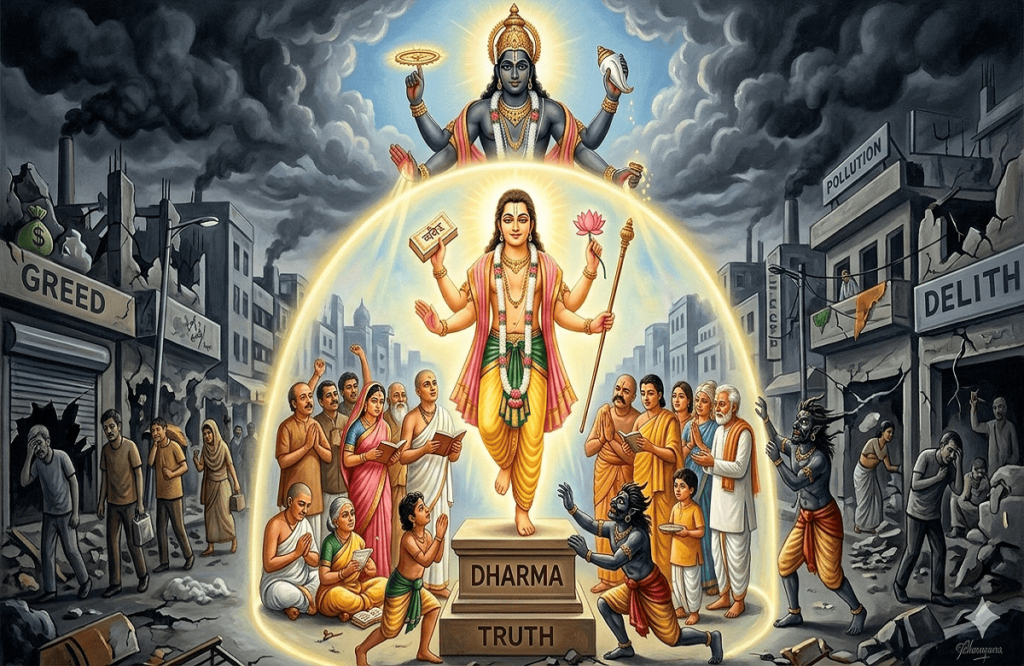
Kali Yuga is the fourth and final age in the Hindu cycle of ages (Satya → Treta → Dvapara → Kali). It is traditionally described as a period marked by decline in dharma, increased materialism, and moral challenges.
Religious teachings suggest that in Kali Yuga, religious virtues like truthfulness, self‑discipline, and purity diminish over time, making moral life harder.The concept of “dharma protection” in this context generally refers to spiritual protection or efforts to preserve righteousness in a world where moral and ethical values are seen as weakening:
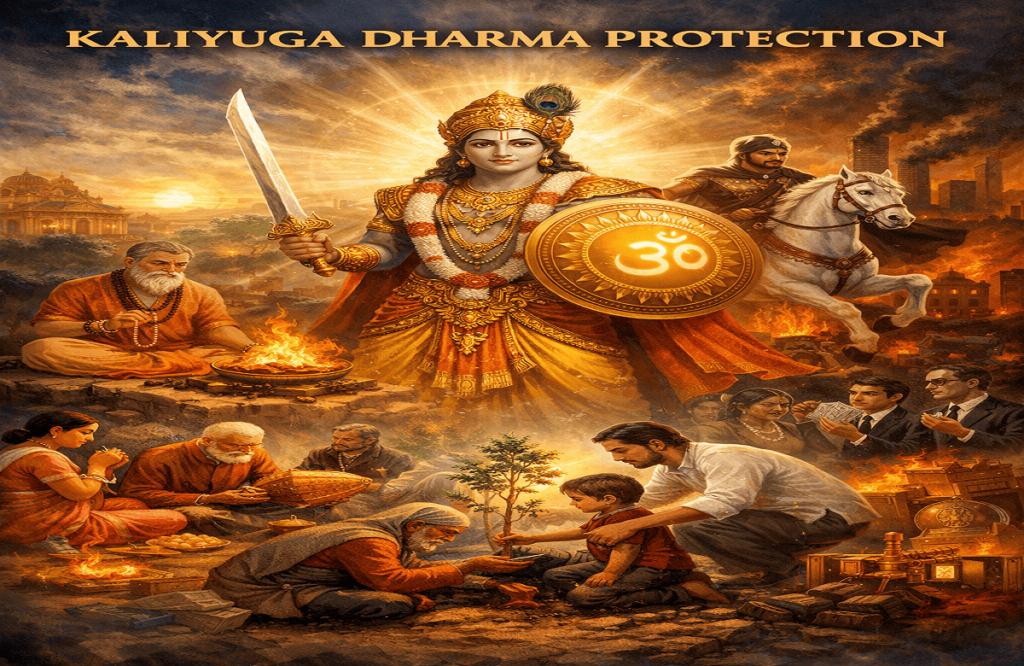
WHAT IS KALIYUGA DHARMA PROTECTION?
Kali Yuga
- In Hindu cosmology, Kali Yuga is the current age of the world in the cycle of four yugas (Satya → Treta → Dvapara → Kali).
- It is described as a time when dharma (righteousness, moral order) declines, while materialism, selfishness, and immorality increase.
- Scriptures often emphasize that life in Kali Yuga is spiritually more challenging than in previous ages.
Dharma
- Dharma refers to righteous conduct, moral duties, and ethical living.
- Protecting dharma means preserving ethical values, spiritual practices, and virtuous behavior despite societal decline.
Protection in Kali Yuga
- Because Kali Yuga is an age of moral and spiritual decay, the concept of “KaliYuga Dharma Protection” focuses on methods to safeguard righteousness.
- Practices commonly associated with this protection include:
- Chanting divine names (e.g., Harinam Sankirtan, chanting Krishna or Ram names)
- Devotional practices (Bhakti)
- Moral and ethical living
- Community and teaching efforts to preserve dharmic knowledge
Key Idea
- It is a spiritual mission, not an organization: the idea is that even in an age of decline, individuals and communities can uphold and protect dharma through devotion, ethical action, and spiritual discipline.
- Some spiritual teachers emphasize that protecting dharma is the ultimate duty in Kali Yuga, and can be achieved even through simple practices like chanting and helping others.
WHO IS REQUIRED KALIYUGA DHARMA PROTECTION?
The idea of “KaliYuga Dharma Protection” isn’t about a formal organization—it’s a spiritual responsibility, and anyone who wants to uphold dharma in this age is considered relevant
Who Needs It?
- Everyone living in Kali Yuga: According to Hindu philosophy, this is a period when moral values and righteousness naturally decline. So all individuals are affected and, ideally, all have a duty to preserve dharma.
- Spiritual seekers and devotees: People who actively want to maintain spiritual discipline, engage in moral action, or support dharmic principles in society.
- Communities and teachers: Groups or leaders who teach, guide, or organize efforts to uphold ethical and spiritual practices are particularly involved in “protection” of dharma.
Why It’s Required?
- Kali Yuga is described as a time of increased chaos, selfishness, and moral decay. Without conscious effort:
- Ethical behavior declines
- Society becomes more materialistic and unjust
- Spiritual progress is harder for individuals
So “KaliYuga Dharma Protection” is needed to maintain balance, safeguard moral values, and support spiritual growth for everyone.
How People “Protect Dharma”?
- Personal practices: chanting, meditation, selfless action, devotion, ethical living
- Community action: teaching dharmic principles, supporting charitable activities, guiding younger generations
- Spiritual leadership: saints, gurus, and teachers often encourage collective efforts like group chanting, satsangs, or study circles
WHEN IS REQUIRED KALIYUGA DHARMA PROTECTION?
The concept of KaliYuga Dharma Protection is not tied to a specific time, date, or season—it’s a spiritual principle that applies continuously in Kali Yuga, which, according to Hindu cosmology, is the current age we are living in. Let me explain carefully:
Continuous Requirement
- Kali Yuga is ongoing: This age is said to last 432,000 years, and we are believed to be well into it.
- Since the decline of dharma is gradual and continuous, protection is needed at all times—there’s no start or end date.
- The idea is that wherever and whenever moral decay or spiritual neglect occurs, dharma protection is required.
Situational Requirement
Even though it’s continuous, protection may be especially emphasized in certain circumstances:
- During personal moral challenges: when a person struggles with greed, anger, or selfishness
- During societal decline: when communities face injustice, corruption, or neglect of dharmic traditions
- During spiritual activities: when teaching, practicing, or spreading dharmic knowledge
In other words, any moment when dharma is threatened is a moment when protection is required.
Practical Takeaway
- You don’t wait for a “formal time”—you practice Dharma Protection every day through righteous action, devotion, and ethical conduct.
- The more Kali Yuga challenges appear (materialism, injustice, moral confusion), the more urgent the protection becomes.
WHERE IS REQUIRED KALIYUGA DHARMA PROTECTION?
KaliYuga Dharma Protection refers to the conscious effort to uphold righteousness, ethical values, and spiritual discipline in the age of Kali Yuga, a period characterized in Hindu philosophy by moral decline and spiritual challenges. The need for this protection is not confined to a particular place or institution; rather, it is required wherever dharma—the moral and cosmic order—is threatened, neglected, or endangered.
1. In Individual Life:
The most immediate and essential arena for Dharma Protection is within the individual. In Kali Yuga, people are prone to moral weaknesses such as greed, anger, deceit, pride, and selfishness. These tendencies can erode personal dharma, making ethical living difficult. Protecting dharma at the personal level means practicing self-discipline, honesty, compassion, devotion, and selfless action. Every decision, thought, and behavior becomes a site where dharma can either flourish or decline. Therefore, KaliYuga Dharma Protection is required in the mind, heart, and actions of every person.
2. In the Family:
The family unit is often considered the first school of dharma. In Kali Yuga, social and familial bonds can weaken under the pressures of materialism, individualism, and neglect of traditional values. Protecting dharma in the family involves nurturing children with ethical education, respecting elders, maintaining honesty in relationships, and fostering love and harmony. By safeguarding moral values at home, individuals contribute to the broader protection of dharma in society.
3. In the Community and Society:
Dharma Protection extends beyond the individual and family to the wider community. In workplaces, neighborhoods, educational institutions, and social networks, ethical principles are often challenged by corruption, injustice, competition, and selfish interests. Protecting dharma in society requires actively promoting justice, fairness, honesty, and service to others. It may include charitable work, teaching moral values, participating in community service, or simply practicing righteous conduct in social interactions. Wherever ethical decay threatens harmony, KaliYuga Dharma Protection is required.
4. In Religious and Spiritual Spaces:
Temples, ashrams, satsangs, and spiritual gatherings are key spaces where dharma can be preserved and transmitted. KaliYuga Dharma Protection in these spaces involves ensuring that spiritual teachings are authentic, that rituals and practices are carried out sincerely, and that devotees are encouraged to cultivate devotion and virtue. The goal is to prevent the dilution of spiritual practices and maintain a living connection with dharmic principles.
5. In the World at Large:
Finally, the protection of dharma is required wherever humanity interacts with the natural and global order. Environmental stewardship, social justice, and cultural preservation are part of this broader duty. In Kali Yuga, the increasing neglect of these responsibilities poses threats to collective dharma. Actions promoting sustainability, fairness, and global harmony can be considered expressions of Dharma Protection on a planetary scale.
Conclusion:
In essence, KaliYuga Dharma Protection is required everywhere—within ourselves, within our families, in our communities, in spiritual spaces, and in the world at large. It is a continuous responsibility, not limited by location or circumstance. Wherever moral decline, spiritual neglect, or ethical threat arises, dharma protection becomes necessary, emphasizing that the preservation of righteousness is both a personal and collective duty in this age.
HOW IS REQUIRED KALIYUGA DHARMA PROTECTION?
KaliYuga Dharma Protection is the conscious effort to uphold righteousness (dharma) in the challenging age of Kali Yuga, where moral and spiritual decline is common. It is not a single ritual or formal action; it is a multi-level practice involving personal, social, and spiritual responsibilities.
1. At the Individual Level (Personal Dharma Protection)
- Self-discipline and moral conduct: Individuals must consciously avoid behaviors like lying, cheating, greed, anger, and envy. Practicing honesty, patience, humility, and self-control is essential.
- Spiritual practices: Daily meditation, chanting of divine names (Harinam), reading and reflecting on dharmic texts (like the Bhagavad Gita, Ramayana, or Puranas) strengthen inner moral resolve.
- Selfless action (Seva): Helping others without expecting anything in return protects dharma by promoting compassion and harmony.
- Continuous mindfulness: Every thought, word, and action is an opportunity to practice righteousness; awareness is key.
In essence, KaliYuga Dharma Protection starts within oneself—by cultivating virtue, resisting negative tendencies, and nurturing a disciplined, spiritual life.
2. At the Family Level
- Ethical upbringing: Teaching children values such as honesty, kindness, respect for elders, and responsibility preserves dharma in the next generation.
- Maintaining harmony: Ensuring that family relationships are based on love, support, and fairness prevents the erosion of moral and emotional foundations.
- Role modeling: Parents and elders lead by example, demonstrating the practical application of dharmic principles.
Dharma protection in the family ensures that ethical values survive in intimate, foundational social units.
3. At the Community and Social Level
- Promoting justice and fairness: Standing against corruption, injustice, or exploitation in society strengthens the collective moral fabric.
- Engaging in service: Community service, charitable actions, and helping the needy contribute to the protection of dharma.
- Encouraging ethical behavior: By teaching and guiding others, sharing spiritual knowledge, and forming dharmic communities (satsangs, study circles), people collectively uphold righteousness.
Protection here is active and communal, extending beyond personal ethics into societal responsibility.
4. At the Spiritual or Religious Level
- Preserving spiritual practices: Ensuring that rituals, teachings, and ceremonies are authentic and meaningful prevents dilution of dharmic traditions.
- Supporting teachers and institutions: Assisting those who guide others spiritually helps protect dharma from being forgotten or corrupted.
- Collective devotion: Participating in group chanting (kirtan), meditation, or satsangs strengthens the spiritual foundation of the community.
This level focuses on maintaining the integrity of spiritual and religious practices in Kali Yuga.
5. In the Broader World
- Environmental responsibility: Caring for nature, animals, and the planet aligns with dharmic principles of balance and respect.
- Cultural preservation: Protecting traditions, languages, and ethical teachings ensures dharma persists through societal changes.
- Global awareness: Actions promoting social justice, peace, and harmony reflect dharma on a larger, worldly scale.
Case study on KALIYUGA DHARMA PROTECTION:
Introduction
KaliYuga Dharma Protection refers to the efforts—both personal and collective—to uphold righteousness (dharma) during Kali Yuga, an age in Hindu cosmology characterized by moral decline, spiritual neglect, and increasing materialism. While KaliYuga has been described in texts like the Bhagavata Purana and Vishnu Purana as a time when dharma diminishes by one-quarter compared to earlier yugas, the principle of dharma protection emphasizes active engagement to preserve ethical and spiritual integrity.
Context
In modern society, many of the challenges predicted in scriptures are evident:
- Rise of selfishness, corruption, and dishonesty
- Decline in communal and family values
- Weakening of spiritual awareness among younger generations
These challenges have prompted spiritual leaders, communities, and individuals to consciously adopt practices that protect dharma and ensure that moral principles continue to thrive.
Case Example: A Community Initiative
Background
A small town in northern India observed that younger members of the community were increasingly disengaged from traditional dharmic practices. Family bonds were weakening, and moral and social responsibilities were neglected. Local spiritual leaders decided to initiate a “KaliYuga Dharma Protection Program” aimed at reviving dharmic awareness.
Implementation
The program included multiple layers of protection:
- Individual Level
- Daily chanting sessions (Harinam Sankirtan)
- Meditation and reflection on dharmic teachings
- Workshops on ethical decision-making and moral responsibilities
- Family Level
- Parent-child sessions on moral values
- Family rituals to promote bonding and respect for elders
- Encouraging children to engage in acts of kindness and service
- Community Level
- Organizing satsangs (spiritual gatherings) where moral stories and lessons were shared
- Social service initiatives like feeding the poor, cleaning public spaces, and tree planting
- Establishing a mentorship network for youth to guide ethical choices
- Spiritual and Cultural Level
- Reviving traditional festivals and rituals in an authentic manner
- Encouraging participation in temple activities and charitable projects
- Preserving local cultural heritage and promoting awareness of dharmic texts
Outcome
After one year, the initiative demonstrated measurable impact:
- Increased participation in devotional and ethical activities
- Strengthened family bonds and mutual respect among community members
- Reduction in petty conflicts and antisocial behavior
- Growing awareness among youth of the importance of moral and spiritual living
The project highlighted that KaliYuga Dharma Protection is not passive but requires structured, conscious efforts across all levels of society. By combining personal discipline, family guidance, community action, and spiritual engagement, the town successfully created an environment that upheld dharmic principles despite the broader challenges of Kali Yuga.
Analysis
This case demonstrates several key points about KaliYuga Dharma Protection:
- It is multi-dimensional, involving the self, family, society, and culture.
- Protection of dharma is proactive, not reactive; it requires consistent effort.
- Spiritual practices and ethical action are deeply interconnected; one supports the other.
- Community involvement amplifies the impact; dharma is preserved collectively as well as individually.
Conclusion
KaliYuga Dharma Protection is a necessary and ongoing effort in any society facing moral decline. This case study shows that even in a small community, structured practices at individual, familial, social, and spiritual levels can maintain righteousness, foster ethical behavior, and safeguard dharma for future generations.In essence, KaliYuga Dharma Protection is about practical spiritual engagement, transforming moral philosophy into daily action to counter the challenges of Kali Yuga.
SOURCE : Iskcon Punawale
White paper on :KALIYUGA DHARMA PROTECTION
Abstract
KaliYuga Dharma Protection is a concept rooted in Hindu philosophy, emphasizing the preservation of righteousness (dharma) during Kali Yuga, the current age characterized by moral decline and spiritual challenges. This white paper explores the need, scope, and practical methods for protecting dharma at individual, familial, community, and societal levels. It also examines the implications of such protection for spiritual, social, and cultural sustainability.
1. Introduction
Kali Yuga, the fourth age in the cycle of yugas, is traditionally associated with the erosion of virtue, rise of selfishness, and weakening of ethical and spiritual practices. Texts like the Bhagavata Purana and Vishnu Purana describe this era as a period where dharma diminishes, and adharmic tendencies dominate. In this context, KaliYuga Dharma Protection refers to conscious, proactive efforts to uphold righteousness and moral order despite societal and individual challenges.
2. Problem Statement
Modern society reflects many characteristics described in ancient texts:
- Increasing materialism and consumerism
- Weakening of moral and spiritual values
- Disintegration of family and community structures
- Decline in participation in dharmic practices
Without deliberate intervention, the erosion of dharma can lead to ethical degradation, social discord, and loss of cultural heritage. Therefore, structured efforts for Dharma Protection are required.
3. Objective
The primary objectives of KaliYuga Dharma Protection are:
- Preserve ethical and moral values at individual and collective levels.
- Promote spiritual awareness and disciplined practice.
- Strengthen family, community, and societal bonds.
- Sustain cultural and dharmic traditions for future generations.
4. Scope of KaliYuga Dharma Protection
Protection of dharma is required at multiple levels:
4.1 Individual Level
- Personal discipline, meditation, ethical conduct
- Selfless service (Seva)
- Daily spiritual practices like chanting, prayer, and study of dharmic texts
4.2 Family Level
- Ethical upbringing and education of children
- Promoting respect, harmony, and compassion in family relationships
- Leading by example through righteous living
4.3 Community Level
- Satsangs, spiritual gatherings, and mentorship programs
- Social service initiatives, charitable activities, and community development
- Ethical guidance and conflict resolution
4.4 Societal and Cultural Level
- Preservation of traditions, rituals, and cultural heritage
- Promoting environmental sustainability and social justice
- Encouraging ethical governance and civic responsibility
5. Methodology
Practical implementation of KaliYuga Dharma Protection involves:
- Education: Teaching dharmic principles through schools, community programs, and digital platforms
- Practice: Daily devotion, ethical decision-making, and community participation
- Engagement: Mentorship, satsangs, volunteering, and cultural preservation initiatives
- Monitoring: Evaluating the impact of spiritual, moral, and social practices on individual and collective behavior
6. Case Illustration
A small town implemented a KaliYuga Dharma Protection initiative involving:
- Daily community chanting sessions (Harinam Sankirtan)
- Family workshops on moral values
- Social service activities and mentorship programs
Outcome: Strengthened moral behavior, family cohesion, youth engagement, and community harmony—demonstrating that structured dharma protection is effective even in modern society.
7. Benefits
- Preservation of ethical, moral, and spiritual values
- Strengthened family, community, and societal bonds
- Reduction in antisocial behavior and moral decay
- Sustained spiritual growth and cultural continuity
8. Challenges
- Modern distractions and materialism
- Resistance to adopting spiritual or ethical practices
- Lack of structured guidance and mentorship in some communities
- Limited awareness of dharmic principles among younger generations
9. Recommendations
- Encourage daily spiritual and ethical practices for individuals.
- Foster family programs emphasizing moral and spiritual education.
- Organize community-based initiatives like satsangs, service projects, and mentorship.
- Integrate dharmic principles into education, culture, and social governance.
10. Conclusion
KaliYuga Dharma Protection is an urgent, ongoing responsibility. It is required across all levels of society, from individuals to global communities. By consciously adopting ethical, spiritual, and cultural practices, humanity can preserve dharma even in the challenging age of Kali Yuga, ensuring moral integrity, social harmony, and spiritual continuity.
ASK FAQ
1.What is KaliYuga Dharma Protection?
KaliYuga Dharma Protection is a spiritual concept in Hindu philosophy that focuses on preserving righteousness (dharma) during Kali Yuga, an age marked by moral decline and materialism. It involves practices such as devotion, ethical living, selfless service, meditation, and community engagement to uphold dharmic principles despite societal and personal challenges.
2.Who requires KaliYuga Dharma Protection?
Everyone living in Kali Yuga requires KaliYuga Dharma Protection. It is especially important for spiritual seekers, families, community leaders, and social influencers who wish to maintain ethical, moral, and spiritual integrity in daily life. Protecting dharma ensures personal growth, social harmony, and preservation of cultural values.
3.Why is KaliYuga Dharma Protection important?
KaliYuga Dharma Protection is important because Kali Yuga is an age of declining morality, increased selfishness, and spiritual neglect. Without active efforts to uphold dharma, society risks moral decay, injustice, and cultural erosion. Protecting dharma strengthens ethical behavior, spiritual resilience, and community well-being.
4.Where is KaliYuga Dharma Protection required?
KaliYuga Dharma Protection can be practiced through:
- Personal discipline: meditation, chanting, and moral decision-making
- Family engagement: teaching children ethical values and maintaining harmony
- Community involvement: satsangs, charity, and mentorship programs
- Cultural and environmental preservation: protecting traditions, nature, and ethical governance.These steps help individuals and communities maintain righteousness in challenging times.
5.How can KaliYuga Dharma Protection be practiced?
- Personal discipline: meditation, chanting, and moral decision-making
- Family engagement: teaching children ethical values and maintaining harmony
- Community involvement: satsangs, charity, and mentorship programs
- Cultural and environmental preservation: protecting traditions, nature, and ethical governanceThese steps help individuals and communities maintain righteousness in challenging times
Industry application of KALIYUGA DHARMA PROTECTION:
KaliYuga Dharma Protection is a philosophical and spiritual principle aimed at preserving ethical conduct, righteousness, and moral responsibility during Kali Yuga. While it originates from Hindu spiritual thought, its concepts can be applied in modern industries, organizations, and professional sectors to ensure ethical practices, social responsibility, and cultural alignment.
1. Corporate Governance and Business Ethics
Application:
- Embedding ethical decision-making and integrity in corporate policies.
- Promoting transparency, fairness, and accountability in management.
- Encouraging corporate social responsibility (CSR) initiatives aligned with dharmic principles such as service, sustainability, and fairness.
Impact:
- Builds trust among stakeholders.
- Reduces corruption and unethical practices.
- Creates a culture of moral responsibility, reflecting “dharma” in business operations.
Example: A company could implement a “Dharma Compliance Program” to ensure that all operations respect environmental, social, and ethical standards, even in competitive markets.
2. Education and Training Industry
Application:
- Integrating moral and ethical education into curricula.
- Offering training on conflict resolution, leadership with integrity, and community engagement.
- Conducting workshops on spiritual awareness, mindfulness, and ethical decision-making.
Impact:
- Students develop personal and professional ethics early.
- Cultivates responsible future leaders who can operate morally in a complex world.
- Encourages community-oriented thinking and value-based education.
Example: Universities or corporate training centers can include modules inspired by dharmic principles to promote honesty, fairness, and service-oriented leadership.
3. Healthcare and Social Services
Application:
- Promoting ethical patient care, empathy, and selfless service.
- Establishing mental health programs that include meditation, mindfulness, and spiritual well-being.
- Encouraging volunteer work and service-oriented initiatives among staff.
Impact:
- Improves patient satisfaction and trust.
- Reduces burnout among healthcare workers by fostering purpose and ethical fulfillment.
- Aligns organizational practices with higher moral standards, similar to dharmic service principles.
4. Technology and AI Ethics
Application:
- Designing AI and technology solutions aligned with ethical and social responsibility.
- Ensuring algorithms do not propagate harm, bias, or injustice.
- Promoting digital well-being and protection of user privacy.
Impact:
- Prevents exploitation of users or communities.
- Encourages tech solutions that prioritize fairness and societal benefit.
- Reflects KaliYuga Dharma Protection by consciously guarding ethical integrity in advanced industries.
5. Environmental and Sustainability Sectors
Application:
- Promoting sustainable practices in industries like agriculture, energy, and manufacturing.
- Protecting natural resources as an ethical duty in line with dharmic values.
- Encouraging corporate environmental responsibility programs.
Impact:
- Preserves ecological balance, reflecting dharma toward nature.
- Strengthens social responsibility and public perception of companies.
- Ensures long-term sustainability of resources for future generations.
6.Media, Entertainment, and Cultural Industries
Application:
- Producing content that promotes ethical values, cultural awareness, and moral lessons.
- Avoiding sensationalism or content that encourages unethical behavior.
- Supporting initiatives that preserve cultural and spiritual heritage.
Impact:
- Influences society positively through media representation.
- Encourages youth to adopt moral and ethical principles.
- Aligns entertainment with socially responsible narratives.
Conclusion
While KaliYuga Dharma Protection originates as a spiritual concept, its principles have direct relevance across modern industries. By integrating ethical practices, service-oriented approaches, sustainability, and cultural preservation, industries can:
- Reduce unethical practices and corruption
- Promote social and environmental responsibility
- Foster personal and collective integrity among employees and stakeholders