Illuminating Minds with JNANA JYOTI WISDOM NETWORK
In today’s fast-paced world, knowledge and wisdom are more valuable than ever. JNANA JYOTI WISDOM NETWORK serves as a beacon of learning, illuminating the path for seekers of insight, personal growth, and intellectual empowerment. The network is dedicated to bridging the gap between traditional wisdom and contemporary understanding, offering resources that inspire curiosity and deepen comprehension.
At the core of JNANA JYOTI is a commitment to holistic development. Through workshops, seminars, online content, and interactive discussions, it fosters an environment where learners can explore philosophy, science, literature, and life skills. Whether you are a student, professional, or lifelong learner, the platform encourages self-discovery and critical thinking, helping individuals apply knowledge meaningfully in their everyday lives.
Beyond academics, JNANA JYOTI emphasizes the importance of values, ethics, and mindfulness. By blending intellectual rigor with spiritual and emotional intelligence, it nurtures well-rounded individuals who can navigate challenges with clarity and resilience.
In essence, JNANA JYOTI WISDOM NETWORK is more than an educational resource—it is a movement toward enlightened living. By making wisdom accessible to everyone, it empowers people to think deeply, act wisely, and contribute positively to society. Whether through online learning modules or community engagement, the network lights the lamp of understanding, ensuring that knowledge is not just acquired but truly integrated into life.
Explore, learn, and grow with JNANA JYOTI WISDOM NETWORK—the light that guides your journey toward lifelong wisdom.
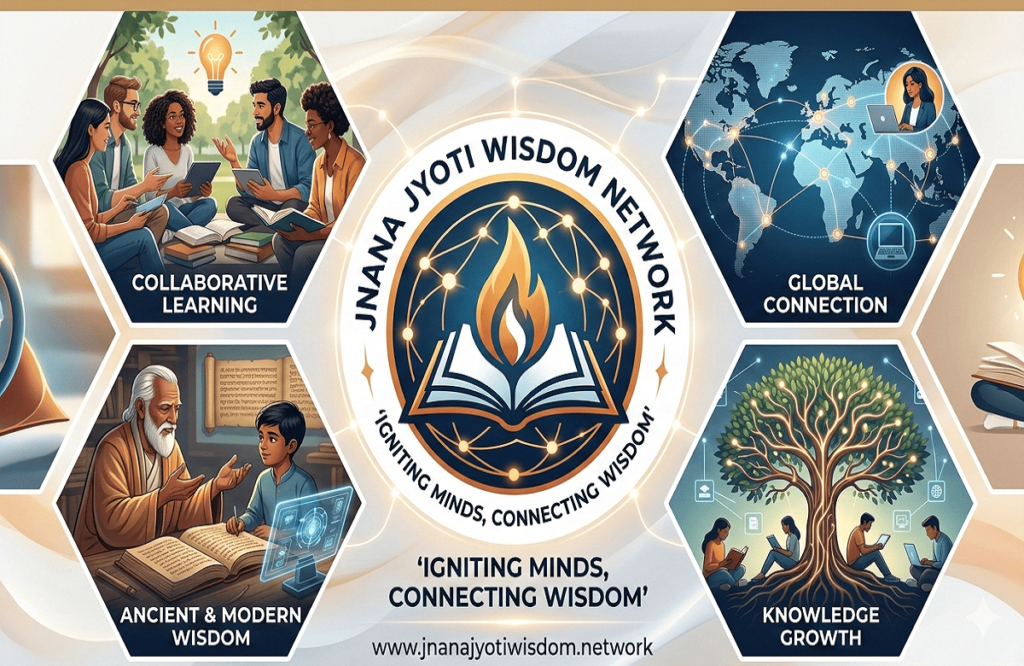
What is JNANA JYOTI WISDOM?
Jnana (ज्ञान)
- Sanskrit word meaning knowledge, wisdom, or insight.
- In Indian philosophy, it often refers to spiritual or experiential wisdom, the kind of deep understanding that leads to self-realization, not just academic learning.
Jyoti (ज्योति)
- Sanskrit word meaning light.
- Symbolically represents illumination, clarity, or enlightenment — the light that dispels ignorance.
Combined Meaning
- Jnana Jyoti = “Light of Wisdom”
- Symbolizes the illumination that knowledge brings, especially inner, spiritual, or philosophical insight.
- Often used in educational, spiritual, or self-development contexts as a metaphor for learning, awareness, and guidance.
🔹 Real-World Context
- There are institutions, schools, and online communities named Jnana Jyoti that focus on learning, teaching, or spiritual education.
- For example, online platforms called Jnana Jyoti offer structured courses, study materials, and interactive learning communities, but there’s no single widely recognized “Jnana Jyoti Wisdom Network.”
Who is Required JNANAM JYOTI WISDOM?
Who “Jnana Jyoti Wisdom” Is For
- Seekers of Knowledge and Insight
- People who want deep understanding, not just superficial facts.
- Interested in spiritual, philosophical, or self‑development knowledge.
- Those Who Value Inner Illumination
- Individuals who wish to bring clarity into their thinking, life choices, or awareness.
- The word Jyoti (light) implies wisdom that dispels ignorance.
- Learners and Reflective Thinkers
- Anyone who enjoys learning, contemplation, and personal growth.
- Open-minded people willing to explore ideas deeply.
- Community-Oriented Learners (if used as a “network”)
- People who want to share knowledge, discuss, or connect with others in pursuit of wisdom.
Who is Required for JNANAM JYOTI WISDOM?
The phrase “Jnana Jyoti Wisdom” literally translates to “the light of knowledge or wisdom”, derived from Sanskrit, where Jnana means knowledge or deep wisdom, and Jyoti means light or illumination. While there is no formally recognized organization or network explicitly named “Jnana Jyoti Wisdom,” the concept itself carries profound philosophical and educational significance. Understanding who is “required” for such wisdom is less about eligibility criteria and more about the qualities, intentions, and mindset of the individuals who would benefit from or contribute to such a pursuit.
At its core, Jnana Jyoti Wisdom is for seekers of knowledge and insight. These are individuals who do not merely desire information but are motivated to achieve a deeper understanding of life, existence, and self. Unlike conventional learning, which often focuses on memorization or practical skills, the pursuit of Jnana Jyoti involves reflective thinking, critical analysis, and an open-minded approach to truth. People who engage with such wisdom are naturally curious, willing to question assumptions, and driven by a desire to expand their perspective on the world and their place within it.
Those who value inner illumination and clarity are also central to the concept. Here, wisdom is metaphorically represented as light that dispels ignorance and confusion. Individuals who are introspective, contemplative, or spiritually inclined resonate strongly with this principle. They seek not just external knowledge but the clarity that comes from understanding the deeper connections between mind, actions, and reality. Such individuals often engage in self-inquiry, meditation, philosophical discussions, or study of classical texts, aiming to align their understanding with truth, ethical principles, and personal growth.
Another category includes learners and reflective thinkers who appreciate continuous education and self-development. In the context of modern applications, Jnana Jyoti Wisdom could extend to communities or networks focused on learning, mentoring, and knowledge sharing. Members in such networks may come from diverse backgrounds but share a common commitment to learning collaboratively, exchanging ideas, and supporting one another in intellectual or spiritual growth. This network aspect underscores that Jnana Jyoti is not only personal but communal, emphasizing dialogue, guidance, and shared insight.
When JNANA JYOTI WISDOM is required?
First and foremost, Jnana Jyoti Wisdom is required during moments of uncertainty and confusion. Life often presents challenges that are not straightforward, whether in personal relationships, career decisions, or moral dilemmas. In such circumstances, mere information or conventional advice is insufficient. One needs discernment, insight, and clarity — the qualities of wisdom — to navigate complexity. Jnana Jyoti illuminates the path forward, helping individuals distinguish between transient distractions and fundamental truths, between superficial gains and lasting fulfillment.
Secondly, this wisdom is essential during periods of self-reflection and inner growth. Human life is not just external action but also internal understanding. When individuals seek to understand their purpose, values, and identity, Jnana Jyoti becomes vital. It helps one recognize patterns of thought, confront biases, and cultivate self-awareness. By applying reflective wisdom, a person can transform experiences into meaningful learning and develop a grounded, thoughtful approach to life. Without the light of wisdom, reflection may remain shallow or misguided, leading to confusion rather than clarity.
Jnana Jyoti Wisdom is also required during decision-making that has long-term consequences. Major choices, whether financial, professional, or personal, demand insight beyond immediate reasoning. Wisdom allows one to consider multiple perspectives, foresee outcomes, and balance competing priorities. For instance, ethical dilemmas often cannot be resolved with technical knowledge alone; they require the illumination of inner understanding, compassion, and ethical reasoning that Jnana Jyoti provides.
Furthermore, this wisdom is necessary in interpersonal relationships and social interactions. Human connections are complex, involving emotions, communication, and empathy. Jnana Jyoti equips individuals to act with understanding, patience, and fairness. It allows people to navigate conflicts, offer guidance, and foster meaningful connections without being clouded by ego or superficial judgment. In this way, the light of wisdom nurtures harmony and constructive engagement with others.
Finally, Jnana Jyoti Wisdom is required in everyday life for continuous learning and adaptation. Modern life is fast-paced, with constant changes in knowledge, technology, and societal norms. Individuals who cultivate the light of wisdom are better prepared to absorb information thoughtfully, make ethical choices, and adapt to change without losing their sense of purpose. Wisdom serves as a guiding compass, ensuring that actions are grounded, deliberate, and beneficial over time.
Where JNANA JYOTI WISDOM Is Required?
1. In Education and Learning Environments
Jnana Jyoti Wisdom is highly relevant in schools, colleges, universities, and other learning spaces. It’s not just about memorizing facts but about developing understanding, critical thinking, and insight. Teachers, students, and researchers benefit from applying wisdom to navigate complex problems, reason ethically, and make knowledge meaningful. In classrooms, wisdom is required to apply knowledge thoughtfully rather than blindly, connecting lessons to real-life understanding.
2. In Personal Life and Self-Reflection
The most intimate setting for Jnana Jyoti Wisdom is the inner life of an individual. In moments of self-reflection, meditation, or personal decision-making, wisdom illuminates choices and helps a person understand their values, goals, and purpose. It is required whenever one faces dilemmas, seeks growth, or tries to overcome internal confusion. Without it, personal development may stagnate or follow superficial paths.
3. In Relationships and Social Interactions
Wisdom is required in all human relationships — family, friends, colleagues, or communities. Jnana Jyoti allows individuals to act with empathy, patience, and fairness, resolving conflicts and understanding others’ perspectives. It is needed wherever emotions, communication, and cooperation are involved, helping maintain harmony and mutual respect.
4. In Professional and Leadership Settings
In workplaces, leadership roles, and social service, Jnana Jyoti Wisdom is essential. Leaders and decision-makers need it to make ethical decisions, foresee consequences, and guide others responsibly. Wisdom helps balance organizational goals with human values, ensuring that success is sustainable and just. It is required wherever strategy, responsibility, and guidance intersect.
5. In Times of Crisis or Uncertainty
Life often brings uncertainty — personal crises, societal challenges, or unexpected events. Jnana Jyoti is required in these moments to provide clarity, calm, and direction. It helps people navigate difficult circumstances with understanding, composure, and ethical judgment, rather than reacting impulsively.
6. In Spiritual or Philosophical Pursuits
Finally, Jnana Jyoti Wisdom is essential in spiritual communities, meditation centers, and philosophical study groups. Here, it guides seekers in their quest for insight, self-realization, and truth. Wisdom illuminates the understanding of life’s deeper questions and fosters inner peace and enlightenment.
How JNANA JYOTI WISDOM is required?
How Jnana Jyoti Wisdom Is Required
1. Through Self-Reflection and Awareness
Jnana Jyoti Wisdom is required by engaging in deep self-reflection. Individuals need to examine their thoughts, actions, and motivations to gain clarity and understanding. This wisdom is applied by questioning assumptions, observing patterns in behavior, and seeking insight into one’s own mind and heart. It is required whenever one wants to act consciously rather than react impulsively. Through awareness, wisdom illuminates choices and provides guidance in personal growth.
2. Through Learning and Knowledge Acquisition
Wisdom is required by studying knowledge thoughtfully. It is not just about gathering information but understanding the deeper principles behind facts, concepts, or experiences. For example, students, professionals, or seekers of truth need this wisdom to analyze information critically, synthesize ideas, and apply lessons meaningfully in their lives. In this way, learning becomes transformative rather than superficial.
3. Through Ethical and Conscious Decision-Making
Jnana Jyoti Wisdom is required in making decisions that affect oneself and others. It is applied by considering consequences, evaluating alternatives, and balancing short-term and long-term impacts. In professional, social, or personal contexts, this wisdom ensures decisions are thoughtful, ethical, and beneficial. It is required whenever judgment calls are made, whether small daily choices or major life-altering decisions.
4. Through Compassion and Understanding in Relationships
Wisdom is required in interpersonal interactions. It is applied by practicing empathy, patience, and careful communication, understanding other perspectives, and resolving conflicts gracefully. In this way, Jnana Jyoti ensures that relationships are nurtured with insight and respect rather than misunderstandings or impulsive reactions.
5. Through Meditation, Contemplation, and Spiritual Practice
Jnana Jyoti Wisdom is required in spiritual or contemplative practices. By meditating, reflecting on philosophical texts, or engaging in guided inquiry, individuals cultivate inner clarity and insight. This application of wisdom illuminates the deeper truths of existence, guiding personal and spiritual development.
6. Through Continuous Application in Daily Life
Finally, this wisdom is required in everyday activities. It is applied by approaching routine decisions, challenges, and interactions thoughtfully, staying mindful, and integrating ethical and insightful understanding into daily life. Wisdom is not only for extraordinary moments but is required continuously to navigate life successfully and meaningfully.
Case study on JNANA JYOTI WISDOM
Background
The concept of Jnana Jyoti, meaning “the light of wisdom”, emphasizes the application of deep knowledge and insight to illuminate understanding and guide actions. It is not limited to academic learning but encompasses self-awareness, ethical decision-making, and mindful living. Wisdom, in this context, is a guiding principle that helps individuals navigate complexity in personal, professional, and social settings.
This case study examines Ananya, a mid-level manager in a technology company, who struggles with decision-making, team management, and personal growth. By applying principles of Jnana Jyoti Wisdom, she aims to improve both her professional effectiveness and personal clarity.
Challenges
Ananya faced several challenges:
- Professional Dilemma: She needed to make a strategic decision about reallocating resources in a project. The options had conflicting priorities and potential consequences for team morale.
- Team Conflicts: Her team was experiencing interpersonal issues, leading to delays and communication breakdowns.
- Personal Confusion: She felt overwhelmed by the pace of work and personal responsibilities, lacking clarity about her long-term career goals.
Application of Jnana Jyoti Wisdom
1. Self-Reflection and Awareness
Ananya started by reflecting on her own biases, priorities, and values. She kept a daily journal and meditated briefly each morning. This allowed her to recognize patterns in her decision-making and emotional responses, cultivating clarity and patience.
2. Ethical and Conscious Decision-Making
When making the resource allocation decision, she applied Jnana Jyoti Wisdom by analyzing long-term consequences, consulting her team, and balancing efficiency with fairness. Rather than rushing for immediate gains, she prioritized sustainable outcomes that aligned with ethical and professional standards.
3. Improving Relationships Through Compassion
Ananya observed conflicts in her team using empathy and open communication. She listened actively, acknowledged differing perspectives, and mediated disputes without imposing unilateral solutions. By applying wisdom in interactions, she fostered cooperation, trust, and morale.
4. Learning and Knowledge Application
She sought guidance from mentors and studied project management principles, combining external knowledge with internal insight. Jnana Jyoti Wisdom required her to synthesize theory with real-life understanding, ensuring decisions were informed yet contextualized.
5. Continuous Growth
Ananya applied wisdom in her personal life as well. She prioritized tasks, set boundaries, and aligned actions with her goals, ensuring that her professional and personal life progressed harmoniously. This reflected the continuous, everyday application of Jnana Jyoti Wisdom.
Outcomes
- Professional Success: The project was completed efficiently, with minimal disruption to the team. Decisions were ethical and sustainable, earning trust from peers and leadership.
- Improved Team Dynamics: Conflicts reduced, communication improved, and collaboration increased.
- Personal Clarity: Ananya gained insight into her strengths, values, and career direction. She reported reduced stress, increased focus, and better work-life balance.
- Long-Term Habit Formation: By practicing self-reflection, ethical judgment, and mindful action, she internalized the principles of Jnana Jyoti Wisdom as part of her daily life.
Conclusion
This case study demonstrates that Jnana Jyoti Wisdom is required wherever clarity, insight, ethical judgment, and personal growth are needed. It is applied through self-reflection, learning, conscious decision-making, and mindful relationships, both in personal and professional contexts. The light of wisdom guides actions, improves outcomes, and fosters meaningful development, illustrating that wisdom is not just theoretical but deeply practical and transformative.
White Paper: JNANA JYOTI WISDOM
Author: [MUKESH SINGH]
Date: [07-03-2026]
Version: 1.0
Executive Summary
Jnana Jyoti Wisdom, derived from Sanskrit (Jnana = knowledge/wisdom, Jyoti = light), symbolizes the light of wisdom. This white paper explores the significance of this wisdom in personal growth, professional decision-making, and societal development. It emphasizes how individuals and organizations can cultivate and apply Jnana Jyoti Wisdom to enhance clarity, ethical decision-making, and meaningful outcomes.
Introduction
In today’s complex and fast-paced world, knowledge alone is insufficient. Decision-makers, professionals, and learners require insight, ethical reasoning, and reflective understanding. Jnana Jyoti Wisdom bridges this gap, offering guidance beyond factual knowledge by illuminating deeper understanding and practical discernment.
The concept is both philosophical and practical: while rooted in Eastern spiritual traditions, it has relevance in education, leadership, management, and personal development.
Understanding Jnana Jyoti Wisdom
Definition
- Jnana: Deep, experiential knowledge; wisdom beyond mere information.
- Jyoti: Light or illumination; symbolic of clarity, insight, and enlightenment.
- Jnana Jyoti Wisdom: The illumination that arises from understanding, applied to guide decisions, actions, and learning.
Core Principles
- Self-Reflection: Insight begins within; understanding one’s motivations, biases, and goals.
- Ethical Awareness: Wisdom guides decisions that balance efficiency, fairness, and long-term consequences.
- Continuous Learning: Knowledge and experience must be synthesized thoughtfully.
- Compassionate Action: Applying wisdom in interactions and relationships to promote understanding and harmony.
Applications of Jnana Jyoti Wisdom
- Personal Growth:
- Enhances decision-making in daily life.
- Supports self-reflection and alignment with personal values.
- Improves mental clarity and emotional intelligence.
- Professional Environments:
- Assists leaders in making ethical, strategic, and sustainable decisions.
- Improves teamwork, communication, and conflict resolution.
- Supports innovation by combining knowledge with insight.
- Educational Contexts:
- Encourages critical thinking and reflective learning.
- Promotes wisdom-based teaching rather than rote memorization.
- Spiritual and Philosophical Contexts:
- Guides seekers in meditation, self-inquiry, and understanding life’s deeper truths.
- Supports communities in fostering meaningful dialogue and ethical action.
Implementation Strategies
- Reflective Practices: Journaling, meditation, and guided inquiry to develop self-awareness.
- Mentorship and Collaboration: Learning from experienced guides and peers to synthesize knowledge.
- Ethical Decision Frameworks: Applying structured approaches that prioritize fairness, long-term impact, and clarity.
- Continuous Learning Programs: Integrating formal education with experiential learning and practical insight.
Benefits
- Improved clarity in personal and professional decisions.
- Enhanced ethical and conscious action.
- Stronger interpersonal relationships and collaboration.
- Sustainable growth, both individually and organizationally.
- Cultivation of a resilient, insight-driven mindset.
Conclusion
Jnana Jyoti Wisdom is universally required wherever clarity, insight, and ethical discernment are needed. It is not limited by age, education, or profession; rather, it is a mindset and practice that illuminates choices, strengthens relationships, and fosters meaningful personal and collective development. Organizations and individuals who cultivate this wisdom are better equipped to navigate complexity, lead with insight, and create lasting positive impact.
source : Atmajyoti Vishwa Gurukulam
ASK FAQ
1.What is Jnana Jyoti Wisdom?
Jnana Jyoti Wisdom, derived from Sanskrit (Jnana = knowledge, Jyoti = light), represents the light of wisdom. It emphasizes the application of deep knowledge, insight, and ethical understanding to guide personal growth, decision-making, and professional excellence. This wisdom is applicable in education, leadership, healthcare, technology, finance, and social impact sectors.
2.How can Jnana Jyoti Wisdom be applied in industries?
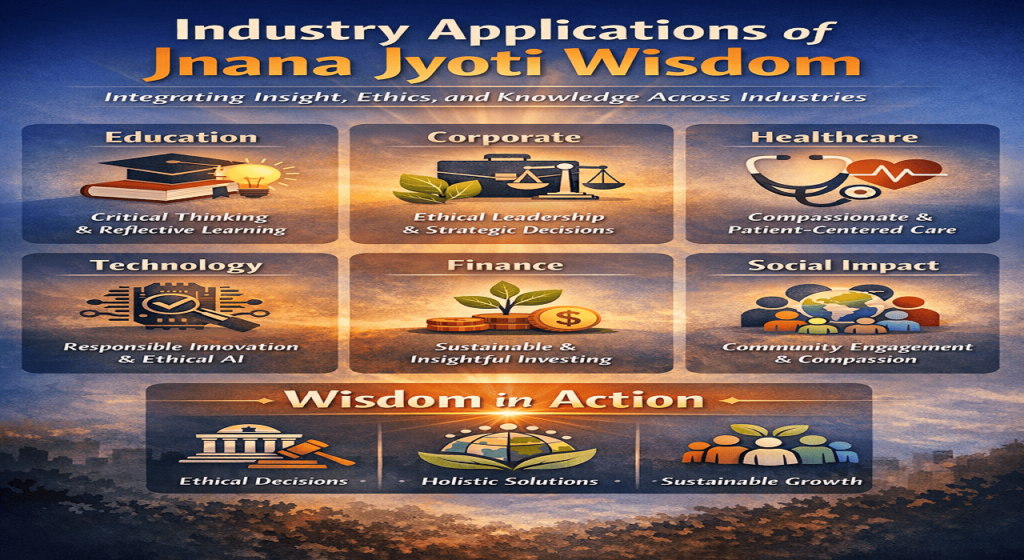
Jnana Jyoti Wisdom can be applied across industries by integrating insight, ethics, and knowledge into decision-making processes. For example:
- Education: Critical thinking and reflective learning
- Corporate: Ethical leadership and strategic decisions
- Healthcare: Compassionate, patient-centered care
- Technology: Responsible innovation and ethical AI
- Finance: Sustainable and insightful investing
- Social Work: Community engagement and compassion
3.Who can benefit from Jnana Jyoti Wisdom?
Anyone seeking clarity, ethical guidance, and personal or professional growth can benefit from Jnana Jyoti Wisdom. It is particularly valuable for:
- Students and educators looking to enhance learning outcomes
- Professionals and leaders making strategic and ethical decisions
- Healthcare practitioners aiming for compassionate care
- Innovators in technology and finance seeking responsible solutions
4.Why is Jnana Jyoti Wisdom important for professional growth?
Jnana Jyoti Wisdom is crucial for professional growth because it combines knowledge with ethical judgment and insight, allowing individuals to make thoughtful decisions, resolve conflicts effectively, and lead with clarity. Organizations that foster this wisdom among employees experience better collaboration, sustainable innovation, and long-term success.
5.How can individuals cultivate Jnana Jyoti Wisdom?
Individuals can cultivate Jnana Jyoti Wisdom through:
- Self-reflection and meditation to enhance clarity
- Continuous learning and practical application of knowledge
- Ethical decision-making in personal and professional life
- Mindful interpersonal interactions to foster compassion and understanding
These practices ensure wisdom is applied consistently across life and work.
Industry application of JNANA JYOTI WISDOM
1. Education and EdTech
- Application: Jnana Jyoti Wisdom can guide curriculum design, teaching methods, and student engagement.
- Impact: Encourages critical thinking, reflective learning, and ethical reasoning rather than rote memorization.
- Example: Online platforms or learning communities that integrate philosophy, life skills, and self-awareness alongside technical knowledge embody Jnana Jyoti principles.
2. Corporate and Management
- Application: Wisdom is applied in strategic planning, ethical decision-making, and leadership development.
- Impact: Leaders make informed, fair, and sustainable decisions that consider both short-term gains and long-term consequences.
- Example: Managers using reflective practices, mentorship programs, and ethical frameworks to balance profit with social responsibility.
3. Healthcare Industry
- Application: Jnana Jyoti Wisdom guides patient care, ethical medical decisions, and healthcare management.
- Impact: Improves patient outcomes through compassionate care, evidence-based decisions, and ethical judgment.
- Example: Doctors combining clinical knowledge with patient-centered empathy and judgment in treatment plans.
4. Technology and Innovation
- Application: Encourages responsible AI development, ethical product design, and user-focused innovation.
- Impact: Mitigates unintended consequences of technology, ensuring innovation is both effective and socially responsible.
- Example: Tech teams adopting reflective design thinking to foresee societal impact before launching new solutions.
5. Financial Services
- Application: Wisdom guides risk assessment, ethical investing, and long-term planning.
- Impact: Reduces reckless decision-making while enhancing stakeholder trust.
- Example: Investment firms using ethical and insight-driven frameworks for portfolio decisions aligned with sustainable development goals.
6. Government and Policy Making
- Application: Jnana Jyoti Wisdom informs policy creation, conflict resolution, and public engagement.
- Impact: Promotes transparency, fairness, and strategic foresight in governance.
- Example: Policymakers applying insight and ethical reasoning to balance economic, social, and environmental priorities.
7. Social Work and Non-Profit Sector
- Application: Guides community engagement, resource allocation, and program planning.
- Impact: Enhances effectiveness of initiatives, fosters trust, and ensures interventions meet real needs.
- Example: NGOs combining data-driven planning with compassionate understanding of local communities.