The Isha Upanishad is one of the principal Upanishads of Hindu philosophy, forming a vital part of the Vedas, specifically the Yajurveda. Comprising only 18 verses, it presents profound spiritual insights in a concise manner. The Upanishad emphasizes the idea of “Isha vasyam” — the vision that the entire universe is pervaded by the Supreme Being and that everything is interconnected. It teaches the harmony between worldly life and spiritual wisdom, urging humans to enjoy the world without attachment.
The concept of an Isha Upanishad Network can be understood as a metaphorical or educational framework connecting its teachings to modern life. Such a network would integrate the Upanishad’s principles into areas like ethics, leadership, education, and mindfulness, fostering holistic learning. By connecting individuals, institutions, and resources that study and propagate the Upanishad’s wisdom, this network promotes spiritual literacy, moral clarity, and social responsibility.
Through structured discussions, online resources, workshops, and courses, an Isha Upanishad Network can serve as a learning ecosystem, helping students and seekers understand the text’s relevance in daily life. It emphasizes the balance between material success and inner fulfillment, making ancient wisdom accessible and practical in contemporary educational and personal development contexts.

What Is Isha Upanishad Network ?
The Isha Upanishad is one of the shortest yet most profound texts among the Upanishads, which are the philosophical teachings embedded in the Vedas. Despite having only 18 verses, it conveys a deep vision of life, spirituality, and the universe. Its core message is “Isha vasyam”, meaning that the entire universe is pervaded by the Supreme Being. Everything that exists—animate or inanimate—belongs to this divine presence. At the same time, humans are encouraged to engage with the world fully but without attachment, achieving a balance between material life and spiritual wisdom.
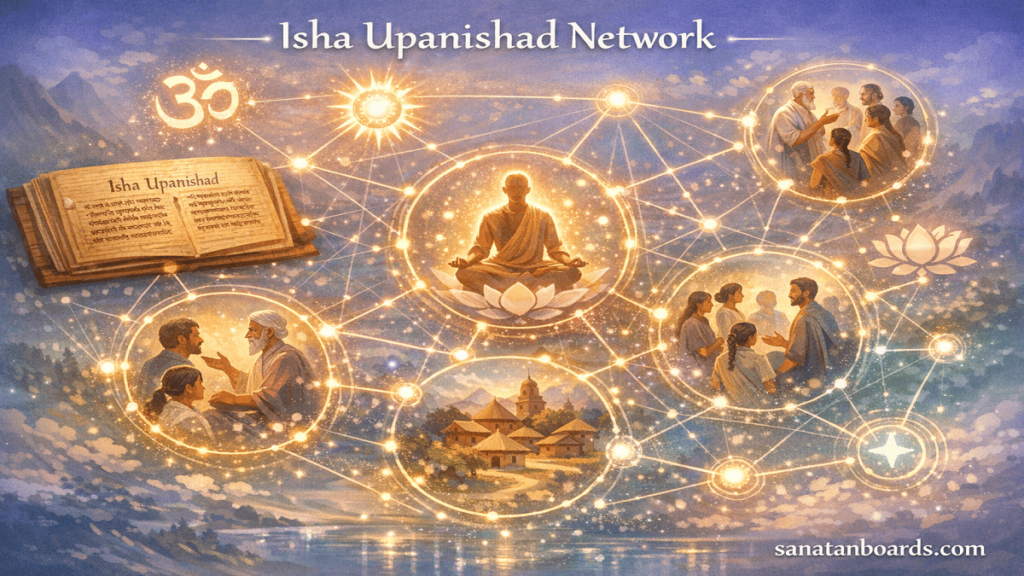
The Isha Upanishad Network is an emerging concept that seeks to connect the teachings of the Upanishad with modern education, research, and personal growth. It is essentially a learning and knowledge-sharing ecosystem built around the philosophy of the Isha Upanishad. The network aims to create a platform where individuals, educational institutions, spiritual organizations, and researchers can come together to explore, discuss, and apply the text’s teachings in daily life.
This network may include online platforms, workshops, webinars, research journals, and courses focused on spirituality, ethics, philosophy, and holistic living. Its purpose is to provide structured learning that bridges ancient wisdom and contemporary challenges. By participating in such a network, learners can understand the interconnectedness of life, cultivate mindfulness, and develop moral and spiritual clarity while remaining active in worldly pursuits.
Furthermore, the Isha Upanishad Network emphasizes practical applications of spiritual knowledge. It encourages responsible living, sustainability, ethical leadership, and social harmony. By drawing on the universal truths of the Upanishad, the network helps individuals make conscious choices that benefit both themselves and society.
Who Is Required For Isha Upanishad Network ?
The Isha Upanishad Network is designed to be a collaborative platform that brings together people from different walks of life who are interested in exploring the wisdom of the Isha Upanishad and applying it in modern life. Because the network focuses on learning, knowledge-sharing, and personal transformation, it requires participants who are committed, curious, and open-minded.
- Students and Learners: Young minds, college students, and lifelong learners form the backbone of the network. They seek to understand the philosophical, spiritual, and ethical teachings of the Upanishad. By participating, they can develop critical thinking, mindfulness, and a deeper awareness of the world around them.
- Educators and Scholars: Teachers, professors, and researchers are essential for structuring knowledge, providing guidance, and interpreting the ancient text in ways that resonate with contemporary audiences. Their expertise ensures that learning is both accurate and meaningful.
- Spiritual Practitioners: Individuals who practice meditation, yoga, or other spiritual disciplines can contribute practical insights from their experiences. They help translate abstract concepts of the Upanishad into daily practices that cultivate inner peace and balance.
- Social Leaders and Innovators: People involved in social work, leadership, or community development can apply the ethical and philosophical principles of the Upanishad in real-world scenarios, promoting sustainability, empathy, and harmonious living.
- Technology and Media Experts: To create an effective network, experts in digital platforms, online learning, and media are needed. They help build the infrastructure for courses, webinars, discussions, and resource-sharing, making the Upanishad’s teachings widely accessible.
When Is The Isha Upanishad Network Required?
The Isha Upanishad Network is not just an abstract idea; it becomes essential in contexts where spiritual insight, ethical guidance, and holistic education are needed to navigate modern life. The teachings of the Isha Upanishad, though ancient, remain highly relevant today. The network is particularly required in times of moral uncertainty, mental stress, societal fragmentation, and environmental challenges.
In today’s fast-paced world, individuals often struggle to balance material pursuits with inner peace. The Upanishad emphasizes “Isha vasyam”, the idea that everything in the universe is interconnected and belongs to the Supreme Being. In such times, the network is required to guide students, professionals, and leaders in integrating this philosophy into daily life, helping them make decisions with awareness, responsibility, and compassion.
The network is also crucial in educational settings. Traditional curricula often emphasize technical knowledge while neglecting ethical and spiritual development. The Isha Upanishad Network provides a platform for holistic learning, helping students develop critical thinking, mindfulness, and moral reasoning. It is particularly needed when learners face challenges like stress, anxiety, and value conflicts, offering them tools to cultivate inner stability while engaging actively with the world.
At a societal level, the network is required when communities seek to promote harmony, sustainability, and ethical leadership. By connecting educators, spiritual practitioners, and social innovators, the network ensures that ancient wisdom is applied to contemporary problems—whether it is environmental conservation, ethical governance, or social welfare.
Finally, the network is required in the digital and global age, where access to knowledge is widespread but often fragmented. A structured network ensures that the teachings of the Isha Upanishad are not lost in superficial interpretations. It provides authentic guidance, discussion forums, online courses, and collaborative projects, making timeless wisdom accessible, practical, and actionable.
Where Is The Isha Upanishad Network Required ?
The Isha Upanishad Network is a conceptual and practical framework designed to bring the timeless wisdom of the Isha Upanishad into contemporary life. While the Upanishad itself originates in ancient India, its teachings are universal, and the network is required wherever there is a need for spiritual guidance, ethical education, and holistic development. Understanding where this network is required helps us identify the areas of society, education, and personal growth that can benefit from its integration.
1. Educational Institutions:
The Isha Upanishad Network is highly relevant in schools, colleges, and universities. Traditional curricula often emphasize technical skills and theoretical knowledge but leave gaps in moral reasoning, mindfulness, and life philosophy. By incorporating the Upanishad’s teachings through structured programs, workshops, or discussion forums, educational institutions can nurture well-rounded learners who are not only academically competent but also ethically and spiritually aware.
2. Spiritual and Wellness Centers:
Yoga studios, meditation centers, and spiritual retreat facilities are natural homes for the network. The Isha Upanishad provides insights into the interconnectedness of life, detachment, and inner harmony, which can enhance meditation practices, mindfulness training, and personal development programs. These centers serve as ideal locations to implement guided learning, study circles, and practical exercises based on the Upanishad’s principles.
3. Corporate and Leadership Platforms:
In the corporate world, the network is required in organizations, training programs, and leadership development initiatives. Modern workplaces often face challenges like stress, ethical dilemmas, and value conflicts. Integrating the Isha Upanishad Network can foster ethical leadership, conscious decision-making, and emotional intelligence, helping employees navigate professional pressures while maintaining personal integrity.
4. Online and Digital Spaces:
The network is increasingly necessary in digital environments where learners and seekers are dispersed across regions. Online platforms, e-learning portals, webinars, and discussion forums allow participants worldwide to access authentic teachings, collaborate on projects, and engage in meaningful dialogues about the Upanishad. This ensures that its wisdom transcends geographical boundaries and reaches a global audience.
5. Community and Social Development Areas:
The network is also required in communities, NGOs, and social initiatives. The Upanishad’s focus on interconnectedness, responsibility, and ethical action provides a philosophical foundation for promoting sustainable living, social harmony, and compassionate action. Community programs that incorporate these principles can help create environments that value both individual growth and collective well-being
How Is the Isha Upanishad Network Required ?
The Isha Upanishad Network is not merely a conceptual idea; it is required in practical ways to connect ancient wisdom with modern life. Understanding how it is required involves looking at the methods, approaches, and structures through which its teachings can be accessed, applied, and shared for education, personal growth, and societal development.
1. Through Structured Learning Programs:
The network is required to provide organized educational programs—both offline and online—where learners can systematically study the Isha Upanishad. Workshops, courses, and discussion groups help break down the complex philosophical concepts into understandable lessons. This structured approach ensures that the wisdom of the Upanishad is not lost or misinterpreted and can be applied in practical scenarios like decision-making, personal growth, and ethical living.
2. By Connecting Learners and Mentors:
The network is required to link students, scholars, spiritual practitioners, and educators. Mentorship and guided learning are crucial for understanding the deeper meanings of the text. Through dialogue, Q&A sessions, and collaborative projects, participants can learn not just the philosophy but also its application in daily life. This relational approach makes learning interactive, reflective, and transformative.
3. Using Digital Platforms and Resources:
In the modern world, the network is required to leverage technology—websites, apps, webinars, podcasts, and online communities. Digital tools make the Isha Upanishad accessible to people globally, allowing discussions, research, and shared projects. This ensures that the wisdom reaches a wider audience and supports continuous learning even beyond traditional classroom settings.
4. Practical Application in Daily Life:
The network is required to translate philosophy into action. This includes practices such as meditation, ethical decision-making, mindful consumption, sustainable living, and social service. By applying the Upanishad’s principles, individuals and communities can balance material life with spiritual growth, fostering harmony and conscious living.
5. Promoting Collaboration and Knowledge Sharing:
Finally, the network is required to encourage collaboration among institutions, educators, and learners. Conferences, study circles, and joint research projects help create a community where the Isha Upanishad’s teachings are continuously explored, debated, and applied.
Case Study On Isha Upanishad Network
Background
The Isha Upanishad, part of the Yajurveda, is one of the shortest and most profound Upanishads, consisting of only 18 verses. Its teachings focus on the unity of life, the concept of “Isha vasyam” (the idea that the entire universe is pervaded by the Supreme Being), ethical living, and balance between material and spiritual pursuits. Despite its timeless relevance, modern education and social systems often lack structured platforms to impart such wisdom in a practical and accessible way.
To address this gap, the Isha Upanishad Network was conceptualized as a holistic learning ecosystem, connecting learners, educators, spiritual practitioners, and communities to study, discuss, and apply the Upanishad’s principles in contemporary life.
Objectives
The primary objectives of the network were:
- To integrate ancient spiritual wisdom into modern education.
- To foster mindfulness, ethical awareness, and social responsibility.
- To create a collaborative platform for knowledge sharing among students, educators, and practitioners.
- To encourage practical application of Upanishadic principles in personal, professional, and community contexts.
Implementation
- Educational Programs:
Universities and schools partnered with the network to include the Isha Upanishad in courses on philosophy, ethics, and holistic education. Students participated in workshops, group discussions, and reflective exercises to understand concepts like interconnectedness, detachment, and ethical action. - Digital Integration:
An online portal was developed to provide lectures, discussion forums, webinars, and resources. This allowed learners from different regions to access authentic teachings, participate in debates, and collaborate on research projects. - Practical Application:
Participants were encouraged to implement Upanishadic principles in daily life. For instance, campus initiatives promoted mindful consumption, sustainability practices, and ethical leadership, demonstrating how ancient teachings could influence modern behaviors. - Community Engagement:
Local communities collaborated with the network to organize workshops and awareness campaigns, applying the philosophy of the Isha Upanishad to social challenges such as environmental responsibility, social harmony, and value-based education.
Outcomes
- Students demonstrated enhanced ethical reasoning and moral awareness.
- Mindfulness and stress management improved through meditation and reflective practices inspired by the Upanishad.
- Community workshops led to practical initiatives promoting sustainability and social cohesion.
- A collaborative network of educators, students, and practitioners was established for continuous study and application of the Upanishad’s teachings.
Conclusion
The Isha Upanishad Network illustrates that ancient wisdom can be effectively integrated into modern learning and social contexts. By connecting education, digital resources, practical application, and community engagement, the network ensures that the philosophy of the Isha Upanishad remains relevant, actionable, and transformative, helping individuals and societies navigate the challenges of contemporary life with mindfulness, ethical awareness, and spiritual insight.
White Paper On Isha Upanishad Network
Executive Summary
The Isha Upanishad, a seminal text of the Vedas, offers profound guidance on life, ethics and spirituality in just 18 verses. Its central teaching, “Isha vasyam”, emphasizes that the entire universe is pervaded by the Supreme Being, and humans should engage with the world responsibly, without attachment. Despite its brevity, the Upanishad provides a framework for ethical living, mindfulness, and holistic development.
The Isha Upanishad Network is envisioned as a collaborative platform that connects learners, educators, spiritual practitioners, and communities to study, discuss, and implement these teachings. This white paper explores the purpose, implementation strategies, and benefits of such a network in modern educational and social contexts.
Purpose and Need
Modern education often emphasizes technical knowledge while overlooking moral, ethical, and spiritual development. Similarly, in professional and community settings, individuals face stress, value conflicts, and disconnection from inner purpose. The Isha Upanishad Network addresses these gaps by:
- Providing structured learning and discussion platforms for understanding the Upanishad.
- Encouraging ethical decision-making, mindfulness, and sustainable living.
- Creating a global knowledge-sharing ecosystem that bridges ancient philosophy with contemporary challenges.
Implementation Strategies
- Educational Integration:
Schools, colleges, and universities can incorporate courses, workshops, and seminars based on the Upanishad, fostering reflective learning and ethical reasoning. - Digital Platforms:
Online portals, webinars, podcasts, and discussion forums make the network accessible globally, allowing learners to participate regardless of geography. - Practical Application:
Participants apply principles such as mindful consumption, ethical leadership, and social responsibility in daily life, workplaces, and community projects. - Community Engagement:
Collaborations with NGOs, social organizations, and local communities ensure the Upanishad’s teachings are applied in addressing societal and environmental challenges.
Benefits
- Enhanced Ethical Awareness: Participants develop moral clarity and social responsibility.
- Mindfulness and Mental Well-being: Practices inspired by the Upanishad reduce stress and improve focus.
- Knowledge Network Creation: A collaborative ecosystem facilitates continuous study, research, and dialogue.
- Social Impact: Community initiatives guided by Upanishadic principles promote sustainability, harmony, and conscious living.
Conclusion
The Isha Upanishad Network demonstrates that ancient spiritual wisdom can be effectively adapted to modern education, workplaces, and society at large. By combining structured learning, digital accessibility, practical application, and community engagement, the network ensures that the philosophy of the Isha Upanishad remains relevant, actionable, and transformative. This initiative bridges the gap between timeless teachings and contemporary life, creating a holistic framework for personal, educational, and social growth.
Industry Applications Of The Isha Upanishad Network
The Isha Upanishad Network, rooted in the teachings of the Isha Upanishad, provides a platform for integrating ethical, spiritual, and holistic learning into modern organizational and societal structures. Its core principles—interconnectedness, ethical action, mindfulness, and balance between material and spiritual life—make it highly relevant across various industries.
1. Education and EdTech
The network can transform educational institutions and EdTech platforms by incorporating the Upanishad’s teachings into curricula. Schools and universities can offer courses on ethics, mindfulness, sustainability, and philosophical thinking, while online learning platforms can provide global access to structured study programs. This fosters holistic learning, encouraging critical thinking, emotional intelligence, and ethical decision-making.
2. Corporate and Workplace Well-being
In the corporate sector, the network can guide leadership development, employee engagement, and workplace wellness programs. Practices inspired by the Isha Upanishad, such as mindfulness, detachment from material stress, and ethical decision-making, can improve productivity, emotional intelligence, and ethical corporate culture. Organizations can implement workshops and seminars through the network to create conscious workplaces.
3. Healthcare and Wellness Industry
The principles of balance, mindfulness, and interconnectedness are highly relevant to the healthcare and wellness industry. Meditation centers, yoga studios, and mental health programs can integrate teachings from the network to enhance mental well-being, stress management, and holistic healing, providing clients with practical spiritual and psychological tools.
4. Social Enterprises and NGOs
For social impact organizations, the Isha Upanishad Network offers a framework to promote sustainable development, ethical governance, and community harmony. NGOs and social enterprises can apply these principles in environmental projects, ethical education campaigns, and social welfare programs, ensuring that their initiatives are value-driven and sustainable.
5. Technology and Digital Platforms
The network can be leveraged in digital industries to create platforms that connect learners, educators, and practitioners worldwide. Apps, e-learning platforms, and online communities can facilitate collaboration, knowledge sharing, and global outreach, making spiritual and ethical learning widely accessible.
6. Leadership and Governance
In leadership and governance sectors, the network can guide ethical decision-making, conscious leadership, and policy frameworks that prioritize the welfare of society, reflecting the Upanishad’s emphasis on interconnectedness and responsibility.
SOURCE : Gaiea Sanskrit
ASK FAQ
What is the Isha Upanishad Network?
The Isha Upanishad Network is a learning and knowledge-sharing platform that connects students, educators, and communities to study and apply the teachings of the Isha Upanishad in modern life.
Who can join the Isha Upanishad Network?
Students, educators, spiritual practitioners, researchers, and social leaders can join to explore, discuss, and implement the Upanishad’s teachings in personal, academic, and professional contexts.
How does the Isha Upanishad Network help in modern life?
It promotes ethical decision-making, mindfulness, holistic education, sustainable living, and spiritual growth, bridging ancient wisdom with contemporary challenges.
Where can I access the Isha Upanishad Network?
The network is accessible through educational institutions, online learning platforms, workshops, webinars, and community programs worldwide.
Why is the Isha Upanishad Network important today?
It addresses stress, ethical dilemmas, and societal challenges by applying the Upanishad’s timeless wisdom, helping individuals and organizations live balanced, conscious, and responsible lives.
Table of Contents
Disclaimer:
The information provided here is for educational and informational purposes only. It does not constitute professional, spiritual, or legal advice. Readers should conduct their own research or consult qualified professionals before applying the teachings of the Isha Upanishad in personal, educational, or professional contexts.