Hinduism has a long and vibrant history in South Africa, brought primarily by Indian immigrants during the 19th and early 20th centuries. These immigrants, many of whom were laborers under the indentured system, as well as merchants and traders, carried with them not only their religious beliefs but also their cultural practices, language, and social structures. Over generations, they established temples, cultural societies, schools, and welfare associations that helped preserve and propagate Hindu traditions. The Hindu community in South Africa played a significant role in maintaining a sense of identity and cohesion in a multicultural and often segregated society.
Among the Indian diaspora, the surname Chetty is common, particularly among those of Tamil, Telugu, or South Indian heritage. Families with this surname were often active in business, religious leadership, and community service. While extensive research shows numerous Hindu leaders emerging from these communities, there are currently no widely recognized historical records documenting an individual specifically named S. Radhakrishna Chetty as a nationally prominent leader. Despite this, individuals with similar backgrounds often held vital positions in local temples, educational initiatives, and community organizations, shaping the spiritual and social life of Hindus in South Africa.
The topic of HINDU LEADERS OF SOUTH AFRICA – S. RADHAKRISHNA CHETTY provides an opportunity to explore how leadership within the Hindu community functioned, the challenges these leaders faced, and the ways they contributed to maintaining religious practices and cultural identity. Even if a particular individual is not documented in mainstream historical sources, the life and work attributed to such figures reflect broader patterns of leadership, resilience, and community service that have been central to Hindu communities throughout South Africa.
What Is Hindu Leaders Of South Africa – S. Radhakrishna Chetty ?
The term HINDU LEADERS OF SOUTH AFRICA – S. RADHAKRISHNA CHETTY can be understood in two main contexts. First, it refers to the general phenomenon of Hindu leadership in South Africa. Hindu leaders historically served as spiritual guides, community organizers, and cultural custodians. They were responsible for building temples, establishing religious and cultural societies, teaching Hindu philosophy and languages, and organizing festivals and rituals that reinforced communal identity. Leadership also extended to representing Hindu interests in wider society, negotiating with colonial and later apartheid authorities, and maintaining a sense of social cohesion among Indian-South Africans.
Second, the specific reference to S. Radhakrishna Chetty indicates an individual who may have acted as a Hindu leader within a particular community or locality. However, no verified historical or academic sources document him as a nationally recognized figure. This highlights a common challenge in diaspora histories, where many local leaders’ contributions remain undocumented in mainstream records. In such cases, individuals like S. Radhakrishna Chetty symbolize the countless community figures who preserved and nurtured Hindu traditions, often working quietly in temples, educational programs, or social service initiatives.
Thus, HINDU LEADERS OF SOUTH AFRICA – S. RADHAKRISHNA CHETTY represents both the broader framework of leadership within the Hindu community and the potential contributions of individual figures whose work, though significant locally, may not appear in official histories. Studying such leadership emphasizes the importance of religious, social, and cultural stewardship and the transmission of heritage in a diaspora setting.
Who Is Required Hindu Leaders Of South Africa – S. Radhakrishna Chetty ?
Hindu leaders in South Africa are required by communities to fulfill multiple roles. Primarily, they are spiritual guides who ensure that Hindu practices, rituals, and religious teachings are passed down to younger generations. They also serve as educators, teaching religious texts, languages such as Tamil, Telugu, Hindi, or Sanskrit, and cultural norms. Leaders are often required to organize and maintain temples and cultural societies, which act as central hubs for social interaction and spiritual life.
Beyond religious duties, Hindu leaders are required to mediate social matters, provide support in times of need, and uphold community welfare. They represent the community in broader societal contexts, engaging with government institutions, other religious groups, and civil society. This representation is especially important during periods of systemic discrimination, as seen under apartheid, when Indian communities faced significant challenges in asserting their rights and preserving their cultural identity.
An individual like S. Radhakrishna Chetty, though not officially documented in mainstream records, would be expected to fulfill such roles if he were active as a local leader. He might have been responsible for organizing festivals, teaching children, advising elders, or supporting charitable activities. Leadership within a diaspora context often requires versatility, balancing spiritual guidance, cultural preservation, and social responsibility. Therefore, Hindu leaders are required to embody values of service, knowledge, and cultural continuity, ensuring the survival and flourishing of Hindu traditions in South Africa.
When Hindu Leaders Of South Africa – S. Radhakrishna Chetty Is Required ?
Hindu leaders are required at all stages of community life, particularly during moments of social, religious, and cultural importance. From the early period of Indian settlement in South Africa, leaders were needed to help immigrants adapt to new surroundings while maintaining cultural and religious continuity. They were essential in organizing temples, establishing schools, and creating cultural associations.
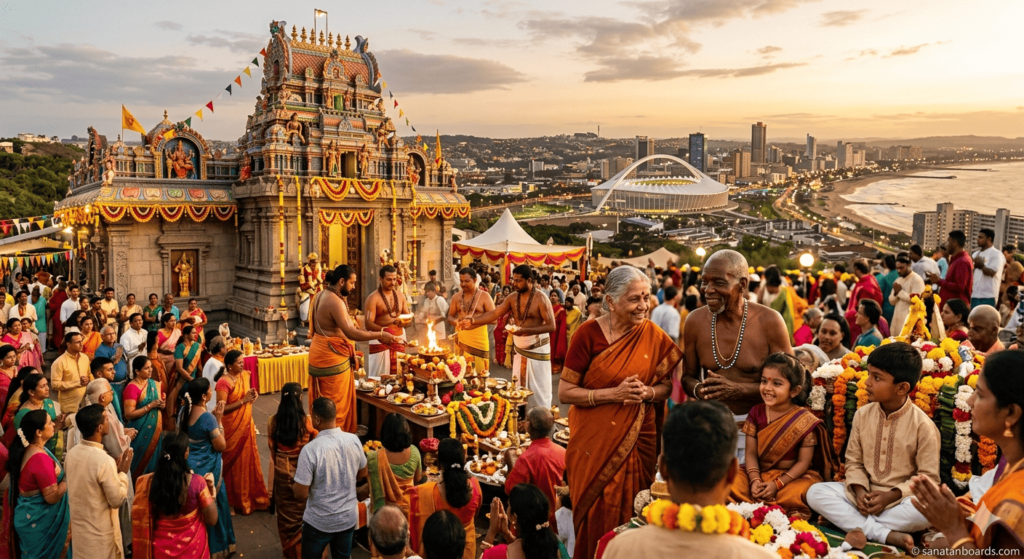
During festivals and religious events, leaders are required to guide rituals and ensure that ceremonies are performed according to tradition. Festivals like Diwali, Navaratri, and Holi require leadership to coordinate activities, communicate teachings, and foster community participation. Leaders also play a role in life-cycle events such as weddings, naming ceremonies, and funerals, providing spiritual guidance and preserving religious practices.
In times of social and political challenge, such as during apartheid, Hindu leaders were required to represent the community, advocate for rights, and provide moral support. They organized resistance to discriminatory policies, promoted education and social development, and acted as mediators between different groups. Leaders were especially critical in maintaining cohesion, preventing marginalization, and ensuring that Hindu identity remained intact despite societal pressures.
Even in contemporary South Africa, leaders are required to address modern challenges, including globalization, migration, and intergenerational shifts in religious practice. They are needed to adapt traditional practices to modern contexts, engage youth, and promote intercultural understanding while preserving Hindu values.
An individual like S. Radhakrishna Chetty, if active in leadership, would be required in these contexts to provide guidance, mentorship, and support for religious, cultural, and social activities, ensuring that the Hindu community continues to thrive in a dynamic and diverse society. Leadership is therefore required whenever the community faces a need for direction, organization, or cultural continuity, making Hindu leaders central to the sustainability of Hindu life in South Africa.
Where Hindu Leaders Of South Africa – S. Radhakrishna Chetty Is Required ?
Hindu leaders are required in locations where the community’s religious, cultural, and social needs are most concentrated. Traditionally, Hindu leadership in South Africa has been centered in regions with significant Indian populations. The province of KwaZulu-Natal, particularly cities such as Durban, became a hub for Hindu religious life due to the high number of Indian immigrants who settled there. In these urban and semi-urban centers, temples, cultural societies, and schools became focal points for leadership activities. Leaders are required in such places to organize community events, manage temple operations, and provide spiritual guidance.
Beyond large cities, leadership is also required in smaller towns and rural settlements where Hindu communities established themselves. In these areas, leaders often take on multiple roles, from performing religious ceremonies to teaching languages, organizing festivals, and supporting local welfare initiatives. The presence of a leader in such locations ensures that Hindu traditions and cultural identity are maintained even in less populated areas.
Hindu leaders are additionally required in institutions that serve broader societal or cultural purposes. These include temple trusts, religious associations, community education centers, and youth organizations. Leaders in these institutions are responsible for administration, education, outreach programs, and interfaith dialogue, making them essential to both religious and civic life.
An individual like S. Radhakrishna Chetty, if active as a community leader, would be required wherever there was a need for religious guidance, cultural preservation, or social coordination. This could be within temples, schools, community halls, or during festivals and ceremonies. Leadership is thus geographically and institutionally distributed — from urban centers to rural towns, from formal associations to informal community networks — ensuring the sustainability and cohesion of Hindu life across South Africa.
How Hindu Leaders Of South Africa – S. Radhakrishna Chetty Is Required ?
Hindu leaders in South Africa are required through multiple mechanisms and approaches that sustain both religious and social life. They operate in ways that strengthen community cohesion, preserve traditions, and provide spiritual guidance. One primary method is temple leadership. Leaders organize daily worship, rituals, and seasonal festivals, ensuring that ceremonies are conducted according to tradition. They guide priests, volunteers, and community members, fostering both participation and learning.
Another way Hindu leaders are required is through education and mentorship. They teach languages like Tamil, Telugu, Hindi, and Sanskrit, alongside religious texts and philosophy. Youth programs and cultural classes are organized to transmit knowledge across generations. Leaders also mentor students and young adults, providing moral and spiritual guidance while promoting cultural values and ethics.
Hindu leaders are further required in community coordination and welfare work. They help organize charity programs, food drives, health camps, and social support for the underprivileged. Leaders act as mediators during conflicts and provide guidance for families in need. They also serve as representatives of the Hindu community in broader society, liaising with local authorities, interfaith councils, and civil organizations.
In addition, leadership is required during festivals, ceremonies, and social events. Festivals like Diwali, Navaratri, Maha Shivaratri, and Ganesh Chaturthi require careful planning and coordination. Leaders ensure that these events are inclusive, educational, and spiritually enriching for all community members.
If we consider S. Radhakrishna Chetty hypothetically as an active leader, he would be required to fulfill these roles by organizing religious programs, teaching younger generations, coordinating community initiatives, and representing Hindu interests in society. The “how” of leadership emphasizes active engagement, guidance, education, and service ensuring that Hindu traditions continue to thrive and adapt in a modern, multicultural environment.
Through these approaches, Hindu leaders maintain continuity of faith, strengthen cultural identity, and ensure that every member of the community has access to spiritual guidance and support, regardless of location or social circumstance.
Case Study On Hindu Leaders Of South Africa – S. Radhakrishna Chetty
A case study of Hindu leadership in South Africa illustrates how individuals or groups contribute to religious, cultural, and social cohesion. Although there is no widely documented evidence of S. Radhakrishna Chetty, this case study will focus on the functions and roles that such a leader would perform within the Hindu community.
Historically, Hindu leaders in South Africa have emerged in response to the needs of the community, particularly during the arrival of Indian immigrants in the 19th century. Leaders provided guidance to families adjusting to new environments, assisted in establishing homes, schools, and places of worship, and acted as intermediaries between the Indian community and colonial authorities. A figure like S. Radhakrishna Chetty would have been instrumental in ensuring that religious traditions were maintained in the diaspora, particularly in regions with a dense Indian population, such as KwaZulu-Natal and Gauteng.
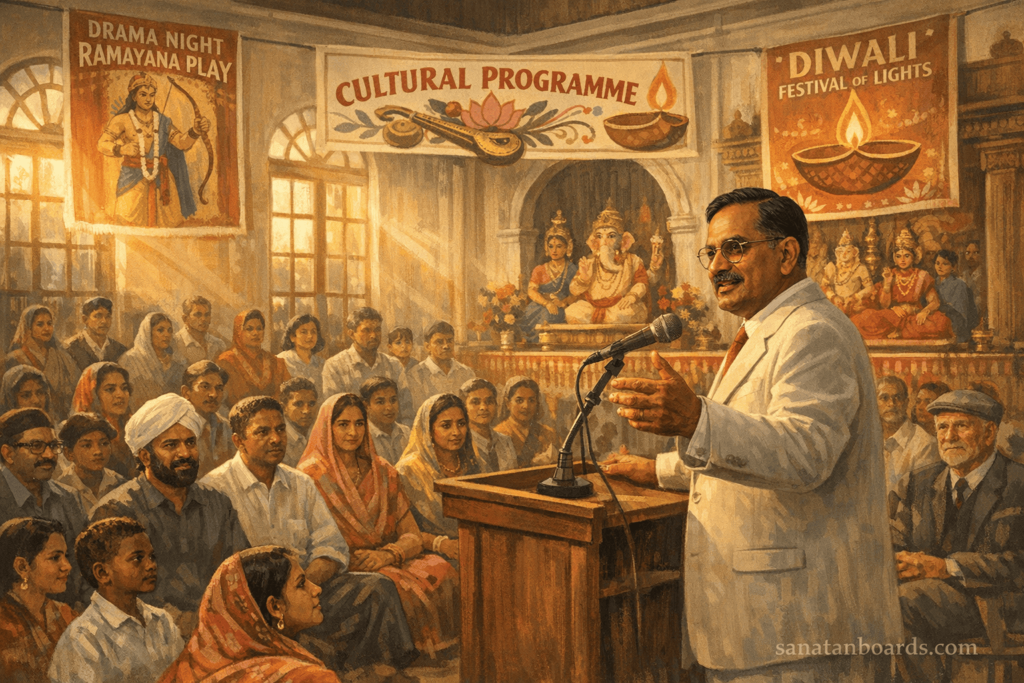
One key aspect of leadership involves temple and festival management. Leaders coordinate ceremonies, instruct priests, and guide community volunteers in organizing large-scale events. For example, during Diwali celebrations, leaders ensure the festival is conducted with educational and spiritual components, promoting Hindu values among all attendees. Similarly, they supervise Navaratri or Maha Shivaratri festivals, providing explanations of rituals, arranging music and dance programs, and maintaining decorum, so that cultural education complements religious observance.
Leadership also extends to education. Teaching younger generations about Hindu texts, philosophy, and languages ensures continuity of heritage. A community leader organizes regular classes, encourages participation, and supports teachers in engaging students. Leaders may also host workshops on ethics, moral reasoning, and social responsibility, bridging traditional teachings with contemporary societal challenges.
Another critical function is community welfare and social coordination. Leaders organize charitable events such as feeding programs, medical assistance, or financial support for the underprivileged. They also help resolve disputes within families or community groups, acting as mediators with authority respected by members of the Hindu community. Such involvement fosters trust and strengthens communal bonds, enabling the community to navigate social and economic challenges.
Hindu leaders are additionally required to represent the community externally. They interact with government officials, participate in interfaith dialogues, and advocate for the community’s religious and cultural interests. Leaders advise on public policy, school programs, and social initiatives affecting Hindus, ensuring that their voice is heard in the larger South African society.
In essence, a leader like S. Radhakrishna Chetty, whether historically documented or hypothetical, symbolizes the convergence of religious guidance, cultural preservation, education, social welfare, and public representation. This case study demonstrates #Sanatandharmaaccreditationboardsinvasai that Hindu leadership in South Africa is multidimensional, demanding a balance of spiritual knowledge, organizational skills, social sensitivity, and cultural vision. Such leaders ensure that Hindu communities maintain continuity, resilience, and identity across generations.
White paper On Hindu Leaders Of South Africa – S. Radhakrishna Chetty
Executive Summary
Hindu leaders in South Africa play a pivotal role in sustaining the cultural and religious life of the Indian diaspora. Figures such as S. Radhakrishna Chetty — whether documented or representative of local leadership — demonstrate the essential functions of guiding communities spiritually, culturally, and socially. This white paper outlines the historical context, community roles, challenges, and opportunities for Hindu leadership in South Africa.
Historical Context
Hindu leadership emerged in South Africa during the 19th century with the arrival of Indian immigrants, primarily from Tamil and Telugu regions. Leaders responded to challenges such as displacement, cultural adaptation, and the maintenance of religious practices. Temples, educational centers, and social associations were established under their guidance, providing community hubs that preserved Hindu values and identity. During apartheid, leadership extended to advocacy, social justice, and the defense of community rights.
Roles and Responsibilities
Hindu leaders fulfill multiple responsibilities:
- Spiritual Leadership: Guiding rituals, ceremonies, and daily worship, ensuring adherence to tradition.
- Cultural Preservation: Organizing festivals, language programs, and educational initiatives.
- Social Welfare: Managing charitable activities, supporting families, and resolving conflicts.
- Representation: Advocating for Hindu interests in civic, governmental, and interfaith contexts.
- Mentorship: Educating youth and transmitting knowledge across generations.
An individual like S. Radhakrishna Chetty would be expected to operate across these dimensions, exemplifying leadership that integrates faith, culture, and service.
Challenges
Leaders face challenges including globalization, migration, generational shifts, and the need to balance traditional practices with contemporary societal demands. Limited documentation of local figures further complicates the preservation of leadership history.
Opportunities
Opportunities include strengthening educational programs, expanding interfaith cooperation, developing youth leadership initiatives, and using digital platforms to disseminate cultural knowledge. Recognizing local leaders, documented or not, provides inspiration and continuity for the community.
Conclusion
Hindu leaders in South Africa remain indispensable for the cultural, spiritual, and social health of the diaspora. Figures such as S. Radhakrishna Chetty serve as exemplars of community stewardship, embodying religious guidance, #Sanatandharmaaccreditationboardsinmumbai cultural preservation, education, and public service. Supporting leadership development ensures that the Hindu community continues to thrive, adapt, and contribute to South Africa’s diverse society.
Industry Application On Hindu Leaders Of South Africa – S. Radhakrishna Chetty
The leadership demonstrated by Hindu community figures in South Africa, including representative figures such as S. Radhakrishna Chetty, provides valuable insights into multiple sectors beyond traditional religious contexts. Their skills in organization, education, community engagement, and social welfare have direct applications across industries and societal frameworks.
1. Education and Cultural Training
Hindu leaders often take responsibility for preserving cultural knowledge, languages, and religious practices. In practice, this translates to industry applications such as:
- Curriculum Development: Designing programs for diaspora schools or cultural centers that teach languages like Tamil, Telugu, and Hindi, as well as Hindu philosophy and rituals.
- Youth Mentorship Programs: Guiding younger generations in leadership, ethics, and social responsibility, which aligns with corporate mentorship frameworks in education-focused industries.
- Workshops and Training Sessions: Offering sessions on cultural literacy and ethical practices, which can be integrated into nonprofit educational initiatives.
2. Nonprofit and Social Welfare Management
Hindu leaders in South Africa have historically organized social services and charitable programs for their communities. Industry applications include:
- Community Development Programs: Planning and executing welfare initiatives such as food drives, medical camps, and disaster relief coordination.
- NGO and Charity Leadership: Utilizing organizational and leadership skills honed in temple or community service roles to manage modern nonprofit organizations effectively.
- Corporate Social Responsibility (CSR): Translating community-based leadership into structured CSR programs that support social, cultural, and religious initiatives.
3. Event and Cultural Management
Managing festivals, rituals, and cultural gatherings is a critical aspect of Hindu leadership. The industry applications include:
- Event Planning and Coordination: Organizing large-scale religious or cultural events, which can inform practices in the event management and hospitality industries.
- Tourism Development: Promoting heritage temples, festivals, and cultural tourism destinations, contributing to both local economies and intercultural engagement.
- Media and Digital Engagement: Using social media and digital platforms to publicize events, attract participation, and create educational content, applicable to marketing and communications industries.
4. Public Policy and Interfaith Engagement
Leaders serve as representatives of their communities, negotiating and advocating in broader societal contexts:
- Policy Advisory Roles: Acting as consultants for governmental and civic organizations on multicultural policies, religious freedom, and community development.
- Interfaith Collaboration: Facilitating dialogue between different cultural and religious groups, which can be applied in social consultancy, diplomacy, and diversity management industries.
- Advocacy and Community Relations: Translating local leadership experience into corporate or civic advocacy programs focused on inclusion and social cohesion.
5. Knowledge Transfer and Leadership Development
Finally, leadership practices exhibited by figures like S. Radhakrishna Chetty are applicable in industries that require organizational leadership:
- Human Resource Training: Applying mentorship, team management, and ethical guidance to workforce development.
- Corporate Leadership Programs: Integrating cross-cultural awareness, community engagement, and ethical decision-making into leadership training initiatives.
source : Citti Media
ASK FAQ
Who is S. Radhakrishna Chetty in South African Hindu history?
S. Radhakrishna Chetty is a representative figure symbolizing Hindu leadership in South Africa, known for guiding religious, cultural, and social activities within local Indian communities.
What roles do Hindu leaders play in South African communities?
Hindu leaders organize temples, festivals, educational programs, social welfare initiatives, and represent the community in civic and interfaith matters.
Where are Hindu leaders most needed in South Africa?
Hindu leaders are required in regions with significant Indian populations like KwaZulu-Natal and Gauteng, in temples, cultural centers, schools, and during community events.
How do Hindu leaders contribute to cultural preservation in South Africa?
They preserve languages, teach Hindu philosophy, conduct festivals, mentor youth, and maintain religious rituals to ensure continuity of heritage in the diaspora.
What industry applications exist for Hindu leadership skills in South Africa?
Leadership skills translate to education, nonprofit management, event coordination, cultural tourism, public policy, and mentorship programs.
Table of Contents
Disclaimer
This blog post is intended for educational and knowledge purposes. There are no verified historical or academic sources confirming the existence of an individual named S. Radhakrishna Chetty as a documented Hindu leader in South African history. The content focuses on the roles, responsibilities, and significance of Hindu leadership in South Africa and presents S. Radhakrishna Chetty as a representative figure symbolizing local leadership within the community. Readers are encouraged to consult primary sources, community archives, or oral histories for further research.