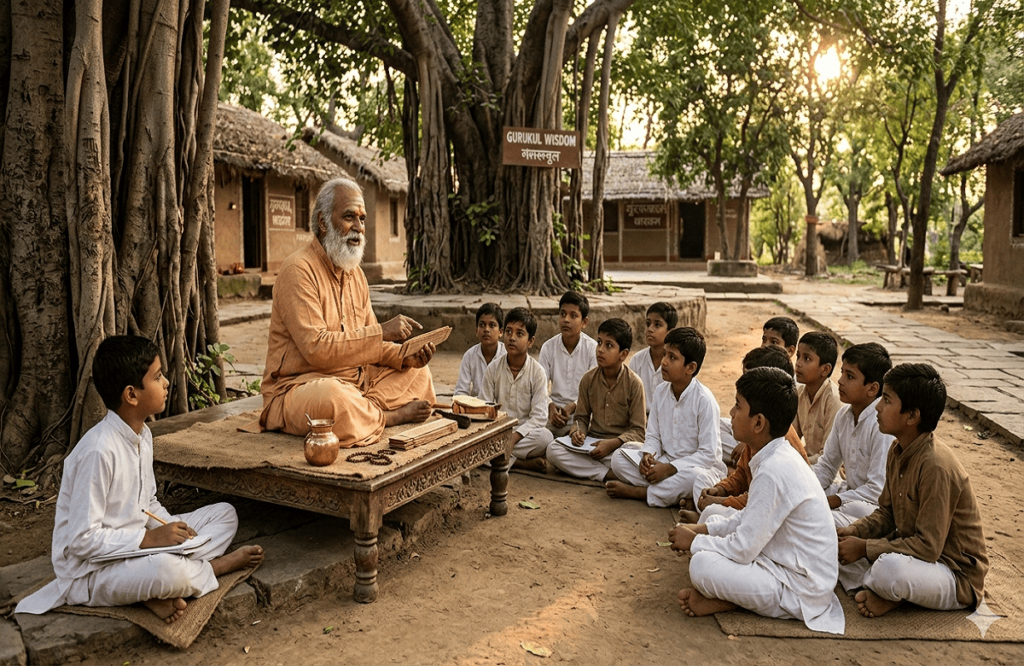
The Gurukul system was an ancient Indian educational tradition where students (ṣhishyas) lived with their teacher (guru) in a residential setting. Learning wasn’t limited to textbooks — it included practical life skills, moral values, spiritual understanding, discipline, and direct mentorship.
- Meaning: Guru means teacher and kul means home — literally “home of the teacher.”
- Holistic Development: The focus was on character, morality, wisdom, and practical skills alongside intellectual knowledge.
- Learning Style: Education was experiential and personalized, with close guidance from the guru rather than classroom lectures.
Many modern schools, camps, educational programs, and digital platforms use phrases like “Gurukul Wisdom,” “Gurukul learning,” or “Gurukul inspired education” to signal that their methods draw inspiration from this ancient system — blending traditional values with contemporary learning
What Is Gurukul Wisdom Network?
Gurukul Wisdom refers to the knowledge, values, and life lessons derived from the traditional Indian Gurukul system of education. It’s less about a modern organization and more about a philosophy of learning.
1. Origin of Gurukul
- Gurukul comes from Sanskrit: “Guru” (teacher) + “Kul” (home/family), literally meaning “the home of the teacher.”
- In ancient India, students (shishyas) lived with a guru and learned in a residential setting.
- Education was holistic, not limited to books — it included life skills, ethics, spirituality, and character development.

2. Core Principles of Gurukul Wisdom
- Mentorship-based learning: Close, personalized guidance from a teacher.
- Holistic development: Focus on intellect, morality, emotional growth, and practical skills.
- Experiential learning: Students learned by doing, observing, and practicing in daily life.
- Values and ethics: Emphasis on discipline, respect, empathy, and societal responsibility.
- Cultural and spiritual grounding: Exposure to philosophy, arts, and ancient Indian knowledge.
3. Modern Application
- Today, “Gurukul Wisdom” is used to describe educational approaches, programs, or communities that seek to revive this holistic, value-driven style of learning.
- It can apply to schools, workshops, online courses, or mentoring networks that integrate ethics, life skills, and experiential learning alongside academics.
Who is Requires Gurukul Wisdom Network?
People who need Gurukul Wisdom / Gurukul-type learning
- Students (Children & Youth)
- To learn values, discipline, and knowledge.
- Gurukul education focuses on mental, physical, and spiritual development, not just textbooks.
- Teachers / Gurus
- Teachers guide students and pass on wisdom and life experience.
- In the Gurukul system, the guru acts as a mentor and role model, helping shape a student’s character.
- Parents
- Parents who want their children to learn good values, discipline, culture, and life skills may choose Gurukul-style education.
- Society / Community
- Gurukul wisdom aims to create responsible, ethical, and knowledgeable citizens who contribute to society.
- Spiritual or Cultural Learners
- People interested in Vedic knowledge, Sanskrit, yoga, philosophy, and Indian culture also seek Gurukul wisdom
When is Requires Gurukul Wisdom Network?
Gurukul Wisdom is required whenever people need value-based learning, guidance, and holistic development. It is especially important in the following situations:
1. During Education
- When students are learning and need not only academic knowledge but also discipline, ethics, and life skills.
2. During Character Building
- When young people are developing their personality, behavior, and moral values.
3. When Guidance Is Needed
- When a person needs a mentor (guru) to guide them in life decisions, knowledge, and personal growth.
4. In Modern Society
- Today many people focus only on marks and careers.
- Gurukul wisdom is needed to balance knowledge with values, culture, and responsibility.
5. Throughout Life
- Gurukul wisdom is not only for children.
- Adults also need it for self-improvement, leadership, and spiritual understanding.
Where is Requires Gurukul Wisdom Network?
Gurukul Wisdom Network (or Gurukul wisdom) is required in places where people learn, grow, and share knowledge and values. Here are the main places:
1. Educational Institutions
- Schools, colleges, and gurukuls where students learn knowledge and character.
- Example: Gurukul Kangri University teaches Vedic studies and modern subjects using Gurukul principles.
2. Communities and Societies
- Communities that want to promote culture, ethics, and responsible citizenship.
- Gurukul learning helps build strong values in society.
3. Ashrams and Spiritual Centers
- Places where people study Vedas, yoga, philosophy, and spirituality under a guru.
4. Rural or Natural Learning Environments
- Traditionally, Gurukuls were located away from cities, often in forests or peaceful rural areas to support focus, discipline, and connection with nature.
5. Modern Learning Networks
- Today Gurukul wisdom can also be shared through online platforms, mentoring networks, and learning communities.
How is Requires Gurukul Wisdom Network?
Gurukul wisdom is required in modern society to develop complete human beings who possess knowledge, values, discipline, and a sense of responsibility. The traditional Gurukul system of education in ancient India was based on the close relationship between the guru (teacher) and the shishya (student). Students lived with their teacher and learned not only academic subjects but also moral values, practical life skills, and spiritual understanding. In today’s fast-changing world, the principles of Gurukul wisdom can play an important role in improving education and society.
First, Gurukul wisdom is required to promote holistic education. Modern education often focuses mainly on marks, exams, and career success. However, students also need to develop emotional intelligence, creativity, discipline, and ethical values. Gurukul wisdom encourages the balanced development of the mind, body, and character. Through guidance from a teacher, students learn how to think wisely, behave responsibly, and live a meaningful life.
Second, Gurukul wisdom is required for character building. One of the most important goals of the Gurukul system was to build strong moral character. Students were taught values such as honesty, respect, humility, compassion, and self-control. These qualities help individuals become good citizens and responsible members of society. In modern times, problems such as stress, lack of discipline, and unethical behavior can often be reduced if education includes these values.
Third, Gurukul wisdom is required to strengthen the teacher–student relationship. In the traditional Gurukul system, the guru was not only a teacher but also a mentor and guide. The teacher understood each student’s strengths and weaknesses and provided personal guidance. This close relationship helped students feel supported and motivated to learn. In modern education, where classrooms are often large and impersonal, applying Gurukul wisdom can help rebuild meaningful mentorship between teachers and students.
Fourth, Gurukul wisdom is required to connect people with culture and traditions. The Gurukul system preserved knowledge about philosophy, language, literature, arts, and spiritual teachings. Learning about cultural heritage helps people understand their identity and respect their traditions while also adapting to modern life. Gurukul wisdom encourages learning that combines ancient knowledge with modern scientific understanding.
Fifth, Gurukul wisdom is required for life skills and practical learning. Students in Gurukuls learned through daily activities such as self-discipline, service, teamwork, and problem solving. This type of learning prepares individuals for real-life challenges. Today, education systems around the world are trying to include practical skills and experiential learning, which reflects the same ideas that were present in the Gurukul system.
Finally, Gurukul wisdom is required to promote peaceful and balanced living. The teachings of Gurukul emphasized harmony with nature, respect for others, and self-awareness. In a world where people face increasing stress and competition, these teachings can help individuals maintain mental balance and inner peace.
In conclusion, Gurukul wisdom is required because it provides a complete approach to education and personal development. By combining knowledge, values, mentorship, culture, and life skills, Gurukul wisdom can help create individuals who are not only intelligent but also ethical, responsible, and compassionate. Integrating these principles into modern education can contribute to a better and more balanced society.
source: Saandeepani Gurukul
Case Study On Gurukul Wisdom Network?
1. Introduction
Gurukul wisdom refers to the traditional Indian system of education where students learn under the guidance of a guru (teacher) in a holistic environment. The focus is not only on academic knowledge but also on character building, discipline, life skills, and spiritual development. This case study explains how Gurukul wisdom works and how it benefits students and society.
2. Background of the Gurukul System
In ancient India, Gurukuls were residential learning centers where students lived with their teacher. Education included subjects such as mathematics, language, philosophy, science, yoga, and ethics. Students also performed daily tasks like cleaning, cooking, and helping the community. These activities helped them develop responsibility, humility, and teamwork.
3. Case Example
A modern example of Gurukul wisdom can be seen in some residential schools that adopt Gurukul principles. For instance, a school inspired by Gurukul traditions focuses on value-based education along with academics.
Situation:
Students in many modern schools often face problems such as stress, lack of discipline, and weak moral values due to excessive focus on exams and competition.
Approach:
The Gurukul-based school introduced the following practices:
- Daily yoga and meditation to improve concentration and mental health.
- Mentorship programs where each teacher guides a small group of students.
- Community service activities to develop empathy and social responsibility.
- Practical learning through projects, nature studies, and cultural activities.
- Teaching moral values and ethics along with academic subjects.
4. Results
After implementing Gurukul wisdom principles, several positive outcomes were observed:
- Students showed better discipline and respect toward teachers and peers.
- Academic performance improved because students became more focused.
- Students developed leadership, teamwork, and problem-solving skills.
- Stress levels reduced due to yoga, meditation, and supportive mentoring.
- Students gained a deeper understanding of culture and values.
5. Key Lessons
This case study highlights several important lessons:
- Education should focus on holistic development, not only academic success.
- A strong teacher–student relationship improves learning and personal growth.
- Values and ethics are essential for building responsible citizens.
- Practical experiences and life skills prepare students for real-world challenges.
6. Conclusion
The Gurukul wisdom approach provides a powerful model for modern education. By combining traditional values with contemporary knowledge, Gurukul-based learning can create well-rounded individuals who are knowledgeable, ethical, and socially responsible. Adopting Gurukul wisdom in today’s education system can help build a balanced and value-driven society.
White Paper On Gurukul Wisdom Network?
1. Executive Summary
Gurukul Wisdom refers to the educational philosophy derived from the ancient Indian Gurukul system, where students learned under the close guidance of a teacher (guru) in a holistic and value-based environment. The Gurukul system emphasized intellectual development, moral values, discipline, practical skills, and spiritual growth. In today’s rapidly changing world, modern education often focuses heavily on academic performance and technical skills while neglecting character development and ethical awareness. This white paper explores the principles of Gurukul wisdom, its relevance in contemporary education, and how its ideas can be integrated into modern learning systems to promote holistic development.
2. Introduction
Education is one of the most powerful tools for shaping individuals and societies. However, many modern education systems prioritize examination results, career preparation, and competition. While these aspects are important, they may overlook the development of values, emotional intelligence, and life skills. Gurukul wisdom offers an alternative approach by focusing on the overall growth of a person. This white paper examines the core ideas of the Gurukul system and how they can contribute to a more balanced and effective educational framework.
3. Background of the Gurukul System
The Gurukul system was widely practiced in ancient India. Students, known as shishyas, lived with their teacher in a residential learning environment. Education included subjects such as language, philosophy, mathematics, science, arts, and spirituality. Learning was not limited to classroom instruction; students participated in daily activities, community service, and practical tasks. This approach helped develop responsibility, independence, discipline, and respect for knowledge.
The teacher–student relationship was central to the Gurukul system. The guru acted not only as an educator but also as a mentor and guide who understood each student’s strengths, weaknesses, and aspirations.
4. Core Principles of Gurukul Wisdom
The Gurukul approach is built on several key principles:
Holistic Development
Education should nurture the intellectual, physical, emotional, and spiritual aspects of a person.
Value-Based Learning
Ethical values such as honesty, respect, compassion, and responsibility are essential components of education.
Mentorship and Personal Guidance
Teachers play a crucial role as mentors who guide students individually and help them reach their full potential.
Experiential Learning
Learning through real-life experiences, practice, and observation enhances understanding and skill development.
Community Living and Service
Students learn cooperation, humility, and social responsibility through shared living and service activities.
5. Relevance in Modern Education
In the 21st century, societies face challenges such as stress among students, ethical dilemmas in professional life, and a lack of social responsibility. Gurukul wisdom can address these issues by introducing a balanced educational approach.
Modern education can benefit from Gurukul principles by incorporating mentorship programs, value-based education, and experiential learning opportunities. Activities such as community service, mindfulness practices, and collaborative learning can help students develop both knowledge and character.
6. Implementation Strategies
To integrate Gurukul wisdom into modern systems, educational institutions can adopt the following strategies:
- Introduce mentorship programs where teachers guide small groups of students.
- Include value education and ethics as part of the curriculum.
- Promote experiential learning through projects, internships, and community engagement.
- Encourage mindfulness practices, such as meditation or reflection sessions.
- Develop teacher training programs that emphasize mentorship and holistic development.
7. Benefits and Impact
Adopting Gurukul wisdom in education can lead to several positive outcomes:
- Development of responsible and ethical citizens
- Improved teacher–student relationships
- Greater emotional intelligence and resilience among students
- Enhanced creativity and critical thinking
- Stronger connection between education and real-life skills
8. Challenges
While Gurukul principles offer many benefits, implementing them in modern education may present challenges, including:
- Large class sizes that limit personalized mentorship
- Curriculum structures focused heavily on standardized testing
- Limited resources and teacher training for holistic education approaches
Addressing these challenges requires policy support, institutional commitment, and innovation in educational practices.
9. Conclusion
Gurukul wisdom provides a timeless model for education that emphasizes holistic development, ethical values, and mentorship. Integrating these principles into modern education systems can help create well-rounded individuals who are knowledgeable, responsible, and compassionate. By combining traditional wisdom with modern innovation, societies can develop an education system that prepares individuals not only for careers but also for meaningful and balanced lives.
Industry Application Of Gurukul Wisdom Network?
1. Introduction
Gurukul Wisdom comes from the traditional Indian Gurukul education system, where learning focused on knowledge, discipline, values, mentorship, and holistic development. In today’s industries, companies are realizing that technical skills alone are not enough. Employees also need leadership, ethics, teamwork, and emotional intelligence. Gurukul wisdom can help industries build strong, responsible, and innovative organizations.
2. Leadership Development
In the Gurukul system, the guru–shishya (mentor–student) relationship played a key role in learning. Industries can apply this principle through mentorship programs where experienced leaders guide young employees.
Example applications:
- Senior managers mentoring junior employees
- Leadership coaching programs
- Knowledge transfer from experienced professionals to new employees
This helps develop future leaders with wisdom, responsibility, and ethical thinking.
3. Corporate Training and Learning
Gurukul wisdom promotes experiential learning, where students learn through practice and real-life experience. Industries can apply this by creating training programs that focus on:
- Hands-on learning
- Problem-solving projects
- Team-based activities
- Continuous learning culture
This approach improves employee skills, creativity, and adaptability.
4. Ethical Business Practices
One of the most important aspects of Gurukul wisdom is value-based education. Students were taught honesty, integrity, and responsibility. Industries can apply these values to promote ethical corporate culture.
Benefits include:
- Increased trust with customers and partners
- Strong corporate reputation
- Reduced corruption or unethical behavior
Ethical leadership is essential for sustainable business growth.
5. Employee Well-being and Balance
The Gurukul system emphasized balance between mind, body, and spirit. Modern industries face challenges such as stress, burnout, and mental health issues.
Companies can apply Gurukul wisdom by promoting:
- Wellness programs
- Yoga and mindfulness sessions
- Work-life balance policies
- Supportive work environments
These practices improve employee happiness and productivity.
6. Teamwork and Community Culture
In Gurukuls, students lived together and learned cooperation, respect, and service. Industries can adopt similar values to build strong team cultures.
Examples include:
- Collaborative work environments
- Community service initiatives by companies
- Team-building activities
This strengthens employee relationships and organizational unity.
7. Innovation and Knowledge Sharing
Gurukul learning encouraged discussion, questioning, and exploration of ideas. Industries can use these ideas to encourage innovation.
Companies can create:
- Knowledge-sharing platforms
- Innovation labs
- Open discussions and brainstorming sessions
This encourages employees to think creatively and solve problems effectively.
8. Conclusion
Gurukul wisdom offers valuable lessons for modern industries. By applying principles such as mentorship, ethical values, experiential learning, teamwork, and holistic well-being, organizations can build a strong and sustainable work culture. Integrating Gurukul wisdom into industry practices can help companies develop skilled professionals who are not only productive but also responsible and ethical contributors to society.