Greater Nepal & Gurkha Kingdom – King Prithvi Narayan Shah
Prithvi Narayan Shah was a pivotal 18th‑century monarch in South Asian history. Born in 1723 in the hill kingdom of Gorkha, he ascended the throne in 1743 and soon began what is widely seen as the unification of the numerous fragmented states in the region into a single political entity. Prior to his rise, the political landscape consisted of many small principalities — including the Baisi and Chaubise confederations of hill states and three major city‑states in the Kathmandu Valley.
King Prithvi Narayan Shah’s vision was to transform these scattered kingdoms into a strong, unified state capable of resisting external threats, especially as colonial expansion by European powers was gaining momentum to the south. Recognizing the threat posed by division, he employed both diplomatic and military strategies to bring these principalities under one central authority. His army captured strategic locations such as Nuwakot before ultimately taking control of the Kathmandu Valley — a cultural and economic heartland — in 1769.
The expanded state that emerged under his leadership came to be known as the Gorkha Kingdom, later called Nepal. Prithvi Narayan Shah moved the capital from Gorkha to Kathmandu, establishing a centralized government and a national identity where previously there had been many. Through his campaigns, lands extending broadly from western to eastern Himalayan regions came under his influence, creating historical precedents for what modern narratives sometimes refer to as Greater Nepal — a concept imagining Nepal’s territorial expanse beyond its current borders.
Prithvi Narayan Shah died in 1775, leaving a legacy as the founder of the unified Nepal state and a monarch whose actions shaped centuries of political history for the people of the Himalayas.
What Is Greater Nepal & Gurkha Kingdom – King Prithvi Narayan Shah ?
Greater Nepal refers to a historical idea based on the territorial extent reached by the Gorkha Kingdom during and shortly after the reign of King Prithvi Narayan Shah. This concept imagines Nepal’s boundaries stretching much farther than today — from the Sutlej River in the west to the Teesta River in the east — as a result of military expansion in the late 18th century.
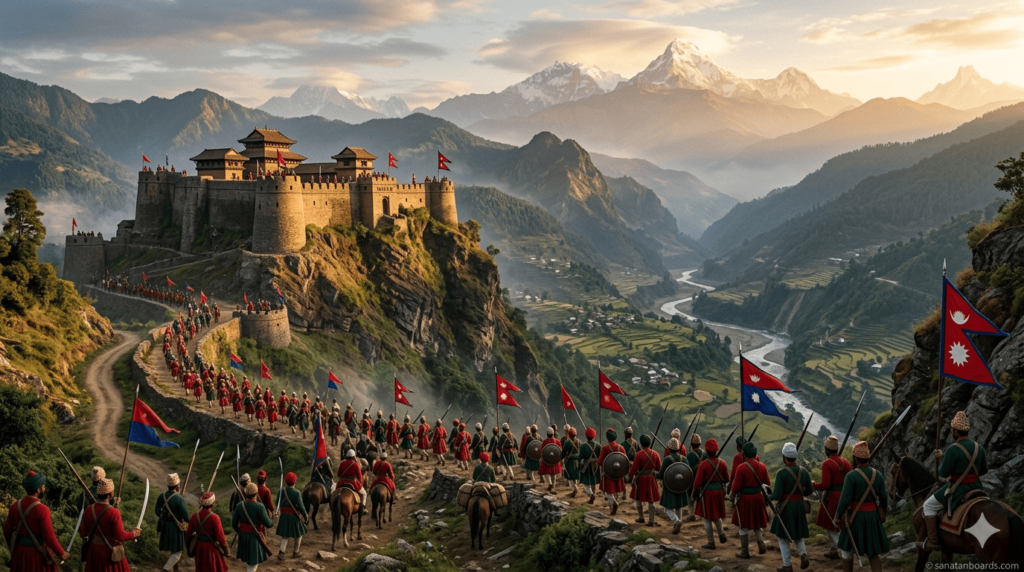
The Gurkha Kingdom, initially a small principality in the hills of present‑day Nepal, was the power base of Prithvi Narayan Shah. Starting in 1743, he embarked on a long military and diplomatic campaign to unite the many small independent states scattered across the Himalayan region. These included the scattered hill states as well as the three Malla kingdoms of the Kathmandu Valley.
Under Shah’s leadership, the kingdom’s army captured important strategic territories, consolidating political control while also forging a shared identity among the diverse populations within those regions. The capital was shifted from Gorkha to the Kathmandu Valley after the successful conquest of the valley in 1769, cementing the foundation of a centralized state.
Historically, Nepal’s territorial reach fluctuated. Under Prithvi Narayan Shah and his successors, campaigns extended influence into neighboring regions like Kumaon, Garhwal, and parts of Sikkim. However, many of these territories were later lost following the Anglo‑Nepalese War and the Treaty of Sugauli in 1815, which fixed Nepal’s boundaries closer to what they are today.
In modern times, Greater Nepal is sometimes referenced in political and cultural discussions about national identity and historical legacy. However, historically this expansive reach was the product of military conquest and strategic necessity, not a formalized nation‑state pursuit based on contemporary ideas of nationalism or international law.
Who Greater Nepal & Gurkha Kingdom – King Prithvi Narayan Shah Is Required ?
The story of Greater Nepal & Gurkha Kingdom – King Prithvi Narayan Shah is central to understanding how a fragmented array of small Himalayan principalities became the unified political entity we now know as Nepal. This narrative is especially relevant for historians, students of South Asian history, political scientists, and anyone interested in state formation and military leadership.
For historians, the campaigns of Prithvi Narayan Shah represent a significant transformation in regional politics during the 18th century. They show how shifting power dynamics, strategic geography, and military innovation converge in complex terrain to shape durable political structures. The transition from many small kingdoms to a centralized state under one ruler offers rich material for research and analysis.
For students, this subject illustrates broader themes in world history: the rise of unified states from fragmented polities; resistance to colonial influence; and the role of leadership and strategy in shaping national destiny. Prithvi Narayan Shah’s campaigns remind learners of the interplay between local politics and larger regional forces at a time when South Asia was undergoing rapid change.
Political scientists and sociologists find value in examining how the concept of Greater Nepal influences contemporary discourse on identity, territorialism, and nationalism. Although the territorial ambitions of the past were grounded in the politics of conquest and defense, modern reinterpretations sometimes reflect cultural pride or political debate.
Finally, this topic is key for general readers and cultural enthusiasts seeking to understand how historical decisions and leadership shaped present‑day nation‑states. The unification of Nepal and the legacy of the Gorkha Kingdom under Prithvi Narayan Shah offer insights into how diverse communities came to see themselves as part of a larger whole.
When Greater Nepal & Gurkha Kingdom – King Prithvi Narayan Shah Is Required ?
The period in which Greater Nepal & Gurkha Kingdom – King Prithvi Narayan Shah became relevant spans primarily the mid-18th century, around the 1740s to 1775. Prithvi Narayan Shah ascended the throne of Gorkha in 1743 and immediately recognized the need for political unification due to the fragmentation of the Himalayan region into small, competing principalities. Before his reign, the Kathmandu Valley alone was divided into three Malla kingdoms — Kathmandu, Patan, and Bhaktapur — each with distinct administrations, cultures, and rivalries.
The historical context is critical. During this era, colonial powers, particularly the British East India Company, were expanding influence in South Asia. This external threat made political consolidation urgent, as a unified kingdom would be better equipped to resist foreign encroachment. Prithvi Narayan Shah’s campaigns between 1743 and 1769 focused on capturing key territories such as Nuwakot, Makwanpur, and eventually the Kathmandu Valley, which culminated in the formal unification of Nepal.
After the conquest of the valley in 1769, the concept of Greater Nepal began taking shape in terms of political imagination. The king continued military campaigns to consolidate influence in surrounding regions, extending as far west as Kumaon and as far east as Sikkim. The relevance of this era lies in its demonstration of the transformation from multiple fragmented polities into a centralized kingdom with a shared administrative and military structure.
The period following Prithvi Narayan Shah’s death in 1775 also highlights the ongoing importance of his unification efforts. Successive rulers maintained and expanded the administrative framework he had created, though territorial adjustments and later treaties, such as the Treaty of Sugauli (1815), redefined boundaries. Nevertheless, the foundational period of his reign is when the ideas of a cohesive Gorkha Kingdom and the aspirational Greater Nepal became most relevant.
Where Greater Nepal & Gurkha Kingdom – King Prithvi Narayan Shah Is Required ?
Geographically, Greater Nepal & Gurkha Kingdom – King Prithvi Narayan Shah centers on the Himalayan region of South Asia. The kingdom’s core was Gorkha, a hilly region located in central Nepal. From this strategic vantage point, Prithvi Narayan Shah planned and executed campaigns to unify neighboring states. The Kathmandu Valley — with its fertile plains, trade routes, and cultural centers — became the political and administrative heart after its conquest in 1769.
Beyond Gorkha and Kathmandu, the expansion extended to multiple regions. Westward campaigns reached areas such as Lamjung, Kaski, and eventually Kumaon, which is in present-day India. Eastward, the kingdom asserted influence over regions like Makwanpur, Ilam, and parts of Sikkim. These campaigns demonstrate how the Gorkha Kingdom’s physical territory spanned rugged mountains, valleys, and strategic trade corridors, making geographical knowledge and terrain mastery critical to military and administrative success.
The locations under Prithvi Narayan Shah’s influence were not only politically significant but also culturally and economically diverse. The Kathmandu Valley contained major urban centers with thriving markets and artisan communities, while the hill states provided strategic defense and access to trade routes linking Tibet and India. Control of these regions allowed the king to consolidate resources, maintain supply lines for his armies, and stabilize governance over a vast and challenging landscape.
Even in modern discourse, the geographic concept of Greater Nepal is tied to the idea of extending influence from the Sutlej River in the west to the Teesta River in the east. While not realized in political terms today, these historic claims underscore the strategic importance of geography in shaping Nepal’s national identity and the legacy of Prithvi Narayan Shah
How Greater Nepal & Gurkha Kingdom – King Prithvi Narayan Shah Is Required ?
The unification and expansion of the Gorkha Kingdom under King Prithvi Narayan Shah was accomplished through a combination of military strategy, diplomacy, and administrative foresight. The “how” involves multiple interrelated mechanisms.
Military Strategy: Prithvi Narayan Shah’s campaigns relied on precise planning, surprise attacks, and gradual encirclement of smaller principalities. The capture of Nuwakot, which controlled access to the Kathmandu Valley, exemplifies his use of strategic locations to gain leverage over stronger neighboring states. He also maintained a disciplined and loyal army, which was crucial in traversing difficult Himalayan terrain.
Diplomacy and Alliances: Not all expansion was achieved by force. Shah negotiated with local rulers, leveraged alliances, and occasionally incorporated defeated leaders into his administration. By balancing coercion with cooperation, he minimized prolonged conflicts and built the foundation for stable governance.
Administrative Reforms: Following conquest, Prithvi Narayan Shah centralized administration, establishing Kathmandu as the capital. He implemented systems to manage taxation, trade, and military logistics, ensuring the kingdom could sustain itself over time. Standardized administrative practices were crucial for integrating culturally diverse regions under a single authority.
Vision and Leadership: Perhaps most importantly, the unification relied on the king’s long-term vision. Shah understood the strategic necessity of a strong, unified state in the face of regional and foreign threats. His leadership inspired loyalty and persistence among his subjects and military commanders.
Integration of Local Cultures: Shah also emphasized preserving local customs and religions while forging a collective national identity. This balance of local autonomy and centralized authority helped maintain social cohesion and prevented rebellion during the early years of unification.
Through these combined methods — strategic, diplomatic, administrative, and cultural — Prithvi Narayan Shah successfully established the Gorkha Kingdom and laid the foundation for the concept of Greater Nepal, demonstrating how leadership and planning can transform a fragmented region into a cohesive state.
Case Study On Greater Nepal & Gurkha Kingdom – King Prithvi Narayan Shah
Background
The unification of Nepal under King Prithvi Narayan Shah represents one of the most remarkable transformations in South Asian history. Before his reign, the region consisted of over 50 small principalities, including the Baisi (22 states) and Chaubise (24 states) confederations, as well as the Malla kingdoms of the Kathmandu Valley. These small states were politically fragmented, culturally diverse, and often in conflict with one another. This fragmentation left the region vulnerable to external threats, particularly as European colonial powers expanded southward in India.
Objective
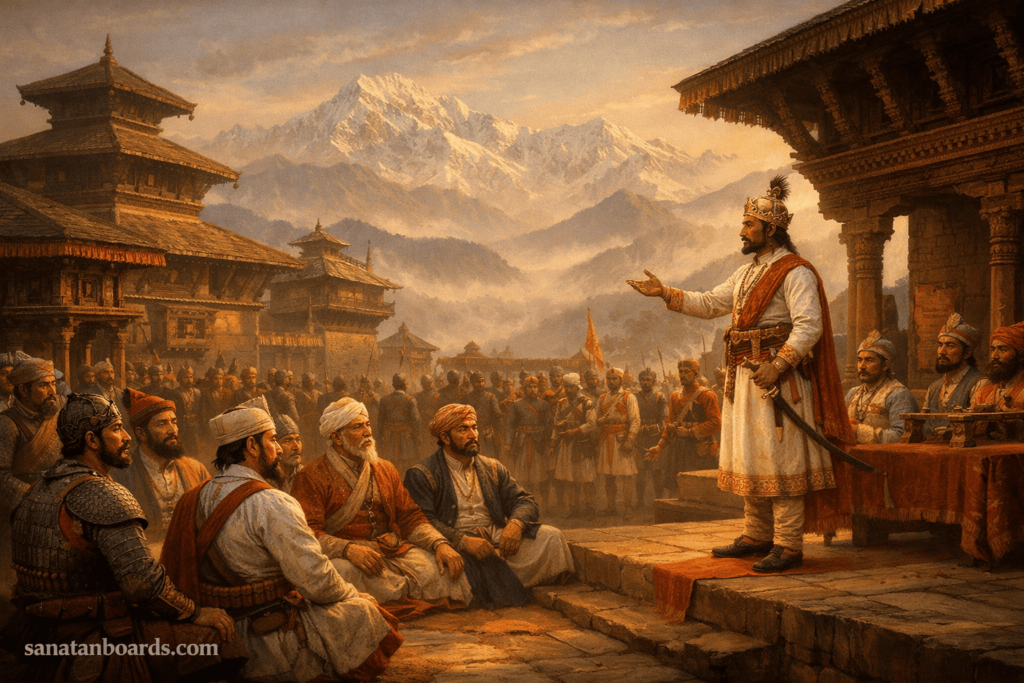
The primary objective of Prithvi Narayan Shah was to unify these scattered hill states into a strong, centralized kingdom capable of resisting foreign influence. His vision extended beyond mere military conquest; it included establishing a sustainable administrative framework, consolidating resources, and fostering a collective identity among diverse ethnic and cultural groups.
Strategy
- Military Campaigns: Prithvi Narayan Shah strategically captured key locations. His initial campaign focused on Nuwakot, which controlled trade access to the Kathmandu Valley. He used surprise attacks, fortified positions, and detailed knowledge of local terrain to overpower stronger kingdoms with minimal forces.
- Diplomatic Alliances: He forged alliances with local leaders who recognized the benefit of a unified state. By incorporating former rivals into his administration, he mitigated rebellion and gained local support.
- Administrative Reforms: After conquering the Kathmandu Valley in 1769, Shah shifted the capital to Kathmandu. He standardized taxation, trade management, and military logistics, enabling long-term governance. This administrative foresight helped integrate culturally diverse populations into a coherent state structure.
- Cultural Integration: Shah maintained local customs and religions, ensuring acceptance of central authority while fostering a shared national identity. This approach minimized resistance and promoted social cohesion.
Results
- Political Unification: The campaigns resulted in the consolidation of over 50 principalities under one rule, forming the early modern state of Nepal.
- Territorial Expansion: The Gorkha Kingdom extended influence from western regions like Kumaon to eastern areas such as Sikkim, establishing the historical basis for the concept of Greater Nepal.
- Military Legacy: The disciplined Gorkha army became a model of Himalayan warfare, earning recognition in later conflicts, including the Anglo-Nepalese War (1814–1816).
- National Identity: Shah’s policies fostered a sense of collective identity among diverse ethnic groups, laying the foundation for the modern nation-state.
Lessons Learned
- Leadership and vision can unify fragmented regions.
- Strategic geographic planning is essential for military success.
- Integrating local culture and governance promotes long-term stability.
- Diplomacy combined with force can achieve sustainable political outcomes.
This case study demonstrates that King Prithvi Narayan Shah’s methods in unifying Nepal were multifaceted, blending military strategy, diplomacy, #Sanatandharmaaccreditationboardsinvasai administration, and cultural integration — a model still studied in political science, military strategy, and South Asian history courses.
White paper On Greater Nepal & Gurkha Kingdom – King Prithvi Narayan Shah
Executive Summary
This paper explores the historical and strategic significance of King Prithvi Narayan Shah’s unification of Nepal and the concept of Greater Nepal. It highlights military, administrative, and diplomatic approaches used to consolidate fragmented Himalayan principalities into a centralized kingdom.
Introduction
In the 18th century, Nepal was a mosaic of independent hill states and city-kingdoms. Prithvi Narayan Shah, ruler of the small Gorkha principality, envisioned a unified Nepal capable of resisting external threats and ensuring long-term stability. His unification campaigns culminated in the conquest of the Kathmandu Valley in 1769, forming the nucleus of the modern Nepalese state. (britannica.com)
Strategic Objectives
- Political Consolidation: Bring all hill states and Malla kingdoms under central governance.
- Economic Stability: Secure trade routes linking India and Tibet.
- Military Strength: Establish a disciplined army capable of defending the kingdom.
- Cultural Cohesion: Integrate diverse ethnic and religious groups under a shared identity.
Methodology
- Military Campaigns: Sequential capture of strategic territories, utilizing geographic advantages.
- Diplomacy: Forming alliances and co-opting former rivals into governance.
- Administration: Implementing taxation, trade, and governance structures.
- Cultural Policy: Respecting local customs while fostering national unity.
Outcomes
- Formation of a centralized Nepalese state with Kathmandu as its capital.
- Expanded territorial influence, forming the foundation for Greater Nepal.
- Established the Gorkha army as a respected military force.
- Created enduring administrative and governance frameworks.
Strategic Implications
- Demonstrates how geography and leadership influence state formation.
- Offers lessons in integrating diverse populations into a single political entity.
- Highlights the balance of force and diplomacy in sustainable governance.
Conclusion
King Prithvi Narayan Shah’s unification of Nepal exemplifies effective statecraft combining military strategy, diplomacy, administration, and cultural integration. #Sanatandharmaaccreditationboardsinmumbai The concept of Greater Nepal reflects the historical ambition and territorial consolidation achieved during his reign, influencing contemporary discussions on Nepalese identity and history.
Industry Application On Greater Nepal & Gurkha Kingdom – King Prithvi Narayan Shah
The legacy of Greater Nepal & the Gurkha Kingdom under King Prithvi Narayan Shah has practical applications across multiple modern industries. By analyzing his unification strategies, military campaigns, and cultural policies, industries can draw inspiration for strategy, leadership, heritage preservation, and education.
1. Education and Academic Research
- History & Political Science: University courses on South Asian history, nation-building, and governance strategies can use Prithvi Narayan Shah’s campaigns as case studies.
- Leadership & Strategy Studies: Management and military academies can analyze his leadership style, diplomacy, and tactical decision-making.
- Cultural Studies: Research on ethnic integration, cultural identity formation, and preservation of indigenous practices draws directly from the Gorkha Kingdom era.
2. Tourism and Heritage Development
- Cultural Tourism: Historic sites such as Gorkha Durbar, Nuwakot Fort, and the Kathmandu Valley can be promoted as key attractions.
- Adventure & Trekking Tourism: Routes taken by the Gorkha army provide historically significant trekking paths that attract both local and international tourists.
- Heritage Preservation: Restoration and storytelling initiatives highlight Nepal’s unification history, creating immersive tourist experiences.
3. Defense and Military Applications
- Mountain Warfare Training: Modern military programs can study the Gorkha army’s tactics in difficult Himalayan terrain.
- Leadership Training: Prithvi Narayan Shah’s methods in motivating troops and strategic resource allocation can inform contemporary defense leadership courses.
- Logistics and Strategy: Case studies on supply chain management and terrain navigation during unification campaigns provide insights for defense planning.
4. Media, Entertainment, and Cultural Industries
- Documentaries & Films: Stories of unification, conquest, and leadership provide rich narratives for media production.
- Publishing: Books and educational materials can explore historical campaigns, governance, and the concept of Greater Nepal.
- Digital Experiences: VR and AR applications can simulate historical battles, cultural sites, and governance scenarios for educational and entertainment purposes.
5. Policy, Governance, and Strategic Planning
- Nation-Building Studies: Policymakers can learn lessons from unifying fragmented regions under effective governance.
- Cultural Integration Models: Shah’s emphasis on respecting local traditions while consolidating central authority can inform modern strategies for multiethnic governance.
- Geopolitical Insights: Historical understanding of regional expansion, treaties, and diplomacy can guide contemporary strategic thinking in South Asia.
6. Corporate and Leadership Training
- Strategic Decision-Making: Lessons from military campaigns and administrative reforms can inspire business strategy simulations.
- Team Management: The integration of diverse groups under a single vision provides practical lessons for corporate leadership and organizational cohesion.
source : IN-Depth Story
ASK FAQ
Who was King Prithvi Narayan Shah?
King Prithvi Narayan Shah (1723–1775) was the founder of the unified Nepal, originally the ruler of Gorkha. He led military campaigns to consolidate small hill states and the Kathmandu Valley into a strong central kingdom.
What is the concept of Greater Nepal?
Greater Nepal refers to the historical idea of Nepal’s territorial expansion under the Gorkha Kingdom, extending from the Sutlej River in the west to the Teesta River in the east during and after Prithvi Narayan Shah’s reign.
How did Prithvi Narayan Shah unify Nepal?
He used a combination of military strategy, diplomacy, and administrative reforms. Key victories included Nuwakot and the Kathmandu Valley, supported by centralizing governance and respecting local culture.
Why is the Gorkha Kingdom important in Nepalese history?
The Gorkha Kingdom was the foundation of modern Nepal. Under King Prithvi Narayan Shah, it transformed fragmented principalities into a unified state, shaping political, cultural, and military history.
What is the legacy of King Prithvi Narayan Shah?
His legacy includes the unification of Nepal, the creation of a disciplined Gorkha army, the foundation of centralized administration, and the historical vision of Greater Nepal, influencing modern Nepalese identity and nationalism.
Table of Contents
Disclaimer
The information provided in this document is intended for informational and knowledge-building purposes only. Historical interpretations, territorial concepts like Greater Nepal, and accounts of King Prithvi Narayan Shah’s campaigns are based on documented sources and scholarly references. This material does not endorse political claims, territorial disputes, or contemporary policy positions. Readers should consult primary historical texts and academic research for detailed analysis and verification.