The Gajapati Kingdom (Odisha) – Kapilendra Deva was a prominent medieval kingdom in eastern India, primarily covering present-day Odisha and parts of Andhra Pradesh and West Bengal. Kapilendra Deva, who reigned from 1434 to 1467 CE, was one of the most powerful rulers of the Gajapati dynasty. Under his leadership, the kingdom reached its peak in terms of territorial expansion, military strength, and cultural development.
Kapilendra Deva is known for his administrative efficiency, military campaigns, and patronage of arts, architecture, and religion. He extended the kingdom’s boundaries up to the river Ganga in the north and parts of the southern Deccan. The Gajapati rulers, under Kapilendra Deva, followed the Hindu dharmic traditions while supporting temples and educational institutions.
The kingdom played a significant role in regional politics, trade, and culture during the 15th century. Its capital, sometimes at Cuttack or nearby regions, became a center for art, literature, and temple architecture. The reign of Kapilendra Deva is often considered a golden era in Odisha’s history, reflecting the power, prosperity, and influence of the Gajapati Kingdom (Odisha) – Kapilendra Deva. This topic is essential for students and history enthusiasts to understand medieval Indian kingdoms and their socio-political impact.
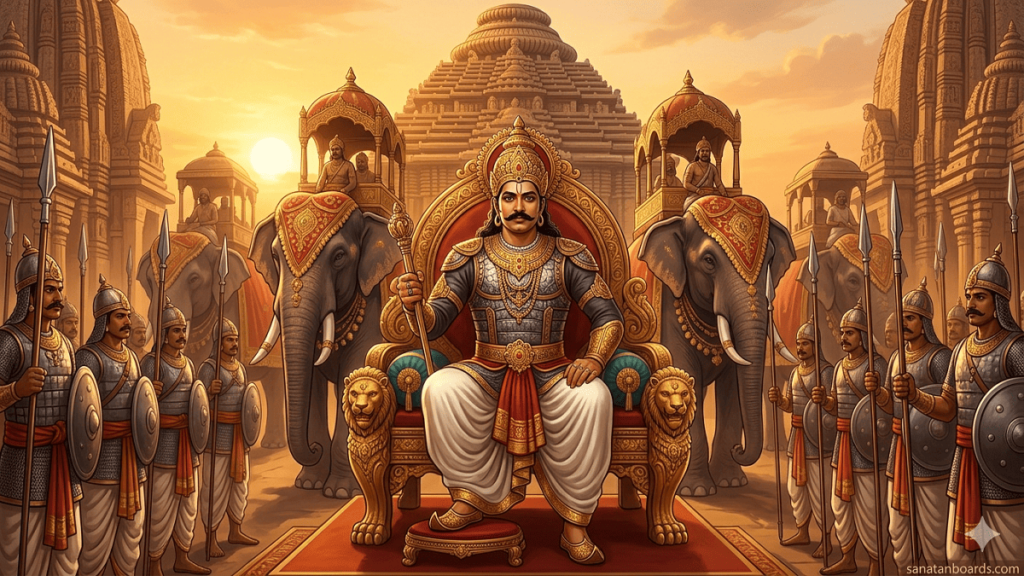
What Is Gajapati Kingdom (Odisha) – Kapilendra Deva?
The Gajapati Kingdom (Odisha) – Kapilendra Deva was a medieval Indian empire that emerged in the 15th century in eastern India. Kapilendra Deva, who ascended the throne in 1434 CE, was the most illustrious ruler of the Gajapati dynasty. His reign marked the zenith of the kingdom’s power, culture, and political influence.
The term “Gajapati” literally means “Lord of Elephants,” signifying military strength and royal authority. Under Kapilendra Deva, the kingdom expanded aggressively through military campaigns, bringing regions of present-day Andhra Pradesh, West Bengal, Jharkhand, and even parts of southern India under his control. These conquests not only enhanced the kingdom’s territory but also its influence in trade and diplomacy.
Kapilendra Deva was a visionary ruler who invested in the development of art, architecture, and religion. The kingdom became a hub of temple architecture, with grand structures dedicated to Lord Jagannath and other Hindu deities. Literature and education flourished under his patronage, making the Gajapati Kingdom (Odisha) – Kapilendra Deva a center of learning and culture.
Administratively, Kapilendra Deva reorganized the kingdom into efficient governance units, ensuring better revenue collection and law enforcement. His military prowess, strategic alliances, and diplomatic skills made the kingdom a formidable power in eastern India.
Who Is Required Gajapati Kingdom (Odisha) – Kapilendra Deva ?
The Gajapati Kingdom (Odisha) – Kapilendra Deva is required knowledge for a wide range of learners, historians, students, and enthusiasts of Indian medieval history. Understanding this kingdom provides insights into the political, cultural, and economic landscape of 15th-century eastern India. Scholars who study dynastic histories or regional powers in India find Kapilendra Deva’s reign crucial, as it exemplifies the consolidation of power in a significant regional kingdom.
Students of history, particularly at the school and university level, require knowledge of the Gajapati Kingdom (Odisha) – Kapilendra Deva to understand the structure of medieval Indian governance. Kapilendra Deva’s administration, military campaigns, and territorial expansions illustrate the strategies rulers used to maintain and grow their domains. His reign also provides examples of how kingdoms balanced political authority with cultural and religious patronage.
Additionally, cultural historians and archaeologists require knowledge of this kingdom to study temple architecture, inscriptions, and artifacts from the period. The Gajapati rulers, especially Kapilendra Deva, supported the construction of temples, educational institutions, and public infrastructure, leaving behind valuable evidence of their governance, artistry, and devotion. These resources are critical for understanding the social, religious, and economic aspects of medieval Odisha.
Furthermore, the Gajapati Kingdom (Odisha) – Kapilendra Deva is relevant for those studying Indian military history. Kapilendra Deva led extensive campaigns that extended the kingdom’s influence across eastern and southern India. His strategies, use of elephants and cavalry, and diplomatic alliances highlight the military sophistication of regional powers during this era.
When Gajapati Kingdom (Odisha) – Kapilendra Deva Is Required ?
Knowledge of the Gajapati Kingdom (Odisha) – Kapilendra Deva is particularly required when studying the medieval period of Indian history, especially the 15th century. This period was marked by the rise of regional powers, shifting political alliances, and flourishing cultural and economic activity. For students and scholars examining how kingdoms expanded their territories, administered diverse populations, and promoted arts and religion, Kapilendra Deva’s reign is a critical case study.
Academically, this knowledge is required when preparing for history examinations, writing research papers, or analyzing historical trends in governance and diplomacy. For instance, understanding the exact period of Kapilendra Deva’s rule (1434–1467 CE) helps contextualize the kingdom’s relations with neighboring regions, including the Vijayanagara Empire, Bengal Sultanate, and southern Deccan territories. Knowing this timeframe is essential to trace trade routes, military campaigns, and cultural exchanges of the era.
Culturally, learning about the Gajapati Kingdom (Odisha) – Kapilendra Deva is required when exploring the evolution of temple architecture, literature, and arts in eastern India. The temples constructed during his reign, many dedicated to Lord Jagannath, serve as living evidence of the kingdom’s cultural priorities. Art historians, architects, and archaeologists require this knowledge to date structures, interpret inscriptions, and understand the religious and social context of Odisha during the 15th century.
From a practical standpoint, knowledge of this kingdom is required for heritage conservation, museum studies, and tourism initiatives. Understanding the historical importance of Kapilendra Deva’s reign allows policymakers and educators to design informed strategies to preserve monuments, promote cultural tourism, and educate the public about Odisha’s medieval heritage.
Where Is Gajapati Kingdom (Odisha) – Kapilendra Deva Required ?
The Gajapati Kingdom (Odisha) – Kapilendra Deva is required in a variety of educational, cultural, and research contexts. Geographically, this knowledge is particularly relevant in eastern India, where Odisha stands as a region rich in medieval history, architecture, and cultural heritage. Students studying the history of Odisha, Bengal, Andhra Pradesh, and neighboring states find Kapilendra Deva’s reign essential to understanding regional politics and socio-cultural developments.
In academic institutions, the Gajapati Kingdom (Odisha) – Kapilendra Deva is required in classrooms, history departments, and research centers. Universities offering courses in medieval Indian history, art history, archaeology, or political science often include modules on regional kingdoms, including the Gajapatis. Here, knowledge of Kapilendra Deva’s governance, military conquests, and patronage of religion and arts provides students with practical examples of statecraft and cultural development.
Museums, heritage sites, and cultural organizations also require this knowledge. Temples, fort ruins, and artifacts linked to the Gajapati era provide tangible learning experiences for visitors. For example, the Sun Temple of Konark and other sites in Odisha showcase architectural styles and religious symbolism promoted during Kapilendra Deva’s reign. Understanding this context allows curators, historians, and tourists to appreciate the historical significance of these monuments.
Moreover, in tourism hubs and cultural festivals across Odisha, knowledge of the Gajapati Kingdom (Odisha) – Kapilendra Deva is required to educate locals and visitors about the region’s history. Guides, educators, and tourism professionals rely on this historical context to enrich visitor experiences and promote heritage awareness.
In the digital and online space, this knowledge is required in educational websites, history blogs, and online learning platforms. With growing interest in India’s regional history, students and enthusiasts worldwide can access resources about Kapilendra Deva and the Gajapati Kingdom, making it globally relevant.
How Gajapati Kingdom (Odisha) – Kapilendra Deva Is Required ?
The Gajapati Kingdom (Odisha) – Kapilendra Deva is required in multiple ways, depending on the field of study, research, or educational purpose. Historically, it is required as a case study of medieval Indian governance, military strategy, and cultural patronage. Researchers analyze how Kapilendra Deva consolidated power, expanded his kingdom, and administered territories through an organized system of governance. This allows historians and political scientists to understand how regional powers functioned in pre-modern India.
Academically, the kingdom is required as a learning tool to teach students about dynastic history, political alliances, and cultural achievements. Teachers and lecturers often use the reign of Kapilendra Deva to illustrate concepts like territorial expansion, military organization, revenue administration, and diplomacy. Through classroom discussions, presentations, and assignments, students engage with primary sources such as inscriptions, temple records, and historical texts.
In cultural and heritage studies, the Gajapati Kingdom (Odisha) – Kapilendra Deva is required to understand temple architecture, art, and literature of the 15th century. Scholars study structures commissioned by Kapilendra Deva to analyze design, symbolism, and craftsmanship. Museums and archaeological surveys use this knowledge to categorize and preserve artifacts, ensuring that historical evidence is interpreted correctly.
For tourism and educational outreach, knowledge of the kingdom is required to communicate history effectively. Guides, educators, and cultural event organizers present Kapilendra Deva’s contributions to Odisha’s heritage, providing context for visitors and learners. Similarly, online platforms, history blogs, and documentaries rely on this knowledge to produce accurate content.
Finally, in comparative historical studies, the kingdom is required to understand regional dynamics across India. By examining Kapilendra Deva’s policies, military campaigns, and cultural patronage, historians can compare the Gajapati Kingdom with contemporary powers such as the Vijayanagara Empire or the Bengal Sultanate.
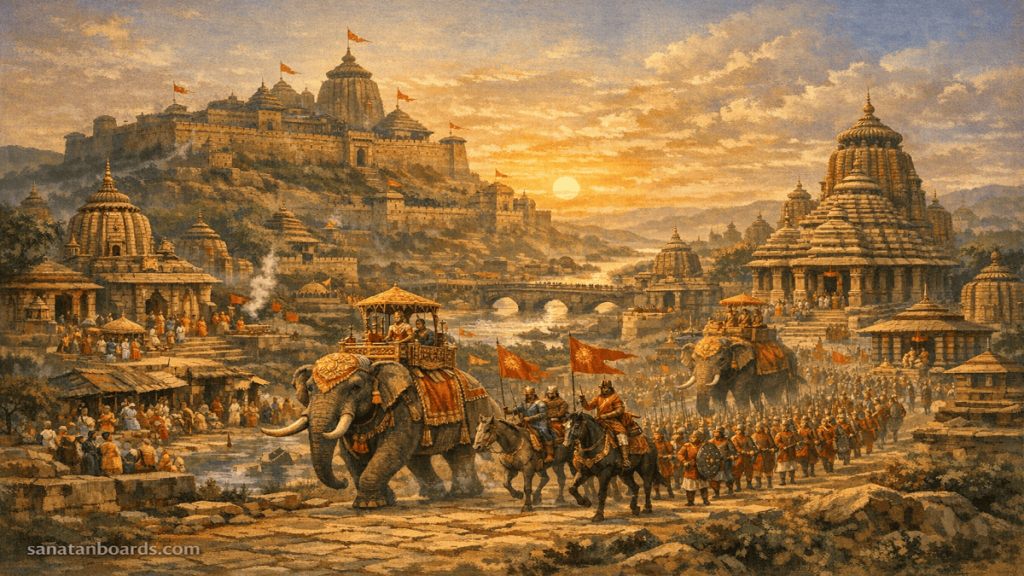
Case Study On Gajapati Kingdom (Odisha) – Kapilendra Deva
Introduction
The Gajapati Kingdom (Odisha) – Kapilendra Deva represents one of the most significant regional powers in 15th-century India. Kapilendra Deva, who reigned from 1434 to 1467 CE, elevated the Gajapati dynasty to unprecedented levels of territorial expansion, military strength, administrative efficiency, and cultural richness. This case study explores the historical context, governance strategies, military campaigns, cultural achievements, and long-term impact of his reign.
Historical Context
During the 15th century, India witnessed the rise of regional kingdoms alongside the weakening of larger empires. Odisha, located strategically along the eastern coast, became a hub of trade, religion, and culture. The Gajapati dynasty had already established itself as a local power, but it was under Kapilendra Deva that the kingdom achieved its peak. His reign coincided with the decline of the Delhi Sultanate’s influence in eastern India, providing an opportunity for regional consolidation and expansion.
Governance and Administration
Kapilendra Deva implemented an organized system of governance to manage the expanded territories of the Gajapati Kingdom. The administration was divided into provinces, each overseen by appointed officials responsible for revenue collection, law enforcement, and public welfare. He introduced policies to ensure economic stability, including the regulation of agriculture, trade, and taxation. These measures strengthened the central authority while maintaining loyalty among local chieftains and administrators.
Military Campaigns
The Gajapati Kingdom (Odisha) – Kapilendra Deva expanded its boundaries through strategic military campaigns. He captured regions of present-day Andhra Pradesh, parts of Bengal, Jharkhand, and even parts of the Deccan. His army, which prominently used war elephants and cavalry, demonstrated high discipline and tactical innovation. Kapilendra Deva formed alliances with neighboring kingdoms while skillfully neutralizing rival powers through diplomacy and force, ensuring the kingdom’s dominance in eastern India.
Cultural Achievements
Kapilendra Deva was a patron of arts, literature, and religion. The kingdom witnessed the construction of temples, educational institutions, and public infrastructure. Temples dedicated to Lord Jagannath became central to religious life, reflecting a combination of spiritual devotion and architectural grandeur. Literature, Sanskrit scholarship, and regional Odia works flourished under his rule, making the kingdom a cultural hub.
Economic Impact
Trade and commerce thrived under Kapilendra Deva’s rule. The kingdom’s location along the coast facilitated maritime trade, while inland trade networks connected agricultural regions with urban centers. Revenue collection from agriculture and trade supported the military and cultural projects, ensuring a balanced economy.
Legacy and Long-term Impact
The reign of Kapilendra Deva left an enduring legacy in Odisha. His military, administrative, and cultural contributions shaped the region’s historical identity. Future rulers of the Gajapati dynasty inherited a powerful and organized kingdom that served as a model of governance and cultural prosperity. Today, monuments, inscriptions, and literary works from this era continue to educate students, historians, and the public about Odisha’s medieval past.
Conclusion
The Gajapati Kingdom (Odisha) – Kapilendra Deva exemplifies the capabilities of a regional medieval Indian kingdom that successfully #gajapatikingdominindia combined military power, efficient governance, and cultural development. This case study highlights the relevance of Kapilendra Deva’s reign in understanding the socio-political, economic, and cultural landscape of #gajapatikingdominkolkata 15th-century eastern India. His legacy remains a vital part of Odisha’s historical and educational narrative.
White Paper On Gajapati Kingdom (Odisha) – Kapilendra Deva
Executive Summary
The Gajapati Kingdom (Odisha) – Kapilendra Deva was a medieval Indian kingdom that reached its zenith under the reign of Kapilendra Deva (1434–1467 CE). This white paper examines the political, military, economic, and cultural significance of the kingdom. It provides insights into how regional powers consolidated authority, fostered cultural development, and influenced the socio-political landscape of eastern India during the 15th century.
Introduction
The Gajapati dynasty, with its seat in Odisha, played a critical role in shaping the history of eastern India. Kapilendra Deva, the most prominent ruler of the dynasty, expanded the kingdom through military conquests and strategic alliances. The term “Gajapati” symbolizes authority and military might, literally translating to “Lord of Elephants.” This white paper explores the governance, military strategies, cultural patronage, and economic foundations of the Gajapati Kingdom under Kapilendra Deva.
Political and Administrative Structure
Kapilendra Deva implemented a centralized administrative system that allowed effective control over a vast territory. The kingdom was divided into provinces, each managed by appointed governors responsible for revenue collection, law enforcement, and military readiness. This hierarchical system ensured stability and accountability while promoting loyalty among regional leaders. Kapilendra Deva’s reign also emphasized justice and social welfare, supporting temples, schools, and public infrastructure.
Military Strategy and Expansion
Under Kapilendra Deva, the Gajapati Kingdom (Odisha) – Kapilendra Deva became a formidable military power. The army included war elephants, cavalry, infantry, and archers, organized for both defensive and offensive campaigns. Kapilendra Deva extended the kingdom’s boundaries north to Bengal and south to parts of the Deccan. His campaigns strengthened Odisha’s political influence and secured vital trade routes, contributing to the kingdom’s economic stability.
Cultural and Religious Patronage
Cultural development was a hallmark of Kapilendra Deva’s reign. Temples, including those dedicated to Lord Jagannath, were constructed with intricate designs, reflecting both religious devotion and architectural skill. Literature, particularly in Sanskrit and Odia, flourished during this period. Kapilendra Deva’s patronage of scholars, poets, and artisans positioned the kingdom as a cultural hub in eastern India.
Economic Framework
The kingdom’s economy was diversified, relying on agriculture, trade, and taxation. Coastal access facilitated maritime trade, while fertile land supported high agricultural productivity. Revenue policies were structured to maintain economic growth while funding military and cultural projects. This balance between administration, commerce, and military expenditure ensured the kingdom’s stability and prosperity.
Legacy and Educational Significance
The Gajapati Kingdom (Odisha) – Kapilendra Deva left an enduring legacy in governance, military strategy, culture, and religion. It serves as a case study for students of history, archaeology, political science, and cultural studies. Monuments, inscriptions, and literary works from this era continue to educate and inspire modern scholars and heritage enthusiasts.
Conclusion
Kapilendra Deva’s reign exemplifies the capabilities of regional powers in medieval India. The kingdom successfully combined military #gajapatikingdominodisha strength, administrative efficiency, economic stability, and cultural prosperity. Understanding the Gajapati Kingdom (Odisha) – Kapilendra Deva is crucial for comprehending the historical evolution of Odisha #gajapatikingdominmumbai and the broader dynamics of Indian medieval kingdoms.
Industry Application On Gajapati Kingdom (Odisha) – Kapilendra Deva
Introduction
Although the Gajapati Kingdom (Odisha) – Kapilendra Deva existed in the 15th century, its study has applications across modern industries including education, heritage tourism, cultural preservation, and digital learning platforms. By analyzing governance, military strategy, culture, and trade in Kapilendra Deva’s reign, contemporary sectors can derive lessons in management, strategy, and cultural engagement.
Educational Industry Applications
The kingdom’s history is required in educational curricula across schools, colleges, and universities. History textbooks, research modules, and online learning platforms utilize knowledge about Kapilendra Deva to teach governance, military organization, economic planning, and cultural development. Educational institutions can develop interactive case studies, digital simulations, and project-based learning modules based on the Gajapati Kingdom. Students studying medieval Indian history, archaeology, political science, or art history directly benefit from these insights.
Tourism and Heritage Industry
The cultural and architectural achievements of the Gajapati Kingdom (Odisha) – Kapilendra Deva are highly relevant for tourism and heritage industries. Temples, fort ruins, and monuments from the period attract domestic and international visitors. Tour operators, guides, and heritage managers can create educational tours highlighting Kapilendra Deva’s contributions. This enhances visitor experience while promoting cultural preservation and generating economic benefits for local communities.
Digital and Media Industry
Knowledge of the kingdom finds application in media, digital content creation, and gaming industries. Documentaries, online courses, educational apps, and video games can integrate Kapilendra Deva’s campaigns, cultural developments, and governance strategies. This not only educates audiences but also increases engagement with historical content, making history accessible to younger generations.
Cultural Preservation and Research
Researchers, archaeologists, and cultural organizations rely on the Gajapati Kingdom (Odisha) – Kapilendra Deva for heritage conservation. Understanding temple architecture, inscriptions, and manuscripts informs preservation strategies. Museums and cultural institutions can design exhibitions, publications, and workshops showcasing the kingdom’s art, literature, and governance.
Management and Strategy Lessons
Modern business and management professionals can draw lessons from Kapilendra Deva’s governance and strategic decisions. His territorial expansion, alliance-building, and administrative efficiency provide historical examples of resource management, risk assessment, and leadership. These insights can be adapted for case studies in strategic planning and leadership programs.
Conclusion
The study of the Gajapati Kingdom (Odisha) – Kapilendra Deva has far-reaching applications in education, tourism, digital media, heritage #sanatandharmaaccreditationboardsinmumbai conservation, and business strategy. By leveraging historical insights, industries can promote cultural awareness, enhance learning experiences, and develop innovative #sanatandharmaaccreditationboardsinodisha applications that connect past achievements to contemporary needs.
source : Ganda Berunda
ASK FAQ
Who was Kapilendra Deva of the Gajapati Kingdom (Odisha)?
Kapilendra Deva was a 15th-century ruler of the Gajapati dynasty who expanded Odisha’s kingdom to its greatest territorial and cultural extent.
What is the significance of the Gajapati Kingdom (Odisha)?
The kingdom represents a golden era of military power, administrative efficiency, art, and temple architecture in medieval eastern India.
When did Kapilendra Deva rule the Gajapati Kingdom?
He ruled from 1434 CE to 1467 CE, marking the peak of the Gajapati dynasty’s influence.
Where was the Gajapati Kingdom (Odisha) located?
It covered present-day Odisha, parts of Andhra Pradesh, West Bengal, and Jharkhand, with its capital near Cuttack.
How did Kapilendra Deva contribute to culture and administration?
He promoted temple construction, Sanskrit and Odia literature, and organized a strong administrative and military system.
Table of Contents
Disclaimer
The information provided on Gajapati Kingdom (Odisha) – Kapilendra Deva is intended solely for educational and knowledge purposes. While efforts have been made to ensure accuracy, historical interpretations may vary according to different sources. This content is not a substitute for professional research or academic references. Readers are encouraged to consult scholarly publications, historical texts, and verified resources for formal study or citation. The content should not be used for commercial, legal or other professional purposes without proper verification. All names, dates, and events are based on historical records as generally accepted by historians.