Dwarka (Gujarat) – Dwarkadhish Temple represents one of the most ancient and revered spiritual landmarks in India. Located in the coastal town of Dwarka in the western Indian state of Gujarat, this temple stands as a testament to deep-rooted tradition, history, and cultural heritage. Dwarka itself is an ancient city, mentioned in many sacred texts, and believed to be the legendary kingdom of Lord Krishna, stretching back thousands of years.
At the heart of this historic city lies the Dwarkadhish Temple, dedicated to Lord Krishna — worshipped here as Dwarkadhish, literally meaning “King of Dwarka.” This temple is not just a religious shrine, but also a symbol of enduring faith, architectural grandeur, and devotional legacy. The temple’s present structure was constructed centuries ago, around the 15th–16th century, although archaeological estimates suggest that the original shrine dates back much earlier.
Standing tall with its intricately carved stonework and elevated spire, the temple is a five‑storied edifice supported by 72 ornate pillars — a design that reflects classical Indian temple architecture and devotion to divine art. It has two main gateways, symbolizing different spiritual paths: Moksha Dwara (Door to Salvation) and Swarga Dwara (Gate to Heaven).
Dwarkadhish Temple is not just an architectural marvel but also a major pilgrimage center. It forms an important part of the Char Dham circuit, a set of four sacred pilgrimage sites across India that Hindus regard as spiritually purifying and essential to religious life.
This temple attracts millions of devotees and visitors each year, drawn by its historical significance,spiritual resonance, and mythological importance. Its unique seaside location — by the Gomti River near the Arabian Sea — adds to its mystical character, making it both a spiritual retreat and a place of cultural study.
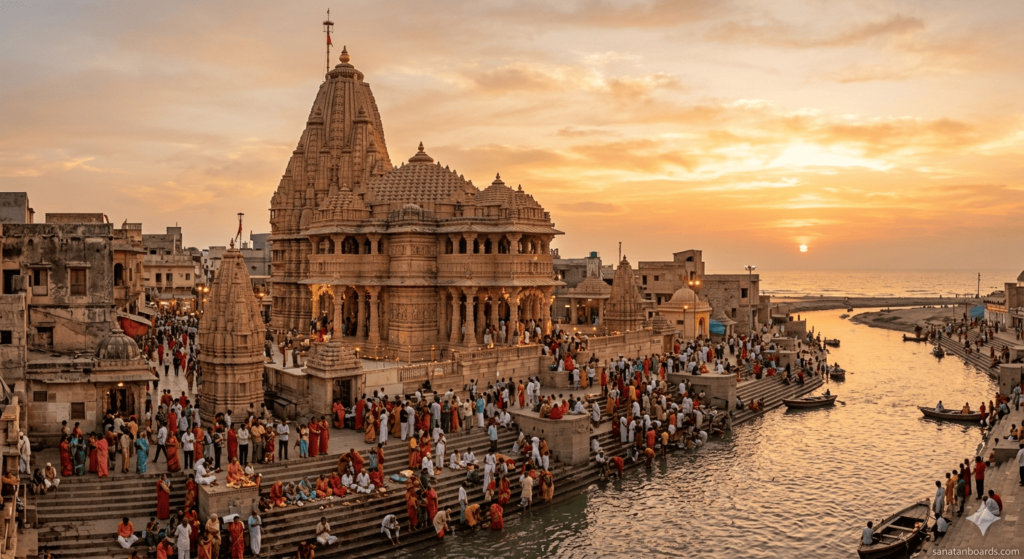
What Is Dwarka (Gujarat) – Dwarkadhish Temple ?
The Dwarkadhish Temple is a historic Hindu temple situated in the sacred city of Dwarka in Gujarat, India. It is primarily dedicated to Lord Krishna, one of the most widely worshipped deities in Hinduism, who is revered here in the form of Dwarkadhish — “King of Dwarka.” The temple forms the focal point of the town’s religious life and is a significant site in the spiritual landscape of India.
Architecturally, the temple is remarkable for its multi‑storied structure. The main shrine — popularly known as the Jagat Mandir or Nija Mandir — rises five stories high and is supported by 72 intricately carved pillars. It is constructed largely from limestone and sandstone, featuring elaborate carvings and traditional ornamentation.
Historical records and archaeological findings suggest that while the current structure dates to the 15th–16th century, the origins of the temple can be traced back many centuries earlier, possibly over 2000 years. Early sources and local tradition claim that Lord Krishna’s great‑grandson, Vajranabha, originally established the shrine over the place associated with Krishna’s legacy.
The temple’s design incorporates two symbolic gates: the Moksha Dwara (Door to Liberation) and the Swarga Dwara (Gate to Heaven), representing the philosophical pathways toward ultimate spiritual fulfillment. A flight of 56 steps outside the temple leads down toward the Gomti River, adding to the temple’s serene and sacred ambiance.
Devotees believe that worship at this temple brings divine blessings, spiritual upliftment, and a connection to the timeless teachings associated with Krishna. Located where the Gomti River meets the Arabian Sea, the temple’s setting combines natural beauty with deep religious meaning, making it an unforgettable spiritual destination for visitors from across India and the world.
Who Is Required Dwarka (Gujarat) – Dwarkadhish Temple ?
Primarily, followers of Hinduism and devotees of Lord Krishna consider Dwarkadhish Temple a vital pilgrimage destination. For devotees, especially Vaishnavas (followers of Vishnu), visiting this temple represents a profound spiritual journey. It is seen as a place where one can express devotion to Krishna, seek blessings, and engage in sacred rituals and observances.
The temple is also deeply significant for those following the Char Dham pilgrimage tradition. Char Dham refers to four spiritually important sites spread across India that Hindus traditionally aspire to visit at least once in their lifetime to achieve moksha (liberation). Dwarkadhish Temple is included in this circuit.
Beyond strictly religious devotion, many students of history, culture, architecture, and mythology find the temple vital to their learning. The temple’s long history, architectural grandeur, and connection with ancient legends make it important for scholars studying Indic civilization, temple architecture, and the development of religious traditions in India.
Tourists interested in India’s cultural heritage often include this temple in their itinerary. Its seaside location, intertwined with ancient mythology and fascinating stories about Krishna’s kingdom, draws people from diverse backgrounds who are curious about India’s historical and spiritual legacy.
When Dwarka (Gujarat) – Dwarkadhish Temple Is Required ?
The relevance and timing of engaging with the Dwarkadhish Temple can be considered from religious, cultural, and life‑event perspectives.
Within Hindu tradition, certain festivals and auspicious days mark the temple as especially important. The most notable is Krishna Janmashtami, the celebration of Lord Krishna’s birth. On this day, the temple becomes an epicenter of devotional activity, drawing pilgrims from across India who wish to offer prayers, participate in special rituals, and experience the spiritual energy associated with Krishna’s divine presence.
Daily temple rituals include multiple aarti (prayer) ceremonies, which are significant for devotees seeking regular spiritual engagement. The temple timings are aligned with traditional worship schedules — typically opening early in the morning and again in the evening — encouraging devotees to engage in prayer at the start and close of the day.
From a cultural and heritage standpoint, tourist seasons — such as winter months in India (October to February) — often coincide with increased visitation, as pleasant weather makes travel and exploration more comfortable. During these times, heritage tours, regional festivals, and cultural events in and around Dwarka further enhance the temple’s appeal.
In the context of one’s spiritual journey or life milestones, many Hindus consider a visit to Dwarkadhish Temple as a meaningful act at specific moments in life — for example, before major life changes, during rites of passage, or as part of fulfilling personal vows. The act of making pilgrimages to sacred sites is believed to offer spiritual reassurance and inner peace during times of transformation or reflection.
Historically, the temple has been important throughout the year, showing no strict seasonality in its spiritual significance. Its enduring relevance means that for millions, it is “required” whenever seekers feel drawn to connect with their devotional roots, explore ancient spiritual wisdom, or appreciate the depth of Indian history.
Where Dwarka (Gujarat) – Dwarkadhish Temple Is Required ?
The temple is located in Dwarka, a coastal city in the Devbhumi Dwarka district of Gujarat, India. Dwarka lies on the western shore of the Okhamandal Peninsula, at the mouth of the Gomti River, where it meets the Arabian Sea.
This strategic seaside setting gives the temple its unique cultural and spiritual ambiance. The combination of river, sea, and ancient sacred geography adds layers of meaning — especially when linked to the Hindu belief that Krishna’s kingdom in mythic times stood on land reclaimed from the sea. Many devotees believe that the divine presence manifested here, amplifying the sacred aura of the temple site.
Within Dwarka, the temple sits near the Gomti River banks, easily accessible by foot and local transport. Historically and spiritually, this location has been central to pilgrimage routes and town planning, making it a hub for religious activity in the region.
From a wider perspective, the temple’s “required” location can be viewed within the Char Dham pilgrimage circuit. Dwarkadhish Temple is one of the four major dhams in India — spiritual destinations that Hindus traditionally seek to visit during their lifetime. The other three are located in the eastern, southern, and northern parts of the country, making Dwarka essential for those completing the full circuit.
Moreover, Dwarka’s position along major travel routes — connected by rail and road to cities such as Ahmedabad, Jamnagar, and beyond — makes it accessible for both domestic and international visitors. Infrastructure developments, including improved transport, reinforce the temple’s role as a key spiritual destination.
How Dwarka (Gujarat) – Dwarkadhish Temple Is Required ?
The importance of the Dwarkadhish Temple is reflected in how it serves religious, cultural, academic, and community purposes.
Spiritually, the temple operates as a place of worship and devotion. Daily rituals, prayers, and ceremonial offerings (such as aarti, abhishekam, and mantra chanting) create an environment where devotees can connect with Krishna’s teachings and seek blessings for personal and family well‑being.
Architecturally, the temple stands as a living example of ancient Indian temple design and craftsmanship. Its multi‑storied structure, supported by 72 pillars and rising high with ornate carvings, represents an artistic tradition that trained artisans and planners over generations. Students of architecture, heritage conservation, and Indian history often study such temples to understand structural techniques, symbolisms, and cultural narratives embedded in design.
The temple also plays an educational role. Through festivals, stories, and rituals, visitors learn about Krishna’s life, legends, and moral teachings — narratives that are central to large sections of the Hindu philosophical tradition. Pilgrims and scholars alike explore these practices to gain insight into ancient Indic texts, mythology, and devotional cultures.
Moreover, the temple anchors the local economy and community life. Festivals and pilgrimages attract travelers from across India and abroad, supporting livelihoods in hospitality, transport, and cultural tourism. In this sense, the temple is required functionally for sustaining community interactions, cultural exchange, and economic vitality of the Dwarka region.
Lastly, the temple acts as a symbolic unifying force across generations. Families often visit together, passing down traditions, values, and stories. Celebrations like Janmashtami become occasions for communal harmony, reinforcing social bonds and reinforcing collective memory.
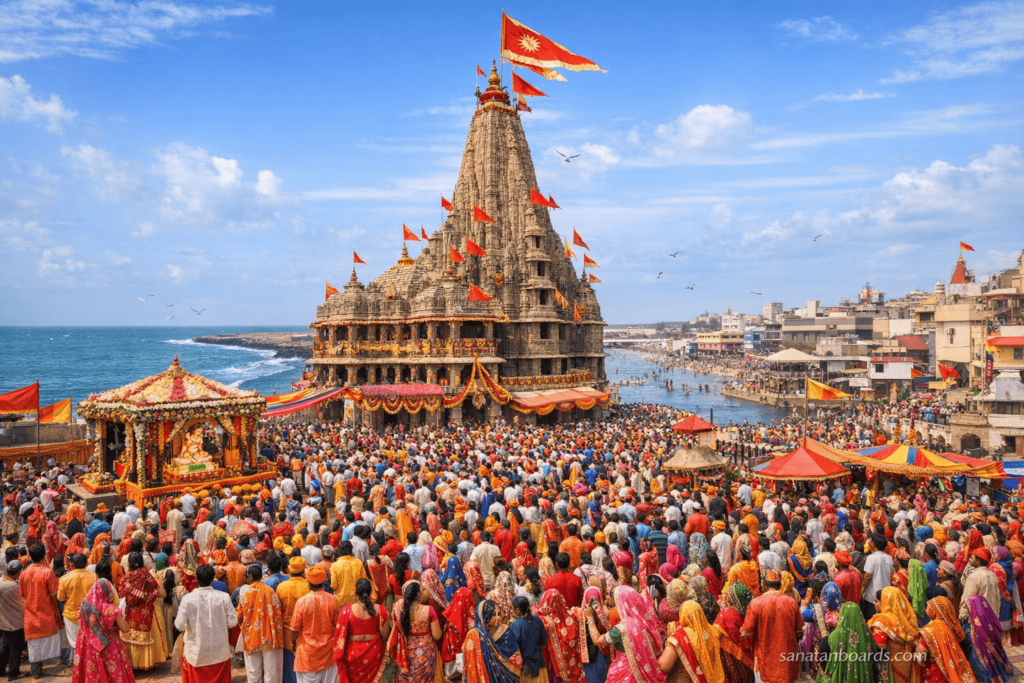
Case Study On Dwarka (Gujarat) – Dwarkadhish Temple
Historical Genesis and Mythological Roots
The Dwarkadhish Temple stands at the intersection of history, legend, and spiritual fervor. Dwarka’s very identity is entwined with the legend of Lord Krishna — believed to have established his kingdom here after leaving Mathura. Ancient texts, including the Mahabharata and Puranas, describe Dwarka as a thriving, majestic city that later sank into the sea — a symbol of the transience of worldly grandeur and the enduring legacy of divine presence.
The temple tradition holds that the original shrine was established by Vajranabha, the great‑grandson of Krishna, over the place associated with his life and rule. Although the present stone structure dates to the 15th–16th century, archaeological studies suggest earlier foundations, possibly over two millennia old. This long history reflects how sacred spaces evolve through time — blending myth and material evidence to create enduring places of worship.
Architectural and Cultural Significance
Architecturally, the Dwarkadhish Temple is remarkable. Its five stories are supported by 72 intricately carved pillars, each telling a story through sculptural details. The design incorporates a garbhagriha (sanctum), antarala (vestibule), and hall structures that align with classical Indian temple layout principles. The spire rising high above the temple resonates with symbolic aspirations — drawing devotees’ eyes (and spirits) upward toward the divine.
The temple’s flag is a recognizable feature — triangular, bearing symbols of the sun and moon — believed to signify Krishna’s eternal presence until the end of time. The flag is replaced multiple times a day, a living ritual that involves devotees who contribute toward the temple’s upkeep. This ongoing practice reflects how ancient traditions adapt and persist into modern communal life.
Culturally, the temple plays a central role in festivals, especially Krishna Janmashtami, when thousands congregate to offer prayers and celebrate Krishna’s birth. These events transform the temple grounds into vibrant hubs of celebration, music, dance, and devotional fervor.
Religious Practices and Pilgrimage
For millions of Hindus, the temple is not merely a historical site but a living center of worship. Daily aarti ceremonies, morning and evening prayers, and offerings help devotees express devotion, seek inner peace, and reaffirm life values rooted in Krishna’s teachings. Pilgrims often take holy dips in the Gomti River before entering the temple — a purification practice seen across many sacred traditions in India.
Being part of the Char Dham circuit amplifies its religious weight. Visiting all four Dham sites is considered spiritually meritorious and cleansing. Dwarkadhish Temple, as the western anchor of this circuit, symbolizes Krishna’s cosmic role and offers pilgrims a sense of fulfillment in their spiritual journeys.
Heritage, Conservation, and Education
From a heritage perspective, the temple represents the continuity of Indian cultural and religious traditions. Archaeological and historical efforts — including ongoing explorations by the Archaeological Survey of India (ASI) — aim to deepen understanding of Dwarka’s ancient past, possibly even revealing more about the submerged city mentioned in legends.
Educationally, the temple serves as a case study for students of history, architecture, mythology, and religious studies. It illustrates how sacred architecture preserves cultural narratives and how living traditions adapt over time.
Community and Economic Impact
Beyond worship and learning, Dwarkadhish Temple influences community life and economics. Pilgrimage tourism supports local businesses, from hospitality to artisanal crafts. Festival seasons and daily visits sustain employment and cultural exchange, embedding the temple into the socioeconomic fabric of Dwarka.
Symbolism and Contemporary Relevance
In contemporary times, the temple’s relevance persists as a site where ancient heritage meets living practice. It symbolizes how spiritual spaces can unify diverse communities, reinforce moral values, and inspire devotion that transcends time.
The temple continues to attract people from all walks of life — seekers of history, culture enthusiasts, architecture lovers, and devout pilgrims — each finding their own meaning in the sacred rhythms of this age‑old sanctuary.
White Paper On Dwarka (Gujarat) – Dwarkadhish Temple
Executive Summary
The Dwarkadhish Temple, located in Dwarka, Gujarat, is one of India’s most sacred and historically significant religious sites. Dedicated to Lord Krishna as the “King of Dwarka,” it represents centuries of spiritual devotion, architectural excellence, and cultural continuity. Beyond its religious significance, the temple influences tourism, heritage conservation, local economies, education, and technological engagement. This white paper examines the temple’s historical, cultural, architectural, and industry relevance while highlighting opportunities for sustainable development and modern applications.
1. Introduction
Dwarka, situated at the confluence of the Gomti River and the Arabian Sea, is historically associated with Lord Krishna. The Dwarkadhish Temple serves as the spiritual and cultural heart of the city, attracting millions of pilgrims annually. Its five-storied architecture, supported by 72 intricately carved pillars, reflects traditional Indian temple design and stands as a testament to human craftsmanship and devotion.
The temple is part of the Char Dham pilgrimage circuit, a key religious network in Hinduism. Its influence extends beyond spiritual practice to impact cultural education, heritage preservation, and regional economic activity.
2. Historical and Cultural Significance
- Mythological Roots: Ancient texts, including the Mahabharata and Puranas, describe Dwarka as a thriving city established by Lord Krishna. Local tradition credits Krishna’s great-grandson, Vajranabha, with founding the original temple shrine over 2,000 years ago.
- Architectural Value: The temple features a multi-tiered structure with 72 carved pillars and spires. Its Moksha Dwara and Swarga Dwara gateways symbolize liberation and divine ascension.
- Cultural Influence: Annual festivals, especially Janmashtami, transform the temple into a vibrant center of music, dance, and devotional activity, reinforcing Dwarka’s identity as a living cultural hub.
3. Strategic Recommendations
- Enhance visitor experiences through multilingual guides, apps, and interactive exhibits.
- Promote sustainable tourism practices, including eco-friendly infrastructure and heritage-sensitive policies.
- Strengthen educational programs and research partnerships.
- Support local artisans and businesses through community-focused initiatives.
- Expand digital platforms for global access and engagement.
4. Conclusion
The Dwarkadhish Temple exemplifies the convergence of spirituality, cultural heritage, architectural brilliance, and economic vitality. Its enduring relevance highlights the importance of preserving sacred spaces while integrating modern technology, sustainable #Sanatandharmaaccreditationboardsinvasai tourism practices, and educational initiatives. As both a spiritual sanctuary and cultural landmark, the temple continues to inspire, educate, and economically support the Dwarka region.
Industry Application On Dwarka (Gujarat) – Dwarkadhish Temple
The Dwarkadhish Temple, while primarily a religious and cultural site, has far-reaching implications for multiple industries, including tourism, heritage management, cultural studies, architecture, and local entrepreneurship. Its significance extends beyond spiritual practice, influencing economic and educational sectors.
1. Tourism and Hospitality Industry
Dwarkadhish Temple is a major pilgrimage destination and attracts millions of domestic and international visitors each year. This high footfall drives the tourism and hospitality industry, including hotels, guesthouses, restaurants, and transport services. Seasonal festivals, particularly Janmashtami, amplify demand for accommodations and travel services, creating employment and entrepreneurial opportunities. Tour operators often package temple visits with nearby attractions such as Bet Dwarka and the Okha coast, integrating cultural tourism with adventure and leisure tourism.
2. Heritage and Conservation Industry
The temple’s ancient architecture and historical value make it a critical site for heritage management and archaeological research. Organizations like the Archaeological Survey of India (ASI) invest in preservation, documentation, and restoration efforts. Heritage-focused firms and NGOs collaborate with the temple authorities to maintain structural integrity, conserve carvings, and promote educational programs about Dwarka’s historical significance.
3. Cultural and Educational Industry
The temple serves as a learning hub for students, scholars, and cultural researchers. Universities and educational institutions organize study tours and workshops focusing on Indian architecture, history, mythology, and religious practices. Academic publications, documentaries, and digital learning modules often feature the temple, influencing educational content production and media industries.
4. Local Craft and Artisanship
Temple tourism has supported traditional handicrafts and artisanal industries. Items such as devotional icons, embroidered garments, religious books, and souvenirs are sold in the temple vicinity, sustaining local craftsmanship. Artisans gain visibility and income, preserving cultural traditions while meeting modern market demand.
5. Event and Festival Management Industry
Large-scale religious celebrations at Dwarkadhish Temple create opportunities for the event management industry. Coordinating rituals, crowd management, ceremonial music, lighting, and food services during festivals demands professional planning and services. Companies and volunteers collaborate to ensure a smooth experience, enhancing the professionalization of spiritual event management.
6. Digital and Tech Industry
With growing interest in virtual tourism and online religious services, the temple has become part of the digital industry ecosystem. Live streaming of aarti, #Sanatandharmaaccreditationboardsinmumbai virtual darshan apps, and online donation platforms demonstrate how technology integrates with heritage and religious practice, opening new avenues in app development, digital marketing, and e-commerce.
source : Yatra Mitra
ASK FAQ
1. What is Dwarkadhish Temple in Dwarka, Gujarat?
Dwarkadhish Temple is a historic Hindu temple in Dwarka, Gujarat, dedicated to Lord Krishna as the “King of Dwarka.” It is part of the Char Dham pilgrimage and features a five-storied structure supported by 72 carved pillars.
2. Who should visit Dwarkadhish Temple in Gujarat?
Devotees of Lord Krishna, Vaishnavas, cultural enthusiasts, scholars, and tourists interested in architecture, history, and spiritual heritage should visit this temple.
3. When is the best time to visit Dwarkadhish Temple?
The best time is during Krishna Janmashtami or between October and February, when the weather is pleasant and festivals are celebrated with grandeur.
4. Where is Dwarkadhish Temple located in Gujarat?
The temple is in the city of Dwarka, on the Okhamandal Peninsula at the confluence of the Gomti River and the Arabian Sea, making it a key pilgrimage destination.
5. How can visitors experience Dwarkadhish Temple?
Visitors can participate in daily rituals, attend festival celebrations, take guided tours, and explore virtual darshan or online aarti services to experience the temple’s spiritual and cultural essence.
Table of Contents
Disclaimer
This white paper is prepared for educational, research, and cultural purposes only. All historical, architectural, and cultural information is sourced from publicly available research, heritage records, and scholarly studies. Interpretations of religious beliefs and practices are presented respectfully and may vary across communities.