
AUSTRALIA & CANADA
Australia and Canada are two of the world’s most developed, stable, and opportunity-rich nations. Located in different hemispheres, these countries share several similarities, including strong economies, multicultural societies, high living standards, and globally respected education systems. Over the years, they have become top destinations for students, professionals, and immigrants seeking better career prospects and quality of life.
Both countries are known for their transparent governance, safety, and inclusive policies, making them attractive for people from diverse backgrounds. Their immigration systems are designed to welcome skilled individuals who can contribute to economic growth, innovation, and social development. This has resulted in vibrant communities where different cultures coexist harmoniously.
Australia is recognized for its dynamic job market, especially in sectors such as healthcare, engineering, mining, and information technology. Canada, on the other hand, is widely appreciated for its progressive immigration policies, excellent public services, and strong emphasis on work-life balance Each country offers unique advantages depending on an individual’s goals, whether they are related to education employment, or long-term settlement.
In today’s globalized world, choosing between these two nations often depends on personal preferences, career aspirations, and expectations. Understanding their systems, requirements, and opportunities is essential for making informed decisions.
This blog explores Australia and Canada from multiple perspectives, including their definition, requirements, applications, and real-world case studies, providing a comprehensive understanding for anyone considering them as a destination for growth and development.
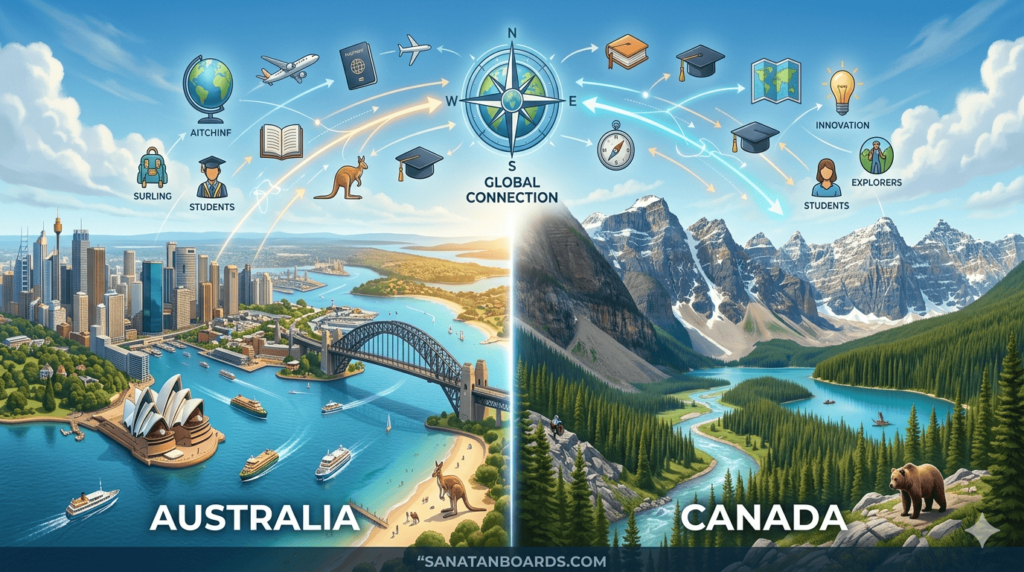
What is AUSTRALIA & CANADA ?
Australia and Canada are sovereign nations that are highly developed and influential in the global economy. They are often compared due to their similar economic structures, immigration systems, and quality of life.
Australia is a country and continent surrounded by the Indian and Pacific Oceans. It is known for its strong economy, abundant natural resources, and advanced infrastructure. The country operates under a democratic system and offers a high standard of living to its residents. Its education system is globally recognized, and its universities attract thousands of international students every year.
Canada, located in North America, is the second-largest country in the world by land area. It is known for its natural beauty, diverse population, and stable political environment. Canada’s economy is driven by industries such as technology, healthcare, finance, and natural resources. The country emphasizes inclusivity, human rights, and social welfare.
Both nations are considered ideal destinations for migration due to their structured immigration programs. These programs are designed to attract skilled workers, students, and entrepreneurs. They offer pathways to permanent residency and citizenship, making them appealing for long-term settlement.
In a broader sense, “Australia and Canada” as a topic often refers to opportunities related to education, employment, immigration, and lifestyle in these countries. It encompasses everything from visa processes and job markets to cultural experiences and economic benefits.
Understanding what these countries represent helps individuals evaluate their potential and align their goals accordingly, whether they aim to study, work, or settle abroad.
Who is Required AUSTRALIA & CANADA ?
Australia and Canada are sought after by a wide range of individuals who aspire to improve their quality of life and expand their opportunities. These countries are particularly relevant for people who are looking for better education, stable careers, and long-term settlement options.
Students are one of the primary groups who consider these destinations. Both countries offer world-class education systems, modern infrastructure, and globally recognized degrees. International students benefit from exposure to diverse cultures, advanced learning environments, and opportunities for post-study work.
Skilled professionals are another major group that requires opportunities in these nations. Individuals with expertise in fields such as healthcare, engineering, information technology, finance, and skilled trades often find better career prospects in these countries. Their economies actively seek talent to fill labor shortages and support economic growth.
Entrepreneurs and business investors also look toward these nations due to their stable economies and supportive business environments. Both countries encourage innovation and provide frameworks that make it easier to establish and grow businesses.
Families seeking a better lifestyle, healthcare, and education for their children often consider relocation. The safety, public services, and social benefits provided by these countries make them attractive for long-term settlement.
Additionally, individuals seeking a more balanced lifestyle, inclusive society, and improved living conditions are drawn to these destinations. Their emphasis on equality, diversity, and well-being creates an environment where people can thrive both personally and professionally.
When AUSTRALIA & CANADA is Required ?
Australia and Canada become relevant choices at various stages of an individual’s life, depending on their personal and professional goals. Timing plays a crucial role in determining when one should consider these destinations.
For students, the need arises after completing secondary education or undergraduate studies. This is the stage where individuals look for higher education opportunities that offer global exposure and better career prospects. Studying in these countries not only provides quality education but also opens doors to international work experience.
For professionals, the right time often comes when they seek career growth, higher salaries, or global exposure. Mid-career professionals may find better opportunities in these countries due to their demand for skilled labor. When individuals feel limited by local job markets, exploring opportunities abroad becomes a logical step.
Entrepreneurs may consider these destinations when they want to expand their businesses into international markets or operate in a stable economic environment. The supportive policies and access to global networks make these countries attractive for business ventures.
Families may decide to move when they prioritize better education for their children, improved healthcare, and a safer environment. This often happens when long-term planning becomes a priority.
Additionally, individuals may consider these countries during times of economic uncertainty or limited opportunities in their home country. Seeking stability and growth becomes a driving factor.
Where AUSTRALIA & CANADA is Required ?
Australia and Canada are relevant across various geographical and professional contexts. Their importance is not limited to specific regions but extends globally, especially in countries where individuals seek better opportunities.
In developing nations, these countries are often seen as gateways to growth and stability. People from regions with limited job opportunities or educational resources look toward these destinations for advancement. They provide access to modern infrastructure, advanced industries, and global networks.
In the context of education, these countries are significant in the global academic landscape. Universities and institutions attract students from all over the world, making them hubs of international learning and research.
Professionally, these countries are relevant in industries experiencing skill shortages. Sectors such as healthcare, engineering, information technology, and construction actively recruit international talent. This creates opportunities for individuals worldwide.
From a migration perspective, these countries play a key role in global mobility. Their structured immigration systems allow individuals to move, work, and settle with clear pathways. This makes them accessible to people from diverse backgrounds.
They are also relevant in discussions about quality of life. Globally, they are ranked among the best countries for living standards, safety, and work-life balance. This makes them desirable for individuals seeking holistic development.
How AUSTRALIA & CANADA is Required ?
Accessing opportunities in Australia and Canada involves a structured and well-defined process. Understanding how these systems work is essential for individuals planning to move.
The first step usually involves identifying the purpose—whether it is education, employment, or business. Based on this, individuals choose the appropriate pathway such as student visas, work permits, or immigration programs.
For students, the process includes selecting a recognized institution, securing admission, and applying for a study visa. Financial proof, academic records, and language proficiency tests are often required.
For professionals, the process typically involves skill assessments, job applications, and meeting eligibility criteria under immigration programs. Many individuals apply through points-based systems that evaluate age, education, work experience, and language skills.
Entrepreneurs and investors follow different pathways that require business plans, financial investment, and compliance with regulations.
Documentation is a crucial part of the process. Applicants must provide accurate and complete information, including identification, qualifications, and financial details.
Language proficiency tests are often required to ensure individuals can communicate effectively. Preparation for these tests plays an important role in the overall process.
Additionally, understanding cultural differences and workplace expectations helps individuals adapt more easily after moving.
Overall, the process requires careful planning, research, and preparation to ensure success.

Case Study On AUSTRALIA & CANADA
A detailed case study of Australia and Canada provides valuable insight into how individuals from different backgrounds successfully transition and build their lives in these countries. By examining real-life scenarios, it becomes easier to understand the practical implications of moving, studying, and working in these nations.
One of the most common case examples involves international students. Many students choose these destinations for higher education due to globally recognized degrees and strong academic frameworks. For instance, a student pursuing a master’s degree in information technology may begin their journey by enrolling in a reputed university. During their studies, they gain both theoretical knowledge and practical exposure through internships and part-time work opportunities. This experience not only helps them financially but also builds a professional network.
After graduation, both countries offer post-study work opportunities, allowing students to gain relevant work experience. In Australia, graduates often enter industries such as IT, healthcare, or hospitality, depending on their qualifications. Similarly, in Canada, graduates benefit from structured programs that allow them to work and eventually transition into permanent residency pathways. This step is crucial as it bridges the gap between education and long-term settlement.
Another important case is that of skilled professionals. Consider an engineer with several years of experience in their home country. By applying through a points-based system, they may qualify for migration based on their qualifications, age, and work experience. Once they arrive, they often find opportunities aligned with their expertise, although initial challenges such as credential recognition or local experience requirements may arise. Over time, many professionals successfully integrate into the workforce and achieve career growth.
Entrepreneurs also form an important part of this case study. Both countries encourage innovation and business development. A small business owner, for example, may relocate with the intention of expanding their operations internationally. With access to supportive policies, funding options, and stable markets, they can establish a successful enterprise. This not only benefits the individual but also contributes to the local economy.
Families relocating to these countries often report significant improvements in their quality of life. Access to healthcare, quality education for children, and a safe environment are some of the key benefits. However, the transition may involve emotional and financial adjustments, especially during the initial phase.
Despite the advantages, challenges such as cultural adaptation, cost of living, and complex procedures cannot be ignored. Individuals must prepare adequately to navigate these issues.
Overall, this case study highlights that while the journey requires effort and planning, the outcomes in terms of personal growth, career advancement, and lifestyle improvement are substantial. These countries provide structured pathways that enable individuals to achieve long-term success.
White Paper On AUSTRALIA & CANADA
Australia and Canada are widely recognized as global leaders in structured migration systems and economic development strategies. Their policies are carefully designed to attract skilled individuals, support innovation, and maintain long-term sustainability. This white paper explores the frameworks, benefits, and challenges associated with these systems.
One of the defining features of both countries is their points-based immigration model. This system evaluates applicants based on criteria such as age, education, work experience, and language proficiency. By prioritizing merit and capability, these countries ensure that incoming individuals can contribute effectively to the economy.
The education sector plays a crucial role in this ecosystem. Both countries have positioned themselves as global education hubs, attracting students from around the world. By offering post-study work opportunities, they create a pipeline of skilled professionals who are already familiar with local systems and culture. This approach benefits both the individuals and the economy.
Economic stability is another key factor. Strong governance, diversified industries, and consistent growth make these countries reliable destinations. Industries such as healthcare, technology, natural resources, and finance contribute significantly to their economies. The demand for skilled workers in these sectors drives migration policies.
Social integration is also a major focus. Policies promote diversity, inclusion, and equal opportunities. Newcomers are encouraged to participate in community activities and contribute to society. Support systems such as language training and settlement services help individuals adapt more easily.
However, there are challenges that need to be addressed. Increasing migration levels can put pressure on housing, infrastructure, and public services. Rising living costs in major cities have become a concern for both residents and newcomers. Governments are continuously working to balance growth with sustainability.
Another challenge is ensuring that immigrants fully utilize their skills. In some cases, individuals may face difficulties in getting their qualifications recognized or finding jobs that match their expertise. Addressing these gaps is essential for maximizing the benefits of migration.
From a policy perspective, both countries continue to evolve their systems to meet changing economic and social needs. They regularly update immigration criteria, introduce new programs, and refine existing processes.
In conclusion, Australia and Canada serve as effective models of how structured migration can drive economic growth and social development. #sanatanboardsinvasai Their systems highlight the importance of planning, inclusivity, and adaptability. While challenges exist, their proactive approach ensures continued success in attracting and retaining global talent.
Industry Application On AUSTRALIA & CANADA
Australia and Canada offer diverse opportunities across multiple industries, making them highly relevant in the global workforce landscape. Their economic structures, combined with ongoing demand for skilled professionals, create strong applications in various sectors.
The healthcare industry is one of the most prominent sectors in both countries. With growing populations and aging demographics, there is a continuous demand for healthcare professionals such as doctors, nurses, and allied health workers. Advanced medical infrastructure and supportive work environments make these countries attractive for professionals in this field. Additionally, ongoing investments in healthcare systems ensure long-term career stability.
The technology sector is another rapidly expanding area. Both countries have embraced digital transformation, leading to increased demand for software developers, data analysts, cybersecurity experts, and IT professionals. Innovation hubs and government support for startups further enhance opportunities in this sector. Professionals working in technology benefit from competitive salaries and exposure to cutting-edge developments.
Engineering and construction also play a vital role. Infrastructure projects, urban development, and resource management create a steady demand for engineers and skilled workers. Civil, mechanical, and electrical engineers are particularly in demand. These industries contribute significantly to economic growth and provide stable employment opportunities.
The education sector is equally important. Universities and institutions require qualified educators, researchers, and administrative staff. International education is a major contributor to the economy, and the presence of diverse student populations enhances cultural exchange and academic collaboration.
Business and entrepreneurship are strongly supported in both countries. Governments encourage innovation through policies, funding programs, and startup ecosystems. Entrepreneurs have access to resources that help them establish and grow their ventures. This not only benefits individuals but also creates jobs and drives economic development.
Agriculture and natural resources remain significant, especially in regional areas. Opportunities exist in farming, mining, and environmental management. These industries are essential for sustaining the economy and supporting exports.
Hospitality and tourism also contribute to employment, particularly in cities and popular destinations. These sectors offer opportunities for both skilled and semi-skilled workers.
Despite the opportunities, individuals #sanatanboardsinmumbai must be prepared for challenges such as competition, licensing requirements, and adapting to workplace standards. Proper planning and skill development are essential for success.
source : Guard The Leaf
ASK FAQ
1. What is the main difference between Australia and Canada?
Australia is an island continent known for its warm climate and resource-based economy, while Canada is a large North American country known for cold weather, strong immigration policies, and a diversified economy.
2. Why do people choose Australia and Canada for study or work?
People choose these countries for high-quality education, better job opportunities, safety, and a high standard of living.
3. Which industries are strong in Australia and Canada?
Healthcare, IT, engineering, education, mining, and finance are strong industries in both countries.
4. Is it easy to migrate to Australia and Canada?
Migration is possible but requires meeting eligibility criteria like education, skills, language ability, and points-based requirements.
5. What benefits do Australia and Canada offer immigrants?
They offer good salaries, permanent residency pathways, free healthcare systems, education opportunities, and a stable lifestyle.
Table of Contents
Disclaimer: This content is provided for general informational and educational purposes only and is not intended to serve as professional, legal, financial, immigration, or career advice. While every effort has been made to ensure the accuracy and relevance of the information, no guarantees are made regarding completeness or reliability. Readers are encouraged to conduct their own research and verify details from official and trusted sources before making any decisions. Any actions taken based on this information are strictly at the individual’s own risk. The author or publisher shall not be held responsible for any outcomes arising from its use.