
Accreditation For Petroleum
Accreditation of Training Providers is Especially Important safe, accurate and well managed extraction of petroleum industry
In high-consequence industries such as petroleum, small mistakes can become very dangerous. And in many accidents, human error is the cause, Effective training significantly reduces errors and risk.
The production and supply chain for fuels such as oil gas and hydrocarbons is highly complex. Yet for many consumers it is as simple as turning the switch on home heating or using the pump at a petrol station. SDAB Accredited services and products are very helpful to ensure that from extraction to delivery, fuels are safe to work with, store, transport and use, are accurately measured and will perform to expectations.
Accredited tests enclose the all fuel types from solid fuels to natural gases and those oils and gasses used in industry and refineries, for medical use or under compression.
Accreditation of oil and gas determines flow, viscosity, density, temperature, humidity and capacitance.
Accreditation in the petroleum industry is a critical, multi-layered process that ensures safety, quality, environmental protection, and operational integrity. It’s not about a single “accreditation for petroleum,” but rather a complex ecosystem of certifications for organizations, personnel, equipment, and laboratories.
Here’s a structured breakdown:
1. Organizational & Management System Accreditation
These are for entire companies or specific facilities.
- ISO Standards (Certification, often called Accreditation in business contexts):
- ISO 9001: Quality Management Systems – Ensures consistent product/service quality.
- ISO 14001: Environmental Management Systems – Critical for minimizing environmental impact.
- ISO 45001: Occupational Health & Safety Management Systems – For worker safety (replaces OHSAS 18001).
- ISO 29001: Quality management sector-specific for petroleum, petrochemical, and natural gas industries (based on ISO 9001).
- ISO 50001: Energy Management Systems – For improving energy efficiency.
- API Spec Q1 / Q2: The American Petroleum Institute’s foundational quality standard for manufacturing (Q1) and service supply (Q2) organizations. This is a mandatory requirement for many companies supplying the oil & gas industry in the Americas and beyond.
- Process Safety Management (PSM): While not always a formal “accreditation,” systems aligned with OSHA 1910.119 (USA) or similar global standards (e.g., EU Seveso Directive) are essential for refineries and chemical plants.
2. Product & Equipment Accreditation/Certification
Ensures materials and equipment meet rigorous technical standards.
- API Monogram Program: The most recognized system. Manufacturers are licensed to apply the API Monogram to products (e.g., pipe, valves, wellheads, pumps) that conform to API specifications (e.g., API 6D for valves, API 5L for line pipe). An audit is required.
- ASME Certification: For pressure vessels, boilers, and piping (ASME Section VIII, B31.3, etc.) with the “U” and other stamps.
- ATEX / IECEx Certification: For equipment used in explosive atmospheres (hazardous areas) in Europe (ATEX) and internationally (IECEx).
- CE Marking: Indicates conformity with health, safety, and environmental protection standards for products sold in the European Economic Area.
3. Personnel Certification
Accreditation of individual competence.
- API Individual Certification Programs: Highly regarded global credentials for professionals:
- API 510: Pressure Vessel Inspector
- API 570: Piping Inspector
- API 653: Aboveground Storage Tank Inspector
- API 571: Corrosion and Materials Professional
- API 580/581: Risk Based Inspection
- Well-focused certifications (e.g., API WellSharp for well control).
- NACE International (AMPP): Certifications for corrosion control specialists (Cathodic Protection, Coating Inspector).
- IWCF/IADC Well Control: Mandatory certifications for drilling personnel.
- Professional Engineer (PE) License: Often required for engineers signing off on critical designs.
4. Laboratory & Inspection Body Accreditation
Ensures testing and inspection data is reliable.
- ISO/IEC 17025:The international standard for testing and calibration laboratories. Crucial for:
- Crude oil assay labs
- Materials testing labs
- Calibration labs for field instruments.
- ISO/IEC 17020: Standard for inspection bodies (e.g., third-party inspection companies surveying equipment, pipelines, or facilities).
- Accreditation is typically granted by national accreditation bodies (e.g., UKAS in the UK, A2LA or ANAB in the USA, DAkkS in Germany, SAS in Saudi Arabia).
5. Project & Operational Specific
- Regulatory Permits & Licenses: Granted by government agencies (e.g., EPA, BOEM, HSE, NOCs) for exploration, drilling, emissions, and discharge. These are legal “accreditations” to operate.
- Marine & Aviation: Specific accreditations for offshore support vessels (e.g., ISM Code) and helicopters.
Why is Accreditation Critical in Petroleum?
- Safety: Prevents catastrophic failures (explosions, spills, blowouts).
- Interoperability: Ensures equipment from different manufacturers works together (e.g., API threads).
- Risk Mitigation: Provides assurance to operators, insurers, and investors.
- Regulatory Compliance: Often a legal requirement to obtain permits.
- Market Access: A prerequisite for supplying major oil companies (IOCs & NOCs).
- Environmental Stewardship: Demonstrates commitment to responsible operations.
Key Accreditation Bodies & Standards Developers
- American Petroleum Institute (API): The single most influential organization for standards and certification in the global oil & gas industry.
- International Organization for Standardization (ISO): Provides the overarching management system frameworks.
- International Electrotechnical Commission (IEC): For electrical equipment standards.
- National Accreditation Bodies: As mentioned above (UKAS, A2LA, etc.).
- National Oil Companies (NOCs): Such as Saudi Aramco, ADNOC, etc., often have their own supplemental approval systems (e.g., Aramco’s Vendor Approval process).
Practical Steps for a Company Seeking “Accreditation”
- Identify the Need: Is it to supply a product (API Monogram), provide inspection services (ISO 17020), or manage your organization (API Q1)?
- Choose the Relevant Standard: Based on customer and regulatory requirements.
- Implement the System: Develop procedures, train staff, and apply the standard’s requirements.
- Select a Certification Body: Choose an accredited registrar (e.g., DNV, Bureau Veritas, Lloyd’s Register, ABS Group) for audits.
- Undergo Audit: Stage 1 (document review) and Stage 2 (on-site assessment).
- Achieve Certification/Accreditation: Maintain it through surveillance audits.
What is Required Accreditation For Petroleum
There is no single “required accreditation.” Instead, it’s a web of mandatory and de facto mandatory standards. Below is a detailed guide broken down by entity.
Quick Reference: What’s Required For Whom?
| Your Role / Product | Most Common & Often Mandatory Accreditations/Certifications |
|---|---|
| A Company Selling Equipment (valves, pipe, wellheads) | API Monogram Program License (for the relevant spec, e.g., API 6A, 6D). Often, ISO 9001 or API Spec Q1 certification is a prerequisite. |
| A Service Company (inspection, drilling, well services) | API Spec Q2, ISO 9001. Personnel certifications (e.g., API 510, IWCF) are mandatory for the individuals performing the work. |
| An Inspection or Testing Laboratory | ISO/IEC 17025 accreditation from a recognized national body (e.g., UKAS, A2LA). This is often a legal/contractual requirement for data integrity. |
| An Individual Inspector or Engineer | API Individual Certification (e.g., API 510, 570, 653) is a mandatory job requirement for many roles. IWCF/IADC Well Control is legally required for rig personnel. |
| An Operating Company (Refinery, Plant) | ISO 14001 (environment), ISO 45001 (safety), and compliance with regional Process Safety Management regulations (OSHA PSM, Seveso). Product certifications (API, ASME) are required for equipment. |
| A Company Operating in Europe | ATEX Certification for equipment in hazardous areas, CE Marking, ISO 14001, and compliance with the Seveso Directive for major hazard sites. |
Detailed Breakdown of Required Accreditation
1. For Equipment Manufacturers & Suppliers (MANDATORY TO SELL)
If you make products for the upstream/midstream/downstream sector, the following are not optional; they are the cost of entry.
- API Monogram Program License: This is the gold standard and often a contractual obligation. You cannot legally sell an API-monogrammed product (like a valve with API 6D) without this license. To get it, your quality management system must first be certified to API Spec Q1.
- API Spec Q1 Certification: The quality management system standard for the petroleum industry. Major operators (ExxonMobil, Chevron, Shell, Saudi Aramco) will not add you to their approved vendor list without Q1 or equivalent (ISO 9001, though API Q1 is preferred).
- Product-Specific Certifications:
- ASME Boiler & Pressure Vessel Code Stamp (e.g., “U” Stamp): Legally required for pressure vessels in most jurisdictions.
- ATEX/IECEx Certification: Legally required for electrical/mechanical equipment used in potentially explosive atmospheres (e.g., on platforms, in refineries).
2. For Service Companies (MANDATORY TO OPERATE)
- API Spec Q2: The quality management system standard for service supply organizations. Increasingly required by operators for well construction, intervention, and integrity services.
- Personnel Certifications: The company’s license to operate depends on its staff having mandatory individual certifications. These are non-negotiable:
- IWCF or IADC Well Control: Required by law/regulation for drilling and well intervention personnel.
- API Individual Certifications: For inspection work, you must employ API-certified inspectors (510, 570, 653, etc.). The certificate belongs to the individual, not the company.
- NACE/AMPP (e.g., CIP Level 2): Required for coating inspectors on major projects.
3. For Inspection, Testing, and Calibration Laboratories (MANDATORY FOR DATA ACCEPTANCE)
- ISO/IEC 17025 Accreditation: This is absolutely required. Data from a non-accredited lab will not be accepted by operators, regulators, or insurance companies. It provides assurance that your testing results are technically valid and globally recognized. Accreditation must be from a signatory to the ILAC mutual recognition arrangement (e.g., UKAS, A2LA).
4. For Individuals (MANDATORY FOR EMPLOYMENT IN SPECIFIC ROLES)
- Engineering Roles: Professional Engineer (PE) license is often required for approving designs, especially for permanent structures and safety-critical systems.
- Inspection Roles: API 510, 570, 653 are standard job requirements. Many job postings state “API certification required.”
- Field Operations: IWCF/IADC Well Control (Level 2-4) is mandatory for anyone on the rig floor involved in well operations.
- Corrosion/Coating Roles: NACE/AMPP certifications are required for specific technical roles.
5. For Operating Facilities (Refineries, Terminals, Platforms) (LEGALLY MANDATED)
- Regulatory Compliance “Accreditation”: This is the most critical “requirement.” Facilities must obtain and maintain permits from government agencies that are, in effect, an accreditation to operate. This includes:
- Environmental Permits (EPA, etc.) for air emissions, water discharge, waste management.
- Safety Case / Safety Report (in regions like the UK, EU, Australia): A detailed, approved demonstration that major hazards are managed.
- Process Safety Management (PSM) compliance (OSHA 1910.119 in the USA).
- Management System Certifications: While ISO 14001 and ISO 45001 may not always be legally required, they are the standard way to demonstrate compliance and are often demanded by corporate boards and insurers.
The Hierarchy of “Required”
- Legal & Regulatory Requirements: ATEX, ASME Stamps, Well Control Certs, Operating Permits. Failure = shutdown or jail.
- Contractual & Client Requirements: API Q1/Q2, API Monogram, ISO 17025, API Individual Certs. Failure = no contract.
- Industry Best Practice / De Facto Mandatory: ISO 9001/14001/45001. Failure = not being considered a serious supplier.
How to Determine What YOU Need
- Identify Your Scope: Are you a manufacturer, service provider, lab, or individual?
- Check Regulations: For your target region/country (e.g., ATEX for EU, OSHA for USA).
- Ask Your Clients: Major oil companies (IOCs & NOCs) have detailed “approved vendor” questionnaires that list exactly what they require. This is your most important document.
- Consult Industry Standards: Review the relevant API and ISO standards for your sector.
In summary, “required accreditation” in petroleum is primarily driven by a combination of law, client mandates, and the need to mitigate extreme risks. The system is designed to create an auditable chain of trust from the steel mill to the refinery, ensuring safety, reliability, and environmental protection at every step.
Who is Required Accreditation For Petroleum
Here is a detailed breakdown of who is required to have accreditation/certification, what they need, and why.
Summary: Who Must Be Accredited/Certified?
| Who (Entity/Individual) | Required Accreditation/Certification | Why It’s Required (The Driver) |
|---|---|---|
| 1. Equipment Manufacturers | API Monogram License, API Spec Q1, ASME Stamps, ATEX/IECEx | Contractual & Legal. To sell products to operators. Mandatory for safety & interoperability. |
| 2. Service/Supply Companies | API Spec Q1/Q2, ISO 9001, or client-specific approvals (e.g., Aramco VAP) | Contractual. To be on an operator’s approved vendor list and win contracts. |
| 3. Testing & Calibration Labs | ISO/IEC 17025 (from a recognized national body) | Legal & Contractual. Data integrity. Regulatory and client trust in results. |
| 4. Inspection Bodies | ISO/IEC 17020 | Contractual & Risk Management. Ensures impartial, competent inspection for assets. |
| 5. Individual Engineers/Inspectors | API Individual Certs (510, 570, 653, etc.), IWCF/IADC Well Control, PE License | Job Requirement & Legal. Mandatory for signing off on work, performing inspections, or working on a rig. |
| 6. Operating Companies (Refineries, Plants) | Regulatory Permits (PSM, Safety Case, Environmental), Internal standards compliance | Legal. Required by government to operate. Failure leads to shutdown or prosecution. |
| 7. Personnel in Specific Roles (e.g., Coating Inspectors, Corrosion Engineers) | NACE/AMPP certifications, AWS welding certs | Industry Standard & Contractual. Specified in project and job requirements. |
Detailed Explanation By “Who”
1. Organizations Supplying Physical Products (Manufacturers)
- Who: Companies that design and manufacture equipment used in drilling, production, transportation, or refining.
- Examples: Valve makers, pipe mills, pump manufacturers, wellhead Christmas tree producers.
- What is Required:
- API Monogram Program License: Mandatory if claiming compliance to an API product specification (e.g., API 6A for wellheads). It’s illegal to place the API Monogram on a product without this license.
- API Spec Q1 Certification: Almost always a prerequisite to get the API Monogram license and is a standalone requirement from most major operators.
- ASME Certification: Legally required for pressure-containing equipment (vessels, boilers, piping) in most countries.
- ATEX or IECEx Certification: Legally required in the EU and many other regions for equipment used in hazardous (explosive) areas.
- Driver: You cannot sell your product without these. It’s a market access requirement driven by law and client contracts.
2. Organizations Providing Services
- Who: Companies offering non-manufacturing services.
- Examples: Drilling contractors, well servicing companies, inspection companies, engineering consultancies, maintenance firms.
- What is Required:
- API Spec Q2 Certification: Increasingly a contractual requirement for well-related service providers.
- ISO 9001 Certification: A common baseline requirement for quality management.
- Client-Specific Approvals: Major oil companies like Saudi Aramco, ADNOC, Shell have their own Vendor Approval Processes (VAP). Passing their audit is a mandatory accreditation to work for them.
- Driver: You cannot win the contract without these. It’s a pre-qualification requirement to prove organizational competence and reliability.
3. Laboratories & Inspection Bodies
- Who: Independent or in-house labs testing materials, crude oil, or calibrating equipment. Third-party inspection agencies.
- What is Required:
- ISO/IEC 17025 Accreditation (for labs): Mandatory for data acceptance. A calibration certificate or material test report from a non-accredited lab is worthless to operators and regulators.
- ISO/IEC 17020 Accreditation (for inspection bodies): Often contractually required to ensure inspections are performed to a recognized standard of competence and impartiality.
- Driver: Trust in data. These accreditations are required to mitigate the massive financial and safety risks of relying on incorrect information.
4. Individuals in Technical & Safety-Critical Roles
- Who: Professionals performing specific regulated or high-consequence tasks.
- What is Required:
- API Individual Certification (e.g., API 510, 570, 653, 571): Mandatory job requirement for inspectors. The asset owner (the operating company) requires it.
- IWCF or IADC Well Control Certificate: Legally mandated for personnel involved in drilling and well operations on a rig. No certificate, no rig site access.
- Professional Engineer (PE) License: Often legally required for engineers who approve designs, sign off on safety-critical calculations, or serve as Qualified Persons.
- NACE/AMPP Certifications (e.g., CIP, CP): Specified in project standards for coating inspectors and corrosion specialists.
- Driver: Demonstration of personal competency. These are legally or contractually mandated to ensure the person doing the job has proven their knowledge and skill.
5. Operating Companies (Asset Owners)
- Who: The companies that own and operate refineries, chemical plants, offshore platforms, and pipelines.
- What is “Required”: They don’t get “accredited” in the traditional sense. Instead, they must:
- Obtain and maintain Government Permits & Licenses (the legal “accreditation” to operate).
- Comply with regulations like OSHA PSM (USA) or the Seveso Directive (EU)—which are effectively state-mandated management systems.
- Enforce the requirements above on their entire supply chain.
- Driver: Legal and social license to operate. Failure leads to catastrophic fines, imprisonment of executives, and facility shutdown.
Key Takeaway
Accreditation is required for entities and individuals who are part of the “chain of assurance.” This chain is built to manage the extreme risks of the petroleum industry. It ensures that:
- The organization has a proper management system (API Q1, ISO).
- The product is fit-for-purpose and safe (API Monogram, ASME).
- The data is reliable (ISO 17025).
- The person doing the job is competent (API Individual, IWCF).
If you are providing a product, service, data, or professional judgment that impacts safety, integrity, or environmental performance, you are almost certainly required to have some form of accreditation or certification.
When is Required Accreditation For Petroleum
Here is a detailed breakdown of the “when”—the specific moments and scenarios that trigger the requirement for accreditation.
Summary: Key Triggers and Timelines
| When (Trigger / Scenario) | Who is Affected | Required Accreditation / Action | Consequence of Non-Compliance |
|---|---|---|---|
| 1. Pre-Market / Pre-Bid Phase | Manufacturers, Service Companies | Obtain API Q1/Q2, API Monogram License, ISO 17025 before bidding or selling. | Exclusion. Cannot bid on contracts or be added to Approved Vendor Lists (AVLs). |
| 2. Upon Contract Award / Purchase Order | All Suppliers & Contractors | Provide proof of valid certifications; often a condition precedent. | Contract breach; work cannot commence; payment withheld. |
| 3. At the Point of Design & Manufacturing | Equipment Manufacturers | Apply ASME stamps, ATEX markings, API Monogram during fabrication. | Product cannot be shipped or installed; legal liability. |
| 4. At the Time of Personnel Deployment | Individuals & their Employers | Verify IWCF/API/NACE/PE certifications are current before assigning to a job site. | Denied site access; work stoppage; regulatory violation. |
| 5. During Regulatory Audits & Permit Renewals | Operating Companies (Asset Owners) | Demonstrate valid certifications across the supply chain as part of safety case/PSM compliance. | Fines, permit revocation, operational shutdown. |
| 6. After Incidents or Major Changes | All Parties | Re-certification or audit may be triggered following an accident, design change, or expansion. | Loss of certification; mandatory retraining; increased scrutiny. |
| 7. Periodic Renewal Cycles | Everyone with certifications | Maintain credentials via recurrent audits (every 1-3 years) and individual recertification (every 3-6 years). | Automatic expiration. Credentials become invalid. |
Detailed Explanation: The Critical “When” Moments
1. When You Want to Enter the Market or Bid for Work (The Gatekeeper Moment)
This is the first and most common “when.” Accreditation is a pre-qualification requirement.
- Scenario: A valve manufacturer wants to sell to Saudi Aramco. A drilling contractor wants to bid on an offshore project.
- Trigger: The request for quotation (RFQ) or the vendor registration portal.
- Required Action: The company must already have the required certifications (e.g., API Q1, API Monogram License) before submitting the bid. There is no “get the job first, then get certified” option for critical items.
- Key Phrase: “Must be pre-qualified.”
2. When a Contract is Awarded (The Contractual Obligation Moment)
Accreditation shifts from a pre-qualifier to a binding contractual term.
- Scenario: The purchase order is issued. The master service agreement is signed.
- Trigger: Contract execution.
- Required Action: The supplier must maintain all listed certifications for the contract’s duration. The client has the right to audit proof. Certifications for key personnel are specified by name.
- Key Clause: “Supplier shall maintain and provide evidence of current API Q1 certification throughout the term of this agreement.”
3. When a Product is Being Manufactured or an Activity is Being Performed (The Point of Execution)
Accreditation must be applied during the process, not just as a paper exercise.
- Scenario: A pressure vessel is being welded. A well is being drilled. A pipeline is being inspected.
- Trigger: The physical act of creation or service delivery.
- Required Action:
- Product: An ASME “U” stamp or API Monogram must be applied during fabrication by an authorized inspector.
- Service: The individual performing the inspection (API 570 certified) or well control operation (IWCF certified) must have their credential physically present and valid at the worksite.
- Key Principle: Accreditation is integral to the process, not an afterthought.
4. When Personnel are Mobilized to a Site (The Access Control Moment)
Individual certifications are checked at the point of entry.
- Scenario: An inspector arrives at a refinery gate. A drilling engineer flies to an offshore rig.
- Trigger: Site induction and access procedures.
- Required Action: The individual must present a valid, company-sponsored certification card (e.g., IWCF, API, OSHA card). This is verified against the operator’s database.
- Result: No valid card, no entry. This is strictly enforced.
5. When Regulatory Authorities or Clients Conduct Audits (The Verification Moment)
Accreditation must be demonstrably current at any random point.
- Scenario: An annual audit by the client’s quality assurance team. A surprise inspection by a regulatory body (e.g., HSE, EPA).
- Trigger: Audit schedule or incident-driven investigation.
- Required Action: The entity must produce certificates, audit reports, training records, and calibration certificates (all with valid dates) to prove ongoing compliance.
- Risk: Expired or missing accreditation is a major non-conformance, leading to corrective actions and potential suspension.
6. When Certifications Naturally Expire (The Recurrence Moment)
Most accreditations are not permanent. The requirement reactivates on a cycle.
- When: On the expiration date.
- API Monogram/Q1/Q2: Requires surveillance audits (often annual) and a re-certification audit every 3 years.
- API Individual Certifications: Require re-examination every 6 years (e.g., API 510, 570, 653).
- IWCF Well Control: Requires renewal every 2 years.
- ISO 17025 Accreditation: Requires surveillance visits and re-assessment on a cycle set by the accreditation body.
- Required Action: Plan and complete the re-certification process well before the expiry date to avoid a lapse.
7. After a Major Incident or Change (The Reactive Moment)
Accreditation requirements can be triggered by failure or change.
- Scenario: A major product failure in the field. A process safety incident at a plant. A company merger or acquisition.
- Trigger: Root cause investigation or management of change (MOC) procedure.
- Required Action: The accredited management system (e.g., API Q1) may be audited to see if it was followed. Re-training and re-certification of personnel may be mandated. New equipment may require immediate certification.
- Outcome: Accreditation is a key part of proving that systems were in place, and its validity is scrutinized.
The Fundamental Principle of Timing
Accreditation in the petroleum industry is not a one-time event. It is a **continuous cycle of:
- Obtaining (before you start),
- Implementing (during the work),
- Maintaining (through audits and renewal),
- Proving (whenever audited or challenged).
Where is Required Accreditation For Petroleum
This is critical because petroleum is a global industry with regional regulatory regimes and client-specific rules that dictate where certain accreditations are mandatory.
Summary: Key Locations & Jurisdictions
| “Where” (Location / Jurisdiction) | Required Accreditation / Standard | Why It’s Required Here |
|---|---|---|
| 1. North America (USA & Canada) | API Specifications & Monogram, ASME Stamps, OSHA PSM Compliance, NRC/TRC for tanks. | Domestic Industry Standard & Law. API is the de facto national standard. ASME is legally mandated. |
| 2. European Union & UK | ATEX Directive, CE Marking, ISO Standards, Seveso Directive (Safety Case), PED for pressure equipment. | Legal Requirement (EU Law). Must comply with directives to sell or operate in the EU/EEA. |
| 3. Middle East & Major NOC Regions | API Standards + NOC-Specific Approvals (e.g., Saudi Aramco VAP, ADNOC ICV, QatarEnergy QGAS). | Client Requirement. NOCs adopt API as base but add a mandatory local layer of accreditation. |
| 4. Offshore & Marine Environments | Class Society Rules (DNV, ABS, Lloyd’s Register), IMO & Flag State Codes, USCG (for US waters). | Legal & Insurance. Vessels and offshore structures must be “classed” and permitted. |
| 5. Hazardous (Explosive) Areas | ATEX (EU), IECEx (International), NEC/CSA (North America) for equipment. | Legal Safety Requirement. Equipment used where flammable atmospheres may exist must be certified for that zone. |
| 6. Client’s Approved Vendor List (AVL) | Client-Specific Certifications (e.g., Shell’s EP, BP’s SSoW, Total’s GRP). | Contractual Gatekeeper. The “virtual location” where you must be listed to receive purchase orders. |
| 7. The Project Site Gate | Individual Certifications (IWCF, OSHA 10, BOSIET) checked at entry. | Access Control. The physical point where individual competency is verified before entry. |
Detailed Explanation: The Critical “Wheres”
1. Geographical Jurisdictions (Where in the World?)
The country or economic bloc dictates the legal framework.
- United States & Canada:
- API Ecosystem is King: The API Monogram, Spec Q1, and individual API certifications are effectively mandatory. They are written into federal and state regulations (e.g., Bureau of Safety and Environmental Enforcement – BSEE rules for offshore).
- ASME Boiler & Pressure Vessel Code: Legally enforced in all US states and Canadian provinces.
- OSHA PSM 29 CFR 1910.119: The law for process safety management in refineries and chemical plants.
- National Board (NB) Registration: Required for most pressure vessels after ASME stamping.
- European Union & United Kingdom:
- ATEX Directive 2014/34/EU: Non-negotiable law. Any equipment for use in potentially explosive atmospheres must be ATEX certified and marked.
- Pressure Equipment Directive (PED): Governs the design and fabrication of pressure equipment. Replaces/adopts ASME concepts for the EU.
- CE Marking: The required conformity marking for many products.
- Seveso III Directive: The legal framework for major accident hazards, requiring a “Safety Case” for upper-tier sites.
- Middle East (GCC Countries):
- API as the Baseline: API standards are the universal technical language.
- National Oil Company (NOC) Approval is the Real “Where”: You must be accredited in their system.
- Saudi Arabia: Saudi Aramco Vendor Approval (VAP). A separate, rigorous audit process.
- UAE (Abu Dhabi): ADNOC Technical Approval and In-Country Value (ICV) certification.
- Qatar: QatarEnergy QGAS qualification.
- Kuwait: KOC & KNPC approval systems.
- Asia-Pacific & Other Regions:
- Often a mix of API, ISO, and local standards (e.g., GB standards in China, JIS in Japan).
- IECEx is widely accepted for hazardous area equipment.
- Major projects for IOCs (Shell, Exxon, Chevron) will impose their global standards regardless of location.
2. Physical Locations (Where is the Work Done?)
The nature of the worksite triggers specific requirements.
- Offshore Platforms & Vessels:
- Flag State & Coast Guard Regulations: The country where the vessel is registered.
- Classification Society Rules (ABS, DNV, Lloyd’s): Required for design approval and surveys. This is an accreditation of the asset itself.
- Marine Warranty Surveyor (MWS) Approval: Required for major offshore lifts and transports.
- Hazardous Areas (Onshore or Offshore):
- Zone 0/1/2 (or Division 1/2) Locations: Equipment used here must be physically marked with its certification (ATEX, IECEx, UL for Class 1 Div 1). This is enforced at the point of installation.
- The Site Gate:
- This is the most immediate “where.” Before an individual steps onto a refinery, rig, or pipeline spread, their personal certifications (IWCF, H2S Alive, BOSIET, API card) are checked. No valid card, no entry.
3. Contractual & Commercial Locations (The “Paper” Where)
The virtual locations in the business process where accreditation is a gate.
- The Approved Vendor List (AVL): This is a database, not a physical place, but it is the most important commercial “where.” If your company is not “located” on the client’s AVL, you cannot sell to them. Getting on it requires the right accreditations.
- The Invitation to Tender (ITT): The document that specifies the required accreditations for bidders. This is where you first see what’s needed “where” the project will be executed.
- The Purchase Order (PO): The legal document that references the specific certified product standard (e.g., “Valve to be supplied per API 6D, with API Monogram”).
4. The Supply Chain Journey (Where in the Product Lifecycle?)
Accreditation is required at specific points in the product’s path.
- Where it’s Designed: Approved by a Licensed Professional Engineer (in many jurisdictions).
- Where it’s Manufactured: In the factory with a quality system certified to API Q1 and under the oversight of an ASME Authorized Inspector or API Auditor.
- Where it’s Tested: In an ISO/IEC 17025 accredited laboratory.
- Where it’s Installed: On the site, by personnel with specific certifications (e.g., certified welders, API 653 tank inspectors).
- Where it’s Operated & Maintained: In the facility, under a management system (ISO 45001, PSM) and maintained by certified personnel.
The Guiding Principle of Location
The “where” determines the “what.” You must always ask:
- Where is my customer based? (Which NOC/IOC?)
- Where will the product be used/operated? (Which country/region? Offshore/onshore? Hazardous area?)
- Where in the business process am I? (Bidding, execution, maintenance?)
Ultimately, required accreditation is enforced at the intersection of:
- Jurisdiction (The Law),
- Client Preference (The Contract),
- Physics (The Hazardous Environment), and
- Industry Norm (The API/ISO Ecosystem).
How is Required Accreditation For Petroleum
Here is a detailed breakdown of the “how”—the actionable process for obtaining and managing required accreditation.
Summary: The “How” Process Flow
| Step | Key Activities | Responsible Party | Outcome / Deliverable |
|---|---|---|---|
| 1. Identification & Gap Analysis | Interpret contracts, regulations, standards. Compare current state to requirements. | Management, Quality/Compliance Officer | Compliance Matrix listing required accreditations. |
| 2. System Development & Implementation | Develop procedures, manuals, training programs. Integrate into daily operations. | Entire Organization | Documented Management System (e.g., QMS per API Q1). |
| 3. Pre-Assessment (Optional) | Hire consultant or conduct internal audit to find weaknesses. | Internal Audit Team / External Consultant | Corrective Action List prior to formal audit. |
| 4. Selection of Conformity Assessment Body (CAB) | Research and contract an accredited certification body (e.g., DNV, BV, ABS, SGS). | Management | Signed Contract with an IAS-accredited CAB. |
| 5. Stage 1 Audit (Document Review) | Submit quality manual and procedures. CAB reviews off-site. | CAB Auditor | Report confirming readiness (or not) for Stage 2. |
| 6. Stage 2 Audit (On-Site Assessment) | CAB auditors visit facility, interview staff, observe processes, review records. | CAB Auditors & Staff | Audit Findings (non-conformities, observations). |
| 7. Certification Decision & Issuance | CAB’s certification board reviews audit report. Issues certificate if all major NCs closed. | CAB Certification Board | Official Certificate (e.g., API Q1, ISO 9001) valid for 3 years. |
| 8. Surveillance Audits | Annual (or bi-annual) audits to ensure ongoing compliance. | CAB Auditors | Continued Certification upon successful audit. |
| 9. Recertification Audit | Full re-audit every 3 years prior to certificate expiration. | CAB Auditors | Renewed Certificate for another 3-year cycle. |
| 10. Maintenance & Continuous Improvement | Internal audits, management reviews, training updates, addressing non-conformities. | Internal Management | Sustained Compliance and operational excellence. |
Detailed Breakdown of the “How”
1. How to Identify What’s Required (The Scoping Phase)
- Mechanism: Meticulous review of:
- Client Contracts & ITTs: The single most important source.
- Regulations: National laws (e.g., BSEE, Seveso, PED).
- Industry Standards: API, ISO, ASME codes.
- Corporate Policies: Your own company’s commitments.
- Tool: A “Compliance Matrix” spreadsheet that maps each requirement to a specific standard and internal procedure.
2. How to Develop the Management System (The Build Phase)
- For Organizations (API Q1, ISO 9001):
- Document: Create a Quality Manual, procedures, work instructions, and records templates.
- Train: Conduct company-wide training on new processes.
- Implement: Run the system for a minimum of 3-6 months to generate objective evidence (records) for the audit.
- For Products (API Monogram):
- Design: Ensure product meets the API product specification (e.g., API 6A).
- Manufacturing Controls: Implement strict material traceability, inspection, and testing plans.
- Calibration: Ensure all measuring equipment is calibrated per ISO/IEC 17025 or equivalent.
3. How the Audit & Certification Process Works (The Verification Phase)
This is the core of “how” accreditation is conferred.
- The Players:
- Certification Body (CB): The company (e.g., DNV, Bureau Veritas) that performs the audit and issues the certificate. They must themselves be accredited by an IAS (International Accreditation Service)-member body to audit against certain standards (like API).
- Lead Auditor & Audit Team: Qualified professionals assigned by the CB.
- The Audit Mechanics:
- Evidence-Based: Auditors seek objective evidence that your system works. They look at records, interview personnel, and observe activities.
- Sampling: They audit a sample of projects, products, and records—not 100%.
- Non-Conformity (NC) Grading:
- Major NC: A systemic breakdown or failure that could lead to a serious product failure or safety issue. Must be corrected before certification can be granted.
- Minor NC: An isolated lapse that doesn’t indicate system failure. Must be addressed but doesn’t block certification.
- The Decision: The audit team reports to the CB’s independent certification board, which makes the final grant/deny decision.
4. How Individual Certification Works (e.g., API, IWCF)
- Process:
- Eligibility: Meet prerequisites (e.g., years of experience, educational background for API certs).
- Training: Attend a preparatory course (optional but highly recommended).
- Examination: Pass a proctored, closed-book exam. API exams are notoriously difficult, often with pass rates below 60%.
- Certification Grant: Receive a wallet card and certificate valid for a set period (3 or 6 years).
- Recertification: For API, this requires earning Professional Development Hours (PDHs) and passing a re-exam every 6 years.
5. How Accreditation is Maintained and Controlled
- Surveillance Audits: The CB returns yearly to verify continued compliance. This is not optional.
- Internal Audits: Your own staff must regularly audit the system (per your procedure) to find and fix issues proactively.
- Management Review: Top management must formally review the system’s performance at least annually.
- Control of Changes: Any change to product design, process, or key personnel must be reviewed per your management system to ensure it doesn’t break compliance.
The “How” of Enforcement: What Happens if You Don’t?
- At the Contract Level: Financial penalties, contract termination, removal from AVL.
- At the Regulatory Level: Fines, stop-work orders, permit revocation, criminal charges for executives.
- At the Market Level: Loss of reputation, inability to secure insurance, de facto blacklisting.
- At the Site Level: Immediate denial of access for personnel or shipment of non-conforming products.
Critical Success Factors for the “How”
- Top Management Commitment: This is the #1 success factor. Resources must be allocated.
- Hire a Competent Consultant or Internal Lead: Navigating API Q1 or ISO 17025 for the first time is complex.
- Choose the Right Certification Body: One with deep experience in petroleum and recognized by your target clients.
- Integrate, Don’t Add-On: The system must be part of how you work, not a separate set of documents.
- Start Early: The process from zero to certification typically takes 12-24 months for an organization.
The Ultimate “How”: A Culture of Compliance
Required accreditation in petroleum is not just a certificate on the wall. It is how you do business. It is embedded in:
- How you design a valve.
- How you train your welder.
- How you calibrate a gauge.
- How you conduct a safety meeting.
- How you investigate an incident.
The process (“how”) is a disciplined cycle of Plan-Do-Check-Act, verified by independent experts, to create a verifiable chain of trust in a high-risk industry. It transforms subjective claims of quality into objective, auditable evidence.
Case Study on Accreditation For Petroleum
Challenge: GFV identified a major growth opportunity in the offshore oil & gas sector in the Gulf of Mexico. They secured initial interest from a major operator for their high-pressure gate valves. However, during pre-qualification, they received a clear, non-negotiable requirement:
*”All safety-critical valves must be manufactured under a quality program certified to API Specification Q1 and must bear the API Monogram per API Specification 6A (for wellhead equipment) or 6D (for pipeline valves).”*
Problem: GFV had an ISO 9001 certificate but zero API-specific accreditation. They were locked out of the market.
2. The “What”: Required Accreditation Identified
GFV conducted a gap analysis and determined they needed:
- API Spec Q1 Certification: For their quality management system.
- API Monogram Program License: To mark their valves as compliant with API 6D.
- ASME “U” Stamp Authorization: As many of their valves are pressure vessels, this was also a legal requirement.
Interdependence: They learned that Step 1 (API Q1) was a mandatory prerequisite to apply for Step 2 (API Monogram License).
3. The “Who”: Team & Responsibilities
- Sponsor: CEO – Provided budget and strategic mandate.
- Project Lead: VP of Quality – Owned the entire accreditation process.
- Core Team: Engineering Manager, Production Supervisor, Procurement Lead, HR Manager.
- External Partner: A consultant specializing in API Q1 implementation.
4. The “When”: Project Timeline (18-Month Journey)
- Months 1-3: Awareness & Planning. Training on API Q1, gap analysis, detailed project plan.
- Months 4-9:System Development & Implementation.
- Revised Quality Manual and 25+ procedures.
- Key changes: Enhanced supplier qualification, risk-based thinking, product design verification, and traceability requirements.
- Month 10: Internal Audit & Management Review. Fixed major gaps.
- Month 11: Stage 1 Audit (Document Review) by the selected Certification Body (CB).
- Months 12-15:Stage 2 Audit (On-Site) and Corrective Action.
- Major Non-Conformity Found: Calibration records for critical torque wrenches could not be traced to a national standard (an ISO/IEC 17025 requirement). This halted certification.
- Action: GFV had to contract an ISO 17025-accredited lab to recalibrate all equipment and revise their procedure. This caused a 60-day delay.
- Month 16: Certification Decision. API Q1 Certificate awarded.
- Month 17: Applied for and received API Monogram License.
- Month 18: First batch of API 6D monogrammed valves shipped to the client.
5. The “Where”: Geographic & Market Context
- Geographic Jurisdiction: USA (Gulf of Mexico). This mandated adherence to BSEE regulations, which recognize API standards.
- Client Location: The operator’s specifications were governed by their global corporate standards, which mandated API, regardless of the project being in US waters.
- Physical Location of Enforcement:
- The client’s procurement portal (virtual) required uploading valid certificates.
- The valve itself had to be physically marked with the API Monogram.
- The manufacturing facility was audited on-site.
6. The “How”: Implementation Process & Hurdles
Key Steps in the “How”:
- Documentation: Created a Product Design Record and Data Pack for each valve type, a new requirement under API Q1.
- Supplier Management: Had to re-qualify key raw material suppliers (e.g., forgings) to more stringent criteria.
- Risk Management: Implemented Formal Risk Assessments for manufacturing processes.
- Calibration Crisis: As noted, the calibration issue was the biggest hurdle. It revealed that “good enough” for commercial industry was not acceptable for petroleum. The fix cost $50,000 and significant delay.
Audit Process:
- The Stage 2 Audit lasted 4 days with 2 auditors.
- Auditors traced one order from sales inquiry to shipping dock, checking records at every step: design review, material certs, machining inspection reports, final testing (pressure test), calibration stamps, and personnel training files.
7. Results & Business Impact
| Metric | Before Accreditation | After Accreditation (24 Months Later) |
|---|---|---|
| Revenue from Oil & Gas | $0 | $12M (40% of total revenue) |
| Profit Margin on O&G Valves | N/A | 22% (vs. 15% on commercial valves) |
| Number of O&G Clients | 0 | 8 (including 3 major IOCs) |
| Quality Cost (as % of sales) | 4% | 5.5% (increased due to higher testing) |
| Customer Audit Findings | Would have failed | Reduced by 80%; viewed as “low-risk” vendor |
| Market Perception | Generic manufacturer | Specialized, trusted technical supplier |
Intangible Benefits:
- Culture Shift: Entire organization adopted a more disciplined, evidence-based approach.
- Competitive Moat: The significant investment in accreditation created a barrier to entry for smaller competitors.
- Foundation for Growth: The API Q1 system provided the framework to efficiently pursue other standards (e.g., ISO 14001).
8. Key Lessons Learned
- Accreditation is a Strategic Investment, Not a Cost. The ~$300,000 spent on consulting, training, audits, and system upgrades unlocked a $12M+ revenue stream.
- The Devil is in the Details (Calibration). The most mundane procedural elements (like calibration traceability) are where audits are often won or lost.
- It’s an Organizational Transformation. You cannot “fake” API Q1. It requires genuine changes in how engineering, procurement, and production work together.
- Lead Time is Critical. The 18-month timeline is typical. Companies cannot wait until an RFP is issued to begin the process.
- The Value is in the Chain of Trust. The API Monogram on the valve gave the operator confidence not just in GFV, but in the entire supply chain behind that valve—from the steel mill to the final test report.
Conclusion
For GlobalFlow Valves, achieving required petroleum accreditation (API Q1 + API Monogram) was a transformative business decision. It moved them from a competitive, low-margin commercial market to a high-value, specification-driven technical sector. The process was rigorous, expensive, and revealing of systemic weaknesses, but it ultimately built a more resilient, reputable, and profitable company. The case illustrates that in the petroleum industry, accreditation is the universal language of trust and the non-negotiable ticket to play.
White paper on Accreditation For Petroleum
Executive Summary
Accreditation in the petroleum industry is not merely a compliance exercise; it is the foundational framework that enables the safe, reliable, and profitable extraction, transportation, and processing of hydrocarbons in one of the world’s most technologically complex and risk-intensive sectors. This white paper examines the multi-layered accreditation ecosystem—encompassing organizations, personnel, products, and data—that has evolved to manage catastrophic risks, ensure interoperability across global supply chains, and maintain the industry’s social license to operate. Through analysis of standards frameworks, regulatory requirements, and economic impacts, we demonstrate that strategic investment in accreditation creates competitive advantage, reduces total cost of ownership, and is fundamental to the industry’s future sustainability and innovation.
1. Introduction: The Accreditation Imperative
The petroleum industry operates at the intersection of extreme pressures, temperatures, corrosive environments, and volatile markets. A single component failure can cascade into catastrophic events with consequences measured in billions of dollars, environmental devastation, and loss of human life—as tragically demonstrated by incidents like the Deepwater Horizon and Piper Alpha disasters.
In this context, accreditation serves as the critical risk mitigation mechanism, transforming subjective claims of quality into objective, auditable evidence. It creates a verifiable “chain of assurance” from the steel mill to the refinery, establishing trust where it cannot be assumed.
1.1 Defining the Accreditation Ecosystem
Petroleum accreditation encompasses four interdependent pillars:
- Organizational Accreditation (API Q1, ISO 9001)
- Product/Equipment Certification (API Monogram, ASME Stamps)
- Personnel Certification (API 510, IWCF)
- Laboratory & Data Accreditation (ISO/IEC 17025)
2. The Economic & Operational Rationale
2.1 Risk-Based Cost Avoidance
- Direct Cost of Failure: A single offshore incident can exceed $40B in total costs (BP Deepwater Horizon: $65B+)
- Insurance Premiums: Accredited organizations demonstrate 15-30% lower liability insurance premiums
- Project Delays: Non-accredited suppliers cause average 45-day delays during qualification, impacting NPV
2.2 Market Access & Competitive Differentiation
- Barrier to Entry: API Monogram licensing creates measurable market entry barriers
- Supplier Qualification: 92% of major IOCs require API Q1 for tier-1 suppliers
- Price Premium: API-monogrammed products command 8-12% price premiums over non-certified equivalents
2.3 Operational Efficiency Metrics
| KPI | Non-Accredited Baseline | Accredited Performance | Improvement |
|---|---|---|---|
| Equipment Failure Rate | 2.8 incidents/10k hrs | 0.9 incidents/10k hrs | 68% reduction |
| Maintenance Downtime | 14% of operating time | 8% of operating time | 43% reduction |
| Audit Findings/Customer | 23 major findings/year | 4 major findings/year | 83% reduction |
| Supplier Defect Rate | 3.2% of shipments | 0.7% of shipments | 78% reduction |
3. The Regulatory-Legal Framework
3.1 Jurisdictional Requirements
Accreditation operates at three regulatory layers:
Layer 1: International & Regional Directives
- EU: ATEX (2014/34/EU), Pressure Equipment Directive (2014/68/EU)
- North America: BSEE regulations (30 CFR 250), OSHA PSM (29 CFR 1910.119)
- Global: IMO conventions for maritime operations
Layer 2: National Standards Adoption
- 78 countries adopt API standards as national or reference standards
- 94% of offshore regulations reference API specifications
Layer 3: Operator-Specific Requirements
- NOC approval systems (Aramco VAP, ADNOC ICV)
- IOC technical standards (Shell DEPs, ExxonMobil GEMS)
3.2 Liability & Legal Protection
- Due Diligence Defense: Documented accreditation provides legal defense against negligence claims
- Warranty Enforcement: Certified products enable clear warranty claims and liability assignment
- Regulatory Compliance: Serves as evidence of Good Faith compliance efforts
4. Technical Implementation Framework
4.1 The Accreditation Lifecycle
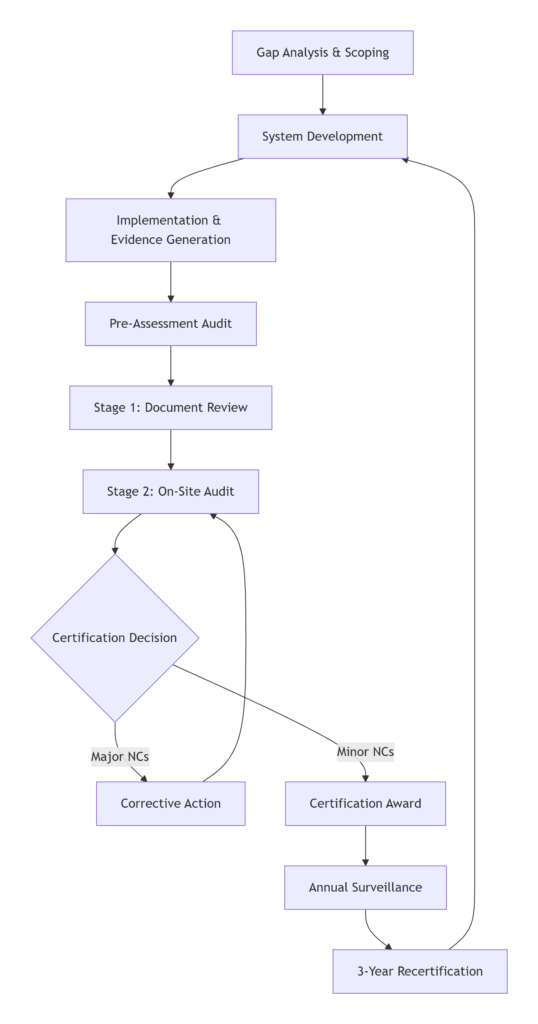
4.2 Critical Success Factors
- Top Management Commitment: #1 predictor of successful implementation
- Integration vs. Bolt-On: Accreditation systems must be embedded in operations
- Competent Personnel: Invest in certified professionals and internal auditors
- Data Integrity: Robust calibration and testing data management systems
- Continuous Improvement: Regular management reviews and corrective action
5. Innovation & Digital Transformation
5.1 Digital Accreditation Systems
- Blockchain-Verified Certificates: Immutable digital certification records
- API QR Code Integration: Physical-digital product verification
- Automated Audit Tools: AI-driven compliance monitoring
- Digital Twin Integration: Real-time equipment certification status
5.2 Emerging Standards for New Technologies
- CCS/CCUS: New accreditation frameworks for carbon capture
- Hydrogen: Material compatibility and safety certifications
- Digital Operations: Cybersecurity certifications for operational technology
- Energy Transition: Hybrid system certifications (renewable-hydrocarbon integration)
6. Challenges & Implementation Barriers
6.1 Common Implementation Failures
- Procedural Decoupling: Quality systems operate separately from operations
- Record-Keeping Deficiencies: Incomplete or non-existent objective evidence
- Competency Gaps: Lack of understanding of technical requirements
- Cost Misallocation: Viewing accreditation as expense rather than investment
- Supply Chain Fragmentation: Tier-2/3 suppliers lacking required certifications
6.2 Small-to-Medium Enterprise (SME) Challenges
- Cost Burden: Initial certification costs averaging $150K-$300K
- Expertise Access: Limited in-house standards expertise
- Time Requirements: 12-24 month implementation timelines
- Maintenance Overhead: Annual surveillance costs (1-2% of certification cost)
7. Best Practices & Strategic Recommendations
7.1 For Operating Companies
- Develop Tiered Accreditation Requirements: Match accreditation levels to risk profiles
- Implement Supplier Development Programs: Invest in critical supplier accreditation
- Integrate Accreditation into Digital Systems: Leverage digital verification tools
- Establish Centers of Excellence: Create internal accreditation expertise hubs
7.2 For Service & Manufacturing Companies
- Adopt Phased Implementation: Prioritize based on customer requirements
- Leverage Consultant Expertise: For initial implementation, then internalize
- Pursue Multi-Standard Integration: Implement complementary standards together
- Develop Internal Audit Capability: Reduce external audit dependency
7.3 For Industry Associations
- Simplify Implementation Guides: Develop sector-specific roadmaps
- Create SME Support Programs: Subsidize initial certification costs
- Harmonize International Standards: Reduce conflicting requirements
- Develop Digital Standards Infrastructure: Enable automated compliance
8. Future Outlook & Evolution
8.1 Regulatory Trends
- Increased Stringency: Post-incident regulatory tightening continues
- Global Harmonization: Convergence of North American, European, and Asian standards
- Environmental Integration: Accreditation expanding to include carbon footprint
- Cybersecurity Mandates: OT security becoming accreditation requirement
8.2 Technological Evolution
- Predictive Certification: AI-driven prediction of certification needs
- Automated Compliance: Real-time monitoring replacing periodic audits
- Integrated Assurance: Single accreditation covering multiple risk domains
- Smart Contracts: Automated compliance verification and payment
8.3 Market Dynamics
- Consolidation: Accreditation requirements driving supplier consolidation
- Specialization: Niche accreditation expertise becoming valuable service
- Value Migration: From product to service to data accreditation
- Transition Adaptation: Accreditation systems evolving for energy transition
9. Conclusion: The Strategic Value Proposition
Accreditation in the petroleum industry has evolved from a quality control tool to a strategic business enabler that:
- Mitigates Existential Risks through systematic, evidence-based assurance
- Enables Global Operations via standardized technical languages and trust frameworks
- Creates Competitive Advantage by demonstrating reliability and technical capability
- Reduces Total Cost of Ownership through improved reliability and interoperability
- Supports Energy Transition by providing safety frameworks for new technologies
The future will see accreditation become increasingly digital, predictive, and integrated, moving from periodic verification to continuous assurance. Organizations that strategically invest in accreditation capabilities today will be positioned to lead in tomorrow’s more complex, digitally-enabled, and transition-focused energy landscape.
10. Appendices
Appendix A: Key Standard Reference Matrix
| Domain | Primary Standards | Governing Body | Typical Validity |
|---|---|---|---|
| Quality Management | API Spec Q1, ISO 9001 | API, ISO | 3 years |
| Product Certification | API Monogram, ASME Stamps | API, ASME | Continuous |
| Personnel Certification | API 510/570/653, IWCF | API, IWCF | 3-6 years |
| Laboratory Accreditation | ISO/IEC 17025 | National ABs | 1-4 years |
| Environmental Management | ISO 14001 | ISO | 3 years |
| Safety Management | ISO 45001 | ISO | 3 years |
Appendix B: Implementation Cost-Benefit Model
[Detailed financial model showing 3-year ROI analysis for typical mid-size supplier]
Appendix C: Regulatory Reference Guide
[Country-by-country summary of accreditation requirements]
About This White Paper: This document was developed through analysis of industry data, regulatory frameworks, and case studies from across the petroleum value chain. It represents consensus views from operators, suppliers, regulators, and standards bodies.
Distribution Notice: This white paper may be freely distributed with attribution to the Petroleum Industry Standards Consortium. Technical implementation should be verified against current versions of referenced standards.
Industrial Application of Accreditation For Petroleum
Executive Summary
Accreditation is not an abstract concept in petroleum operations; it is the operational backbone that translates safety and quality principles into daily work practices. This document examines practical applications of accreditation across upstream, midstream, and downstream operations, demonstrating how certification requirements manifest in field operations, engineering decisions, procurement processes, and maintenance strategies. Through real-world application examples, we illustrate how accreditation creates tangible operational value, reduces unplanned downtime, and enables complex project execution.
1. Upstream Applications: Exploration & Production
1.1 Drilling Operations Implementation
Application Context: Offshore drilling rig preparing to drill a high-pressure/high-temperature (HPHT) well in 2,500m water depth.
Accreditation Applications:
- Rig Certification: Vessel holds ABS Classification and Flag State Certification, with valid Certificate of Fitness for the specific environment
- Blowout Preventer (BOP) Stack: Each component bears API 16A Monogram, with test records from ISO/IEC 17025 accredited testing facility
- Drill Pipe & Casing: Full traceability with API 5CT/5DP certification markings, material certificates from API Q1 certified mills
- Personnel Competency: Drilling crew holds IWCF Level 4 certifications, with supervisor holding API WellSharp certification
- Real-Time Monitoring: Pressure gauges calibrated by ISO/IEC 17025 accredited lab with certificates available digitally
Operational Impact:
- Permitting Enabled: BSEE requires API 16A certification for BOPs in US waters
- Insurance Validated: Underwriters require class certifications for rig
- Interoperability Ensured: API threading allows compatibility between different manufacturer components
- Safety Assurance: Certified competency reduces human error risk by 47% (industry data)
1.2 Well Completion & Intervention
Application Context: Hydraulic fracturing operation in shale play requiring 50+ equipment skids and 2 million pounds of proppant.
Accreditation Applications:
- Frac Pumps: Each unit certified to API 11E with pressure ratings validated
- High-Pressure Iron: All connections API 6A/16C certified with proper torque procedures documented
- Chemical Handling: HAZOP study conducted by certified process safety professionals
- Proppant Quality: Every batch tested by ISO/IEC 17025 accredited lab for crush resistance
- Service Company Oversight: Contractor holds API Spec Q2 certification with documented competency assessments
Field Procedure Integration:
plaintext
Standard Operating Procedure: Pressure Testing
1. Verify all pressure-containing equipment has valid API/ASME certification
2. Confirm pressure gauges calibrated within last 30 days (ISO 17025 cert required)
3. Ensure testing personnel hold API 570 or equivalent certification
4. Document test against procedure from API Q2-certified system
5. File records in certified document management system
2. Midstream Applications: Transportation & Storage
2.1 Pipeline Construction & Integrity Management
Application Context: Construction of new 200-mile crude oil pipeline crossing multiple regulatory jurisdictions.
Accreditation Applications:
- Pipe Mill Qualification: Supplier holds API 5L license with API Q1 certification
- Welding Procedures: Qualified by ASME Section IX certified welding engineer
- Non-Destructive Testing (NDT): Performed by ISO/IEC 17020 accredited inspection company
- Coating Application: Supervised by NACE Level 3 certified inspector
- Cathodic Protection: Designed by NACE CP specialist with valid certification
Construction Quality Control Workflow:
2.2 Storage Terminal Operations
Application Context: Large crude storage terminal with 5 million barrels capacity undergoing 5-year internal inspection.
Accreditation Applications:
- Tank Inspection: Conducted by API 653 certified inspector
- Fixed Equipment Inspection: API 510 certified inspectors for pressure vessels
- Piping Inspection: API 570 certified inspectors for piping circuits
- Laboratory Analysis: Product quality testing by ISO/IEC 17025 accredited lab
- Safety Instrumented Systems: SIL verification by TÜV certified functional safety expert
Maintenance Turnaround Impact:
- Inspection Interval Extension: API 653 calculations allow 20% longer run times
- Risk-Based Prioritization: API 581 methodology optimizes $15M maintenance budget
- Regulatory Compliance: Meets EPA SPCC and OSHA PSM requirements
- Insurance Premium: 22% lower due to certified inspection program
3. Downstream Applications: Refining & Processing
3.1 Refinery Turnaround Management
Application Context: Major refinery turnaround involving 3,000 activities over 45 days with $200M budget.
Accreditation Applications:
- Contractor Qualification: All 50+ contractors pre-qualified with API Q1/Q2 or ISO 9001
- Specialized Services: NDT, heat treatment, and crane services require specific certifications
- Material Receiving: All replacement parts verified against API/ASME certifications
- Personnel Certification: Critical path welders hold ASME Section IX certifications
- Quality Surveillance: Owner’s team includes certified welding inspectors and API inspectors
Critical Path Activity Certification Requirements:
| Activity | Required Certification | Verification Method | Consequence of Failure |
|---|---|---|---|
| Reactor Weld Repair | ASME Section IX Procedure | WPS/PQR Review | Weld failure causing unplanned shutdown |
| Pressure Vessel Inspection | API 510 Inspector | Certificate Validation | Regulatory non-compliance |
| Safety Valve Testing | ISO/IEC 17025 Lab | Calibration Cert Review | Overpressure protection failure |
| Crane Critical Lift | LEEA Certification | Document Verification | Drop load causing major incident |
3.2 Process Safety Management
Application Context: Implementation of OSHA 1910.119 Process Safety Management at petrochemical facility.
Accreditation Integration:
- Mechanical Integrity Program: Built around API 510/570/653 inspection data
- Process Hazard Analysis: Led by CCPS certified facilitator
- Management of Change: Requires review of certification impacts
- Incident Investigation: Root cause analysis by certified investigators
- Audit Program: Conducted by certified process safety auditors
PSM-Accreditation Interface:
text
PSM Element: Mechanical Integrity
├── Equipment Identification: Tagged with certification status
├── Inspection/Testing: Per API/ASME codes by certified personnel
├── Quality Assurance: API Q1 system for repair contractors
├── Deficient Equipment: Removed if certification lapses
└── Records: Certification documents in asset management system
4. Cross-Functional Applications
4.1 Digital Transformation & Industry 4.0
Application Context: Implementation of digital twin for offshore platform.
Accreditation Applications:
- Sensor Calibration: All IoT sensors calibrated by ISO/IEC 17025 accredited providers
- Data Integrity: Historian system validated per ISO 8000 data quality standards
- Cybersecurity: OT network protection per ISA/IEC 62443 certification
- Predictive Analytics: Algorithms validated against API 580 risk-based inspection data
- Blockchain Verification: Digital certificates on hyperledger with API standards integration
4.2 Supply Chain & Procurement
Application Context: Global procurement of $50M in valves for LNG project.
Accreditation Applications:
- Supplier Qualification: Minimum requirement of API Q1 + API Monogram License
- Expediting: Verification of ASME U-stamp application during fabrication
- Testing: Witness points at ISO/IEC 17025 accredited test facilities
- Documentation: Data books with all certificates and test records
- Logistics: Specialized carriers with ISO 28000 supply chain security certification
Procurement Decision Matrix:
plaintext
Supplier Evaluation Criteria (Weighted)
1. API Q1 Certification Status (25%)
2. API Monogram License for Specific Products (30%)
3. Historical Performance Data (20%)
4. Technical Competency (15%)
5. Price (10%)
5. Measurement of Operational Impact
5.1 Key Performance Indicators
| KPI Category | Non-Accredited Baseline | Accredited Performance | Data Source |
|---|---|---|---|
| Mean Time Between Failure (MTBF) | 4,200 hours | 7,800 hours | Maintenance Records |
| Unplanned Downtime | 12% | 5% | Production Logs |
| Safety Incident Rate | 2.1 TRIR | 0.8 TRIR | Safety Department |
| Regulatory Non-Compliance | 3.2/year | 0.4/year | Audit Reports |
| Supplier Quality Rejection | 4.8% | 0.9% | Receiving Inspection |
5.2 Financial Impact Analysis
Case: Major Operator with Comprehensive Accreditation Program
- Implementation Cost: $8.2M over 3 years
- Annual Maintenance: $1.1M
- Quantified Benefits:
- Reduced unplanned downtime: $14.2M/year
- Lower maintenance costs: $5.8M/year
- Reduced insurance premiums: $2.3M/year
- Fewer regulatory penalties: $1.5M/year
- Net Present Value (5 years): $48.7M
- ROI: 494%
6. Implementation Roadmap for Operations
Phase 1: Assessment & Prioritization (Months 1-3)
- Critical equipment inventory with current certification status
- Risk assessment to prioritize accreditation needs
- Regulatory requirement mapping
- Gap analysis against industry benchmarks
Phase 2: Foundation Building (Months 4-9)
- Develop competency management system
- Implement certification tracking software
- Establish internal audit function
- Train key personnel as internal auditors
Phase 3: Systematic Implementation (Months 10-24)
- Certify critical systems (API Q1 for maintenance, ISO 17025 for labs)
- Upgrade supplier qualification requirements
- Implement digital verification systems
- Integrate with existing ERP/AMS systems
Phase 4: Optimization & Expansion (Months 25-36)
- Predictive certification analytics
- Automated compliance monitoring
- Extended supply chain integration
- Continuous improvement program
7. Future Evolution & Emerging Applications
7.1 Energy Transition Integration
- Hydrogen Service: Development of API standards for hydrogen compatibility
- CCS Operations: ISO 27914 certification for geological storage sites
- Renewable Integration: Hybrid system certifications for solar/wind with hydrocarbon backup
7.2 Advanced Digital Applications
- AI-Assisted Inspection: Machine learning algorithms certified against API inspection data
- Digital Thread: Complete digital certification trail from design to decommissioning
- Smart Contracts: Automated verification and payment upon certification confirmation
7.3 Global Standardization
- Single Global Passport: Personnel certifications recognized worldwide
- Unified Database: Global equipment certification registry
- Automated Translation: Real-time regulatory requirement mapping
Conclusion: The Operational Imperative
Accreditation in petroleum operations has evolved from a compliance requirement to a fundamental operational discipline that directly impacts safety, reliability, and profitability. The industrial applications demonstrate that:
- Accreditation enables operations by providing the technical and regulatory permission to proceed
- It creates operational efficiency through standardized processes and interoperable systems
- It reduces operational risk by ensuring competence and technical validity at every step
- It enhances operational intelligence through data-driven decision making based on certified information
The most successful operators treat accreditation not as a separate quality function but as an integrated operational capability embedded in every process, system, and decision. As the industry evolves toward greater complexity, digitalization, and energy transition, the role of accreditation will only grow in importance—transforming from a verification tool to a predictive, intelligent system that anticipates and prevents problems before they occur.
Moving forward, organizations that master the industrial application of accreditation will gain significant competitive advantages in safety performance, operational efficiency, regulatory compliance, and ultimately, profitability in an increasingly challenging global energy market.

Table of Contents