
JAGANNATH PURI (ODISHA) – RATH YATRA FESTIVAL
Puri, Odisha, India is one of the most sacred pilgrimage destinations in India, globally known for its deep spiritual heritage and cultural richness. At the heart of this coastal city stands the revered Jagannath Temple, Puri, Odisha, India, dedicated to Lord Jagannath, an incarnation of Lord Vishnu. This temple is not only a religious center but also a symbol of unity, devotion, and ancient traditions that have been preserved for centuries.
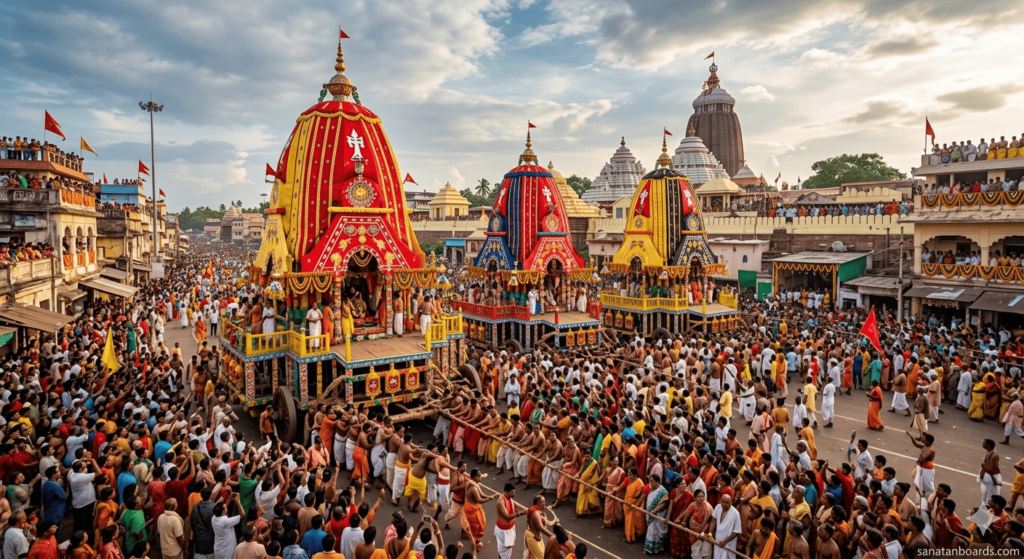
Among the many festivals celebrated here, the most significant is the grand Rath Yatra Festival, which attracts millions of devotees and visitors from across the world. This festival is known for its massive chariot procession, where Lord Jagannath, along with his siblings Lord Balabhadra and Goddess Subhadra, is taken out of the temple and placed on beautifully decorated towering wooden chariots. These chariots are then pulled by thousands of devotees through the streets of Puri to the Gundicha Temple.
The Rath Yatra is not just a religious event but a celebration of faith, equality, and devotion. It symbolizes the belief that the divine comes out of the temple to meet all people, regardless of caste, creed, or social status. The atmosphere during the festival is filled with chanting, music, rituals, and spiritual energy making it one of the largest and most vibrant religious gatherings in the world.
This festival also reflects India’s ancient cultural values, community participation, and traditional craftsmanship involved in building the massive chariots every year. Rath Yatra stands as a living example of devotion and cultural unity that continues to inspire generations.
What Is Jagannath Puri (Odisha) – Rath Yatra Festival ?
The Rath Yatra Festival is an ancient Hindu chariot festival dedicated to Lord Jagannath, held annually in Puri, Odisha, India. It is one of the oldest and most famous religious festivals in India. The festival involves the ceremonial journey of Lord Jagannath, Lord Balabhadra, and Goddess Subhadra from the Jagannath Temple, Puri, Odisha, India to the Gundicha Temple, which is considered their aunt’s house.
The highlight of this festival is the construction of three massive wooden chariots every year. These chariots are decorated with vibrant colors and religious symbols. Devotees pull these chariots using thick ropes, believing that participating in this act brings blessings and spiritual merit.
Rath Yatra is not just a ritual but a symbolic event representing the journey of life, devotion, and equality. During this time, the deities leave the temple premises, allowing everyone, including those who may not enter the temple, to have a glimpse of the divine. This reflects the inclusive nature of the festival.
The festival usually takes place in June or July, depending on the Hindu lunar calendar. It continues for several days and ends with the return journey known as Bahuda Yatra.
The Rath Yatra is globally recognized for its massive gathering of devotees, cultural performances, and spiritual energy. It is also closely associated with devotion, faith, and unity among people of different backgrounds. Over time, it has become not only a religious event but also a cultural heritage symbol of India.
Who Is Required Jagannath Puri (Odisha) – Rath Yatra Festival ?
The Rath Yatra Festival is required for devotees, pilgrims, and followers of Lord Jagannath who seek spiritual fulfillment and divine blessings. It is especially significant for devotees of Hinduism, particularly Vaishnavism, who consider Lord Jagannath an important manifestation of Lord Vishnu.
The festival is also important for the residents of Puri, Odisha, India, as it is deeply embedded in their cultural identity and traditions. Local artisans, temple priests, craftsmen, and volunteers play a crucial role in organizing the festival each year. Without their participation, the event cannot take place in its traditional form.
Pilgrims from across India and the world are drawn to the Jagannath Temple, Puri, Odisha, India during this time. Many believe that participating in the chariot pulling grants spiritual liberation and blessings. It is also required for cultural researchers, historians, and anthropologists who study Indian traditions, rituals, and ancient religious practices.
Tourists and cultural enthusiasts also consider this festival important, as it offers insight into India’s living heritage. Additionally, government bodies and tourism departments play a role in managing crowds, infrastructure, and safety, making the festival a major administrative requirement as well.
When Jagannath Puri (Odisha) – Rath Yatra Festival Required ?
The Rath Yatra Festival is required annually according to the Hindu lunar calendar, specifically on the second day of the bright fortnight (Shukla Paksha) of the month of Ashadha. This generally falls in June or July every year in Puri, Odisha, India.
The timing of this festival is spiritually significant. It is believed that during this period, cosmic energies are highly favorable for devotion and spiritual growth. The deities are taken out of the Jagannath Temple, Puri, Odisha, India to travel among devotees, symbolizing accessibility of divinity to all.
Historically, the timing also aligns with seasonal changes in India, especially the monsoon season, which brings freshness and renewal. This seasonal shift is metaphorically connected with spiritual cleansing and renewal of faith.
The festival is also required during times when communities seek unity and collective celebration. It acts as a social and cultural anchor, bringing together people from different regions, languages, and backgrounds.
From a practical perspective, the festival is required for maintaining traditional cycles of worship and temple rituals that have been followed for centuries. It ensures continuity of ancient practices and strengthens religious discipline.
In modern times, the timing of Rath Yatra is also important for tourism planning. Millions of visitors schedule their travel around this period, making it a peak time for cultural tourism in Odisha. Authorities also plan security, logistics, and infrastructure support based on this annual schedule.
Thus, the festival is required not only in a religious sense but also socially, culturally, and economically at a fixed time every year, reinforcing its importance in both traditional and modern contexts.
Where Jagannath Puri (Odisha) – Rath Yatra Festival Required ?
The Rath Yatra Festival is primarily required in Puri, Odisha, India, a sacred coastal city located in the eastern Indian state of Odisha. This city is the permanent and original location where the festival is conducted with grand scale and traditional rituals.
The central location of the festival is the Jagannath Temple, Puri, Odisha, India, one of the four major pilgrimage sites (Char Dham) in Hindu tradition. From here, the deities begin their ceremonial journey to the Gundicha Temple, located a few kilometers away.
The festival is required in this specific geographical location because of its historical and spiritual significance. Puri is considered the abode of Lord Jagannath, making it the most authentic and sacred place for this celebration.
Although smaller versions of Rath Yatra are celebrated in other parts of India and around the world, the original and most significant observance takes place only in Puri. The cultural landscape, temple architecture, and coastal environment all contribute to the uniqueness of the festival.
The streets of Puri transform into a massive devotional pathway filled with millions of devotees who gather to witness and participate in the chariot procession. The entire city becomes a spiritual hub during this time.
Thus, the festival is required in Puri because it is the birthplace and spiritual center of the tradition, making it irreplaceable in its authenticity and religious importance.
How Jagannath Puri (Odisha) – Rath Yatra Festival Is Required ?
The Rath Yatra Festival is conducted through a series of traditional rituals and well-organized cultural practices in Puri, Odisha, India.
The process begins with the construction of three massive wooden chariots for Lord Jagannath, Lord Balabhadra, and Goddess Subhadra. Skilled artisans and craftsmen build these chariots every year using sacred wood, following ancient guidelines.
Once the chariots are ready, the deities are ceremonially brought out from the Jagannath Temple, Puri, Odisha, India in a ritual called “Pahandi,” where they are placed on the chariots.
After this, thousands of devotees gather to pull the chariots using thick ropes. The movement of the chariots through the Grand Road (Bada Danda) is the main attraction of the festival. Chanting, music, and devotional songs fill the atmosphere.
The festival continues for several days at the Gundicha Temple, after which the return journey, known as Bahuda Yatra, takes place.
This entire process is required to be conducted with strict adherence to tradition, rituals, and spiritual discipline. Priests, temple authorities, government officials, and volunteers all coordinate to ensure smooth execution.
Thus, Rath Yatra is required to be performed through a structured combination of devotion, craftsmanship, ritual practice, and community participation.
Case Study On Jagannath Puri (Odisha) – Rath Yatra Festival
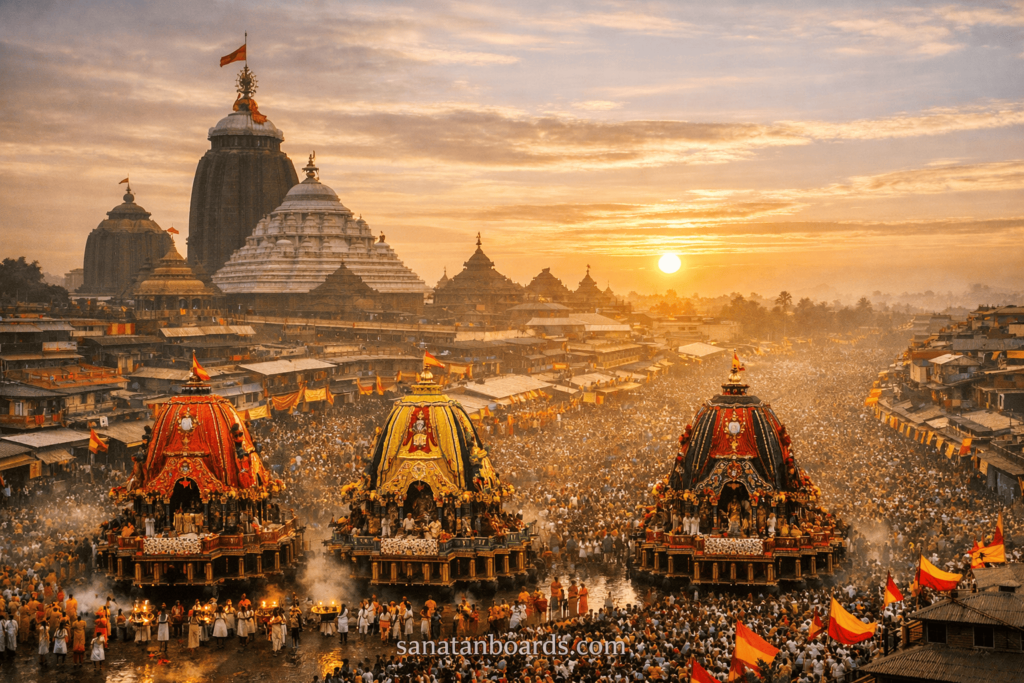
The Rath Yatra Festival held in Puri, Odisha, India represents one of the most complex and large-scale religious gatherings in the world. This case study examines its management, cultural impact, logistics, economic influence, and sustainability challenges, with the Jagannath Temple, Puri, Odisha, India acting as the central operational and spiritual hub.
1. Event Scale and Crowd Management
One of the most striking aspects of this festival is its massive scale. Millions of devotees gather over a short period, making crowd control a critical challenge. The entire city becomes a densely packed spiritual zone. Managing such crowds requires coordination between temple authorities, police forces, disaster management teams, and volunteers. Temporary barriers, surveillance systems, drone monitoring, and real-time communication networks are deployed to ensure safety.
2. Religious and Ritual Structure
The festival follows a precise sequence of rituals starting with the construction of chariots, followed by the ceremonial procession of deities. The deities are brought from the temple in a ritual called “Pahandi” and placed on chariots. The movement of these chariots along the Grand Road is the core event. The structured ritual system ensures continuity of tradition that has existed for centuries.
3. Economic Impact
Rath Yatra creates a significant seasonal economic boost. Hotels, transportation services, food vendors, artisans, and souvenir sellers benefit from the influx of visitors. Local employment increases temporarily, and small businesses see exponential growth. The festival acts as a micro-economic ecosystem that sustains livelihoods for thousands of families.
4. Cultural Preservation
The festival plays a vital role in preserving traditional craftsmanship. The construction of massive wooden chariots requires skilled artisans who follow age-old techniques. This helps preserve intangible cultural heritage, passing knowledge from one generation to another.
5. Social Inclusion
A defining feature of Rath Yatra is inclusivity. People from all backgrounds participate equally in pulling the chariots. This symbolizes equality and breaks social barriers, reinforcing unity among diverse communities.
6. Environmental and Infrastructure Challenges
The large gathering creates challenges such as waste generation, traffic congestion, and strain on public infrastructure. Authorities implement waste management systems, sanitation drives, and environmental protection measures to reduce impact.
7. Technology Integration
Modern technology has enhanced festival management. CCTV surveillance, GPS tracking, and digital crowd analytics help improve safety. Social media and live streaming platforms extend global accessibility.
Conclusion
This case study shows that Rath Yatra is not only a spiritual festival but also a highly complex socio-economic event. It integrates tradition, governance, economy, and technology into a unified system, making it one of the most successful large-scale cultural events in the world.
White Paper On Jagannath Puri (Odisha) – Rath Yatra Festival
The Rath Yatra Festival conducted in Puri, Odisha, India is one of India’s most significant cultural heritage events, centered at the Jagannath Temple, Puri, Odisha, India. This white paper analyzes its religious significance, cultural value, economic impact, governance structure, and future development opportunities.
1. Religious Significance
The festival represents the journey of Lord Jagannath, Lord Balabhadra, and Goddess Subhadra. It symbolizes divine accessibility, where the deity comes out of the temple to meet devotees. This reinforces spiritual equality and devotion across all social groups.
2. Cultural Heritage Value
Rath Yatra is an important element of India’s intangible cultural heritage. It preserves traditional music, rituals, craftsmanship, and oral traditions. The chariot construction process alone is a significant cultural practice involving specialized artisans.
3. Governance and Administration
The festival requires multi-level coordination between temple authorities, state government, police departments, healthcare services, and municipal bodies. Planning begins months in advance. Crowd control, emergency response systems, and infrastructure management are key responsibilities.
4. Economic Contributions
The festival generates significant economic activity in tourism, hospitality, transportation, retail, and local handicrafts. It supports both formal and informal sectors. Seasonal employment opportunities increase significantly during the festival period.
5. Social Impact
Rath Yatra promotes inclusivity and unity. People from diverse backgrounds participate together in religious activities. The act of pulling chariots symbolizes shared devotion and equality.
6. Environmental Concerns
Large crowds lead to waste generation and environmental pressure. Waste management systems, plastic control measures, and sanitation initiatives are implemented to reduce ecological impact.
7. Technological Advancements
Modern surveillance systems, AI-based crowd analysis, and live broadcasting have improved safety and global reach. Digital platforms allow global audiences to participate virtually.
8. Challenges
Key challenges include overcrowding, infrastructure strain, safety risks, and environmental degradation. Managing millions of people in a short duration remains a complex task.
9. Future Opportunities
Future development includes smart festival management systems, eco-friendly practices, digital tourism platforms, and enhanced global cultural promotion.
Conclusion
Rath Yatra is a living example of how ancient traditions #Sanatanboardsinvasai can adapt to modern systems. It is a model for integrating spirituality, governance, economy, and sustainability.
Industry Application On Jagannath Puri (Odisha) – Rath Yatra Festival
The Rath Yatra Festival in Puri, Odisha, India has wide-ranging applications across multiple industries, making it not only a religious event but also a major economic and cultural driver. The central hub of activity remains the Jagannath Temple, Puri, Odisha, India.
1. Tourism Industry
The festival is a major attraction for domestic and international tourists. Travel agencies design special pilgrimage packages. Airlines, railways, and bus services experience peak demand. Tourism boards use the festival to promote cultural heritage tourism.
2. Hospitality Industry
Hotels, lodges, guest houses, and homestays experience full occupancy during the festival. Food services, catering businesses, and local restaurants also see massive demand. Temporary accommodations are often created to manage overflow visitors.
3. Transportation Industry
Railways, public transport, taxis, and private operators play a crucial role in handling millions of visitors. Special trains and additional buses are scheduled to manage crowd flow efficiently.
4. Media and Entertainment Industry
The festival is widely covered by national and international media. Television channels broadcast live events, while digital platforms stream the procession globally. Documentaries, photography, and cultural programs are produced around the festival.
5. Handicrafts and Artisan Industry
Chariot construction supports traditional artisans, carpenters, and craftsmen. Local handicrafts, souvenirs, and religious artifacts also see high demand. This helps sustain indigenous skills and rural employment.
6. Technology Industry
Technology plays an increasing role in festival management. CCTV systems, drone surveillance, AI-based crowd monitoring, and mobile apps enhance safety and coordination. Digital payment systems also support transactions for vendors.
7. Security and Public Safety Industry
Large-scale deployment of police, disaster response teams, and medical units creates demand for security planning systems, surveillance equipment, and emergency services.
8. Retail and Local Business Industry
Street vendors, shops, and small businesses benefit significantly from high footfall. Temporary markets emerge during the festival period, boosting local commerce.
9. Healthcare Industry
Temporary hospitals, emergency medical camps, and ambulance services are deployed to handle health-related issues during the massive gathering.
Conclusion
The Rath Yatra festival is a multi-industry ecosystem that supports economic growth, cultural preservation, and technological integration. It demonstrates #Sanatanboardsinmumbai how a traditional religious event can influence and sustain multiple modern industries simultaneously.
source : National Geographic India
ASK FAQ
1. What is Rath Yatra in Puri?
Rath Yatra in Puri is a famous Hindu festival where Lord Jagannath, along with Balabhadra and Subhadra, is taken in grand chariots from the Jagannath Temple to Gundicha Temple in Odisha.
2. Why is Rath Yatra festival celebrated in Jagannath Puri?
It is celebrated to honor Lord Jagannath’s annual journey outside the temple, symbolizing divine connection with all devotees and promoting equality and devotion.
3. When does Rath Yatra festival take place in Puri?
Rath Yatra is held every year in June or July on the second day of Shukla Paksha in the Hindu month of Ashadha.
4. Where is Rath Yatra festival celebrated?
The main Rath Yatra festival is celebrated in Puri, Odisha, India, especially at the Jagannath Temple and along the Grand Road (Bada Danda).
5. Who participates in Rath Yatra festival?
Millions of devotees, priests, tourists, and local residents participate by pulling chariots, performing rituals, and taking part in the celebrations.
Table of Contents
DISCLAIMER
This content is created purely for educational, informational, and learning purposes. It is based on general knowledge and cultural references. While care has been taken to ensure accuracy, readers are advised to verify important details from authentic and official sources if needed. The information does not intend to promote or oppose any belief, religion, or tradition.