
OMKARESHWAR (MADHYA PRADESH)
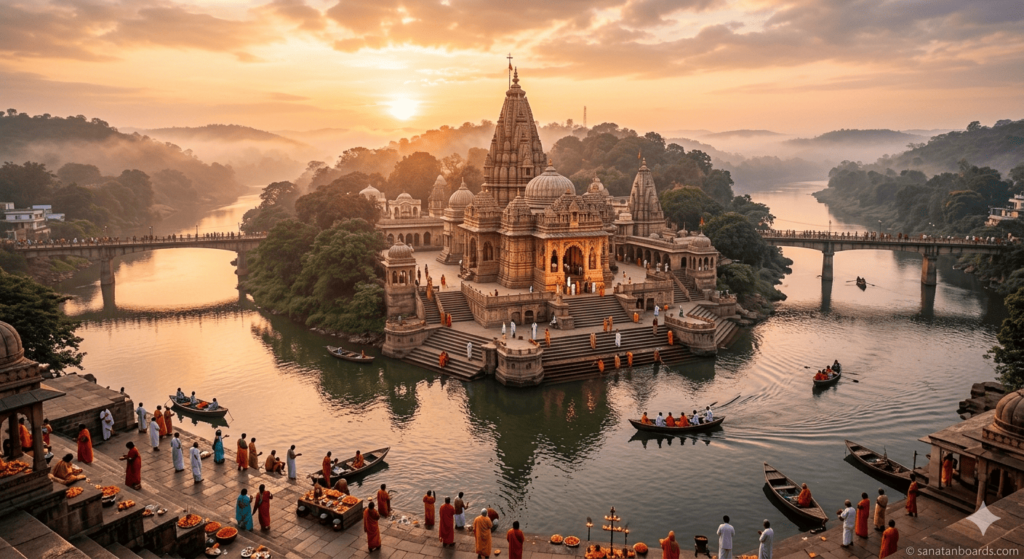
Omkareshwar is one of the most sacred and spiritually significant pilgrimage destinations in India. Located in the Indian state of Madhya Pradesh, it is situated on an island called Mandhata or Shivpuri in the holy river Narmada River. The name “Omkareshwar” is derived from the sacred Hindu symbol “Om,” as the island is naturally shaped like the symbol itself, making it a unique spiritual landmark.
This place is widely known for its deep religious importance, peaceful surroundings, and ancient temple architecture. Omkareshwar is part of the twelve Jyotirlingas of Lord Shiva, making it one of the most revered Shiva shrines in India. Pilgrims from across the country and the world visit this destination throughout the year to seek blessings and experience spiritual peace.
The town is not only a religious center but also a place of natural beauty. Surrounded by the flowing waters of the Narmada River and hills, Omkareshwar offers a calm and serene environment. The reflection of temples on the river water creates a divine atmosphere that enhances the spiritual experience of visitors.
Apart from its religious importance, Omkareshwar also holds cultural and historical value. Ancient scriptures mention its significance, and it has been a center of devotion for centuries. The architecture of the temples, the rituals performed by priests and the continuous flow of devotees make it a living spiritual hub.
Omkareshwar is also connected with nearby sacred sites, including Mamleshwar Temple, which together form a complete pilgrimage circuit. The combination of mythology, devotion, and natural beauty makes Omkareshwar a unique destination that reflects the spiritual essence of India.
What Is Omkareshwar (Madhya Pradesh) ?
Omkareshwar is a sacred pilgrimage town located in the Khandwa district of Madhya Pradesh, India. It is internationally recognized as one of the twelve Jyotirlingas dedicated to Lord Shiva, which are considered the most powerful Shiva shrines in Hindu tradition.
Geographically, Omkareshwar is situated on an island formed in the shape of the holy symbol “Om” within the river Narmada River. This natural formation is rare and contributes to its spiritual importance. The island is divided into two main temple complexes: Omkareshwar Temple and Mamleshwar Temple, both equally revered by devotees.
The primary attraction of this place is the Omkareshwar Jyotirlinga Temple, which is dedicated to Lord Shiva. According to Hindu beliefs, visiting this shrine and performing rituals here helps devotees attain spiritual liberation and peace of mind.
Omkareshwar is not just a religious site but also a cultural and historical hub. It has been mentioned in several ancient scriptures and texts, highlighting its importance in Hindu mythology. The temple architecture reflects traditional Indian craftsmanship, with intricate carvings and stone structures that represent ancient building styles.
The town is also a center for spiritual learning, meditation, and rituals. Many saints and spiritual leaders have visited or stayed here, contributing to its reputation as a divine energy center. The peaceful environment created by the flowing river, surrounding hills, and temple chants makes it a place of deep spiritual connection.
Who Is Required Omkareshwar (Madhya Pradesh) ?
Omkareshwar is required or significant for a wide range of people, especially those who seek spiritual, cultural, or historical understanding.
Firstly, it is highly important for devotees of Lord Shiva. Followers of Hinduism who worship Shiva consider visiting this Jyotirlinga as a sacred duty. It is believed that pilgrimage to this holy site brings peace, removes negative karma, and helps in spiritual growth. Therefore, religious seekers and pilgrims are the primary group who “require” Omkareshwar in their spiritual journey.
Secondly, scholars and researchers of Indian culture, history, and religion also find Omkareshwar essential. The site provides insights into ancient Hindu traditions, temple architecture, and mythological stories. Students of history, archaeology, and theology often study this location to understand India’s spiritual heritage.
Thirdly, tourists and travel enthusiasts are drawn to Omkareshwar for its unique geographical formation and peaceful environment. The island shaped like “Om” in the river Narmada River makes it a rare natural wonder, combining tourism with spirituality.
Fourthly, yoga practitioners and meditation seekers also find this place valuable. The calm atmosphere, river surroundings, and spiritual energy make it suitable for meditation, self-reflection, and inner peace practices.
Finally, architects and cultural historians are interested in the temple structures and design. The ancient construction techniques and symbolic carvings offer learning opportunities in traditional Indian architecture.
When Omkareshwar (Madhya Pradesh) Is Required ?
Omkareshwar is required at different stages of life depending on personal beliefs, spiritual needs, and cultural interests.
For many devotees, Omkareshwar becomes important during religious journeys and pilgrimages. People often plan visits during Hindu festivals such as Maha Shivaratri, Shravan month, and Kartik Purnima. During these times, the spiritual energy of the place is believed to be at its peak, and special rituals are performed at the Omkareshwar Jyotirlinga Temple.
It is also required during personal life transitions. Many individuals visit Omkareshwar when they face challenges such as illness, stress, or emotional difficulties. They seek peace and clarity through prayer and meditation along the banks of the Narmada River.
Students and researchers may require Omkareshwar when studying Indian history, religion, or architecture. Visits during academic projects or cultural studies help them gain real-world understanding of ancient traditions.
Spiritual seekers often feel the need to visit Omkareshwar during periods of self-discovery or when starting practices like yoga, meditation, or spiritual retreats. The calm environment helps them connect with inner consciousness.
Tourists may require visiting Omkareshwar when planning travel routes in Madhya Pradesh or exploring religious circuits that include Ujjain, Maheshwar, and Indore. It becomes a key destination in spiritual tourism circuits.
Seasonally, the best time when Omkareshwar is required is during winter months (October to March), when weather conditions are comfortable for travel and temple visits. Monsoon season also enhances the beauty of the island, though travel may be slightly difficult due to river conditions.
Thus, Omkareshwar is required at different times—festivals, personal needs, academic purposes, spiritual growth periods, and tourism seasons—making it a place of continuous relevance throughout the year.
Where Omkareshwar (Madhya Pradesh) Required ?
Omkareshwar is required in multiple contexts and locations of life, both physically and spiritually.
Geographically, it is located in the Khandwa district of Madhya Pradesh, India, on an island in the river Narmada River. This makes it physically required as a destination for pilgrimage routes across central India. It is often included in religious travel circuits connecting Ujjain, Indore, and Maheshwar.
Spiritually, Omkareshwar is required wherever devotion to Lord Shiva exists. Temples and shrines across India refer to its significance as one of the twelve Jyotirlingas. Therefore, its spiritual presence extends beyond its physical location into Hindu religious practices worldwide.
Culturally, it is required in places where Indian traditions are studied, preserved, or practiced. Universities, cultural institutions, and religious organizations reference Omkareshwar when teaching about Hindu philosophy, temple architecture, and pilgrimage systems.
Tourism-wise, Omkareshwar is required in travel itineraries across Madhya Pradesh. Travel agencies, tourism boards, and guides include it as a major destination due to its religious importance and natural beauty.
Historically, it is required in research centers and museums where ancient Indian history is documented. Scholars use Omkareshwar as a case study for understanding temple town development and river-based civilizations.
In modern digital spaces, Omkareshwar is required in online religious content, travel blogs, virtual tours, and educational platforms. It is frequently discussed in spiritual forums and heritage websites.
Thus, Omkareshwar is required not only at its physical location but also in spiritual, cultural, educational, tourism, and digital contexts, making it a globally recognized sacred destination.
How Omkareshwar (Madhya Pradesh) Required ?
Omkareshwar is required through various methods of engagement, travel, and spiritual practice.
Physically, it is accessed by traveling to Madhya Pradesh and reaching the island town via bridges or boats across the Narmada River. Pilgrims and tourists walk through temple paths and ghats to reach sacred sites like the Omkareshwar Jyotirlinga Temple.
Spiritually, Omkareshwar is required through rituals, prayers, and meditation. Devotees perform offerings, chant mantras, and participate in temple ceremonies to seek blessings of Lord Shiva. These practices create a deep emotional and spiritual connection.
Culturally, it is required through participation in festivals and religious gatherings. During events like Maha Shivaratri, large crowds gather to celebrate, sing devotional songs, and perform rituals together, strengthening community bonds.
Educationally, Omkareshwar is required through study and research. Students of history and religion analyze its architecture, inscriptions, and mythology. Field visits and academic studies help them understand its importance in Indian heritage.
Digitally, it is required through virtual tours, online articles, and educational videos. Many people who cannot physically visit still engage with Omkareshwar through digital platforms to learn about its significance.
Economically, the town requires tourism infrastructure such as hotels, transport, guides, and local markets. This supports livelihoods of people living in and around the region.
Case Study On Omkareshwar (Madhya Pradesh)
Omkareshwar serves as an important case study in the integration of religion, geography, tourism, and socio-economic development.
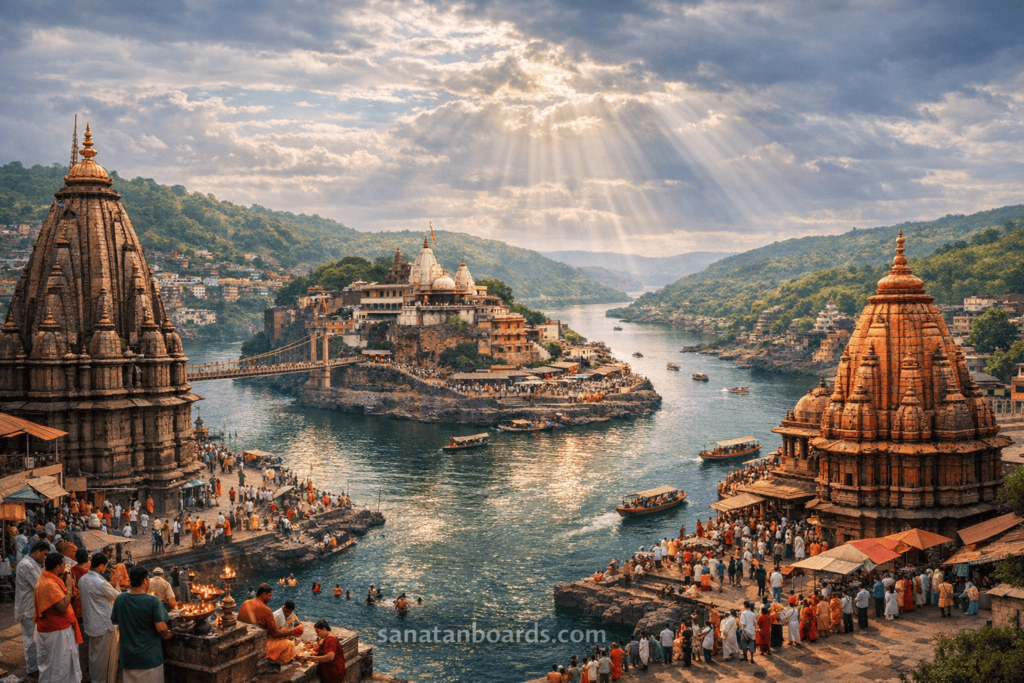
Located on an island shaped like the sacred symbol “Om” in the river Narmada River, Omkareshwar demonstrates how geography can influence cultural and spiritual identity. The natural formation of the island has directly contributed to its religious significance, making it one of the most unique pilgrimage sites in India.
The central focus of this case study is the Omkareshwar Jyotirlinga Temple. As one of the twelve Jyotirlingas, it attracts millions of devotees annually. The temple acts as a major driver of religious tourism, influencing local infrastructure development, transportation systems, and hospitality services.
From a socio-economic perspective, Omkareshwar plays a significant role in the livelihood of local residents. The economy of the region is heavily dependent on pilgrimage tourism. Small businesses, boat operators, priests, guides, hotel owners, and shopkeepers rely on the continuous flow of visitors. This creates a sustainable ecosystem centered around religious travel.
However, the site also faces challenges. Seasonal overcrowding during festivals like Maha Shivaratri leads to strain on infrastructure. Environmental concerns such as river pollution and waste management are ongoing issues that require attention. Balancing spiritual preservation with environmental sustainability is a key aspect of managing Omkareshwar.
From a cultural perspective, Omkareshwar preserves ancient Hindu traditions and rituals. Daily prayers, aarti ceremonies, and festival celebrations maintain continuity of centuries-old practices. This makes it not only a religious site but also a living cultural heritage center.
In terms of infrastructure, development projects such as bridges, roads, and river ghats have improved accessibility. However, maintaining the sanctity of the site while modernizing facilities remains a delicate balance.
The case of Omkareshwar also highlights the importance of pilgrimage tourism in India’s broader economy. It shows how religious destinations can contribute to regional development while preserving cultural identity.
In conclusion, Omkareshwar stands as a model for understanding the relationship between spirituality, geography, economy, and sustainability .#omkareshwarmadhyapradesh It reflects how sacred spaces can influence both human life and regional development when managed thoughtfully.
White Paper On Omkareshwar (Madhya Pradesh)
Omkareshwar represents a significant intersection of spirituality, cultural heritage, tourism development, and environmental management.
This white paper examines Omkareshwar as a multidimensional system where religious importance and socio-economic dynamics coexist. Situated on an island in the river Narmada River, the site is globally recognized for its unique geography and spiritual symbolism.
The primary religious institution, the Omkareshwar Jyotirlinga Temple, attracts millions of pilgrims annually. This influx generates significant economic activity for the region, including transportation, accommodation, retail, and religious services.
From a development perspective, Omkareshwar highlights the importance of pilgrimage-based economies. Local communities depend heavily on tourism-related income. This creates opportunities for employment and entrepreneurship but also introduces dependency risks if tourist flow declines.
Infrastructure development has improved accessibility through roads, bridges, and river transport systems. However, increasing visitor numbers require continuous upgrades in waste management, sanitation, and crowd control systems.
Environmental sustainability is a major concern. The river ecosystem of the Narmada faces pressure due to increased human activity. Waste disposal, plastic pollution, and water quality management are critical issues that must be addressed through coordinated policies.
Culturally, Omkareshwar plays a vital role in preserving ancient Hindu traditions. Rituals, festivals, and temple practices maintain continuity of intangible heritage. This cultural preservation enhances national identity and spiritual continuity.
Governance and management of the site involve coordination between religious authorities, local administration, and tourism departments. Effective collaboration is essential to maintain both sanctity and functionality of the site.
Technology is increasingly being used to improve visitor experience, including digital ticketing, virtual darshan, and online information systems. These innovations help manage crowd flow and enhance accessibility.
The white paper concludes that Omkareshwar serves as a model for integrated heritage management, where religious significance, economic development, #Sanatanboardsinvasai and environmental sustainability must be balanced carefully.
Industry Application Of Omkareshwar (Madhya Pradesh)
Omkareshwar has multiple industry applications, especially in tourism, hospitality, transportation, cultural management, and digital services.
The most prominent industry linked to Omkareshwar is religious tourism. The presence of the Omkareshwar Jyotirlinga Temple attracts millions of visitors annually, supporting a wide tourism ecosystem. Travel agencies design pilgrimage packages, hotels provide accommodation, and local guides offer cultural interpretation services.
The hospitality industry benefits significantly from this pilgrimage site. Hotels, dharamshalas, guest houses, and food services operate extensively to serve visitors. Seasonal demand peaks during festivals, requiring scalable service management.
Transportation is another key industry application. Road transport, bus services, taxi operators, and boat services across the Narmada River are essential for connecting pilgrims to the island. Infrastructure planning in this region is influenced by visitor flow patterns.
The retail and handicraft industry also thrives in Omkareshwar. Local markets sell religious items such as incense sticks, idols, prayer beads, and souvenirs. This supports local artisans and small businesses.
In the cultural industry, Omkareshwar plays a role in media, documentaries, and educational content. It is frequently featured in spiritual programs, travel documentaries, and historical studies, increasing its global recognition.
Digital industries are also becoming relevant. Virtual darshan platforms, travel apps, and online booking systems are increasingly used by pilgrims. This digital transformation enhances accessibility and improves crowd management.
Public administration and infrastructure development industries are involved in maintaining roads, sanitation systems, riverfront development, and crowd safety measures. These services are crucial during peak pilgrimage seasons.
The education and research industry also uses Omkareshwar as a study model for architecture, religious studies, environmental science, and tourism management.
In conclusion, Omkareshwar serves as a multi-industry #Sanatanboardsinmumbai hub where religion, tourism, economy, and technology intersect, creating a sustainable ecosystem that supports both spiritual and economic growth.
source : Traveller Rishabh
ASK FAQ
1. What is Omkareshwar famous for?
Omkareshwar is famous for being one of the 12 Jyotirlingas of Lord Shiva and for its unique island shape resembling the sacred “Om” symbol in the Narmada River.
2. Where is Omkareshwar located?
Omkareshwar is located in the Khandwa district of Madhya Pradesh, India, on an island in the Narmada River.
3. Why is Omkareshwar a popular pilgrimage site?
It is a major pilgrimage site because it is a Jyotirlinga of Lord Shiva, attracting devotees seeking blessings, peace, and spiritual fulfillment.
4. What is the best time to visit Omkareshwar?
The best time to visit Omkareshwar is from October to March when the weather is cool and comfortable for temple visits and travel.
5. Which river flows near Omkareshwar?
The sacred Narmada River flows around Omkareshwar, forming the island on which the temple town is located.
Table of Contents
Disclaimer
The information provided above is for general informational and educational understanding only. It is based on cultural, historical, and widely accepted descriptions of Omkareshwar and does not claim absolute accuracy or official authority. Readers are encouraged to verify details from authentic and updated sources when required.