
NAGESHWAR (GUJARAT)
Nageshwar Jyotirlinga is one of the most revered Shiva temples in India and holds deep spiritual significance in Hindu tradition. Located near Dwarka in the western state of Gujarat this sacred shrine is dedicated to Lord Shiva in the form of a Jyotirlinga, which represents one of the most powerful manifestations of divine energy.
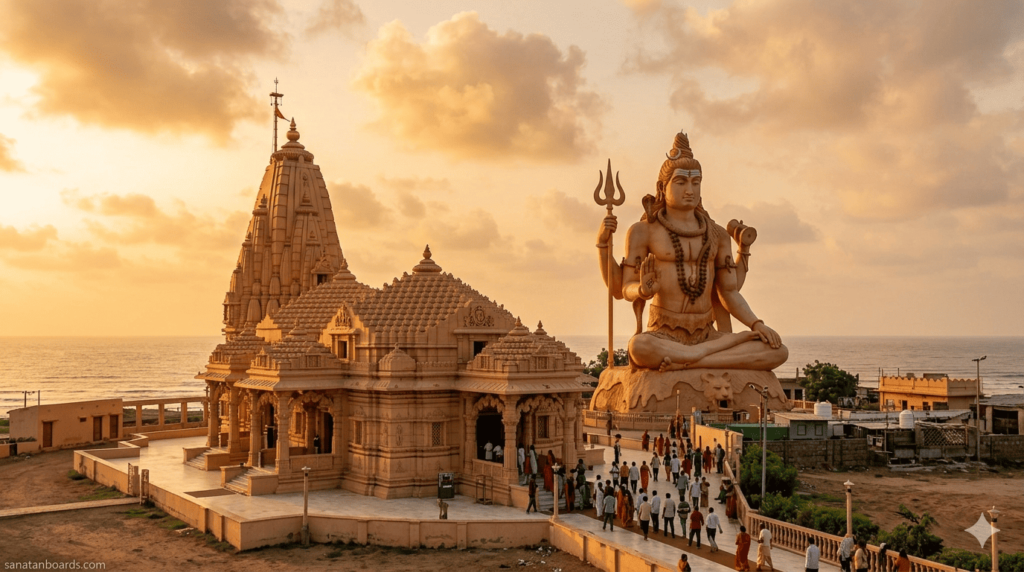
The temple is situated on the coastal route between Dwarka city and the island of Bet Dwarka, making it an important stop for pilgrims visiting the region. The towering 25-meter statue of Lord Shiva seated in a meditative posture is one of the most striking features of this site and symbolizes protection, peace, and spiritual strength.
According to Hindu belief, Jyotirlingas are self-manifested forms of Lord Shiva, and Nageshwar is considered among the twelve Jyotirlingas spread across India. This makes it a major pilgrimage destination for devotees seeking blessings, liberation, and inner peace.
The surroundings of Nageshwar are serene, with the Arabian Sea nearby enhancing the spiritual atmosphere. Devotees often visit the temple to perform rituals, offer prayers, and experience the divine presence associated with Lord Shiva.
The architecture of the temple is simple yet powerful, reflecting traditional Hindu temple design. The sanctum houses the sacred lingam, which is worshipped daily with offerings of milk, water, flowers, and prayers.
Nageshwar is not only a religious site but also a cultural landmark that represents centuries-old traditions of devotion and faith. It attracts thousands of visitors throughout the year, especially during Maha Shivaratri, when special celebrations and rituals take place.
What Is Nageshwar (Gujarat) ?
Nageshwar Jyotirlinga is a sacred Hindu temple dedicated to Lord Shiva, widely recognized as one of the twelve Jyotirlingas in India. A Jyotirlinga is considered a divine and self-manifested symbol of Lord Shiva, worshipped as a powerful energy center.
Nageshwar is located near Dwarka in Gujarat and is associated with ancient Hindu scriptures and mythological stories. It is believed that visiting this shrine helps devotees overcome negative energies, fears, and obstacles in life. The name “Nageshwar” is derived from “Naga” (serpent) and “Ishwar” (God), meaning “Lord of Serpents,” symbolizing Shiva’s control over destructive forces.
The temple structure includes a large sanctum where the Shiva Lingam is enshrined. One of its most iconic features is the massive statue of Lord Shiva seated in a yogic posture, which is visible from a distance and adds to the spiritual aura of the place.
Religious texts mention that Nageshwar Jyotirlinga is a place where Lord Shiva protects his devotees from poison and evil forces. This belief makes it especially significant for people seeking spiritual protection and peace of mind.
The temple also serves as a center for cultural and religious gatherings. Pilgrims from all over India visit Nageshwar as part of the Dwarka pilgrimage circuit, which includes other sacred sites such as Dwarkadhish Temple and Bet Dwarka.
The peaceful environment, combined with spiritual rituals performed by priests, creates a strong devotional experience for visitors. The chanting of mantras and ringing of bells enhance the sacred atmosphere, making it a deeply immersive spiritual destination.
Who Is Required Nageshwar (Gujarat) ?
Nageshwar Jyotirlinga is primarily required and visited by individuals who seek spiritual growth, mental peace, and divine blessings from Lord Shiva. Devotees of Hinduism, especially followers of Shaivism, consider this temple an essential pilgrimage site.
It is particularly significant for those who believe in the power of Jyotirlingas. People facing emotional distress, fear, or uncertainty often visit Nageshwar to find inner strength and reassurance. The spiritual energy of the temple is believed to help remove negativity and bring stability in life.
Pilgrims undertaking the Char Dham or Dwarka pilgrimage circuit also include Nageshwar in their journey. Religious travelers, monks, and spiritual seekers visit to deepen their connection with divine consciousness and practice meditation in a sacred environment.
Families also visit the temple seeking blessings for health, prosperity, and harmony. Many devotees perform special prayers for protection from harmful influences, inspired by the belief that Lord Shiva safeguards his followers from all dangers.
Apart from religious seekers, cultural tourists and history enthusiasts also visit Nageshwar to understand its mythological importance and architectural significance. The temple serves as a point of learning about ancient Indian traditions and spiritual heritage.
When Nageshwar (Gujarat) Is Required ?
Nageshwar Jyotirlinga is considered spiritually significant at various moments in a person’s life, especially during times of emotional, mental, or spiritual imbalance. Devotees often feel the need to visit this sacred shrine when they are facing challenges that cannot be resolved through ordinary means.
It is commonly visited during important Hindu festivals, particularly Maha Shivaratri, when devotion to Lord Shiva reaches its peak. During this time, thousands of pilgrims gather to perform rituals, fast, and offer prayers throughout the night. The temple becomes a center of intense spiritual activity and devotion.
Individuals also feel the need to visit Nageshwar when they are starting new phases in life, such as marriage, business ventures, or major life decisions. Seeking blessings from Lord Shiva is believed to ensure success, protection, and stability in these new beginnings.
Another important time when Nageshwar is required is during periods of personal hardship, such as illness, financial difficulties, or emotional stress. Devotees believe that praying at the Jyotirlinga helps in overcoming obstacles and restoring balance in life.
Pilgrimage seasons, especially winter and early summer, are also popular times for visiting the temple due to favorable weather conditions in Gujarat. Many religious tours and group pilgrimages are organized during these months.
Spiritual seekers may also visit the temple during times of introspection or meditation practice. The peaceful environment of Nageshwar provides an ideal setting for reflection and inner transformation.
In a broader sense, Nageshwar is required whenever an individual feels disconnected from peace, purpose, or spiritual strength. It serves as a place of renewal and divine connection, making it relevant throughout the year for different personal and religious reasons.
Where Nageshwar (Gujarat) Is Required ?
Nageshwar Jyotirlinga is located in the western coastal region of India, in the state of Gujarat. It lies on the route between Dwarka city and Bet Dwarka island, making it an important part of the Dwarka pilgrimage circuit.
Geographically, the temple is situated near the Arabian Sea, which enhances its spiritual and natural beauty. The coastal environment adds to the calm and serene atmosphere, making it ideal for worship and meditation. The surrounding area is well connected by road, allowing easy access for pilgrims and tourists.
Nageshwar is required in the cultural and religious landscape of Gujarat as one of the most important Shiva temples in the region. It serves as a key destination for devotees traveling across western India, especially those visiting other sacred sites in Dwarka.
From a pilgrimage perspective, it is required as part of a spiritual journey that includes multiple holy places. Many devotees consider it incomplete to visit Dwarka without paying homage at Nageshwar Jyotirlinga.
The temple is also required in the tourism sector of Gujarat, attracting both domestic and international visitors interested in Indian spirituality, architecture, and mythology. It contributes to religious tourism and supports local economic activity in nearby areas.
In terms of spiritual geography, Nageshwar represents a powerful energy center dedicated to Lord Shiva. It is believed that the divine presence at this location makes it essential for worshippers seeking protection and blessings.
How Nageshwar (Gujarat) Is Required ?
Nageshwar Jyotirlinga is required through devotion, rituals, and structured pilgrimage practices followed by Hindu devotees. The process of visiting and worshipping at the temple involves traditional customs that have been followed for generations.
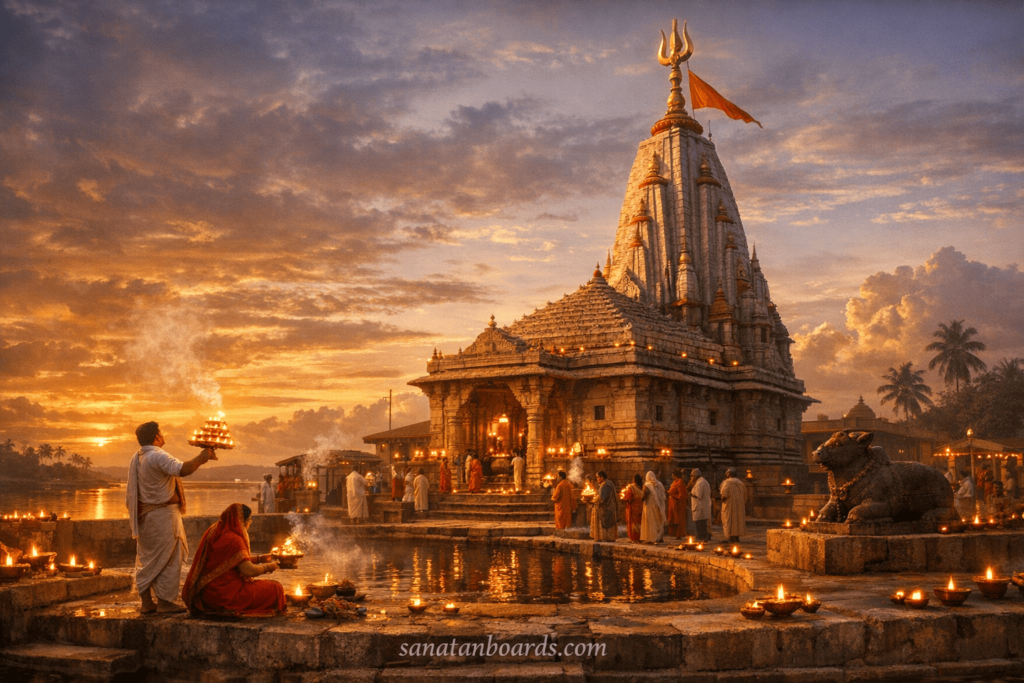
Devotees usually begin their journey by planning a pilgrimage to Dwarka, which includes visiting Nageshwar as an essential stop. Upon reaching the temple, they perform rituals such as offering water, milk, flowers, and bilva leaves to the Shiva Lingam. These offerings symbolize purity, devotion, and surrender to divine power.
Chanting of mantras such as “Om Namah Shivaya” is an important part of worship at Nageshwar. It is believed that continuous chanting helps in focusing the mind and connecting with divine energy.
Priests at the temple guide visitors through rituals, including aarti and puja ceremonies. These rituals are performed at specific times of the day, creating a structured spiritual experience for devotees.
The temple also encourages meditation and silent prayer. Many visitors spend time sitting in the temple premises, absorbing the peaceful environment and reflecting inwardly.
In a broader sense, Nageshwar is required as a spiritual discipline. It is not just about physical presence but also about devotion, faith, and mental surrender. The act of visiting the temple is seen as a way to cleanse negative energies and strengthen inner resolve.
For many devotees, regular visits or participation in religious tours ensure continued spiritual connection. It is also required in community practices where groups of pilgrims travel together reinforcing shared faith and cultural unity.
Thus, Nageshwar is required through both ritual actions and inner devotion, making it a complete spiritual experience.
Case Study On Nageshwar (Gujarat)
Nageshwar Jyotirlinga serves as an important case study in the field of religious tourism, cultural heritage, and spiritual sociology. Its significance extends beyond worship, influencing travel patterns, local economy, and cultural identity in Gujarat.
From a religious tourism perspective, Nageshwar attracts thousands of pilgrims every year. It forms a crucial part of the Dwarka pilgrimage circuit, which includes other sacred sites. This integration increases footfall and encourages longer stays in the region, boosting local hospitality services such as transport, lodging, and food businesses.
The temple’s location near the Arabian Sea adds to its uniqueness, making it both a spiritual and scenic destination. The presence of the large Shiva statue enhances its visibility and makes it an iconic landmark, contributing to its popularity among tourists.
In terms of cultural heritage, Nageshwar represents ancient Hindu traditions that have been preserved for centuries. Ritual practices performed at the temple reflect continuity of Vedic traditions. The temple acts as a living example of devotion-based culture, where rituals and beliefs are actively practiced rather than preserved only in texts.
From a sociological perspective, the temple plays a role in community bonding. Pilgrimage groups often consist of families and communities traveling together, strengthening social relationships. Shared rituals and collective prayers create a sense of unity and belonging among devotees.
Economically, Nageshwar contributes to the local economy through religious tourism. Small businesses, guides, transport operators, and vendors benefit from the continuous flow of visitors. The temple indirectly supports employment and regional development.
Environmentally, the temple area requires sustainable management due to increasing tourist activity. Maintaining cleanliness, managing waste, and preserving the coastal ecosystem are important challenges associated with high visitor numbers.
Spiritually, the case of Nageshwar highlights the human need for faith-based spaces. Devotees report feelings of peace, emotional relief, and mental clarity after visiting the temple. This demonstrates the psychological impact of sacred spaces on individuals.
The temple also plays a role in preserving mythological narratives. Stories associated with Lord Shiva and the Nageshwar Jyotirlinga are passed down through generations, ensuring cultural continuity.
White Paper On Nageshwar (Gujarat)
Nageshwar Jyotirlinga can be analyzed as a significant model for understanding the intersection of spirituality, heritage management, and tourism development in India.
The temple is one of the twelve Jyotirlingas dedicated to Lord Shiva, making it a critical node in India’s religious geography. Its importance is not limited to religious devotion but extends to cultural identity and economic activity in Gujarat.
One of the key observations is the strong inflow of pilgrimage tourism. The site attracts devotees from across India throughout the year. This continuous flow creates demand for infrastructure such as roads, accommodation, sanitation, and security services. Managing this demand is essential for sustainable tourism development.
Another key factor is heritage preservation. The temple and its surroundings must be maintained in a way that preserves both spiritual sanctity and historical authenticity. This includes maintaining the architectural structure, ritual practices, and cultural narratives associated with the site.
From an economic perspective, Nageshwar contributes significantly to local livelihoods. The tourism ecosystem around the temple includes transport operators, local vendors, priests, guides, and hospitality providers. This makes it an important driver of micro-economy in the Dwarka region.
Socially, the temple acts as a unifying space for diverse groups of people. Visitors from different regions, languages, and backgrounds come together with a shared sense of devotion. This creates a unique social environment where cultural diversity and religious unity coexist.
A major challenge identified is sustainability. Increasing visitor numbers can lead to environmental pressure on the coastal ecosystem. Waste management, crowd control, and preservation of natural surroundings are critical issues that require long-term planning.
Digital transformation also plays a role in modern management of pilgrimage sites. Information systems, online pilgrimage guides, and digital donation systems are increasingly being used to improve visitor experience and transparency.
The white paper also highlights the importance of integrating cultural education with tourism. Providing structured information about the history, rituals, and significance of Nageshwar enhances visitor understanding and enriches the pilgrimage experience.
In conclusion, Nageshwar represents a complex system where spirituality, economy, culture, and environment intersect. #Sanatanboardsinvasai Proper management and preservation strategies are essential to ensure that its significance continues for future generations.
Industry Application On Nageshwar (Gujarat)
Nageshwar Jyotirlinga has multiple applications across different industries, particularly in tourism, hospitality, cultural management, transportation, and digital services.
In the tourism industry, Nageshwar functions as a major pilgrimage destination that drives domestic travel. Travel agencies design packages that include Dwarka, Bet Dwarka, and Nageshwar as a combined religious circuit. This increases demand for organized tours, guides, and transportation services.
In the hospitality sector, the influx of pilgrims creates continuous demand for hotels, guest houses, dharamshalas, and food services. Local businesses benefit from seasonal and year-round occupancy, contributing to regional economic growth.
The transportation industry is also significantly influenced. Bus operators, taxi services, and private tour vehicles operate regularly between Dwarka and Nageshwar. Improved connectivity infrastructure supports mobility and enhances accessibility for pilgrims.
In the digital industry, Nageshwar has become part of online pilgrimage guides, mobile applications, and virtual tour platforms. Digital mapping and navigation tools help visitors locate the temple and understand its significance before visiting.
The education and research sector also finds value in Nageshwar as a case study for religious studies, anthropology, and cultural history. It is used to understand the evolution of Hindu pilgrimage traditions and temple architecture.
In media and content creation, Nageshwar is featured in documentaries, travel blogs, and cultural storytelling platforms. This helps in spreading awareness about its spiritual and historical importance to a global audience.
The retail industry benefits through sale of religious items such as flowers, incense sticks, idols, and souvenirs near the temple premises. These micro-businesses form an important part of the local economy.
In public administration, the temple is #Sanatanboardsinmumbai relevant for planning crowd management, infrastructure development, and safety measures during festivals and peak pilgrimage seasons.
source : India To Bharat
ASK FAQ
What is Nageshwar (Gujarat) famous for?
Nageshwar Jyotirlinga is famous as one of the 12 Jyotirlingas of Lord Shiva and is known for its powerful spiritual significance and large Shiva statue near Dwarka.
Where is Nageshwar Jyotirlinga located?
It is located near Dwarka in Gujarat, India, on the route between Dwarka city and Bet Dwarka island, close to the Arabian Sea.
Why do devotees visit Nageshwar?
Devotees visit Nageshwar Jyotirlinga to seek blessings of Lord Shiva, protection from negativity, and peace of mind through spiritual worship.
When is the best time to visit Nageshwar?
The best time to visit is during winter months and festivals like Maha Shivaratri, when special prayers and rituals are performed with large gatherings of devotees.
How important is Nageshwar in Hindu pilgrimage?
Nageshwar Jyotirlinga is a key part of the Dwarka pilgrimage circuit and is considered essential for devotees completing Jyotirlinga darshan journeys.
Table of Contents
Disclaimer
The information provided above is written for general knowledge, cultural understanding, and informational purposes only. It should not be considered as professional, historical, or religious authority. Interpretations of beliefs and traditions may vary across sources and communities.