
RAMESHWARAM (TAMIL NADU) – RAMANATHASWAMY TEMPLE
Located on the serene island of Rameswaram, the Ramanathaswamy Temple stands as one of the most revered pilgrimage destinations in India. This sacred temple is dedicated to Lord Shiva and holds immense significance in Hindu mythology, history, and spiritual practice. It is one of the twelve Jyotirlingas, making it a central spiritual hub for devotees across the country and beyond.
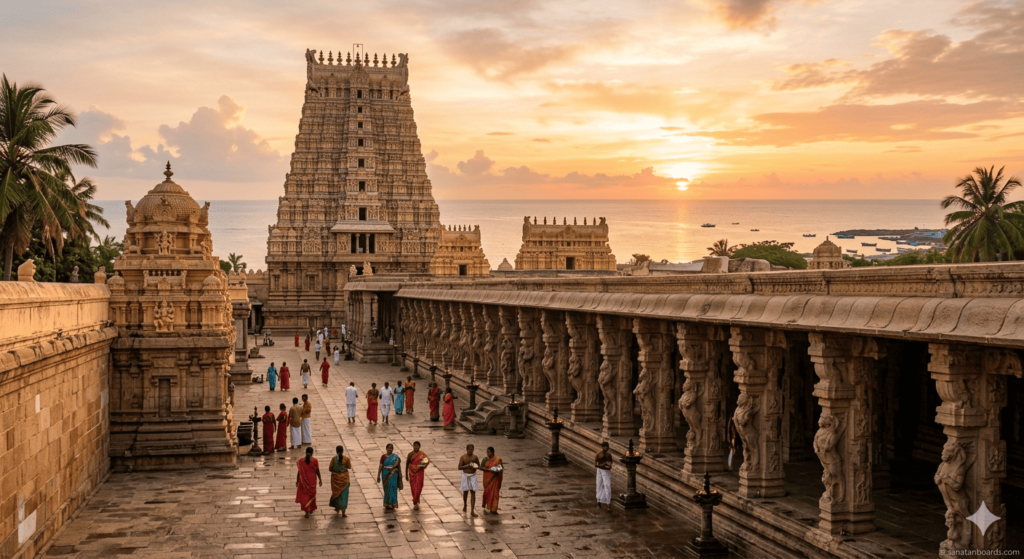
The temple’s architectural brilliance is equally captivating. Known for having one of the longest temple corridors in the world, its intricately carved pillars and expansive hallways reflect the artistic excellence of ancient Indian craftsmanship. Pilgrims are drawn not only to its religious importance but also to its cultural and historical value.
Rameswaram itself is deeply connected to the epic Ramayana. According to legend, Lord Rama worshipped Lord Shiva here to seek forgiveness after defeating Ravana. This connection enhances the temple’s sacred aura, making it a vital part of the Char Dham pilgrimage circuit.
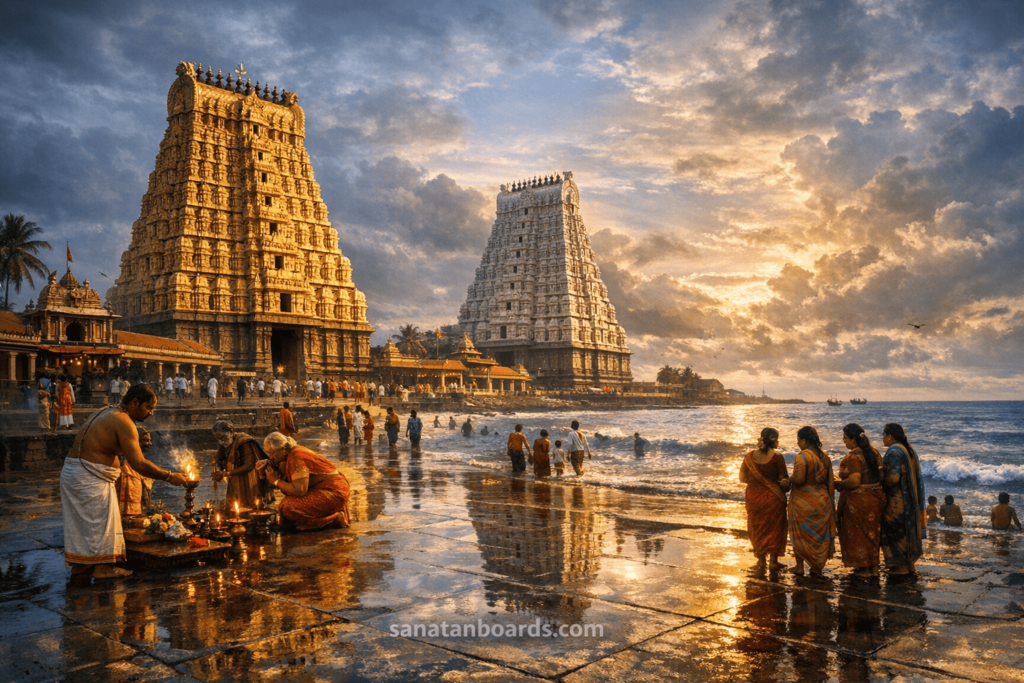
The surrounding environment adds to its spiritual charm. With the vast Bay of Bengal on one side and the Indian Ocean on the other the temple is enveloped in natural beauty and tranquility.
Today, the Ramanathaswamy Temple is not just a religious site but also a center of learning tradition, and devotion. It symbolizes unity, faith, and the enduring legacy of Indian spirituality, attracting millions of pilgrims, historians, and tourists every year.
What Is Rameshwaram (Tamil Nadu) – Ramanathaswamy Temple ?
The Ramanathaswamy Temple is a historic Hindu temple dedicated to Lord Shiva, located in the town of Rameswaram in Tamil Nadu. It is one of the holiest sites in India and forms an essential part of the Char Dham pilgrimage established by Adi Shankaracharya.
The temple is famous for its Jyotirlinga, which represents the infinite nature of Lord Shiva. Devotees believe that worshipping here helps cleanse sins and leads to spiritual liberation. The temple also houses 22 sacred wells, known as “theerthams,” each believed to have unique healing and purifying properties.
Architecturally, the temple is a masterpiece of Dravidian style, featuring towering gopurams (gateway towers), detailed sculptures, and long corridors stretching over 1,200 meters. These corridors are supported by thousands of pillars, each uniquely carved.
Historically, the temple has been expanded and renovated by various South Indian dynasties, including the Pandya Dynasty and Chola Dynasty. Their contributions have added layers of artistic and cultural richness to the structure.
Religiously, the temple is deeply tied to the Ramayana, where Lord Rama is believed to have installed the Shiva lingam. This act symbolizes devotion, humility, and the importance of seeking divine blessings even after victory.
Thus, the Ramanathaswamy Temple is not merely a place of worship but a symbol of spiritual discipline, architectural excellence, and historical continuity that continues to inspire millions.
Who Is Required Rameshwaram (Tamil Nadu) – Ramanathaswamy Temple ?
The Ramanathaswamy Temple is significant for a wide range of individuals, each drawn by different motivations—spiritual, cultural, educational, and personal.
Primarily, Hindu devotees, especially followers of Lord Shiva, consider visiting this temple a sacred duty. Pilgrims undertaking the Char Dham Yatra regard Rameswaram as an essential destination to complete their spiritual journey. Devotees seeking purification from sins or wishing to perform ancestral rituals often visit the temple.
Students and researchers in fields such as history, architecture, and religious studies also find immense value in the temple. The Dravidian architectural style, intricate carvings, and historical evolution provide rich material for academic exploration.
Tourists and cultural enthusiasts are equally drawn to the temple. Its artistic grandeur and mythological connections make it a fascinating destination for those interested in India’s heritage. Photographers and travel writers often document its beauty and cultural significance.
Spiritual seekers and meditators visit the temple to experience peace and introspection. The sacred environment, rituals, and chants create a deeply calming atmosphere conducive to inner reflection.
Local communities and businesses also rely on the temple, as it supports tourism, livelihoods, and cultural preservation. Priests, guides, and artisans play crucial roles in maintaining the temple’s traditions.
Thus, the Ramanathaswamy Temple serves a diverse audience, from devout pilgrims to curious learners, making it a universal center of faith, knowledge, and cultural exchange.
When Rameshwaram (Tamil Nadu) – Ramanathaswamy Temple Is Required ?
The importance of visiting the Ramanathaswamy Temple often depends on spiritual timing, personal milestones, and religious occasions.
Many devotees choose to visit during auspicious Hindu festivals such as Maha Shivaratri, when the temple witnesses grand celebrations dedicated to Lord Shiva. This period is considered highly sacred, and participating in rituals during this time is believed to bring immense blessings.
Another significant time is during Amavasya (new moon days), especially for performing ancestral rites. Devotees believe that offering prayers and rituals at Rameswaram helps bring peace to departed souls.
Pilgrims also visit the temple as part of life events such as marriage, childbirth, or after achieving major milestones. It is considered auspicious to seek divine blessings during these transitional phases of life.
Seasonally, the months between October and April are preferred due to pleasant weather conditions. This allows visitors to comfortably explore the temple and nearby sites.
From a spiritual perspective, the temple is “required” whenever an individual seeks inner peace, forgiveness, or a deeper connection with the divine. Many people visit during times of personal difficulty, believing that prayers offered here provide strength and guidance.
The temple also plays a role during religious pilgrimages like the Char Dham Yatra, where it serves as a concluding point for many travelers.
Where Rameshwaram (Tamil Nadu) – Ramanathaswamy Temple Is Required ?
The Ramanathaswamy Temple holds significance in both geographical and symbolic contexts.
Geographically, it is located in Rameswaram, a coastal town in Tamil Nadu, situated on Pamban Island. This island is connected to mainland India by the famous Pamban Bridge, which itself is an engineering marvel.
The temple’s location between the Bay of Bengal and the Indian Ocean adds to its spiritual symbolism. Water bodies are considered purifying in Hindu tradition, and the temple’s proximity to the sea enhances its sacredness.
Symbolically, the temple represents a bridge between humanity and divinity. It is believed to be the place where Lord Rama built the legendary Ram Setu to reach Lanka.
The temple is also significant within the Char Dham circuit, which includes Badrinath Temple, Dwarkadhish Temple, and Jagannath Temple. Together, these sites represent spiritual coverage across India.
In a broader sense, the temple is “required” wherever discussions of Indian spirituality, architecture, or cultural heritage take place. It serves as a case study in religious harmony, historical continuity, and artistic excellence.
Thus, the Ramanathaswamy Temple is not confined to a physical location alone—it exists as a spiritual landmark in the hearts and minds of millions.
How Rameshwaram (Tamil Nadu) – Ramanathaswamy Temple Is Required ?
The relevance of the Ramanathaswamy Temple is understood through its role in spiritual practices, cultural preservation, and personal transformation.
Spiritually, the temple provides a structured path for devotion. Rituals such as bathing in the 22 theerthams, performing पूजा (puja), and offering prayers help devotees achieve purification and peace. These practices are deeply rooted in Hindu traditions and continue to be followed with devotion.
Culturally, the temple preserves ancient architectural techniques and artistic traditions. The detailed carvings and long corridors demonstrate the engineering brilliance of past civilizations.
Educationally, the temple serves as a living museum. Students and scholars learn about South Indian dynasties, religious practices, and architectural evolution through direct observation.
Economically, the temple supports local livelihoods through tourism. Hotels, shops, guides, and transport services benefit from the influx of visitors.
Socially, it acts as a unifying force, bringing together people from diverse backgrounds in a shared spiritual experience.
Case Study On Rameshwaram (Tamil Nadu) – Ramanathaswamy Temple
The Ramanathaswamy Temple located in Rameswaram serves as a comprehensive case study demonstrating the intersection of religion, architecture, economy, and cultural sustainability. As one of the twelve Jyotirlingas and a major Char Dham pilgrimage site, the temple attracts millions of devotees annually, making it a dynamic model of spiritual tourism and heritage management.
Historically, the temple has evolved through contributions from multiple dynasties, including the Pandya rulers and later regional kings. Its construction and expansion over centuries reflect a layered development process influenced by political, cultural, and religious changes. The temple’s current structure largely dates back to the 17th century, though earlier foundations existed, showcasing continuity in religious practices and architectural evolution.
From an architectural standpoint, the temple is globally recognized for having the longest corridor among Hindu temples, with intricately carved pillars and expansive hallways. These corridors, stretching thousands of feet, represent advanced engineering and aesthetic precision. The temple also features towering gopurams and Dravidian-style architecture, making it a significant subject of study for architects and historians.
Religiously, the temple holds immense importance due to its association with the epic Ramayana. According to tradition, Lord Rama worshipped Lord Shiva at this site to seek absolution after defeating Ravana. This narrative strengthens the temple’s spiritual relevance and highlights the integration of mythology into cultural identity.
Economically, the temple significantly contributes to the local and regional economy. The influx of pilgrims generates demand for hospitality services, transportation, food industries, and local crafts. This creates employment opportunities and supports the livelihoods of thousands of people in the region.
Socially, the temple acts as a unifying institution, bringing together people from diverse backgrounds. Festivals, rituals, and daily पूजा practices foster community engagement and cultural continuity. The temple also serves as a center for religious education and transmission of traditional knowledge.
However, the temple also faces challenges. Environmental factors such as coastal erosion, climate conditions, and infrastructure strain due to heavy footfall pose risks to its preservation. Government bodies and temple authorities have initiated restoration and conservation efforts, including renovation projects and improved pilgrim facilities.
In conclusion, the Ramanathaswamy #rameshwaramtamilnadu Temple stands as a holistic case study of how a religious institution can influence architecture, economy, society, and heritage preservation. Its ability to balance tradition with modern management practices makes it a valuable model for sustainable cultural development.
White Paper On Rameshwaram (Tamil Nadu) – Ramanathaswamy Temple
The Ramanathaswamy Temple represents a critical asset in India’s religious, cultural, and tourism ecosystem. This white paper evaluates its significance, operational challenges, and future sustainability strategies within the broader framework of heritage management.
The temple is a key component of the Char Dham pilgrimage circuit, which includes Badrinath Temple, Dwarkadhish Temple, and Jagannath Temple. This positioning ensures a consistent flow of pilgrims and reinforces its national and international importance.
From an infrastructure perspective, the temple operates within a complex environment that requires continuous maintenance. The structure’s age, combined with environmental exposure, necessitates regular conservation efforts. Restoration initiatives focus on preserving intricate carvings, maintaining structural stability, and ensuring the safety of visitors.
The temple’s architectural uniqueness, particularly its long corridors and detailed sculptures, demands specialized conservation techniques. Preservation efforts must balance maintaining authenticity with incorporating modern engineering solutions.
Technological integration has emerged as a key strategy for improving temple management. Digital systems for crowd control, online booking, and information dissemination enhance efficiency and visitor experience. These systems help manage the large volume of pilgrims, especially during peak seasons and festivals.
Economically, the temple plays a vital role in regional development. It supports industries such as tourism, hospitality, transportation, and retail. The steady influx of visitors contributes significantly to the local economy and promotes small-scale enterprises.
Sustainability is a major focus area. Environmental concerns such as waste management, water conservation, and energy usage are being addressed through eco-friendly initiatives. The temple’s location between the Bay of Bengal and the Indian Ocean makes it particularly vulnerable to climate-related challenges, necessitating proactive measures.
Policy recommendations for the temple include increased funding for conservation, improved transportation infrastructure, and enhanced visitor management systems. Collaboration between government agencies, heritage organizations, and local communities is essential for sustainable development.
The temple also serves as a platform for cultural diplomacy, attracting international tourists and scholars interested in Indian heritage. Educational programs and guided tours can further enhance its role as a learning center.
In conclusion, the Ramanathaswamy Temple exemplifies how heritage sites can integrate tradition with modern management practices. #Sanatandharmaaccreditationboardsinvasai By adopting sustainable strategies and leveraging technology, the temple can continue to thrive as a center of spirituality, culture, and economic activity.
Industry Application Of Rameshwaram (Tamil Nadu) – Ramanathaswamy Temple
The Ramanathaswamy Temple in Rameswaram is not only a major spiritual destination but also a powerful driver of multiple industries. Its influence extends beyond religion into economic development, cultural preservation, and infrastructure growth. Below are the key industry applications:
1. Tourism Industry
The temple plays a central role in India’s religious tourism sector. As one of the Char Dham pilgrimage sites, it attracts millions of visitors annually. This continuous flow of pilgrims and tourists boosts regional and national tourism revenue. Travel agencies, tour operators, and pilgrimage planners rely heavily on destinations like Rameswaram to design spiritual travel packages.
2. Hospitality Industry
The large number of visitors creates strong demand for hotels, guest houses, lodges, and restaurants. From budget accommodations to mid-range hotels, the hospitality sector thrives due to temple tourism. Local food businesses and traditional South Indian cuisine outlets also benefit significantly.
3. Transportation & Infrastructure Industry
The temple drives the development of transportation networks, including roads, railways, and connectivity via the famous Pamban Bridge. Bus services, taxis, auto-rickshaws, and private travel operators all gain business due to increased movement of pilgrims. Infrastructure improvements such as better roads and public facilities are often driven by tourism demand.
4. Cultural & Heritage Industry
The temple is a living example of Dravidian architecture and ancient Indian craftsmanship. It supports industries focused on heritage conservation, restoration, and cultural tourism. Traditional arts, temple rituals, and local customs are preserved and promoted through this ecosystem.
5. Education & Research Industry
The temple serves as an important subject for academic research in history, archaeology, architecture, and religious studies. Universities, historians, and researchers study its structure, inscriptions, and cultural relevance. It acts as a real-world learning site for students and scholars.
6. Retail & Local Business Industry
Local markets flourish due to temple tourism. Shops selling पूजा items, souvenirs, handicrafts, seashell artifacts, and religious books benefit directly. Small-scale vendors and artisans gain steady income from visiting pilgrims.
7. Media, Publishing & Digital Content Industry
The temple inspires documentaries, travel blogs, photography projects, and social media content. Writers, filmmakers, and influencers create content around its mythology, architecture, and spiritual significance, contributing to the media and publishing ecosystem.
8. Event & Religious Services Industry
Priests, ritual service providers, and organizers of religious ceremonies depend on temple activities. Events like festivals, special पूजा, and ancestral rituals generate employment and sustain traditional occupations.
9. Environmental & Sustainability Sector
Due to its coastal location between the Bay of Bengal and the Indian Ocean, the temple influences environmental management practices. Waste management, water conservation, and eco-tourism initiatives are increasingly being developed to maintain sustainability.
Conclusion
The Ramanathaswamy Temple functions as a multi-industry catalyst, supporting economic growth, preserving cultural heritage, and #Sanatandharmaaccreditationboardsinmumbai promoting sustainable development. Its impact extends far beyond spirituality, making it a vital component of regional and national industry ecosystems.
source : visa2explore
ASK FAQ
1. What is the significance of Ramanathaswamy Temple?
The Ramanathaswamy Temple is one of the twelve Jyotirlingas dedicated to Lord Shiva and an important part of the Char Dham pilgrimage. It is believed to cleanse sins and provide spiritual liberation to devotees.
2. Where is Ramanathaswamy Temple located?
The temple is located in Rameswaram, a coastal town in Tamil Nadu, situated on Pamban Island and connected to mainland India by the Pamban Bridge.
3. Why is Ramanathaswamy Temple famous?
It is famous for its long temple corridors, sacred 22 theerthams (holy wells), and its connection to the Ramayana, where Lord Rama worshipped Lord Shiva.
4. When is the best time to visit Ramanathaswamy Temple?
The best time to visit is between October and April due to pleasant weather. Festivals like Maha Shivaratri are also considered highly auspicious.
5. How to reach Ramanathaswamy Temple?
Rameswaram can be reached by train, road, and nearby airports. The iconic Pamban Bridge connects the island to mainland India, making travel accessible.
Table of Contents
Disclaimer
This content is created for informational, educational, and knowledge-sharing purposes only. While efforts have been made to ensure accuracy and completeness, interpretations of historical and religious aspects may vary. Readers are encouraged to refer to official sources or visit the site for firsthand experience.