TIBETAN EMPIRE – KING TRISONG DETSEN (PATRON OF BUDDHISM, HINDU INFLUENCE)
The history of Central and South Asia in the first millennium CE is marked by powerful empires that shaped religious, cultural, and geopolitical landscapes. Among these was the Tibetan Empire, which rose to prominence in the 7th–9th centuries CE and became a central force in Himalayan history. One of the most consequential rulers of this empire was King Trisong Detsen, often remembered for his decisive role in establishing Buddhism as a major faith in Tibet and for fostering intellectual exchanges between Tibet and South Asian cultures. His reign marked an extraordinary period of religious transformation and cultural flowering.
Trisong Detsen inherited a kingdom that had already begun to expand militarily and politically. What set his rule apart was the strategic focus on religious reform, scholarly development and intercultural dialogue. He actively invited Buddhist scholars from India, including the renowned masters Shantarakshita and Padmasambhava, to Tibet. Their arrival and influence led to the founding of major monastic institutions, the translation of Buddhist scriptures from Sanskrit into Tibetan, and the formation of doctrinal foundations that would guide Tibetan Buddhism for centuries.
In addition to Buddhist influence, the intellectual and ritual traditions of Hindu philosophical thought and South Asian cultural exchange played a role in shaping the Tibetan religious landscape. This interweaving of traditions contributed to a complex syncretism in Tibetan ritual and metaphysics, particularly in the early growth of Vajrayana Buddhism.
King Trisong Detsen’s legacy is thus pivotal not only for the establishment of Buddhism as a state-supported religion but also for the broader exchange of ideas across Himalayan and South Asian civilizations His leadership set the stage for Tibet’s emergence as a major religious and cultural center in Asia.
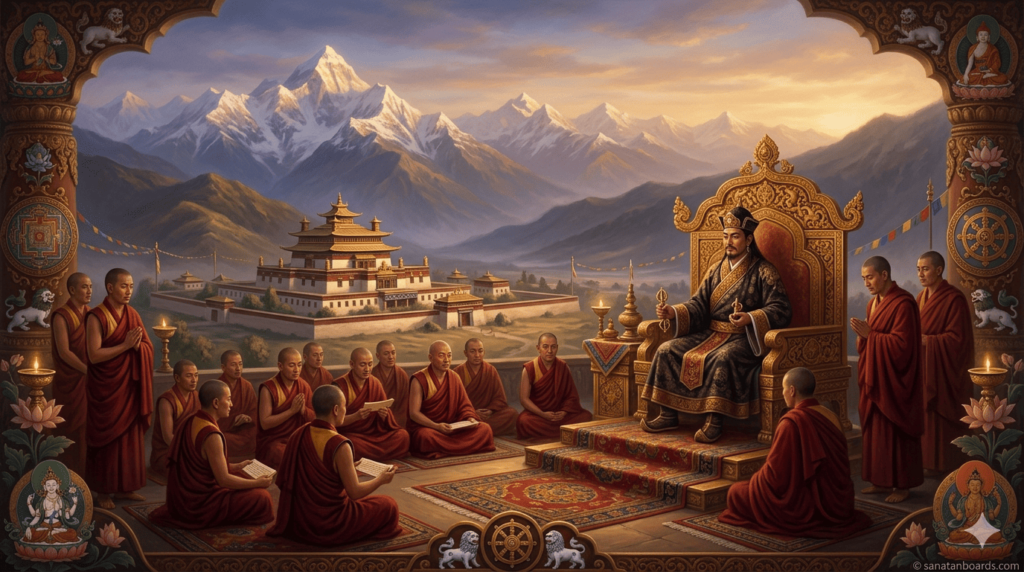
What Is Tibetan Empire – King Trisong Detsen (Patron Of Buddhism, Hindu Influence) ?
The term “Tibetan Empire – King Trisong Detsen” refers to a central historical era in Tibet, roughly dated from the mid-8th century CE, where the Tibetan polity reached immense territorial strength and cultural integration. The Tibetan Empire itself was a powerful regime that controlled regions spanning from Central Asia to parts of the Indian subcontinent. Within this context, King Trisong Detsen stands out as a key monarch, whose reign marked a turning point in Tibet’s religious identity.
Trisong Detsen’s rule is primarily defined by his support and institutionalization of Buddhism. Prior to his reign, Tibet had various indigenous spiritual traditions, including Bon and shamanic practices. Trisong Detsen saw Buddhism not only as a spiritual path but as a tool for unifying his expanding kingdom under shared philosophical and ethical principles.
To accomplish this, he invited Indian Buddhist masters such as Shantarakshita, who helped establish early monastic systems, and Padmasambhava, credited with introducing Tantric or Vajrayana teachings to Tibet. These teachers worked alongside Tibetan translators to render key Buddhist texts into Tibetan-language script, forming the backbone of Tibetan Buddhist canon.
He founded Samye Monastery, the first major Buddhist monastic center in Tibet, symbolizing the formal establishment of Buddhist institutional life.
During this time, Tibetan intellectual life also absorbed ideas from Hindu philosophy and South Asian ritual traditions. Though not uniformly dominant, the influence of Hindu thought can be seen in early liturgical traditions, cosmological ideas, and linguistic borrowings. These interactions contributed to a rich blend of spiritual thought, where Buddhist and pre‑Buddhist ideas interlaced across Tibetan cultural life.
Thus, the phrase signifies both the political structure of the Tibetan Empire under Trisong Detsen and his role in shaping Tibet’s spiritual identity—mainly through Buddhism and intercultural exchanges with South Asian traditions.
Who Is Required Tibetan Empire – King Trisong Detsen (Patron Of Buddhism, Hindu Influence) ?
It involves identifying the people, groups, and societies that played essential roles or whose identities became defined by these developments.
First and foremost, the central figure is King Trisong Detsen himself. He is the historical person around whom this topic revolves. Born into the Yarlung dynasty, Trisong Detsen became emperor at a young age and ruled for several decades. His leadership was defined by statecraft, religious reform, and cultural diplomacy.
Integral to this story are Indian Buddhist masters such as Shantarakshita and Padmasambhava. These scholars were invited to Tibet at Trisong Detsen’s request to establish Buddhist teaching and monastic systems. Shantarakshita helped introduce scholarly and monastic discipline, while Padmasambhava is often credited with integrating Tantra and establishing esoteric practices that became prominent in Tibetan Buddhism.
Alongside these figures were Tibetan translators and scholars—not always individually named in historical records but collectively pivotal. They mastered Sanskrit and Tibetan languages, facilitating the translation of hundreds of Buddhist texts. Their work ensured that Buddhist philosophy could be studied, taught, and practiced widely within Tibetan society.
The broader Tibetan nobility and military elites are also part of “who” this topic includes. Their support or opposition could determine the success of religious reforms. While some nobles resisted the spread of Buddhism, others embraced and protected the network of monasteries and teachers backed by the king.
Finally, the indigenous spiritual practitioners—those practicing Bon and Himalayan folk traditions—also figure into this narrative. Though not always converters to Buddhism, they were deeply impacted by the shifts in religious authority, adaptations of ritual practices, and the changing cultural landscape under Trisong Detsen’s reign.
When Is Tibetan Empire – King Trisong Detsen (Patron Of Buddhism, Hindu Influence) Required ?
It refers to the historical period and circumstances in which this topic becomes significant. This period mainly centers on the 8th century CE, during which Trisong Detsen’s reign catalyzed transformative shifts in religion, culture, and political identity in Tibet.
Trisong Detsen is believed to have started his rule around circa 755 CE and continued until approximately 797 CE, though some sources suggest slight variations in dating. This era falls within the broader timeline of the Tibetan Empire, which existed from about 618 CE to 842 CE. The early phase of the empire was defined by military expansion and consolidation of power, but it was under Trisong Detsen that religious reform became a priority.
The “requirement” of this topic arises not only at the point of his ascension to the throne but in response to several critical needs within Tibet at that time:
- Political Consolidation: As the empire grew geographically, unifying diverse peoples and belief systems became essential. A shared spiritual framework helped integrate various regions and tribes into a cohesive polity.
- Cultural Development: Tibet had no centralized script or standardized educational system before this period. Under the king’s patronage, scholars began systematizing language, literature, and philosophy—especially through translating Indian Buddhist texts into Tibetan.
- Religious Reform: Buddhism had reached Tibet earlier but lacked institutional support. During Trisong Detsen’s reign, Buddhism required formal legitimization and a structured monastic presence. The king’s invitation to Indian masters and establishment of monastic institutions were responses to this need.
- Intercultural Exchange: As Tibet interacted with neighboring powers like the Tang Dynasty China and Indian kingdoms, diplomatic and cultural exchange intensified. Understanding Buddhist and Hindu thought became necessary for both internal governance and external relations.
Thus, the period circa mid–8th century CE to late–8th century CE is when the topic is most relevant. It was a time when Tibet was actively transforming and redefining its identity. The convergence of political expansion with the institutionalization of Buddhism under Trisong Detsen made the question of “when” not merely a chronological point but a convergence of political, spiritual, and intellectual needs.
Where Is Tibetan Empire – King Trisong Detsen (Patron Of Buddhism, Hindu Influence) Required ?
It involves the geographical and cultural spaces in which this historical phenomenon took place and had impact. The epicenter of this narrative is the Tibetan Plateau, but its influence extended far beyond.
Primary Location: The Tibetan Plateau
The core of the Tibetan Empire under King Trisong Detsen was located in what is today the Tibet Autonomous Region (China) and parts of western China. Here, the imperial capital—often identified as Zhang Zhung and later Lhasa—served as the political and spiritual heart of the empire.
Monastic Centers
One of the most significant sites associated with Trisong Detsen is Samye Monastery, the first large Buddhist monastery established in Tibet. Founded under his reign in the late 8th century CE, Samye became a model for monastic layout, scholastic life, and spiritual practice.
Indian Subcontinent
The presence of the Indian subcontinent in this narrative was not merely intellectual but physical: Tibetan delegations traveled to regions corresponding to modern-day northern India, including Bihar and Uttar Pradesh, to seek teachers and scriptures. Indian Buddhist masters such as Shantarakshita and Padmasambhava brought their teachings into Tibet, making India itself a crucial geographic node in this history.
Central Asian Frontiers
The Tibetan Empire extended its influence into Central Asia, interacting with neighboring powers such as the Tang Dynasty in China and various Turkic states. These interactions facilitated cultural exchange and the movement of ideas. Border regions like Xinjiang and Khotan were also part of the broader geopolitical environment in which Tibetan religious and political policies were enacted.
Himalayan Cultural Zones
Regions such as Nepal, Bhutan, and Sikkim were part of a shared Himalayan cultural sphere influenced by the religious developments emanating from Tibet. Buddhist traditions adopted and adapted in these regions show traces of the early institutional Buddhism that began under Trisong Detsen’s patronage.
In summary, where this topic is required includes:
- The Tibetan Plateau (core political center)
- Samye and other monastic sites (religious hubs)
- Northern India (source of teachers and scriptures)
- Central Asian frontiers (zones of interaction)
- Himalayan cultural regions (areas affected by Tibetan religious diffusion)
These geographic spaces together form the landscape in which political authority, religious transformation, and cultural exchange converged during Trisong Detsen’s era.
How Is Tibetan Empire – King Trisong Detsen (Patron Of Buddhism, Hindu Influence) Required ?
It refers to the mechanisms and processes through which this historical reality unfolded—essentially, how these developments took place.
1. Royal Patronage
King Trisong Detsen exercised state power to support the institutionalization of Buddhism. He mobilized resources to build monasteries, fund translation projects, and sustain resident scholars and monks. His patronage made Buddhism a sanctioned and protected tradition.
2. International Scholarly Exchange
One of the defining processes was the invitation and exchange of knowledge. Trisong Detsen sent emissaries to India to invite Buddhist masters and secure sacred texts. This involved diplomatic negotiation, travel logistics, and cultural adaptation. Scholars like Shantarakshita and Padmasambhava were embedded within Tibetan society, teaching both theory and practice.
3. Translation and Linguistic Systematization
A massive effort to translate Sanskrit texts into Tibetan was organized under royal directive. Teams of Tibetan scholars learned Sanskrit and collaborated with Indian pandits to render sutras and tantras into Tibetan script. This translation movement institutionalized not only religion but also academia and literacy.
4. Monastic Institutionalization
The establishment of monasteries such as Samye created centers for ritual life, education, and community. Monasteries became places where doctrine was taught, debated, memorized, and practiced, shaping an intellectual tradition that would endure for centuries.
5. Ritual Integration
The interplay between Buddhist and pre‑existing local religious practices involved negotiation, adaptation, and synthesis. Ritual forms, cosmologies, and ceremonial roles were adapted from indigenous traditions and Hindu elements into a distinctly Tibetan Buddhist expression.
6. Political Strategy
King Trisong Detsen employed religion as part of statecraft. By aligning religious authority with political authority, he was able to unify disparate regional leaders, resolve internal tensions, and strengthen central governance.
7. Cultural Transmission
Through pilgrimage, study, and diplomatic contact with neighbors like the Tang Dynasty, knowledge traveled both inward and outward. Artistic styles, architectural forms, and philosophical debates circulated across borders.
Case Study On Tibetan Empire – King Trisong Detsen (Patron Of Buddhism, Hindu Influence)
Background
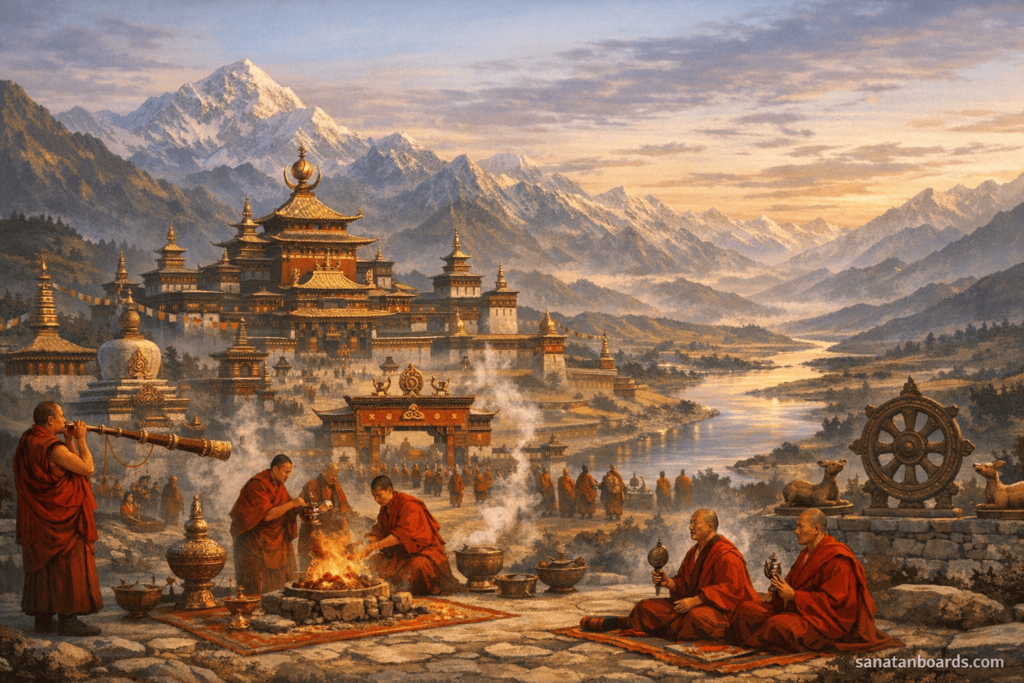
During the 8th century CE, the Tibetan Empire had grown into a regional power. While military expansion defined its earlier centuries, the reign of King Trisong Detsen marked a distinct pivot toward religious consolidation, intellectual growth, and cultural synthesis. To understand how this transformation unfolded, one can examine the case of Samye Monastery and the surrounding socio‑political strategies that made it a global pivot of religious change.
The Challenge: Institutionalizing Buddhism
When Trisong Detsen ascended to power, Tibet had diverse spiritual practices, with Bon being the predominant tradition. Buddhism had made inroads but lacked structured monastic communities and standardized texts. Both the nobility and local practitioners were divided in their religious affiliations. Establishing Buddhism as a central tradition required overcoming resistance, integrating new philosophies, training clergy, and building significant physical institutions.
Strategic Response: International Scholarly Engagement
To address the need for authentic religious teaching, Trisong Detsen sent envoys to Indian centers of Buddhist learning. This diplomatic engagement was not merely ceremonial—Tibetan officials negotiated the arrival of established Buddhist masters such as Śāntarakṣita, a renowned abbot, and Padmasambhava, an adept of tantric practices. These invitations were strategic: Śāntarakṣita provided scholastic rigor, while Padmasambhava brought ritual expertise that resonated with local spiritual sensibilities.
Samye Monastery: A Model Institution
The establishment of Samye Monastery in the late 8th century became the central case study for how religion, politics, and culture converged.
Planning and Construction
Trisong Detsen oversaw its construction carefully. According to Tibetan tradition, Samye was modeled on the cosmic mandala, symbolizing the Buddhist universe. The layout was not merely architectural—it was an embodiment of philosophical principles meant to guide practitioners toward enlightenment.
The king allocated state resources, land, and labor to ensure its completion. Craftsmen, artisans, and scholars from across Tibet and neighboring regions were involved, creating an early example of transregional collaboration.
Educational and Ritual Roles
Once functional, Samye became a center for translation and doctrinal study. Teams of Tibetan scholars worked with Indian masters to translate essential texts. This translation project was methodical: Sanskrit terms were carefully rendered into Tibetan, shaping the future lexicon of Buddhist philosophy in Tibet.
At the same time, Samye established ritual traditions that blended Buddhist Tantra with indigenous features, showing how religious practice adapted to local cultural contexts.
Overcoming Opposition
Not all segments of Tibetan society welcomed this shift. Certain nobility and Bon practitioners resisted the authority of Buddhist clergy. Trisong Detsen managed opposition through a combination of political negotiation and strategic integration. Some local leaders were offered roles within monastic institutions; others were persuaded through ritual and philosophical debate.
Hindu Influence and Cultural Exchange
Though the central figures were Buddhist teachers, the broader cultural exchange included elements resembling Hindu thought, especially as Indian philosophical texts informed Buddhist doctrinal debates. Concepts like cosmology, meditation methods, and ritual symbolism carried shades of South Asian intellectual traditions, influencing Tibetan ritual arts, philosophical vocabulary, and monastic pedagogy.
This case illustrates how cultural interaction was not a one‑way imposition but a negotiated blending of ideas that shaped a unique Tibetan identity.
Outcomes and Legacy
Within decades, Samye spawned satellite monasteries throughout Tibet, consolidating Buddhist education and practice. The era marked a renaissance in Tibetan writing, #Sanatandharmaaccreditationboardsinvasai philosophy, and ritual life. Political authority and religious authority became closely linked, giving the Tibetan Empire a coherent identity distinct from neighboring cultures.
Lessons from the Case
- Leadership matters: A ruler’s vision can redefine cultural trajectories.
- Collaboration over coercion: Inviting experts from abroad proved more effective than impositional policies.
- Cultural synthesis increases resilience: By blending local tradition with inherited teachings, Tibetan Buddhism became rooted and enduring.
- Institutional foundations have lasting impact: Samye laid the structural groundwork for Tibetan Buddhist schools that persist today.
White Paper On Tibetan Empire – King Trisong Detsen (Patron Of Buddhism, Hindu Influence)
Executive Summary
This paper examines the transformative role of King Trisong Detsen in the Tibetan Empire with a focus on his support for Buddhism and the influence of South Asian (including Hindu) cultural and philosophical interactions. It highlights the processes, decisions, and outcomes that not only redefined Tibetan religious identity but also reinforced state authority and interregional connectivity.
Introduction
The Tibetan Empire in the 8th century was both a political and cultural powerhouse. Under King Trisong Detsen, the state undertook a deliberate program to establish Buddhism as a dominant institutional tradition. This was accomplished through careful diplomacy, scholarly exchange, translation projects, and the establishment of monastic centers that institutionalized Buddhist practice across the empire.
Historical Context
Prior to Trisong Detsen’s reign, Tibet’s religious landscape was dominated by Bon and localized spiritual practices. Buddhism had entered Tibet but lacked structure, canonical texts, and monastic institutions. The empire itself was expanding rapidly, and governing a territory with differing belief systems posed a central challenge.
The king recognized that a shared intellectual and spiritual foundation could serve as a cohesive force uniting his diverse subjects and strengthening central authority. This insight formed the basis of his religious reforms.
Strategic Framework
The king’s strategy rested on several pillars:
1. Diplomatic Outreach
Trisong Detsen sent envoys to Indian centers of learning to invite renowned Buddhist scholars. The successful recruitment of Śāntarakṣita and Padmasambhava was foundational. Their presence provided authenticity and deep wisdom, aiding acceptance among the educated elite and common populace.
2. Knowledge Transfer
A systematic translation project was launched. Working collaboratively, Tibetan scholars and Indian teachers translated key sutras and tantric texts. This project standardized religious terminology and created a corpus of written material that would support future generations of scholars.
3. Institutional Building
The foundation of Samye Monastery set a structural precedent. Its design reflected philosophical principles and established protocols for community life, ritual observance, and monastic discipline.
Intercultural Influence
While Buddhism was the primary tradition promoted, the surrounding intellectual environment was rich with South Asian thought, including Hindu philosophical ideas. Interaction with Indian thinkers meant exposure to broader discourses on cosmology, meditation techniques, and metaphysical inquiry. These encounters enriched Tibetan religious thought and provided a bridge between older Indic traditions and emerging Tibetan forms.
Implementation and Governance
The king’s framework wasn’t limited to spiritual influence; it was a conscious governance choice. Aligning religious authority with the state helped in:
- Providing legitimacy to royal rule.
- Unifying diverse ethnic communities.
- Institutionalizing legal and educational systems.
- Strengthening international ties with neighboring powers.
Resistance from traditional groups was addressed through negotiation, inclusion, and adaptation, rather than outright suppression. This careful management of social tension was key to long‑term stability.
Outcomes
By the end of Trisong Detsen’s reign:
- Buddhism had institutional footing in governmental and cultural life.
- Tibetan script and literary culture expanded significantly.
- Monastic networks proliferated, serving as centers of education and ritual practice.
- Tibetan identity began to coalesce around shared philosophical traditions and intellectual heritage.
Broader Impacts
The king’s influence extends beyond his lifetime. Tibetan Buddhism became a lasting tradition influencing neighboring Himalayan cultures. The translation movements he initiated laid the groundwork for later scholastic schools like Nyingma and Kagyu. His model of religious sponsorship set precedents for future Tibetan leadership.
Conclusions and Recommendations
King Trisong Detsen’s reign demonstrates how strategic cultural engagement and intellectual partnership can shape societal evolution. #Sanatandharmaaccreditationboardsinmumbai Modern policymakers and cultural institutions can draw lessons from:
- Investing in knowledge exchange
- Supporting multilingual and cross‑cultural collaboration
- Balancing tradition with innovative institutional design
Industry Application On Tibetan Empire – King Trisong Detsen (Patron Of Buddhism, Hindu Influence)
1. Education and Curriculum Design
The translation movement initiated under King Trisong Detsen shows the value of knowledge transfer and language accessibility. In modern educational industries:
- Developing curricula that incorporate multilingual resources broadens inclusivity.
- Collaborative translation tools can enable cross‑cultural learning platforms.
- Universities can design programs around historical case studies to illuminate interdisciplinary integration (religion, politics, linguistics).
Educational publishers can create specialized textbooks and digital content drawing on this history to teach comparative religion, leadership ethics, and intercultural communication.
2. Leadership and Organizational Development
Trisong Detsen’s strategic vision offers a template for modern leadership training and consultancy:
- Stakeholder engagement: Trisong Detsen consulted external experts and internal elites, showing how leaders can balance consultation with decisive action.
- Change management: Transitioning a society from one dominant tradition to another required negotiation, patience, and structural support—lessons relevant to corporate change initiatives.
- Corporate training modules can incorporate such historical leadership models to develop adaptive strategies.
3. Cultural Tourism and Heritage Management
Regions associated with Trisong Detsen, such as Samye Monastery and broader Tibetan cultural zones, are powerful international travel destinations. Tourism boards, cultural NGOs, and preservation societies can leverage this history to:
- Design heritage trails showcasing monastic architecture, translation centers, and ancient trade routes.
- Produce immersive experiences that narrate stories of intercultural learning between Tibet and India.
- Engage local communities in sustainable tourism that honors traditional practices while supporting economic development.
4. Publishing and Media
The rich narrative of Trisong Detsen’s era offers material for books, documentaries, podcasts, and film projects. Media producers can create:
- Documentary series exploring historical leadership models.
- Biographical works on translators, monks, and diplomats of the era.
- Interactive digital archives of translated texts and scripts.
Content creators can use this topic to bridge ancient history with contemporary themes like globalization and intercultural collaboration.
5. Technology and Knowledge Platforms
In software and tech industries focused on language tools, this historical example reinforces the importance of:
- Translation software and AI‑driven linguistic tools that respect context and nuance.
- Digital preservation of ancient manuscripts and scripts.
- Developing VR/AR experiences that let users explore monastic environments and ancient learning centers.
Tech firms can collaborate with historians and cultural institutions to create platforms that educate through immersive technology.
6. Nonprofit and Cultural Exchange Organizations
Organizations that foster cross‑cultural dialogue can use this history to:
- Create scholarship programs inspired by the model of inviting global experts.
- Facilitate residencies that bring international practitioners into local contexts for mutual learning.
- Promote community programs that combine traditional practices with contemporary innovations.
7. Religious and Interfaith Dialogues
Institutes focused on interfaith cooperation can study how Buddhist and Hindu intellectual exchanges in the 8th century fostered mutual understanding. Workshops and forums can draw parallels for modern interfaith peace initiatives.
8. Policy and Governance Think Tanks
Policymakers can reflect on how cultural policy strengthens social cohesion. Historical precedent shows that sanctioning intellectual freedom and institutional support for plural traditions can stabilize expanding geopolitical entities.
source : Masters of Buddhism
ASK FAQ
Who was King Trisong Detsen in the Tibetan Empire?
King Trisong Detsen (reign: 755–797 CE) was a Tibetan emperor who established Buddhism as a state religion and invited Indian scholars like Shantarakshita and Padmasambhava to Tibet.
What role did King Trisong Detsen play in spreading Buddhism in Tibet?
He founded Samye Monastery, initiated large-scale translation of Sanskrit texts into Tibetan, and supported monastic institutions, solidifying Buddhism across the empire.
How did Hindu influence affect Tibetan culture under Trisong Detsen?
Hindu philosophical concepts and rituals influenced early Tibetan Buddhist practices, particularly Vajrayana meditation, cosmology, and ceremonial traditions.
When did the Tibetan Empire flourish under King Trisong Detsen?
The Tibetan Empire flourished during the 8th century CE, particularly under Trisong Detsen’s reign from around 755 to 797 CE, combining political power with religious reform.
Why is King Trisong Detsen significant in Tibetan history?
He unified Tibet under Buddhism, promoted intercultural exchange with India, and established lasting religious, educational, and cultural institutions.
Table of Contents
Disclaimer
The information provided above is a comprehensive historical and analytical overview created for informational purposes based on available academic knowledge of the Tibetan Empire, King Trisong Detsen, Buddhism, and related cultural influences. It is intended to support broad context and understanding and does not constitute professional or academic endorsement of any particular interpretation.