
SRIVIJAYA EMPIRE (INDONESIA, MALAYSIA) – KING SRI JAYANASA
The history of Southeast Asia is marked by powerful maritime kingdoms that shaped trade, culture, and political structures across vast regions. Among these, the Srivijaya Empire stands out as one of the most influential. Flourishing between the 7th and 13th centuries, this empire was centered in present-day Indonesia and extended its influence across parts of Malaysia and beyond. Its strategic control over maritime routes made it a dominant force in regional trade, particularly along the Strait of Malacca.
At the heart of this empire’s early expansion was Sri Jayanasa, a ruler credited with establishing the foundations of Srivijaya’s power. His reign is primarily known through inscriptions, such as the Kedukan Bukit inscription, which highlights his military expeditions and territorial conquests. These records provide valuable insight into the political ambitions and organizational strength of early Southeast Asian states.
The significance of Sri Jayanasa lies not only in his role as a conqueror but also as a visionary leader who recognized the importance of maritime dominance. By securing trade routes and fostering alliances, he ensured economic prosperity and cultural exchange within the region. The empire became a hub for Buddhist learning, attracting scholars and travelers from across Asia.
Understanding the Srivijaya Empire and the leadership of Sri Jayanasa offers a deeper perspective on how early Southeast Asian civilizations developed complex systems of governance trade, and culture. Their legacy continues to influence historical studies and regional identity today.

What Is Srivijaya Empire (Indonesia, Malaysia) – King Sri Jayanasa ?
The Srivijaya Empire was a powerful maritime and commercial kingdom that emerged in the 7th century. It was primarily located in Sumatra but extended its influence across the Malay Peninsula and surrounding islands. The empire functioned as a thalassocracy meaning its strength relied heavily on naval power and control of sea routes rather than large land territories.
Sri Jayanasa was one of the earliest known rulers of this empire. His leadership marked the beginning of Srivijaya’s rise as a dominant regional power. Historical inscriptions suggest that he led military expeditions to expand the empire’s reach, securing important ports and trade centers. This allowed Srivijaya to control the flow of goods such as spices, gold, and other valuable commodities between India and China.
The empire was not only a political and economic center but also a cultural and religious hub. It played a crucial role in the spread of Mahayana Buddhism across Southeast Asia. Monks and scholars traveled to Srivijaya to study and exchange knowledge, making it an important center of learning.
The combination of strategic geography, strong leadership, and economic control defined the essence of the Srivijaya Empire. Sri Jayanasa’s contributions laid the groundwork for centuries of prosperity and influence. His reign symbolizes the early formation of organized maritime states in Southeast Asia and highlights the importance of leadership in shaping historical trajectories.
Who Is Required Srivijaya Empire (Indonesia, Malaysia) – King Sri Jayanasa ?
Sri Jayanasa was a significant historical figure known as one of the founding rulers of the Srivijaya Empire. His identity and achievements are primarily documented through ancient inscriptions discovered in Sumatra. These inscriptions provide evidence of his leadership, military campaigns, and the establishment of political authority in the region.
Sri Jayanasa is believed to have ascended to power in the 7th century. He is most famously associated with the Kedukan Bukit inscription, which describes a successful expedition involving thousands of troops. This campaign is interpreted as a foundational event that marked the beginning of Srivijaya’s territorial expansion and consolidation.
As a ruler, Sri Jayanasa demonstrated strong organizational and strategic capabilities. He understood the importance of controlling maritime trade routes, which were essential for economic growth. By securing key locations, he ensured that Srivijaya became a central hub for international trade between India and China.
In addition to his military achievements, Sri Jayanasa played a role in promoting cultural and religious development. Under his rule, the empire supported Buddhist institutions and learning, contributing to the spread of religious ideas across Southeast Asia.
Sri Jayanasa’s legacy lies in his ability to transform a regional polity into a powerful maritime empire. His leadership set the stage for future rulers and established Srivijaya as a dominant force in the region. His contributions remain a key subject of historical research and continue to shape the understanding of early Southeast Asian civilizations.
When Srivijaya Empire (Indonesia, Malaysia) – King Sri Jayanasa Is Required ?
The significance of the Srivijaya Empire and Sri Jayanasa becomes particularly relevant when studying the early development of maritime trade networks and political systems in Southeast Asia. Their importance is most evident during the 7th century, a period marked by increasing trade interactions between major civilizations such as India and China.
This era required strong leadership and strategic positioning to manage the growing demand for trade goods. Sri Jayanasa’s reign coincided with this need, as he successfully established control over crucial sea routes. His actions ensured that Srivijaya became a central point for trade, facilitating economic growth and cultural exchange.
The relevance of Sri Jayanasa also emerges in the context of state formation. During this time, many regions were transitioning from small, localized communities into organized political entities. His leadership provided a model for governance, demonstrating how military strength and economic strategy could be combined to build a stable and influential state.
Additionally, the role of Srivijaya is significant in the study of religious and cultural diffusion. The empire served as a center for Buddhist learning, attracting scholars from across Asia. This highlights the importance of Sri Jayanasa’s support for intellectual and spiritual development during a period of expanding cultural interactions.
The need to understand Sri Jayanasa and Srivijaya also arises in modern historical analysis. Scholars examine this period to gain insights into early globalization, trade systems, and cross-cultural exchanges. The empire’s success illustrates how geography and leadership can influence historical outcomes.
In summary, the importance of Sri Jayanasa and the Srivijaya Empire is most evident during periods of economic expansion, political development, and cultural exchange. Their contributions remain essential for understanding the historical dynamics of Southeast Asia.
Where Srivijaya Empire (Indonesia, Malaysia) – King Sri Jayanasa Is Required ?
The Srivijaya Empire, under King Sri Jayanasa, was geographically located in modern-day Sumatra (Indonesia) and parts of the Malay Peninsula (Malaysia). The empire’s strategic location along the Strait of Malacca allowed it to control key maritime trade routes connecting India, China, and other regions of Southeast Asia. The “where” aspect is essential to understand the empire’s influence, trade power, and political reach.
Srivijaya’s capital is believed to have been in Palembang (Sumatra), a location ideal for managing naval fleets and overseeing commercial traffic. Its geographic position allowed the empire to act as a maritime hub where merchants from across Asia could converge. King Sri Jayanasa’s policies emphasized controlling these strategic locations to maintain dominance over the flow of goods, ensure security of trade, and assert political influence over neighboring regions.
The empire’s reach extended beyond Sumatra to parts of the Malay Peninsula, southern Thailand, and western Borneo. These territories were crucial for resource acquisition, including spices, forest products, and precious metals, which supported both the economy and diplomatic negotiations. King Sri Jayanasa’s expansion into these areas helped establish Srivijaya as a regional power capable of projecting both economic and military strength.
The empire also established influence over maritime routes and ports that served as intermediary stops for Chinese and Indian merchants. Srivijaya’s control over these locations ensured a steady flow of trade taxes, tributes, and cultural exchanges. Buddhist centers were established along these regions, demonstrating the integration of religious, commercial, and administrative strategies in specific geographic areas.
Understanding the “where” is also important for archaeological and historical research. Excavations in Palembang and other parts of Sumatra and the Malay Peninsula provide evidence of temples, inscriptions, and port facilities, which reveal how King Sri Jayanasa governed and how Srivijaya’s influence spread geographically. The location of the empire directly contributed to its prominence in trade and culture, showing the strong connection between geography and historical success.
How Srivijaya Empire (Indonesia, Malaysia) – King Sri Jayanasa Is Required ?
The Srivijaya Empire (Indonesia, Malaysia) under King Sri Jayanasa achieved prominence through a combination of strategic governance, maritime control, and cultural patronage. Understanding “how” the empire was successful requires analyzing its trade networks, administrative structure, religious influence, and military capabilities.
King Sri Jayanasa focused on strengthening Srivijaya’s maritime power, which was essential for controlling the Strait of Malacca and other key trade routes. The empire maintained a strong navy to protect merchant ships, enforce trade regulations, and deter rival kingdoms. By securing maritime routes, Srivijaya ensured economic prosperity and maintained its status as a central hub in the regional and international trade network.
Administratively, King Sri Jayanasa implemented a centralized governance system that allowed the empire to manage distant territories efficiently. Local leaders were often appointed as vassals, ensuring loyalty while benefiting from centralized policies on taxation, trade regulation, and resource management. This system enabled Srivijaya to maintain control over multiple islands and peninsulas, integrating diverse populations under a single political framework.
Economically, Srivijaya thrived by leveraging its strategic location. King Sri Jayanasa encouraged trade with China, India, and other parts of Asia. By taxing and regulating commerce, the empire accumulated wealth, which in turn funded public works, military expansion, and religious institutions. Its ports became centers for goods exchange, cultural diffusion, and diplomatic interaction.
Culturally, King Sri Jayanasa promoted Buddhism, establishing Srivijaya as a center of religious learning. Temples, monasteries, and educational institutions attracted scholars from India and China, facilitating the exchange of knowledge and reinforcing the empire’s soft power. The spread of Buddhist teachings helped consolidate internal unity and enhanced Srivijaya’s reputation internationally.
Furthermore, Srivijaya under King Sri Jayanasa maintained diplomatic ties with contemporary powers, including the Tang dynasty in China. These relationships ensured trade stability, political recognition, and cultural exchange, illustrating the importance of diplomacy alongside military and economic strategies.
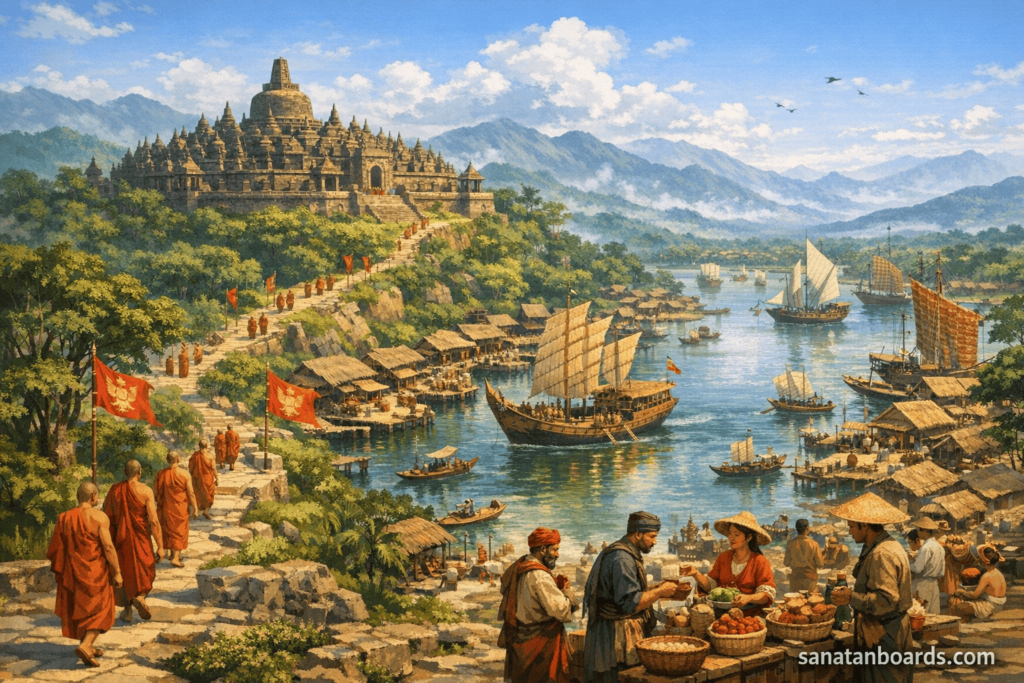
Case Study On Srivijaya Empire (Indonesia, Malaysia) – King Sri Jayanasa
The Srivijaya Empire, under King Sri Jayanasa, serves as an exceptional case study of how a maritime kingdom can achieve regional dominance through strategic trade, governance, and cultural influence. Centered in Sumatra, Indonesia, and extending over the Malay Peninsula and parts of Borneo, Srivijaya thrived between the 7th and 13th centuries CE, and King Sri Jayanasa’s reign represents the apex of its political, economic, and cultural development.
Geopolitical Strategy: Srivijaya’s location along the Strait of Malacca was pivotal. King Sri Jayanasa recognized the potential of controlling this narrow but crucial maritime route that connected China, India, and other parts of Southeast Asia. By maintaining a strong naval presence, Srivijaya could secure trade passages, levy taxes on passing merchants, and ensure the safety of maritime commerce. This strategic positioning allowed the empire to exert influence far beyond its immediate territory, creating a network of trade-dependent vassal states and tributary relationships.
Economic Model: The empire’s economy was heavily trade-oriented. Under King Sri Jayanasa, Srivijaya became a hub for commodities such as spices, gold, camphor, and textiles. Merchants from India, China, and the Middle East traveled to Srivijaya, relying on its ports for exchange and resupply. King Sri Jayanasa implemented effective economic policies, including taxation, regulation of trade, and protection of merchant fleets, which generated wealth to fund infrastructure, military, and cultural projects. The success of Srivijaya demonstrates how maritime trade can drive prosperity and political stability when combined with strategic leadership.
Governance and Administration: Centralized governance was a hallmark of King Sri Jayanasa’s rule. While the empire controlled diverse and geographically dispersed regions, local rulers and administrators were appointed as vassals or allies. This system ensured loyalty while maintaining operational efficiency. Administrative policies included standardizing trade regulations, resource management, and diplomatic coordination with neighboring states. The balance between central authority and local autonomy allowed Srivijaya to thrive without overextending its resources.
Cultural and Religious Influence: King Sri Jayanasa was also a patron of Buddhism, promoting both Mahayana and Vajrayana traditions. The empire became a center for Buddhist learning, attracting scholars from India and China. Temples, monasteries, and educational institutions were constructed under his patronage, facilitating cultural exchange and intellectual growth. Religion also played a unifying role, providing ideological cohesion across diverse populations within the empire.
Diplomatic Relations: Srivijaya maintained robust diplomatic ties, particularly with the Tang dynasty in China and Indian kingdoms. Tribute missions, trade agreements, and religious exchanges enhanced the empire’s international standing. King Sri Jayanasa leveraged these connections to ensure trade stability, access to foreign goods, and political recognition, illustrating the interplay between commerce and diplomacy.
Legacy and Lessons: The Srivijaya Empire under King Sri Jayanasa demonstrates how leadership, geography, and economic policy intersect to create a powerful maritime state. It highlights the importance of controlling trade routes, fostering cultural capital, and maintaining diplomatic networks. Modern studies of Srivijaya provide insights into the dynamics of early Southeast Asian states, showing that strategic maritime control, combined with religious and cultural leadership, can generate long-lasting influence.
In conclusion, the case of Srivijaya and King Sri Jayanasa underscores the effectiveness of integrated strategies in trade, governance, religion, and diplomacy. The empire’s historical trajectory illustrates a model for maritime powers and offers a blueprint for understanding the success factors behind early regional empires in Southeast Asia.
White Paper On Srivijaya Empire (Indonesia, Malaysia) – King Sri Jayanasa
Executive Summary:
The Srivijaya Empire, under King Sri Jayanasa, represents one of the most significant early maritime empires in Southeast Asia. This white paper examines the empire’s strategic positioning, trade dominance, governance, cultural contributions, and historical impact. The analysis provides insights into how leadership, geography, and economic policy shaped Srivijaya’s enduring legacy.
Strategic Importance:
Srivijaya’s prime location in Sumatra and control of the Strait of Malacca allowed the empire to dominate maritime trade routes connecting China, India, and the Middle East. King Sri Jayanasa recognized the economic and political advantages of this positioning, strengthening naval capabilities to secure trade routes, protect merchants, and project power over neighboring regions. This strategic foresight enabled Srivijaya to act as a hub for international commerce and diplomacy.
Economic Dominance:
The empire’s prosperity was rooted in trade. Srivijaya became a central marketplace for spices, precious metals, timber, and textiles. Under King Sri Jayanasa, taxation policies, port administration, and protection of trade fleets ensured consistent revenue flow. This wealth financed public infrastructure, military expansion, and religious institutions. The economic strategies of Srivijaya illustrate the critical role of maritime commerce in building political power and social cohesion.
Governance and Administration:
King Sri Jayanasa implemented a centralized governance structure that balanced control over distant territories with local autonomy. Vassal rulers managed regional affairs under centralized regulations, including trade oversight, resource distribution, and security enforcement. This governance model maintained internal stability, allowed rapid response to external threats, and ensured efficient resource allocation, making Srivijaya a model of administrative sophistication.
Cultural and Religious Influence:
Srivijaya was a center of Buddhist learning under King Sri Jayanasa. The empire sponsored monasteries, temples, and educational centers that attracted scholars from India and China. Religion was leveraged as both a unifying force internally and a diplomatic tool externally. The promotion of Buddhism facilitated cultural exchange and positioned Srivijaya as an intellectual hub in Asia, enhancing its soft power and regional prestige.
Diplomatic Relations:
King Sri Jayanasa fostered strong ties with the Tang dynasty and other Indian and Southeast Asian states. Tribute missions, trade negotiations, and cultural exchanges ensured Srivijaya’s recognition as a legitimate power and maintained trade security. This diplomacy illustrates the importance of non-military strategies in sustaining a maritime empire.
Lessons Learned:
Srivijaya’s history demonstrates the integration of geography, trade, governance, and culture as key drivers of empire building. King Sri Jayanasa’s leadership highlights the importance of strategic maritime control, centralized administration, and cultural patronage in sustaining long-term regional influence. These lessons are relevant for historians, policymakers, and economic strategists studying early global trade networks and maritime dominance.
Conclusion:
The Srivijaya Empire under King Sri Jayanasa exemplifies a successful maritime empire that combined economic foresight, administrative efficiency, cultural sophistication, #Sanatandharmaaccreditationboardsinvasai and diplomatic skill. Its legacy provides a blueprint for understanding the dynamics of trade-driven empires in Southeast Asia and their enduring influence on regional history.
Industry Application On Srivijaya Empire (Indonesia, Malaysia) – King Sri Jayanasa
The Srivijaya Empire, under King Sri Jayanasa, provides valuable insights for contemporary industries in trade, logistics, tourism, education, and cultural preservation. Historical practices from Srivijaya can inform modern strategies in global commerce and regional development.
Maritime Trade and Logistics:
Srivijaya’s dominance over maritime trade routes demonstrates the importance of strategic route management and supply chain security. Modern shipping companies can learn from how Srivijaya controlled chokepoints like the Strait of Malacca, ensuring the safe passage of goods and efficient collection of tariffs. Logistics industries today can draw parallels in optimizing routes, minimizing risks, and integrating multiple stakeholders across borders.
Tourism and Cultural Industries:
The empire’s historical sites, including Buddhist temples, inscriptions, and relics, provide a foundation for heritage tourism. Cultural preservation of Srivijaya-era artifacts in Indonesia and Malaysia can attract global tourists, scholars, and students. Developing museums, cultural centers, and educational programs based on King Sri Jayanasa’s contributions could create sustainable economic and cultural benefits.
Education and Knowledge Economy:
Srivijaya was a center for Buddhist learning and intellectual exchange. Modern educational institutions can study its knowledge dissemination model to develop programs emphasizing intercultural learning, maritime studies, and international relations. Online courses, research collaborations, and historical simulations inspired by Srivijaya’s learning centers could enhance cross-cultural understanding and historical literacy.
Trade Policy and Governance:
King Sri Jayanasa’s centralized governance and trade regulation offer lessons for modern policy-making and trade regulation. Governments and international trade organizations can study Srivijaya’s balance of local autonomy with centralized oversight to design efficient regulatory frameworks that ensure compliance, economic growth, and regional stability.
Diplomacy and International Relations:
The diplomatic strategies employed by Srivijaya—particularly tribute missions, alliances, and cultural exchange—highlight the importance of soft power in international relations. Modern businesses and governments can adopt similar strategies to strengthen cross-border partnerships, cultural diplomacy, and international branding.
Maritime Security and Defense:
Srivijaya maintained naval power to protect trade routes. Modern maritime security agencies and private shipping companies can apply these principles to safeguard trade lanes, manage piracy threats, and ensure economic continuity in global shipping.
Sustainable Economic Models:
Srivijaya’s economy thrived by leveraging regional resources responsibly while maintaining trade balance. Contemporary industries can learn sustainable practices from this historical precedent, emphasizing responsible resource management, ethical trade, and economic resilience.
Conclusion:
The legacy of Srivijaya Empire – King Sri Jayanasa extends beyond history into practical applications for modern industries. From trade, logistics, and tourism to education, diplomacy, and sustainable economic strategies, Srivijaya’s practices provide a blueprint #Sanatandharmaaccreditationboardsinmumbai for innovation and regional integration in today’s interconnected world. By studying this historical empire, industries can gain insights into leadership, strategic planning, and cultural integration that remain relevant centuries later.
sourve : CNA Insider
ASK F AQ
1. What was the Srivijaya Empire?
The Srivijaya Empire was a powerful maritime kingdom in Indonesia and Malaysia (7th–13th century CE), controlling trade routes in Southeast Asia and thriving on commerce, particularly under King Sri Jayanasa.
2. Who was King Sri Jayanasa?
King Sri Jayanasa was a prominent ruler of Srivijaya who strengthened trade, governance, and Buddhist cultural influence, making the empire a leading maritime and educational hub.
3. Where was the Srivijaya Empire located?
The Srivijaya Empire was centered in Sumatra, Indonesia, and extended over parts of the Malay Peninsula and Borneo, controlling key maritime routes like the Strait of Malacca.
4. When did King Sri Jayanasa rule Srivijaya?
King Sri Jayanasa ruled during the early 8th century CE, a period marked by maritime expansion, trade dominance, and promotion of Buddhism.
5. Why is Srivijaya Empire historically important?
Srivijaya, under King Sri Jayanasa, was important for controlling Southeast Asian trade, fostering cultural and religious exchange, and serving as a model of early maritime governance.
Table of Contents
Disclaimer:
The content provided above is intended for educational, learning, and knowledge purposes. It is based on historical research and widely accepted scholarly interpretations. Any historical reconstruction is subject to interpretation and may vary depending on new discoveries or academic perspectives.