
MAJAPAHIT EMPIRE (INDONESIA) – KING HAYAM WURUK
The Majapahit Empire was one of the most powerful and influential kingdoms in Southeast Asia, reaching its peak during the 14th century under the reign of King Hayam Wuruk. Located in present-day Indonesia, this empire is recognized for its impressive political organization, cultural richness, and territorial expansion that spanned across the Malay Archipelago. King Hayam Wuruk, born in 1334 ascended to the throne at a young age and ruled from 1350 to 1389. His leadership marked the golden age of Majapahit, a period known for stability, prosperity, and extensive trade networks.
During Hayam Wuruk’s reign, the empire consolidated power over numerous islands, including Java, Sumatra, Bali, Borneo, and parts of the Philippines. He was guided by his prime minister, Gajah Mada whose strategic vision and loyalty were instrumental in unifying the Nusantara region. Majapahit’s governance combined centralized authority with local autonomy, allowing regional leaders to manage their territories while contributing to the empire’s prosperity.
Culturally, the empire became a center for art, literature, and Hindu-Buddhist philosophy. Temples, monuments, and literary works flourished, reflecting the sophistication of Majapahit society. Hayam Wuruk himself was known as a patron of the arts and religion, supporting the development of epic poems and architectural marvels.
Trade was another cornerstone of the empire’s success. Majapahit became a hub for regional and international commerce, facilitating the exchange of spices, textiles, and precious metals with China, India, and other Southeast Asian kingdoms. This combination of military, cultural, and economic strength cemented Majapahit’s reputation as a dominant empire in the region, with King Hayam Wuruk remembered as its most iconic ruler.

What Is Majapahit Empire (Indonesia) – King Hayam Wuruk ?
The Majapahit Empire was a Javanese Hindu-Buddhist kingdom that flourished from the late 13th century to the early 16th century in what is now Indonesia. Under the leadership of King Hayam Wuruk, it reached its most illustrious period, expanding its influence across a vast maritime network. The empire’s capital was located in Trowulan, East Java, and became a thriving center for politics, culture, and trade.
Majapahit’s political system was centralized under the king, yet it allowed considerable autonomy to regional vassals. This enabled effective governance over an expansive territory, including modern Indonesia and surrounding islands. King Hayam Wuruk’s reign (1350–1389) saw the empire achieve territorial unity unmatched in Southeast Asia, largely thanks to the strategic policies of his prime minister, Gajah Mada, who famously pledged the “Sumpah Palapa” oath to unite the archipelago.
Economically, the empire thrived on agriculture, trade, and tribute from subordinate regions. Its control over strategic ports and trade routes enabled Majapahit to become a critical link between East and West, facilitating commerce with China, India, and other neighboring kingdoms. This trade brought wealth that funded cultural, religious, and architectural developments.
Culturally, Majapahit was remarkable for its literary works, temple architecture, and arts. King Hayam Wuruk encouraged the creation of epics, inscriptions, and monumental structures that reflected Hindu-Buddhist ideals and Javanese traditions. The empire’s sophisticated administration, combined with strong military power and naval dominance, established Majapahit as a leading regional authority, leaving a lasting legacy in Indonesian history.
Who Is Required Majapahit Empire (Indonesia) – King Hayam Wuruk ?
The study of the Majapahit Empire under King Hayam Wuruk is essential for historians, scholars, students, and enthusiasts of Southeast Asian history. Understanding this period offers critical insights into governance, diplomacy, culture, and trade in pre-modern Indonesia. King Hayam Wuruk’s era demonstrates the importance of strategic leadership and political vision in unifying diverse regions under one empire.
Historians rely on accounts like the Nagarakretagama, a Javanese epic poem written during Hayam Wuruk’s reign, to analyze the political structure, military strategies, and cultural achievements of the time. Scholars of political science study the empire’s governance model, where a centralized monarchy balanced regional autonomy, providing lessons for decentralized administration and leadership.
For students and learners, the Majapahit Empire is an essential case study in state formation, maritime power, and cultural integration. King Hayam Wuruk’s collaboration with his prime minister, Gajah Mada, illustrates effective leadership, visionary policymaking, and diplomacy. For cultural researchers, the empire’s art, literature, and architecture reveal the blending of Hindu-Buddhist influences with local traditions, offering valuable insights into Southeast Asia’s cultural evolution.
Even the general public benefits from understanding Majapahit’s significance, as it informs national identity in Indonesia. The empire represents unity, strength, and the historical foundations of modern Indonesian culture. Learning about King Hayam Wuruk and his accomplishments fosters appreciation for heritage, historical continuity, and the socio-political achievements of past civilizations.
When Majapahit Empire (Indonesia) – King Hayam Wuruk ?
The Majapahit Empire reached its peak under King Hayam Wuruk between 1350 and 1389, a period often referred to as the empire’s golden age. The timeline of his reign corresponds with significant political consolidation, territorial expansion, and cultural flourishing in the Nusantara region. Understanding “when” Majapahit rose to prominence provides context for the socio-political and economic developments that shaped Southeast Asia during the 14th century.
Before Hayam Wuruk ascended the throne, Majapahit faced political instability. The empire, founded in 1293 by Raden Wijaya, had experienced leadership transitions and regional conflicts. However, Hayam Wuruk’s rule marked the stabilization of central authority. He assumed kingship at the age of 16 and benefited from the strategic guidance of his prime minister, Gajah Mada, who had pledged to unite the entire archipelago under Majapahit’s sovereignty. This collaboration was crucial in the empire’s rapid expansion during the mid-14th century.
During this period, Majapahit extended its influence over Java, Sumatra, Borneo, Bali, and parts of the Philippine islands. Trade and diplomacy were carefully timed to enhance economic power, particularly with China and India. The 14th century was also a time of cultural innovation, with the composition of the Nagarakretagama in 1365, which detailed the empire’s territories, governance, and societal norms.
The timing of Majapahit’s rise was not accidental. The 14th century represented a period of regional flux in Southeast Asia, with multiple kingdoms vying for control over trade routes and territory. Majapahit capitalized on this historical moment, combining military strength, strategic marriages, and alliances to consolidate power. Its well-timed expansion allowed it to dominate regional trade networks, secure vital ports, and influence neighboring polities.
Where Majapahit Empire (Indonesia) – King Hayam Wuruk ?
The Majapahit Empire under King Hayam Wuruk was primarily located on the island of Java, in present-day Indonesia, with its political and cultural center at Trowulan, East Java. This region served as the heart of the empire, where royal palaces, administrative offices, and monumental temples were concentrated. The choice of Java as the empire’s core was strategic due to its fertile land, central location in the archipelago, and access to critical trade routes connecting Southeast Asia to the Indian Ocean and beyond.
From its Javanese heartland, Majapahit extended its influence across much of the Malay Archipelago. Territories under its control or influence included parts of Sumatra, Borneo, Bali, Lombok, and even parts of the Philippine islands. The empire’s reach relied on a combination of maritime power, vassal alliances, and strategic diplomacy. Through these controlled regions, Majapahit could collect tribute, secure valuable trade goods, and exert cultural influence, spreading Javanese Hindu-Buddhist practices across the region.
The empire’s maritime geography played a critical role in its success. Majapahit dominated key port cities and sea lanes, which allowed it to control trade in spices, textiles, and other goods. Its location in Java gave it both agricultural wealth and the ability to project naval power, making it a dominant regional force. The archipelagic geography also required a decentralized administration; local rulers managed islands while pledging loyalty to the emperor, ensuring governance over widely dispersed territories.
Culturally, the “where” of Majapahit is reflected in the remains of temples, inscriptions, and artifacts found across Java and surrounding islands. Sites such as the Candi Tikus and the ruins of Trowulan illustrate the concentration of religious, administrative, and ceremonial activities. Even today, these sites provide evidence of Majapahit’s sophisticated architecture, urban planning, and artistic achievements.
Understanding where the Majapahit Empire operated highlights the strategic importance of its geographic position in Southeast Asia. Java served as the center of administration, culture, and commerce, while its maritime reach enabled influence over the broader Nusantara region. The combination of fertile lands, trade routes, and strategic locations allowed Majapahit to thrive under King Hayam Wuruk, making it one of the most influential empires in Indonesian history.
How Majapahit Empire (Indonesia) – King Hayam Wuruk
The Majapahit Empire achieved its greatness “how” through a combination of strategic leadership, military power, administrative organization, and cultural patronage. King Hayam Wuruk’s reign illustrates how effective governance and vision can unify a vast and diverse territory.
Hayam Wuruk relied on his prime minister, Gajah Mada, to implement policies that strengthened the empire. The Sumpah Palapa oath pledged the unification of the Nusantara islands, guiding military campaigns, diplomatic alliances, and trade policies. Military strategy was central to how Majapahit maintained control, with organized armies and a strong navy safeguarding territories and maritime routes.
Administration was another key factor. Majapahit combined centralized authority with local autonomy, allowing vassal states to govern daily affairs while remaining loyal to the king. This balance created political stability and enabled the empire to manage an extensive territory efficiently. Revenue from taxes, tribute, and trade supported governance and public works, reinforcing the empire’s power.
Culturally, Majapahit flourished because Hayam Wuruk promoted arts, religion, and literature. Temples, monuments, and literary works served both as expressions of power and as tools to unify diverse ethnic groups. Religious ceremonies and festivals fostered loyalty and social cohesion across the empire.
Trade networks were carefully managed. Majapahit controlled strategic ports and maintained relations with China, India, and other Southeast Asian kingdoms. This ensured economic prosperity, which funded cultural and military projects.
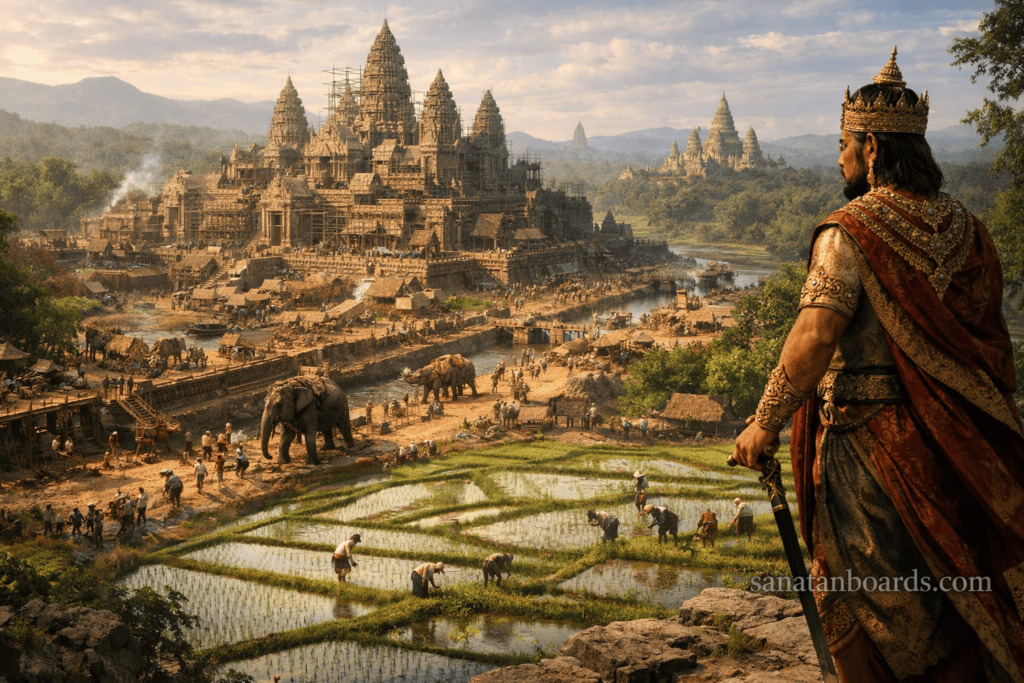
Case Study On Majapahit Empire (Indonesia) – King Hayam Wuruk
The Majapahit Empire under King Hayam Wuruk provides one of the most instructive historical case studies in statecraft, governance, cultural integration, and regional influence in Southeast Asia. This case study examines the empire’s political structure, military expansion, economic strategy, cultural achievements, and legacy, providing insights into why it remains a cornerstone of Indonesian history.
Political Structure and Governance
At the center of Majapahit’s success was its strong, centralized monarchy, led by King Hayam Wuruk. Ascending the throne at 16, Hayam Wuruk was guided by his prime minister, Gajah Mada, whose vision and strategy were pivotal. Gajah Mada’s “Sumpah Palapa” oath, pledging to unite the archipelago, became the foundation of Majapahit’s expansionist policies. The empire combined central authority with regional autonomy, allowing local rulers to maintain governance over their territories while paying tribute and following imperial directives. This balance created stability across the sprawling islands and enabled effective control over distant vassal states.
Military and Strategic Expansion
Majapahit’s military strategy was both defensive and offensive. The empire maintained a powerful army and navy, capable of securing maritime trade routes and defending against rival kingdoms. Strategic alliances, marriages, and diplomacy complemented military campaigns. The result was an unprecedented territorial reach, spanning Java, Sumatra, Bali, Borneo, and parts of the Philippines. This control enabled Majapahit to enforce regional order and integrate diverse populations into the empire, ensuring loyalty and economic contribution from distant lands.
Economic Strategy and Trade
The empire’s prosperity relied heavily on trade. Majapahit’s ports, particularly in Java, became hubs for commerce connecting China, India, and Southeast Asia. Commodities like spices, rice, textiles, and precious metals flowed through these routes. Tribute from vassal states further enriched the empire. Economic wealth funded monumental architecture, cultural patronage, and military campaigns. By controlling trade networks, Majapahit leveraged geography to enhance both wealth and political influence.
Cultural and Religious Influence
Culturally, Majapahit under Hayam Wuruk represented a synthesis of Hindu-Buddhist traditions with local Javanese culture. The Nagarakretagama, a literary masterpiece written during his reign, documents the empire’s territories, administration, and ceremonies. Temples, monuments, and royal palaces reflected the sophistication of urban planning and artistic expression. Religious practices, festivals, and literature promoted unity across the diverse population, reinforcing the king’s legitimacy and consolidating social cohesion.
Leadership and Legacy
Hayam Wuruk’s reign demonstrates how visionary leadership can transform a kingdom into a regional superpower. His collaboration with Gajah Mada exemplifies effective delegation, strategic planning, and long-term vision. The empire’s achievements in administration, culture, and trade laid the foundations for modern Indonesian identity. Today, Majapahit is remembered as a symbol of unity, resilience, and cultural richness, and its historical model informs contemporary studies of governance, diplomacy, and economic strategy in Southeast Asia.
Lessons Learned
From this case study, several lessons emerge: the importance of visionary leadership, the balance between central authority and local autonomy, leveraging trade for economic and political power, and using culture and religion as tools for social cohesion. Majapahit under King Hayam Wuruk illustrates that successful empires require integration of military, economic, and cultural strategies.
In conclusion, Majapahit under King Hayam Wuruk serves as a comprehensive case study in empire-building. Its political innovations, cultural achievements, and economic strategies offer enduring lessons for historians, policymakers, and leaders #Sanatandharmaaccreditationboardsinvasai seeking to understand the mechanisms behind regional dominance and sustainable governance. The empire’s golden age remains a testament to the power of strategic vision, effective administration, and cultural patronage.
White Paper On Majapahit Empire (Indonesia) – King Hayam Wuruk
Executive Summary
The Majapahit Empire under King Hayam Wuruk represents a historical benchmark in governance, trade, culture, and regional influence in Southeast Asia. This white paper examines the empire’s political framework, economic strategy, cultural impact, and lessons for contemporary application. The analysis draws on historical texts, archeological findings, and the literary work Nagarakretagama to provide a comprehensive understanding of the empire’s structure and significance.
Introduction
Founded in 1293, the Majapahit Empire rose to prominence under King Hayam Wuruk (1350–1389), marking the golden age of Javanese civilization. Its capital at Trowulan, East Java, became a center of administration, trade, and culture. Hayam Wuruk’s leadership, coupled with the guidance of prime minister Gajah Mada, facilitated unprecedented territorial expansion, political stability, and cultural flourishing.
Political Framework
Majapahit’s governance combined centralized monarchy with decentralized administration. Local rulers managed regional affairs but remained loyal to the emperor. This balance allowed efficient governance over a vast territory, including Java, Sumatra, Bali, Borneo, and parts of the Philippines. The Sumpah Palapa oath by Gajah Mada served as a guiding principle for territorial unification and strategic military campaigns. Diplomacy, strategic alliances, and military power reinforced Majapahit’s authority over subordinate states, creating a durable political system.
Economic Strategy
The empire thrived as a maritime and agricultural power. Java’s fertile lands supported agriculture, while strategic ports facilitated regional and international trade. Majapahit became a hub for spices, textiles, and precious metals, connecting the archipelago with China, India, and other Southeast Asian polities. Tribute from vassal states supplemented revenue, funding infrastructure, cultural projects, and military campaigns. Economic strategy relied on controlling trade routes and cultivating political alliances to maintain prosperity and influence.
Cultural Impact
Cultural development under Hayam Wuruk was extensive. Hindu-Buddhist traditions merged with Javanese customs, producing a rich artistic and literary heritage. The Nagarakretagama provides insight into governance, societal norms, and ceremonial practices. Temples, monuments, and royal palaces reflected architectural sophistication and religious devotion. Festivals, art, and literature fostered social cohesion, promoted loyalty to the monarchy, and preserved historical knowledge.
Strategic Lessons
The Majapahit model offers insights for contemporary governance, business strategy, and cultural management. Key takeaways include:
- Visionary Leadership: The collaboration of Hayam Wuruk and Gajah Mada highlights strategic planning and long-term vision.
- Balanced Governance: Centralized authority with local autonomy promotes efficiency and stability.
- Economic Leverage: Controlling trade routes and resources ensures sustainable prosperity.
- Cultural Integration: Promoting shared values and traditions strengthens societal cohesion.
Conclusion
Majapahit under King Hayam Wuruk illustrates how leadership, governance, culture, and economy intersect to build a successful empire. #Sanatandharmaaccreditationboardsinmumbai The lessons derived from its golden age remain relevant in political strategy, organizational management, and cultural policy. The empire’s historical legacy continues to inform studies of Southeast Asian civilization, statecraft, and maritime trade networks.
Industry Application On Majapahit Empire (Indonesia) – King Hayam Wuruk
The study of the Majapahit Empire under King Hayam Wuruk has practical implications for multiple modern industries:
- Governance and Public Administration – The decentralized yet unified governance model provides a case study for managing large organizations or states, showing how central authority can coexist with local autonomy.
- Trade and Logistics – Majapahit’s control over maritime trade networks demonstrates the value of strategic supply chains and port management. Modern logistics companies can draw lessons from how trade routes and economic hubs enhance regional influence.
- Cultural Tourism – The temples, palaces, and historical sites of Majapahit form the basis for heritage tourism. Travel and hospitality industries can develop educational tourism experiences that connect visitors to Indonesia’s rich history.
- Education and Research – Majapahit’s literary and cultural achievements provide material for academic programs in history, political science, and cultural studies, promoting research-based educational initiatives.
- Urban Planning and Architecture – The city layout of Trowulan and its architectural achievements serve as a reference for sustainable urban planning and heritage conservation, relevant to architects and urban developers.
- Leadership and Management Training – Lessons from King Hayam Wuruk and Gajah Mada’s leadership can be applied in corporate training programs, emphasizing vision, strategic planning, and integration of diverse teams.
- Digital Media and Cultural Preservation – Modern technology can be used to recreate Majapahit heritage digitally, providing interactive experiences for museums, gaming, and educational platforms.
By translating historical insights into modern applications, the Majapahit Empire remains relevant beyond history classrooms, influencing strategy, culture, and innovation in multiple industries today.
source : Kings and Generals
ASK FAQ
Who was King Hayam Wuruk of the Majapahit Empire?
King Hayam Wuruk ruled the Majapahit Empire from 1350 to 1389, leading it to its golden age with political unity, economic prosperity, and cultural achievements under the guidance of his prime minister, Gajah Mada.
When did the Majapahit Empire reach its peak?
The Majapahit Empire reached its peak in the 14th century, particularly during King Hayam Wuruk’s reign (1350–1389), expanding across Java, Sumatra, Bali, Borneo, and parts of the Philippines.
Where was the Majapahit Empire located?
The Majapahit Empire was centered in East Java, Indonesia, with Trowulan as its capital, and extended influence across much of the Malay Archipelago, including surrounding islands.
What made the Majapahit Empire under Hayam Wuruk so powerful?
The empire’s power came from strong leadership, strategic military expansion, control over maritime trade routes, a sophisticated administrative system, and promotion of arts and culture.
Why is the Majapahit Empire historically significant?
Majapahit under King Hayam Wuruk is significant for unifying the Indonesian archipelago, fostering cultural and religious development, establishing trade dominance, and influencing Indonesia’s national identity.
Table of Contents
Disclaimer
The content provided above is intended for informational, educational, and knowledge purposes only. It does not constitute professional, historical, or legal advice. While every effort has been made to ensure accuracy, some historical interpretations may vary according to sources, and readers are encouraged to consult additional scholarly references for comprehensive research.