VISHNUVARDHANA (HOYSALA)
Vishnuvardhana was a prominent king of the Hoysala dynasty, one of the major South Indian kingdoms during the medieval era. He reigned from around 1108 CE to 1152 CE, a period marked by important military achievements, cultural growth, and religious transitions. Born as Bitti‑deva he was the son of the Hoysala ruler Ereyanga and ascended the throne following the death of his elder brother Veera Ballala I. Initially, Bitti‑deva practiced Jainism, a religion that had deep roots in the region and enjoyed royal patronage during the early Hoysala period.
Vishnuvardhana is best remembered for his military prowess, particularly his campaign against the powerful Chola Empire, which held sway over large parts of South India. In around 1116 CE, he successfully defeated the Chola forces at Talakad, reclaiming key territories and significantly expanding Hoysala influence in the region. This remarkable victory elevated the status of the Hoysala kingdom from a minor feudatory state under the Western Chalukyas to a dominant power in southern India.
A pivotal moment in his life was his encounter with the influential Vaishnavite philosopher Ramanujacharya, whose teachings inspired Vishnuvardhana to adopt Vaishnavism — devotion to Lord Vishnu. To reflect his new faith and strengthened political stature, he took the name Vishnuvardhana, meaning “one who enhances or increases (the glory of) Vishnu.”
Under his rule, not only did the Hoysalas achieve territorial gain and military respect, but Kannada literature, temple architecture, and art also flourished under royal patronage. The legacy of Vishnuvardhana is deeply embedded in the cultural and historical heritage of Karnataka and South India.
WHAT IS VISHNUVARDHANA (HOYSALA) ?
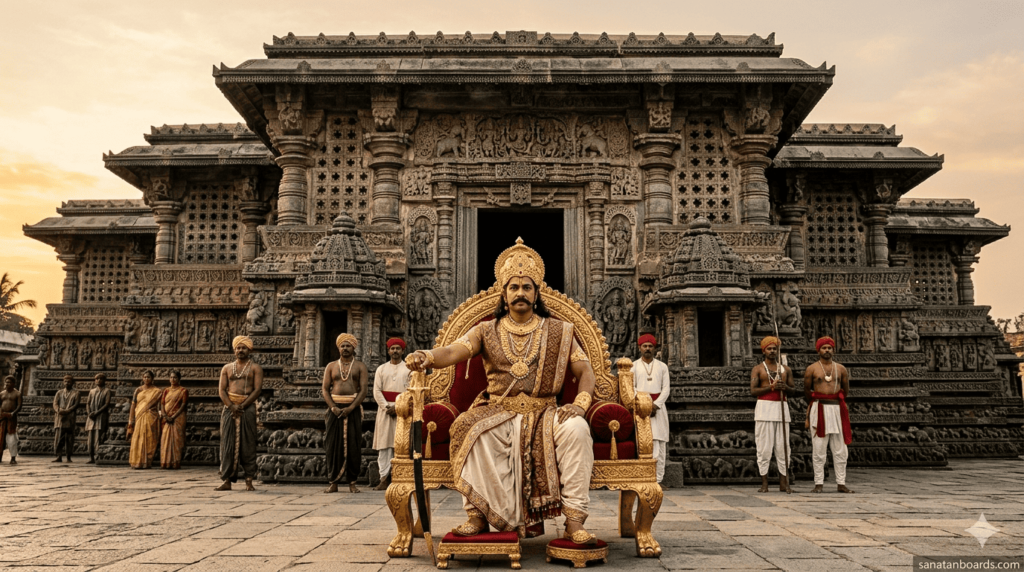
Vishnuvardhana was a medieval South Indian king of the Hoysala dynasty, whose reign marks a central phase in the transformation of the Hoysalas from regional chieftains to powerful sovereigns. Historians regard him as one of the most important rulers in Hoysala history.
He began his life as Bitti‑deva, a follower of Jainism — a religion that shaped much of early Hoysala culture. However, under the influence of the philosopher Ramanujacharya, Bitti‑deva adopted Vaishnavism and changed his name to Vishnuvardhana, symbolising his new religious orientation.
Politically, Vishnuvardhana was a military leader and strategist. His most significant campaign was against the Chola Empire, then a dominant power in southern India. His decisive victory at Talakad ended Chola supremacy in parts of Karnataka, bringing the region under Hoysala control. This win not only expanded Hoysala territory but also laid the foundation for an independent Hoysala kingdom, breaking away from the influence of the Western Chalukya overlords.
Under his rule, the Hoysalas moved their capital from Belur to Halebidu (Dwarasamudra), which became a hub of political power and cultural efflorescence. He is known for his patronage of art, literature, and temple architecture. Vishnuvardhana commissioned grand temples such as the famous Chennakesava Temple at Belur and supported scholars and poets who enriched Kannada literature.
Vishnuvardhana’s reign was a turning point where military strength, cultural patronage, and religious evolution converged. Today he is remembered not only as a successful ruler but also as a key figure in shaping the historical and cultural identity of medieval South India.
Who Is Required Vishnuvardhana (Hoysala)
Vishnuvardhana is required to understand medieval South Indian history because he represents a turning point in how regional powers emerged, thrived, and left lasting cultural legacies.
Firstly, as a political figure, Vishnuvardhana illustrates how subordinate leaders rose to independence. His campaigns against the Cholas and assertion of autonomy from the Western Chalukyas show the dynamics of power shift in the 12th century — a crucial period when older empires declined and new ones emerged.
Secondly, as a military strategist, his victories rewrote the map of southern India. They not only expanded Hoysala boundaries northward and southward but also weakened rivals, enabling the Hoysalas to become one of the dominant regional powers.
Thirdly, from a cultural perspective, Vishnuvardhana’s reign was a major moment in temple architecture. The Hoysala style he helped foster — detailed star‑shaped shrines with elaborate sculptures — remains celebrated today. These monuments are studied by historians, architects, and art scholars alike.
Finally, as a religious influencer, his conversion from one faith tradition to another underlines the interaction between political authority and religious movements in medieval India, revealing how rulers shaped — and were shaped by — spiritual currents of their time.
In all these ways, Vishnuvardhana is a necessary figure in understanding the social, political, artistic, and religious history of the Hoysala dynasty and medieval South India as a whole.
When Vishnuvardhana (Hoysala) Is Required ?
Vishnuvardhana ruled the Hoysala kingdom during the early 12th century CE, a transformative era in South Indian history. He ascended the throne in 1108 CE, following the death of his elder brother Veera Ballala I, and his reign continued until about 1152 CE (approximately 44 years).
The beginning of his rule came at a time when the Hoysala dynasty was still emerging from its position as a regional vassal to more powerful neighbouring empires. Before becoming king, Vishnuvardhana was known as Bitti‑deva and held military experience as a commander in Hoysala forces. His early years were marked by subordination to the Western Chalukyas and interaction with the Chola Empire to the south.
A significant early event in his rule was his decisive military campaign against the Cholas, a powerful dynasty that dominated much of South India at the time. Around 1116 CE, Vishnuvardhana led his forces against the Chola general Adiyamma near Talakad, succeeding in re‑capturing territories that were lost or under continual threat. This victory earned him the honorary title Talakadugonda (“Conqueror of Talakad”), marking a turning point in his reign and significantly reducing Chola influence in the region.
During his reign, Vishnuvardhana also broke away from direct dependence on the Western Chalukyas and began asserting Hoysala autonomy. This period of military success laid the groundwork for future expansion under his successors.
The timeline of his reign overlaps with broader shifts in South Indian power dynamics, including the gradual decline of the Cholas and the rise of regional powers like the Hoysalas, Pandyas, and later the Vijayanagara Empire. By the time of Vishnuvardhana’s death around 1152 CE, the Hoysala kingdom had expanded significantly in territory and influence, setting the stage for further growth under subsequent rulers such as Narasimha I and Veera Ballala II.
Thus, the timeframe of his rule — early to mid‑1100s — is central to understanding how the Hoysala kingdom transitioned from feudal relevance toward becoming a major independent power in the medieval Deccan and South India.
Where Vishnuvardhana (Hoysala) Is Required ?
Vishnuvardhana’s life and reign were rooted in the southern part of India, particularly in what is today the state of Karnataka. The geographical and political landscape of his era shaped his goals, campaigns, and legacy.
The Hoysala dynasty originated in the Malnad region of Karnataka, a hilly and forested zone in the southern Deccan plateau. This area formed the initial power base of the Hoysalas long before Vishnuvardhana’s reign.
When Vishnuvardhana became king in 1108 CE, the dynasty’s centre of power was still largely in Karnataka. However, under his leadership the realm began expanding far beyond its original base. One of his first significant military actions took place in the Talakad region, near the modern Mysore‑Mandal region, where he successfully repelled incursions by the Chola Empire, which had been penetrating into southern Karnataka.
This victory at Talakad not only regained territory for the Hoysalas but also marked a broader shift in control of the Gangavadi region — an important cultural and economic area in southern Karnataka. From these campaigns, Vishnuvardhana expanded influence to regions extending toward Tamil Nadu and Kerala, bringing more of the southern Deccan under Hoysala control.
During his reign, the capital of the Hoysala kingdom was moved from earlier seats such as Belur to Halebidu (also known historically as Dwarasamudra). This became the political and cultural heart of Hoysala power under Vishnuvardhana and his successors, witnessing grand architectural achievements and courtly patronage.
Halebidu and Belur today are located in the Hassan district of Karnataka, and they remain important sites of Hoysala temples — many commissioned during Vishnuvardhana’s reign. These include the Chennakesava Temple at Belur and the Hoysaleswara Temple at Halebidu, which stand as lasting evidence of cultural and religious life in the region.
Thus, the “where” of Vishnuvardhana is both geographical and strategic: based in Karnataka’s central and southern regions, he expanded influence into neighbouring areas, shaping the map of medieval South India. His reign anchored Hoysala power in the rich plains and hills of Karnataka while extending reach into areas of cultural and political importance across the southern subcontinent.
How Vishnuvardhana (Hoysala) Is Required ?
Understanding how Vishnuvardhana became a pivotal ruler in South Indian history involves examining his strategies, leadership, and the methods by which he transformed the Hoysala kingdom from a subordinate chiefdom into a regional power.
Military Strategy and Conquest
Vishnuvardhana’s rise was largely driven by his military leadership. Upon ascending the throne in 1108 CE, he focused on strengthening the army and consolidating territorial control. His forces were reorganised to be more effective against the powerful neighbouring dynasties, especially the Chola Empire, which had previously dominated the region.
Around 1116 CE, Vishnuvardhana led a decisive campaign against the Chola general Adiyamma near Talakad. The resulting victory regained lost Hoysala lands and pushed Chola influence back into the south, earning him the title Talakadugonda — “Conqueror of Talakad.”
Political Realignment
Vishnuvardhana also used political reform to solidify his power. Initially, the Hoysala kings were subordinate to the Western Chalukyas. However, through calculated expansion and strategic alliances, Vishnuvardhana progressively asserted Hoysala independence. This shift from subordinate ruler to sovereign king reoriented the political landscape in the Deccan.
Religious Influence and Cultural Patronage
A key transformation in how Vishnuvardhana influenced his world was through religion. Originally a follower of Jainism, he was influenced by the Vaishnavite philosopher Ramanujacharya, leading to his conversion to Vaishnavism. This transition strengthened his appeal among Hindu subjects and helped unify the kingdom under a shared religious framework.
Beyond religion, Vishnuvardhana was notable for promoting temple architecture and the arts. He commissioned many structures in the ornate Hoysala style, characterized by detailed stone carving and intricate iconography. Temples such as the Chennakesava at Belur and Hoysaleswara at Halebidu were built under his reign and reflect a fusion of aesthetic excellence and religious devotion.
Administrative Reforms
To govern a growing realm, Vishnuvardhana also improved administrative systems. He empowered local leaders where necessary and integrated conquered regions into Hoysala administration, balancing central authority with regional governance — a key factor in maintaining stability across an expanding kingdom.
Together, these military, political, religious, artistic, and administrative methods explain how Vishnuvardhana achieved his legacy: through strategic conquest, cultural investment, and effective governance during a competitive era of South Indian polities.
Case Study On Vishnuvardhana (Hoysala)
A compelling case study on Vishnuvardhana focuses on how his leadership transformed the Hoysala dynasty from a regional chiefship into a sovereign power that left a lasting historical and cultural legacy in South India.
Background Context
Before Vishnuvardhana’s reign, the Hoysalas were relatively minor feudatories under larger South Indian powers, particularly the Western Chalukyas of Kalyani. Their early years were characterised by payments of tribute and limited autonomy. This began to change in the early 12th century as the Western Chalukyas weakened and rival powers like the Chola Empire exerted influence in the southern Deccan region.
Ascension and Name Change
Vishnuvardhana ascended the throne in 1108 CE after the death of his elder brother Veera Ballala I. Born Bitti‑deva, he initially practised Jainism, which was a dominant religion in his family and court. His life took a major turn when he encountered the Vaishnavite philosopher Ramanujacharya, whose teachings influenced him deeply. As a result, he adopted Vaishnavism, a form of Hindu devotion centred on Vishnu, and changed his name to Vishnuvardhana, meaning “one who increases (the glory of) Vishnu”.
Military Campaigns and Sovereignty
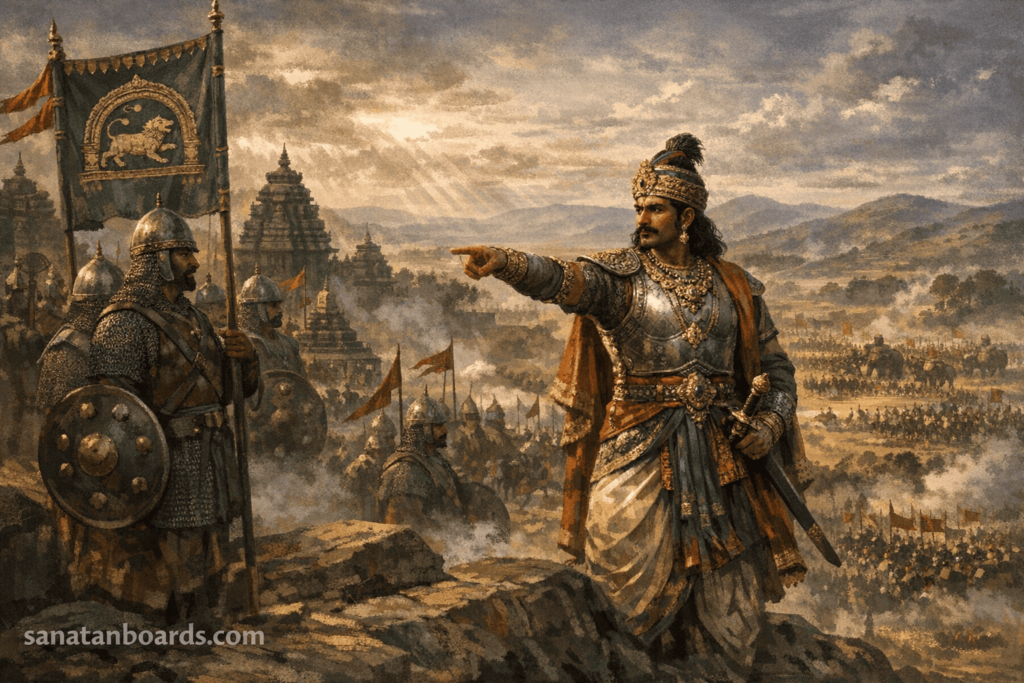
One of the defining moments of his rule was the campaign against the Cholas, a powerful dynasty that held dominance in parts of South India. Around 1116 CE, Vishnuvardhana led his armies to a decisive victory over the Cholas at Talakad, pushing them out of fertile regions of southern Karnataka and reclaiming control for the Hoysalas. This earned him the title Talakadugonda (“Conqueror of Talakad”).
This military success had two major outcomes:
- It broke Chola influence in the region, ending centuries of their intermittent dominance in southern Deccan politics.
- It signalled the shift of the Hoysalas from being vassals to sovereign rulers of their own expanding kingdom.
These victories laid the groundwork for Hoysala expansion and independence, setting the stage for future rulers to push boundaries even further.
Political and Administrative Transformation
Vishnuvardhana recognised that military success alone could not sustain a growing state. He and his ministers reorganised the Hoysala administrative system to better integrate territories and manage revenues. While still influenced by earlier models from the Western Chalukyas, this system improved local governance and tax collection, which underpinned state power.
Agriculture formed the economic backbone of the state, with land classified and taxed according to productivity. Trade and commerce also grew under his rule, generating additional resources that financed both the military and monumental building projects.
Cultural and Religious Patronage
Vishnuvardhana’s reign also marked a cultural renaissance. After his conversion to Vaishnavism, he championed religious tolerance and pluralism, continuing to support Jain institutions while significantly promoting Vaishnava traditions. Temples, mathas (religious institutions), and religious schools flourished across his domains.
Among his most enduring contributions were the temple commissions that showcased the emerging Hoysala architectural style. These structures used soapstone, a softer stone that allowed extremely detailed carving, and often featured star‑shaped plans and intricately sculpted panels from Hindu epics and mythologies.
The Chennakesava Temple at Belur and the Hoysaleswara Temple at Halebidu are two such masterpieces — standing today as masterpieces of medieval Indian art.
Legacy and Evaluation
By the time of his death around 1152 CE, Vishnuvardhana had extensively reshaped the trajectory of the Hoysala dynasty. He turned a modest chieftainship into a kingdom with political autonomy, military strength, and cultural influence. Successive rulers built upon his foundation, expanding the realm and deepening its cultural footprint across South India.
This case study of Vishnuvardhana illustrates the interplay of military strategy, religious transformation, administrative acumen, and cultural investment in shaping the fortunes of a medieval South Indian power. His reign exemplifies how a ruler’s vision can steer a society through conflict, change, and achievement.
White Paper On Vishnuvardhana (Hoysala)
Executive Summary
Vishnuvardhana was a pivotal ruler of the early Hoysala kingdom whose reign (c. 1108–1152 CE) reshaped political power in South India and inaugurated a period of cultural and architectural excellence. This white paper analyses his strategic leadership, policies, and enduring legacy.
Introduction
Historically, the Hoysala dynasty began as a group of local chiefs in the Malnad region of present‑day Karnataka. Into the early 12th century, the Hoysalas were under the influence of larger powers such as the Western Chalukyas and Cholas. Vishnuvardhana’s reign marked a turning point in this trajectory, as he assumed power and embarked on a comprehensive program of territorial expansion, cultural patronage, and institutional consolidation.
Political and Military Strategies
Vishnuvardhana inherited a kingdom that was strategically positioned between the weakening Western Chalukya authority and the ambitious Cholas. Instead of maintaining subordination, he adopted assertive military action. His victory at Talakad against the Cholas not only recaptured lost lands but also heralded a new status for the Hoysalas as sovereign rulers.
His military strategies combined strong defensive measures with offensive campaigns, allowing the kingdom to extend influence without overextending its resources. This balance ensured political stability and deterred rival invasions during his reign.
Administrative Framework
While the literary and architectural achievements of Vishnuvardhana are widely celebrated, his administrative reforms were equally important. The Hoysala judiciary and revenue system were enhanced to support a growing kingdom. Land revenue, classified by productivity, was supplemented by trade tariffs, ensuring financial robustness.
Local governance structures were adjusted to integrate newly annexed territories, creating a framework that balanced central authority with local autonomy — a forerunner to later South Indian administrative norms.
Religious Dynamics
Vishnuvardhana’s conversion from Jainism to Vaishnavism is one of the most discussed aspects of his life. Although he adopted a new personal faith, he maintained religious tolerance, allowing Jain and other traditions to flourish concurrently.
His affiliation with the teachings of Ramanujacharya, a major Vaishnavite philosopher, deepened the influence of Sri Vaishnavism in the region and fostered philosophical exchange across South Indian polities.
Cultural and Architectural Innovation
Under Vishnuvardhana, the Hoysala era witnessed a renaissance in art and architecture. The kingdom’s patrons developed a distinctive architectural style — a hybrid of northern and southern Indian traditions known as Vesara. The temples constructed during or inspired by his reign showcased soapstone carving, complex superstructures, and narrative iconography depicting religious themes.
Temples like the Chennakesava at Belur and Hoysaleswara at Halebidu became centres of religious and cultural life, while also serving as symbols of the kingdom’s wealth and craftsmanship.
Impact and Legacy
The legacy of Vishnuvardhana extends beyond territorial conquest. By laying the foundations of political autonomy and cultural vibrancy, he enabled the Hoysalas to flourish for centuries. Successive rulers expanded the kingdom northwards and southwards, #Sanatandharmaaccreditationboardsinvasai but their accomplishments would not have been possible without the groundwork he established.
Today, his reign is commemorated through monumental temples, literary patronage, and historical scholarship, all of which contribute to our understanding of medieval South Asian history.
Industry Application On Vishnuvardhana (Hoysala)
Although Vishnuvardhana (Hoysala) was a 12th-century monarch, his legacy continues to influence modern industries across heritage, education, arts, and technology sectors. His reign offers valuable insights into how historical achievements can translate into practical applications today.
1. Heritage Tourism and Hospitality
The temples commissioned during Vishnuvardhana’s reign, notably the Chennakesava Temple at Belur and the Hoysaleswara Temple at Halebidu, are prime tourist destinations in Karnataka. The historical architecture, intricate carvings, and cultural significance attract millions of visitors each year.
- This drives growth in tourism infrastructure, including hotels, guided tours, and cultural festivals.
- Heritage tourism has become a key revenue source for local economies, with many artisans, guides, and small businesses benefiting directly from this historical legacy.
2. Architecture, Design, and Construction
Vishnuvardhana’s era marked the peak of Hoysala architectural innovation. Modern architects and civil engineers study these temples to understand advanced stone masonry, star-shaped platforms, and detailed iconography.
- The Vesara-style architecture and precision carvings provide lessons in structural stability, aesthetics, and design symmetry.
- Contemporary construction and heritage restoration projects often apply these principles to modern temples, monuments, and cultural centers.
3. Arts, Crafts, and Cultural Industries
The soapstone carving tradition promoted under Vishnuvardhana continues to thrive.
- Artisans trained in Hoysala sculpture techniques supply decorative items, replicas, and museum pieces, sustaining the handicraft and fine arts industry.
- Educational workshops and craft schools promote the Hoysala style to students and designers, preserving and commercializing these cultural skills.
4. Education and Research
Vishnuvardhana’s reign is a key subject in history, archaeology, and religious studies programs.
- Universities and research institutions analyze his military strategies, administrative reforms, and temple patronage to develop courses in medieval South Indian polity, religious transitions and art history.
- Academic publications and seminars on Hoysala history contribute to knowledge dissemination and global awareness of India’s medieval heritage.
5. Media, Entertainment, and Storytelling
Films, documentaries, digital media, and gaming increasingly draw on Hoysala history and Vishnuvardhana’s life.
- His campaigns, cultural contributions, and temple construction provide content for historical dramas, virtual reality experiences, and educational storytelling.
- This helps generate interest in Indian history while creating jobs in media production, animation, and educational content creation.
6. Heritage Conservation and Technology
Modern conservation projects rely on Vishnuvardhana-era structures as case studies for preserving stone carvings, temple foundations, and ancient construction methods.
- Advanced technologies like 3D scanning, digital reconstruction, and structural analysis are applied to maintain and restore temples.
- These efforts bridge traditional craftsmanship with modern engineering, creating innovative applications in heritage preservation.
Vishnuvardhana’s legacy demonstrates that historical rulers can influence modern industries, from tourism and architecture to education #Sanatandharmaaccreditationboardsinmumbai and technology, proving that medieval heritage remains a driver of contemporary economic and cultural value.
source : Pro PLANET
ASK FAQ
Who was Vishnuvardhana in the Hoysala dynasty?
Vishnuvardhana, originally Bitti-deva, was a 12th-century Hoysala king (c. 1108–1152 CE) known for defeating the Cholas, expanding the Hoysala kingdom, promoting Vaishnavism, and commissioning iconic temples like the Chennakesava Temple at Belur.
What are the major achievements of Vishnuvardhana (Hoysala)?
His achievements include military victories against the Cholas, conversion to Vaishnavism, building Hoysala-style temples, fostering Kannada literature, and establishing Halebidu as a cultural and political capital.
Where did Vishnuvardhana rule and build temples?
Vishnuvardhana ruled the Hoysala kingdom in present-day Karnataka, mainly in regions like Belur, Halebidu (Hassan district), and Gangavadi. He built iconic temples that remain heritage sites today.
How did Vishnuvardhana influence art and architecture?
He promoted the Hoysala architectural style, characterized by soapstone carvings, star-shaped temple layouts, and intricate sculptures. Temples like Chennakesava at Belur reflect his patronage of art and religion.
Why is Vishnuvardhana important in South Indian history?
Vishnuvardhana strengthened the Hoysala kingdom, established political independence, fostered religious and cultural growth, and left a lasting legacy through architecture and literature, shaping medieval Karnataka’s history.
Table of Contents
DISCLAIMER:
This content is provided for educational and informational purposes only and should not be considered professional historical interpretation or advice. All historical facts and analyses are based on widely accepted scholarly sources.