
TRILOCHANAPALA (SHAHI KINGDOM, AFGHANISTAN)
TRILOCHANAPALA (SHAHI KINGDOM, AFGHANISTAN) refers to a historic ruler from the Hindu Shahi dynasty in what is today eastern Afghanistan and parts of Pakistan and northern India. The Shahi Kingdom — frequently called the Kabul Shahi or Hindu Shahi kingdom in medieval history — was a powerful regional dynasty that ruled key parts of the Kabul Valley, Gandhara (around present‑day Peshawar) and adjacent areas from the early medieval era until the early 11th century CE.
Trilochanapala was the son of King Anandapala and ascended the throne around AD 1011 during a period of great regional upheaval. The Shahi Kingdom at that time was struggling to maintain its territorial integrity against the expanding Ghaznavid Empire — a Turko‑Persian Muslim empire based in Ghazni that was also extending into the Indian subcontinent.
Although his father Anandapala had tried to preserve peace with the Ghaznavids through treaties and occasional tribute, Trilochanapala eventually resisted incursions by Sultan Mahmud of Ghazni one of the most formidable military leaders of the age. Under his leadership, the Shahi forces attempted to block Ghaznavid advances and sought military alliances — for example with the ruler of Kashmir — to bolster resistance.
Despite determined resistance, several decisive battles — including at Ramganga — resulted in defeat for his forces. Trilochanapala ultimately lost control of his kingdom and was assassinated by his own followers around 1021–1022 CE. His reign is remembered as the last major phase of Shahi autonomy before the dynasty’s ultimate collapse under external pressure.
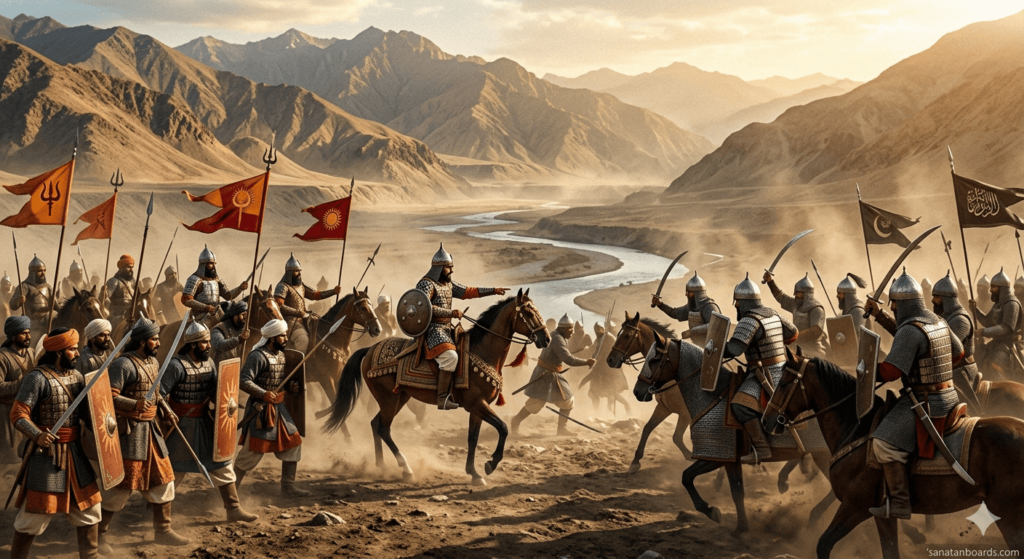
What Is Trilochanapala (Shahi Kingdom, Afghanistan) ?
TRILOCHANAPALA (SHAHI KINGDOM, AFGHANISTAN) specifically identifies both a historical figure and the context of the Hindu Shahi realm during the early 11th century CE. The Shahi dynasty was one of the last Indian dynastic powers in the region around modern Afghanistan and northern Pakistan before the establishment of deep Ghaznavid rule.
The term “Shahi” originates from the Persian word for “king” and came to denote a series of Hindu dynastic rulers who held sway over the Kabul Valley and Gandhara for several centuries. From around the 8th to early 11th centuries, this kingdom played a pivotal role at the crossroads of South and Central Asian politics. It was culturally diverse — embracing Hinduism and Buddhism — and served as a buffer between Central Asian empires and Indian plains states.
Trilochanapala himself was the successor to King Anandapala and inherited a kingdom weakened by decades of conflict with rising Ghaznavid power. Defined by territorial loss and military pressure, his reign is marked by determined attempts to recover lost ground and preserve autonomy. He attempted to expand control into the Siwalik Hills and to fortify alliances, particularly with the Kashmiri kingdom, in order to resist Mahmud of Ghazni’s incursions.
In military engagements, the Shahi forces under Trilochanapala often made use of challenging terrain — such as hill passes — to slow Ghaznavid advances. Despite these efforts, important battles such as those at the River Ramganga ended in defeat, signalling the decline of independent Shahi control.
Today, TRILOCHANAPALA and the Shahi Kingdom are studied as an important chapter in early medieval South Asian history — a period of inter‑civilizational contact, cultural exchange, and the shifting frontiers of empires on the edge of South and Central Asia
Who Is Required Trilochanapala (Shahi Kingdom, Afghanistan) ?
TRILOCHANAPALA (SHAHI KINGDOM, AFGHANISTAN) is required in historical studies for several important reasons.
First, his reign marks the final era of the Hindu Shahi dynasty — a dynasty that served as a crucial political and cultural bridge between South Asia and Central Asia in the medieval period. Understanding Trilochanapala’s leadership helps scholars grasp the dynamics of state‑level resistance to external forces during a transformational era of regional history.
Second, from a military history perspective, the conflicts involving Trilochanapala — particularly against Mahmud of Ghazni — illustrate the tactical and strategic challenges of defending mountainous frontier kingdoms against well‑organized invading armies. Battles like those at Ramganga show how terrain and force composition influenced outcomes and how smaller polities adjusted to the threats of larger expanding empires.
Third, his role is also significant for cultural history. The Shahi kingdom preserved Hindu and Buddhist traditions in a region that was increasingly influenced by Islamic governance under the Ghaznavids and later dynasties. Trilochanapala’s reign represents one of the last strong periods of indigenous religious and cultural continuity in the area before centuries of change.
Furthermore, for comparative studies of medieval politics, Trilochanapala’s interactions with neighboring kingdoms such as Kashmir demonstrate how smaller states negotiated alliances to counter external threats — an enduring theme in human history.
Finally, his legacy serves educational purposes by providing context on how historical identities, territorial shifts, and leadership decisions influence the rise and fall of dynasties — lessons relevant to broader historical inquiry and understanding of early medieval South and Central Asian contexts.
When Trilochanapala (Shahi Kingdom, Afghanistan) Is Required ?
TRILOCHANAPALA (SHAHI KINGDOM, AFGHANISTAN) is particularly significant during the early 11th century CE, a time of major political upheaval in South and Central Asia. He ascended the throne around AD 1011 following the death of his father, King Anandapala. This period was characterized by the expansion of the Ghaznavid Empire under Sultan Mahmud of Ghazni, whose campaigns stretched from Ghazni into northern India, challenging regional kingdoms like the Shahi.
The “requirement” of studying Trilochanapala arises in the context of understanding key historical turning points. His reign represents the final chapter of independent Shahi rule, highlighting how dynasties faced existential threats from expanding empires. Between AD 1011 and 1021–1022, when he lost his kingdom, the period illustrates military, political, and diplomatic strategies employed by smaller states to defend their territories.
This timeframe is also essential for understanding cultural transition. Under Trilochanapala, Hindu and Buddhist practices persisted in regions like Kabul and Gandhara despite increasing Islamic influence. The study of this era provides insight into how political change affected religious and cultural continuity, particularly in frontier regions where empires met.
Furthermore, examining Trilochanapala’s period helps scholars understand the chronology of Ghaznavid expansion. His resistance to Mahmud of Ghazni’s incursions provides clear markers for military history, including battles, sieges, and alliances with neighboring states like Kashmir. These events allow historians to place the decline of the Shahi Kingdom within a broader narrative of regional transformation in early medieval South Asia.
Where Trilochanapala (Shahi Kingdom, Afghanistan) Is Required ?
TRILOCHANAPALA (SHAHI KINGDOM, AFGHANISTAN) is relevant primarily in the regions that constituted the Shahi Kingdom. Geographically, this includes the Kabul Valley, parts of Gandhara (modern-day Peshawar region), and surrounding frontier territories of eastern Afghanistan and northern Pakistan. These areas were strategically important due to their position at the crossroads between Central Asia and the Indian subcontinent.
The “where” of Trilochanapala’s significance extends beyond territorial control. The Shahi capital served as a hub for political decision-making, cultural exchange, and military coordination. Control over fortified cities, hill passes, and river valleys was critical to resisting external forces like the Ghaznavids. Battles often occurred in key strategic locations such as river crossings, hill forts, and mountain passes, where terrain heavily influenced military outcomes.
Studying where Trilochanapala exercised authority also highlights cultural geography. These areas retained Hindu and Buddhist temples, monasteries, and local administrative structures under his reign. The physical locations of these sites are essential for historians, archaeologists, and cultural scholars tracing the persistence of indigenous religious practices before full Ghaznavid control.
Additionally, the relevance of “where” applies to military alliances. Trilochanapala sought support from neighboring kingdoms, including Kashmir and parts of Punjab, emphasizing the interconnectedness of frontier regions. The strategic locations of these allied territories enabled communication, troop movement, and coordinated resistance against invading forces.
Finally, “where” encompasses modern-day historical studies. Archaeological sites in Afghanistan and northern Pakistan continue to yield evidence of Shahi fortifications, coins, and inscriptions that illuminate Trilochanapala’s reign. Understanding the geography of these areas provides insight into the broader dynamics of early 11th-century politics and culture.
How Trilochanapala (Shahi Kingdom, Afghanistan) Is Required ?
TRILOCHANAPALA (SHAHI KINGDOM, AFGHANISTAN) is required in historical studies through his role as a defender of a declining dynasty. Understanding “how” he is relevant involves examining the methods, strategies, and decisions that defined his reign.
- Military Resistance: Trilochanapala’s approach to defending the Shahi Kingdom involved mobilizing armies and fortifying key strategic locations. He leveraged difficult terrain, including mountain passes and rivers, to counterbalance the superior numbers and organization of Mahmud of Ghazni’s forces.
- Diplomacy and Alliances: He sought alliances with neighboring kingdoms like Kashmir to strengthen his position against external threats. Through these diplomatic measures, he attempted to create a network of support that could resist Ghaznavid expansion.
- Cultural Preservation: Beyond military and political strategies, Trilochanapala played a role in sustaining Hindu and Buddhist cultural institutions in his territories. Temples, monasteries, and local traditions continued under his reign, reflecting how rulers maintained social and religious cohesion even in times of political instability.
- Economic Management: Funding military campaigns required careful economic planning. Tributes, resource allocation, and local taxation under Trilochanapala ensured the kingdom could sustain prolonged resistance against more powerful adversaries.
- Legacy Through Records: Coins, inscriptions, and historical chronicles documenting his reign help modern scholars reconstruct the “how” of his influence. These records indicate his administrative style, the territorial extent of his rule, and the social dynamics of the Shahi Kingdom during its final phase.
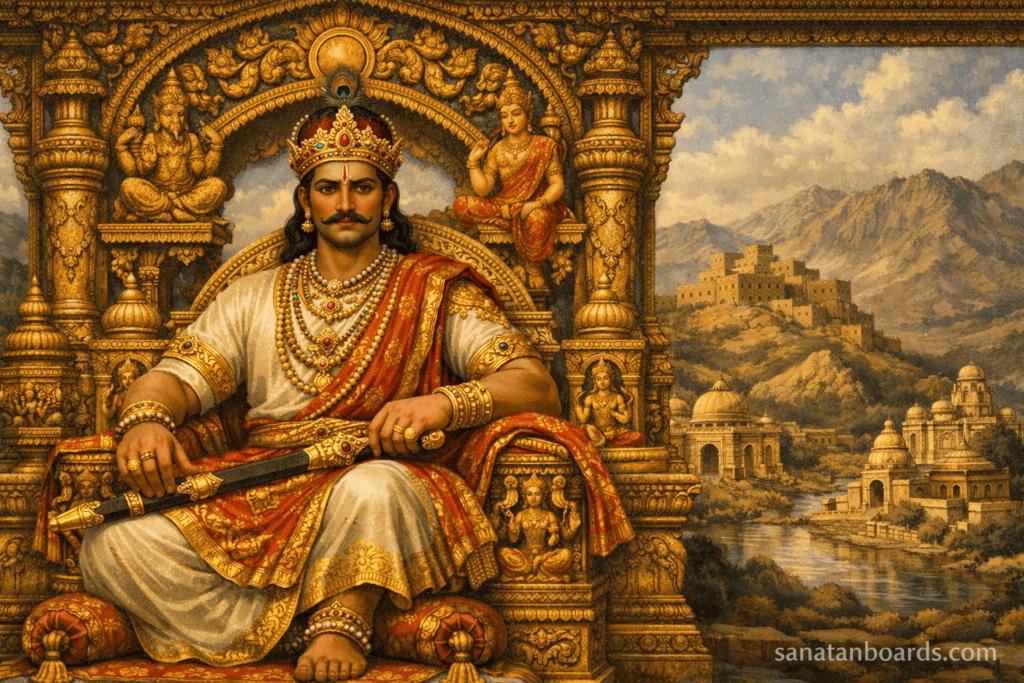
Case Study On Trilochanapala (Shahi Kingdom, Afghanistan)
The reign of TRILOCHANAPALA (SHAHI KINGDOM, AFGHANISTAN) provides a compelling case study in medieval statecraft, military strategy, and cultural preservation. Trilochanapala ascended the Shahi throne around 1011 CE during a period of geopolitical turbulence. The Shahi Kingdom, strategically located in the Kabul Valley and Gandhara, faced persistent threats from the rising Ghaznavid Empire under Sultan Mahmud of Ghazni, whose campaigns extended deep into South Asia.
Political and Military Context
Trilochanapala inherited a kingdom that had already experienced repeated conflicts with Ghaznavid forces. His father, Anandapala, had attempted both military resistance and diplomatic appeasement, but the increasing might of Mahmud of Ghazni demanded decisive leadership. Trilochanapala’s reign illustrates the challenges of ruling a frontier state caught between powerful neighboring empires.
Military strategy under Trilochanapala focused on defensive positioning. The kingdom utilized mountainous terrain and fortified passes to slow Ghaznavid advances. Key battles, including those at the Ramganga River, demonstrated both the resilience and limitations of Shahi forces. Despite meticulous planning, the Shahi army was ultimately unable to match the well-equipped and numerically superior Ghaznavid troops.
Diplomatic Initiatives
Recognizing the strategic importance of alliances, Trilochanapala sought support from neighboring kingdoms such as Kashmir and Punjab. These alliances were intended to create a multi-front defense against Ghaznavid incursions. The efforts highlight the role of diplomacy alongside military strategy in preserving smaller kingdoms during periods of expansionist threats.
Cultural Preservation
Trilochanapala’s reign was marked not only by military engagement but also by the preservation of Hindu and Buddhist cultural practices. Temples and monasteries within the Shahi territories continued functioning under royal patronage. This cultural continuity demonstrates the Shahi Kingdom’s role as a buffer of South Asian traditions during the early 11th century, even as Islamic influence expanded in adjacent regions.
Economic Management
Sustaining prolonged resistance required careful economic management. Trilochanapala oversaw taxation and resource allocation to maintain his army and fortifications. The kingdom relied on agricultural productivity and trade routes passing through the Kabul Valley. Despite external pressures, these measures enabled the kingdom to maintain a functional state apparatus during a period of existential threat.
Decline and Legacy
Despite his efforts, Trilochanapala eventually suffered defeat, losing key battles to Ghaznavid forces and facing internal dissent. His assassination around 1021–1022 CE marked the end of major Shahi autonomy. The case study of Trilochanapala demonstrates the challenges faced by frontier rulers confronting larger empires, highlighting the interplay of military strategy, diplomacy, economic planning, and cultural resilience.
Trilochanapala’s reign continues to serve as a teaching model in historical studies, illustrating the dynamics of medieval statecraft, the impact of geography on military campaigns, and the preservation of cultural identity under political duress. Scholars today study his reign to understand the broader processes of empire-building, frontier defense, and cultural preservation in early medieval South and Central Asia.
White Paper On Trilochanapala (Shahi Kingdom, Afghanistan)
Executive Summary
This white paper examines the historical significance of TRILOCHANAPALA (SHAHI KINGDOM, AFGHANISTAN), exploring his reign as the final phase of the Shahi dynasty and its implications for regional politics, culture, and military strategy in early 11th-century South and Central Asia.
Introduction
The Shahi Kingdom served as a pivotal geopolitical and cultural node between Central Asia and the Indian subcontinent. Trilochanapala ascended the throne around AD 1011 during a period of heightened Ghaznavid expansion under Sultan Mahmud of Ghazni. The kingdom’s strategic location, diverse culture, and frontier dynamics made his reign both challenging and historically significant.
Historical Context
The Shahi Kingdom had maintained regional influence for centuries, balancing diplomacy, military campaigns, and cultural patronage. By the early 11th century, Ghaznavid forces threatened to overrun the kingdom. Trilochanapala inherited these challenges and faced the dual task of defending his territory while preserving cultural and administrative structures.
Military and Strategic Analysis
Trilochanapala implemented defensive strategies leveraging geographic advantages, such as hill passes and river valleys. Despite these measures, decisive battles like those at the Ramganga River and various passes revealed the limitations of frontier kingdoms against larger empires.
Strategically, Trilochanapala attempted to consolidate power through regional alliances with Kashmir and other neighboring states. These alliances provided temporary support but were insufficient to counter the military superiority of the Ghaznavids.
Cultural and Administrative Impact
Trilochanapala’s reign preserved Hindu and Buddhist cultural institutions, including temples, monasteries, and local educational centers. Administrative records indicate continued taxation, legal adjudication, and governance despite external pressures. These activities demonstrate the kingdom’s resilience and the ruler’s commitment to maintaining socio-political stability.
Lessons Learned
The study of Trilochanapala offers key lessons:
- Frontier kingdoms require adaptive military and diplomatic strategies to survive external threats.
- Cultural and religious preservation is critical in maintaining societal cohesion during periods of political instability.
- Strategic alliances, though valuable, may not guarantee survival against superior forces.
Conclusion
Trilochanapala’s reign represents a significant historical episode in the decline of the Shahi Kingdom. His leadership demonstrates the interplay #Sanatandharmaaccreditationboardsinvasai between military strategy, diplomacy, governance, and cultural preservation. Scholars and strategists can draw insights from his experiences to understand broader patterns of empire-building, regional resistance, and frontier administration in medieval history.
Industry Application Of Trilochanapala (Shahi Kingdom, Afghanistan)
Although TRILOCHANAPALA (SHAHI KINGDOM, AFGHANISTAN) pertains to a historical context, several modern “industry” applications of studying his reign exist in education, defense studies, cultural heritage, and tourism:
- Education and Historical Research: Scholars, universities, and historians use Trilochanapala’s reign to teach medieval South Asian history, military strategy, and statecraft. His era illustrates the challenges faced by frontier kingdoms, providing case studies for academic curricula.
- Cultural Heritage Management: Understanding the Shahi Kingdom under Trilochanapala informs conservation efforts of archaeological sites in Afghanistan and Pakistan. Preserving temples, coins, and inscriptions allows cultural institutions to maintain historical continuity.
- Military Strategy and Defense Studies: Defense academies and military historians study his campaigns against Ghaznavid forces to understand frontier defense strategies, logistics in mountainous terrain, and the role of alliances in asymmetric warfare.
- Tourism and Regional Development: Historical sites associated with the Shahi Kingdom attract educational tourism. Understanding Trilochanapala’s reign can help develop informative heritage trails, exhibitions, and cultural programs.
- Digital Humanities: Digitizing historical records, maps, and inscriptions from the Shahi era allows researchers to model medieval governance, military logistics, and cultural networks. Trilochanapala’s reign is a key dataset in such projects.
By integrating lessons from Trilochanapala’s era, modern industries — #Sanatandharmaaccreditationboardsinmumbai from education to tourism to digital humanities — can enhance cultural knowledge, strategic thinking, and heritage preservation.
source : Bharat Varsh project
ASK FAQ
Who was Trilochanapala in the Shahi Kingdom?
Trilochanapala was the last major ruler of the Hindu Shahi Kingdom in eastern Afghanistan and northern Pakistan during the early 11th century CE, known for resisting Ghaznavid invasions.
What is the historical significance of the Shahi Kingdom?
The Shahi Kingdom was a frontier dynasty that preserved Hindu and Buddhist culture in the Kabul Valley and Gandhara region before the rise of the Ghaznavid Empire.
When did Trilochanapala rule the Shahi Kingdom?
Trilochanapala ruled approximately from AD 1011 to 1021–1022, marking the final phase of Shahi autonomy.
Where was the Shahi Kingdom located under Trilochanapala?
The Shahi Kingdom under Trilochanapala covered the Kabul Valley, Gandhara region, and parts of present-day eastern Afghanistan and northern Pakistan.
How did Trilochanapala resist Ghaznavid invasions?
He used fortified passes, alliances with neighboring kingdoms like Kashmir, and strategic military defense to slow Ghaznavid expansion, although ultimately the kingdom fell.
Table of Contents
DISCLAIMER
The information provided in this document is intended for educational, learning, and knowledge purposes only. All historical interpretations are based on available academic sources and archaeological research. Readers should consult additional scholarly references for comprehensive analysis. This document does not promote any political, religious, or cultural ideology and is strictly for informational and historical study.