
SOMESHVARA I (WESTERN CHALUKYA)
SOMESHVARA I (WESTERN CHALUKYA) was one of the most remarkable emperors of the Western Chalukya Empire, ruling from 1042 until his death on 29 March 1068. His reign marked a pivotal era in the medieval history of the Indian subcontinent, with extensive military campaigns, diplomatic engagements, cultural developments, and architectural achievements that shaped the political landscape of the Deccan and Central India.
As a successor to his father Jayasimha II, Someshvara I ascended the throne during a period of persistent conflict and growing competition among regional powers. He inherited a powerful dynasty known as the Chalukyas of Kalyani, who had established their dominance in the western Deccan after the decline of the Rashtrakuta Empire. Despite facing formidable rivals such as the Cholas of the Tamil region, the Paramaras of Central India, and other regional dynasties Someshvara I maintained the integrity of his realm and even expanded his influence northward into present‑day Gujarat, Madhya Pradesh, and parts of eastern India.
Under his rule, the Chalukyan capital was shifted from Manyakheta to Kalyani (now Basavakalyana in Karnataka), allowing him to better administer and defend his empire. Beyond warfare, he promoted literature and the arts, patronizing scholars who produced important works in Kannada and Sanskrit. His reign is often remembered as a significant chapter that set the stage for the later apex of Western Chalukya power under rulers like Vikramaditya VI.
What Is Someshvara I (Western Chalukya) ?
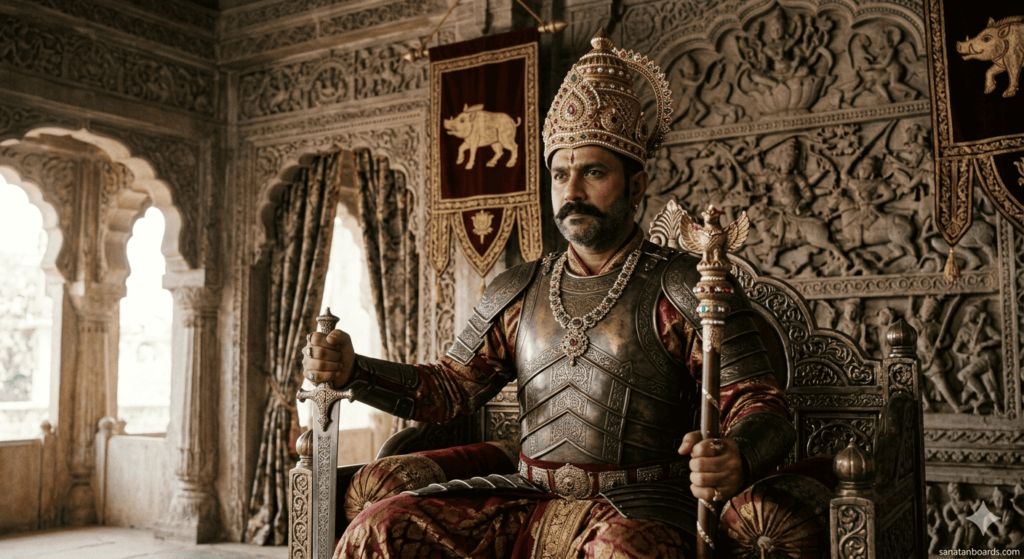
SOMESHVARA I (WESTERN CHALUKYA) was an emperor of the Western Chalukya dynasty, which ruled parts of the Deccan Plateau in South India during the 11th century. He succeeded Jayasimha II to become king in 1042 CE, taking on titles such as Ahavamalla and Trilokamalla — names that underscored his valor and authority.
As a medieval Indian monarch, Someshvara I was both a warrior and an administrator. His reign was defined by constant military activity, especially against rival powers. The greatest of these challenges came from the rising Chola dynasty of the Tamil region, whose rulers sought to expand northward. Although Someshvara I suffered occasional setbacks in battle against them, he retained control over key territories and prevented the Cholas from permanently occupying his core domains.
Apart from the Cholas, Someshvara I engaged in warfare with several other significant kingdoms of his time — including the Paramaras, Kalachuris, and regional powers such as the Shilaharas and the Yadavas. His military campaigns extended Chalukya influence deep into Central India, reaching parts of what are today Gujarat, Madhya Pradesh, and Vidarbha.
Someshvara I was also a patron of culture, supporting scholars who contributed to Kannada literature and learning. During his reign, works like Jatakatilaka in astrology became prominent. His governance style blended martial energy with cultural encouragement, helping sustain the Chalukya state through the turbulence of constant warfare
Who Is Required Someshvara I (Western Chalukya) ?
SOMESHVARA I (WESTERN CHALUKYA) was required — in the sense of historical significance — because his leadership steered the Western Chalukya empire through one of its most dynamic periods. He embodied the traits expected of a powerful medieval monarch: military courage, political strategy, territorial expansion, and cultural patronage. At a time when dynastic identities were often shaped by conquest and governance, Someshvara I’s reign reinforced the Chalukyas’ position as a formidable force in the Indian subcontinent.
As a warrior‑king, he faced threats on multiple fronts. The Cholas to the south, ambitious and powerful, constantly challenged his rule, pushing him into protracted conflicts that tested his military acumen. His ability to defend his kingdom — and even expand influence toward Gujarat and Central India — signified not just personal valor but strategic statecraft.
Beyond warfare, Someshvara I was required as a figure who shaped administrative and cultural foundations. By moving the capital to Kalyani, he strengthened the political heartland of his realm. By patronizing scholars and the arts, he enriched literary traditions and supported intellectual growth. His reign influenced the historical trajectory of the Deccan, preparing the ground for future rulers — especially his son Vikramaditya VI — to further elevate the dynasty’s prestige.
When Someshvara I (Western Chalukya) Is Required ?
SOMESHVARA I (WESTERN CHALUKYA) became required — meaning historically significant — in the mid‑11th century, specifically from 1042 CE to 1068 CE, the period of his reign. This era in Indian history was marked by intense political competition. Emerging powers like the Cholas of the Tamil region were seeking expansion, while established dynasties like the Chalukyas were striving to sustain influence across the Deccan and beyond.
Someshvara I’s rule began during a time of uncertainty. His father, Jayasimha II, had established the foundations of the Western Chalukya state but had also left unresolved tensions with neighboring kingdoms. The empire faced military pressure from the Cholas, who had already annexed several territories in southern India. Around 1042 CE, Someshvara I ascended the throne and rapidly became involved in defending and reasserting Chalukya power.
The when of his historical role becomes more defined when viewed against specific conflicts and events. In the 1040s and 1050s, Someshvara I engaged in repeated warfare with the Cholas. Although he experienced defeats — including the loss of strategic forts — he demonstrated resilience by rallying his forces and forging temporary alliances with other regional powers. These decades were pivotal because they shaped the territorial boundaries of south and central India in this period. The intensity of these conflicts made Someshvara I’s leadership crucial; without his intervention, the Western Chalukya Empire could have been overshadowed or absorbed by rival states.
Additionally, his reign must be placed in the broader timeline of medieval Indian politics, where dynasties such as the Paramaras, Kalachuris, and Shilaharas interacted through war, diplomacy, and marriage alliances. The 1050s through the 1060s witnessed these multi‑front engagements that required the Chalukyan king to be both a warrior and a statesman.
Where Someshvara I (Western Chalukya) Is Required ?
SOMESHVARA I (WESTERN CHALUKYA) was required — both geographically and politically — across the Deccan Plateau and adjoining regions of central and southern India. The primary geographic center of his rule was the Western Chalukya heartland, with the capital at Kalyani (present‑day Basavakalyana in northern Karnataka). This location was strategically significant, serving as both a military stronghold and a political core from which the empire could assert authority over a vast territory.
The Deccan region itself was a crossroads of competing powers. To the south, the Cholas had consolidated much of Tamil territory and were aggressively extending their influence northward. The borders between Chola and Chalukya territories were ever contested, and battles took place throughout regions that now comprise parts of Karnataka, Andhra Pradesh, and Telangana. Someshvara I’s presence was required in these contested border zones to defend Chalukya control, reclaim lost forts, and maintain influence over local chieftains and subordinate rulers.
Beyond the south, his reign expanded influence westward into parts of modern‑day Maharashtra and Goa, where regional dynasties and clans frequently shifted alliances. His diplomatic and military engagements ensured that the Western Chalukyas remained relevant players in the power balance of western India.
Northward, Someshvara I engaged with Central Indian dynasties such as the Paramaras of Malwa and the Kalachuris of Tripuri. Control over areas near the Narmada River and surrounding territories became important not only for defense but also for asserting authority over trade routes and political spheres of influence. His expeditions into these regions underscored the territorial ambitions of the Western Chalukyas beyond their core Deccan domain.
Additionally, his influence spread toward the Gujarat region, where interactions with the Solankis (Chaulukyas of Gujarat) revealed the interconnected nature of Indian politics during this era. By pushing into areas further north, Someshvara I sought to secure alliances, expand territorial reach, and counterbalance the power of adversaries.
How Someshvara I (Western Chalukya) Is Required ?
SOMESHVARA I (WESTERN CHALUKYA) was required through a combination of military strategy, administrative governance, and cultural patronage. His reign demonstrated that sustaining a medieval empire required both battlefield leadership and effective statecraft.
1. Military Strategy: Someshvara I was required to protect his kingdom from external threats, primarily the Cholas, who were expanding northward into Deccan territories. He employed fortified strongholds, rapid troop mobilization, and alliances with regional rulers to counter these threats. Military campaigns were carefully planned to defend key cities, retain control over trade routes, and assert Chalukya dominance in contested areas.
2. Administrative Governance: Beyond warfare, Someshvara I was required to maintain internal stability. He moved the capital to Kalyani, centralizing authority and enabling better control over distant provinces. Local chieftains and vassals were integrated into the administration through a system of allegiance and tribute, ensuring loyalty while maintaining the emperor’s authority. Revenue systems, land grants, and administrative oversight were tools through which he reinforced the empire’s sustainability.
3. Cultural and Intellectual Patronage: Someshvara I was also required to promote cultural identity. He patronized Kannada and Sanskrit scholars, encouraged temple construction, and supported literary works that reinforced the Chalukya legacy. These efforts helped legitimize his rule and strengthened the social cohesion of the empire.
4. Diplomacy: He skillfully engaged in diplomacy with neighboring dynasties. Treaties, strategic marriages, and temporary alliances with other regional powers allowed him to counterbalance stronger opponents like the Cholas.
Case Study On Someshvara I (Western Chalukya)
Background:
The Western Chalukya Empire, under SOMESHVARA I, faced unprecedented challenges from the Cholas and other regional powers. The case study examines his leadership during the Chola invasion of the mid-11th century, highlighting how military, political, and cultural strategies contributed to sustaining the empire.
Military Engagements:
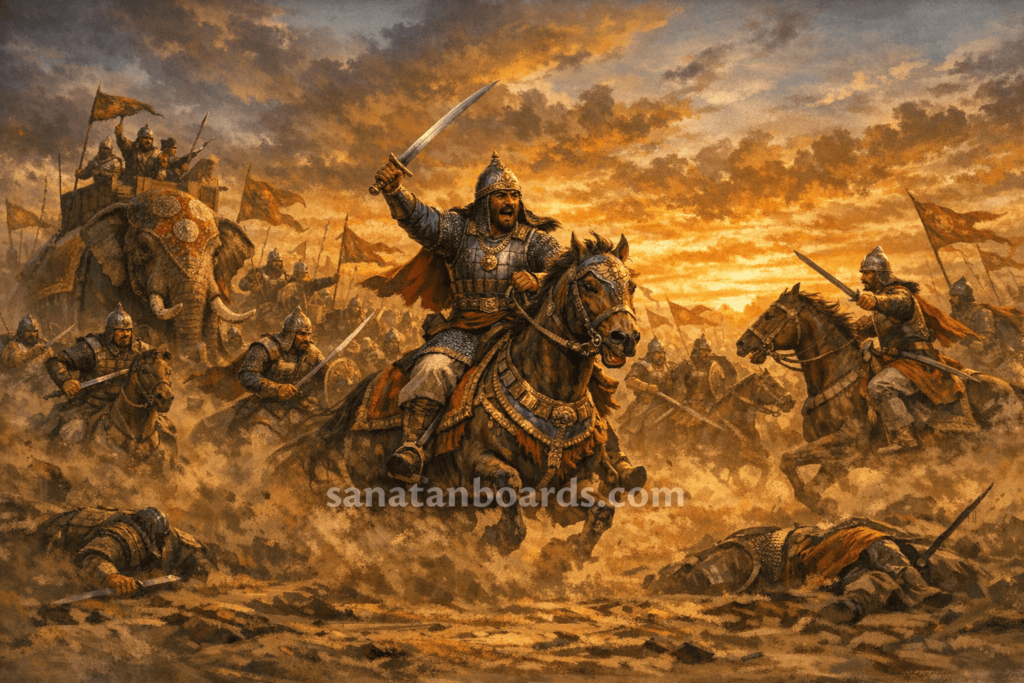
In 1045 CE, the Chola king Rajadhiraja Chola launched a northern campaign, targeting Chalukya territories. Someshvara I faced the challenge of defending multiple fronts simultaneously. Utilizing intelligence networks and fortified defenses, he employed both defensive and offensive strategies. For instance, Kalyani and surrounding forts were reinforced to withstand sieges. While certain northern territories were temporarily lost, Someshvara I’s counter-attacks in the Deccan reclaimed key regions and prevented permanent Chola occupation.
Administrative Measures:
Recognizing that warfare alone could not ensure stability, Someshvara I implemented administrative reforms. By centralizing governance at Kalyani, he streamlined tax collection regulated local officials, and strengthened loyalty among subordinate chieftains. Land grants and temple patronage helped secure both the economic base and social cohesion of the empire. This approach illustrates effective crisis management, combining military defense with internal governance.
Cultural Initiatives:
Even during conflict, Someshvara I supported Kannada and Sanskrit scholars, commissioning works like Jatakatilaka, which preserved intellectual traditions. Temples constructed under his reign served as centers of community, learning, and religious practice, reinforcing loyalty and identity during turbulent times.
Diplomatic Maneuvers:
Someshvara I also leveraged diplomacy. Temporary alliances with the Paramaras of Malwa and Kalachuris of Tripuri prevented the Cholas from concentrating their forces solely on Chalukya territories. Marriages and treaties further stabilized relations with peripheral regions, highlighting a multi-dimensional strategy of combining force and negotiation.
Outcome and Lessons:
Despite facing a superior opponent, Someshvara I successfully defended the core of the Western Chalukya Empire. While some territories fluctuated under Chola pressure, the empire’s cultural, economic, and military structures remained intact. Key takeaways include:
- The importance of strategic fortification and intelligence in defense
- Centralized governance to maintain loyalty and administrative efficiency
- Cultural patronage as a tool for social cohesion and legitimacy
- Diplomatic engagement to mitigate external threats
This case study demonstrates that SOMESHVARA I’s leadership was multi-faceted, making him indispensable for the stability and growth of the Western Chalukya Empire. His reign provided a foundation for subsequent rulers, especially Vikramaditya VI, to expand the dynasty’s influence.
White Paper On Someshvara I (Western Chalukya)
Abstract:
This white paper explores the historical significance, leadership strategies, and enduring impact of SOMESHVARA I (WESTERN CHALUKYA), a key ruler of the Western Chalukya dynasty in the 11th century. His reign (1042–1068 CE) was marked by military campaigns, political consolidation, cultural patronage, and administrative innovations. The paper provides a structured analysis of his governance model, regional influence, and legacy, offering insights into the dynamics of medieval Indian empires.
Introduction:
SOMESHVARA I ascended the Western Chalukya throne during a period of intense competition in the Deccan Plateau. The Cholas to the south, Paramaras to the north, and other regional powers presented constant threats. His role was required to stabilize the empire, defend territorial boundaries, and project cultural authority. By examining his reign, we understand how leadership strategies can balance military, administrative, and cultural imperatives.
Historical Context:
Following the decline of the Rashtrakuta Empire, the Western Chalukyas emerged as a dominant power. Someshvara I inherited a strong but contested kingdom from his father, Jayasimha II. The period was characterized by inter-dynastic warfare, regional alliances, and territorial flux. Maintaining control required both decisive action on the battlefield and careful management of internal administration.
Military Strategy and Defense:
Someshvara I faced repeated incursions from the Chola dynasty, whose expansionist policies threatened Chalukya territories. He adopted a multi-layered defensive strategy:
- Fortification of key cities such as Kalyani, Manyakheta, and strategic border towns.
- Rapid mobilization of regional armies supported by local chieftains.
- Counter-offensives in Central India to reclaim lost territories.
- Use of diplomacy and alliances to divide adversaries and limit coordinated attacks.
These approaches highlight adaptive leadership, combining tactical defense with strategic offense to maintain territorial integrity.
Administrative Governance:
Someshvara I restructured governance to centralize authority, enhance revenue collection, and integrate local chieftains into the empire’s administrative framework. By relocating the capital to Kalyani, he ensured better supervision of both civil and military affairs. Land grants, tax reforms, and patronage of temples helped consolidate loyalty and stabilize the socio-economic structure.
Cultural Patronage:
Even during military campaigns, Someshvara I promoted Kannada and Sanskrit scholarship, commissioning works like Jatakatilaka. Temple construction served not only religious purposes but also as centers of education and community cohesion, reinforcing the Chalukya identity.
Legacy and Impact:
Someshvara I’s reign laid the foundation for the Western Chalukya golden period under Vikramaditya VI. His ability to manage multiple fronts, maintain internal cohesion, and encourage cultural activity demonstrates a holistic governance model. Modern interpretations of his leadership offer lessons in strategic planning, crisis management, and balancing multiple governance priorities.
Conclusion:
SOMESHVARA I (WESTERN CHALUKYA) exemplifies the role of a medieval monarch required to defend, govern, and cultivate culture simultaneously. His strategies #someshvara1westernchalukya ensured the survival and continuity of the Chalukya Empire, contributing to its historical prominence in Indian history
Industry Application On Someshvara I (Western Chalukya) ?
While SOMESHVARA I (WESTERN CHALUKYA) lived in the 11th century, the lessons from his reign have relevance for modern organizational leadership, strategic management, and cultural stewardship. This section explores his applications in contemporary industries.
1. Strategic Leadership in Organizations:
Someshvara I successfully navigated a landscape of competing powers, akin to modern business environments with multiple stakeholders and competitors. His multi-pronged strategy — combining defense, offense, and diplomacy — mirrors approaches in corporate strategy where leaders must anticipate market changes, mitigate risks, and leverage alliances. Industries such as defense, technology, and multinational corporations can draw insights from his ability to manage multiple fronts simultaneously.
2. Risk Management and Crisis Response:
Faced with Chola invasions and territorial instability, Someshvara I demonstrated adaptive risk management. Modern sectors such as financial services, disaster management, and logistics can study his approach: assessing threats, reallocating resources, and implementing contingency plans to safeguard organizational interests.
3. Centralized Governance and Operational Efficiency:
By relocating the capital to Kalyani and strengthening administration, he enhanced oversight and operational control. In today’s context, this reflects the importance of centralized project management and workflow optimization in industries like manufacturing, IT services, and supply chain management.
4. Cultural and Knowledge Capital:
Someshvara I’s patronage of literature and temple construction emphasizes investment in intellectual and cultural capital, fostering long-term societal cohesion. Modern organizations in education, cultural industries, and corporate social responsibility initiatives can draw parallels by supporting research, innovation, and employee engagement programs.
5. Diplomacy and Stakeholder Management:
He used alliances and strategic negotiations to manage external threats. Today, industries must maintain relationships with partners, regulators, and communities. Someshvara I’s example reinforces the value of collaborative leadership and negotiation skills for sustainable growth.
6. Case Integration:
The defense against Cholas, administration reforms, and cultural initiatives together show integrated management practices. Industries focusing on project portfolio management and multi-department coordination can apply similar principles for efficiency and resilience.
Conclusion:
The study of SOMESHVARA I (WESTERN CHALUKYA) demonstrates that historical leadership models can inform modern industry practices. His emphasis on strategy, #Sanatandharmaaccreditationboardsinmumbai risk management, administrative centralization, cultural investment, and diplomacy provides timeless lessons for contemporary organizational leaders. By applying these principles, modern industries can #Sanatandharmaaccreditationboardsinvasai achieve sustainable growth, resilience, and stakeholder trust, much like the Western Chalukya Empire thrived under his reign.
source : Spotlight Academy
ASK FAQ
Who was Someshvara I of the Western Chalukya dynasty?
Someshvara I was a 11th-century king of the Western Chalukya dynasty who ruled from 1042 to 1068 CE, known for defending the empire against the Cholas and promoting Kannada and Sanskrit culture.
When did Someshvara I rule the Western Chalukya Empire?
Someshvara I ruled the Western Chalukya Empire from 1042 CE until his death in 1068 CE.
What were the major achievements of Someshvara I ?
His major achievements include defending the empire from Chola invasions, expanding influence in Central India, relocating the capital to Kalyani, and patronizing literature and temple construction.
Where was the capital of Someshvara I located?
The capital of Someshvara I was at Kalyani (modern Basavakalyana, Karnataka), which served as the political and administrative center of the Western Chalukya Empire.
How did Someshvara I contribute to culture and administration?
He centralized administration, strengthened governance, supported Kannada and Sanskrit scholars, and commissioned temples, ensuring both political stability and cultural development.
Table of Contents
Disclaimer:
All information provided above is compiled from historical sources and modern interpretations for informational purposes. It is intended to guide readers in understanding the historical significance of SOMESHVARA I (WESTERN CHALUKYA) and its applications in contemporary leadership and management contexts. Accuracy may vary due to the historical nature of the sources.