RUDRADEVA (KAKATIYA DYNASTY)
Rudradeva, also known as Prataparudra I, was a prominent ruler of the Kakatiya dynasty, which dominated large parts of the eastern Deccan region of India in the 12th and early 13th centuries CE. His reign, spanning approximately from 1158 to 1195 CE, marks a critical phase in the transition of the Kakatiyas from regional vassals to independent sovereigns. During this time, the political landscape of South India was shifting rapidly as older powers like the Western Chalukyas weakened allowing ambitious local leaders to assert greater autonomy and establish lasting kingdoms.
Rudradeva was the eldest son of Prola II, a feudatory under the Chalukyas of Kalyani. Initially serving under greater overlords, Rudradeva displayed strategic brilliance and military skill that helped him gradually assert Kakatiya independence. He subjugated several regional chiefs and expanded his influence across present‑day Telangana and Andhra Pradesh. Around 1163 CE he proclaimed sovereignty for the Kakatiya realm, an act seen as a defining moment in the dynasty’s rise.
Under his leadership, foundational changes were made that shaped the future of the dynasty. Rudradeva relocated the Kakatiya capital from Anumakomda (modern Hanamkonda) to Orugallu (modern Warangal), where he initiated several projects to fortify and cultivate his kingdom. His rule is especially remembered for the construction of the Rudreshvara temple, popularly known as the Thousand Pillar Temple — an architectural marvel that stands as a testimony to the cultural and artistic spirit of his reign.
By consolidating territories, reducing external dependencies, and reinforcing administrative structures, Rudradeva laid a firm foundation for the Kakatiya dynasty’s golden period, which would flourish under later kings such as Ganapati Deva and Rudrama Devi.
What Is Rudradeva (Kakatiya Dynasty) ?
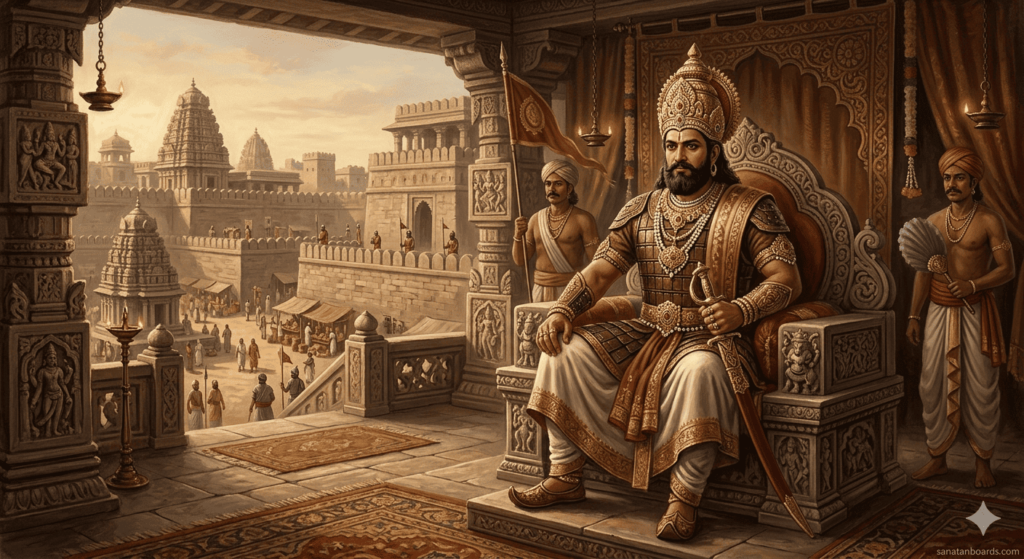
Rudradeva was a ruler of the Kakatiya dynasty, a powerful medieval South Indian dynasty centered in the region corresponding to modern Telangana and Andhra Pradesh. The Kakatiyas were initially feudal chiefs under the dominance of larger empires such as the Western Chalukyas. However, under Rudradeva’s leadership, they emerged as an independent sovereign power.
Rudradeva’s reign is significant for several reasons. First, he is widely regarded as the first sovereign ruler of the Kakatiyas — a leader who no longer acknowledged any external overlord’s authority. Prior to him, the Kakatiya chiefs had served under Chalukya rulers, but with the weakening of Chalukya political power, Rudradeva seized the moment to assert full independence for his house.
He commanded military campaigns that subdued rebellious chieftains and extended Kakatiya influence across strategic territories. His victories helped reshape the political map of the eastern Deccan, positioning the Kakatiya state as a significant regional power.
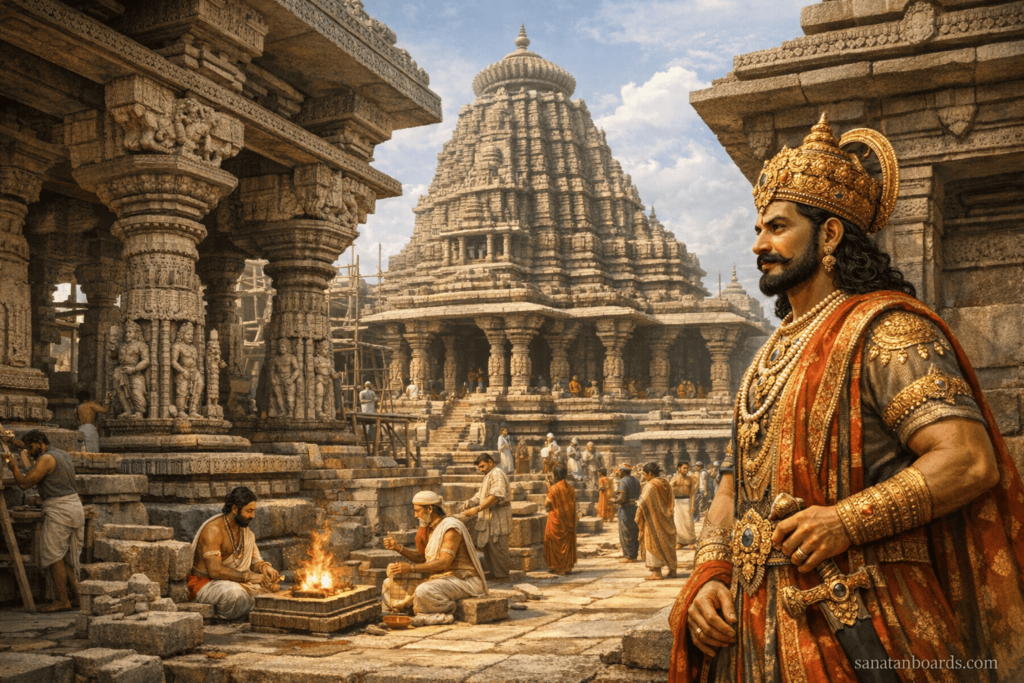
Beyond military achievements, Rudradeva was also a builder and patron of culture. Most notably, he commissioned the construction of the Thousand Pillar Temple (Rudreshvara Temple) in Anumakonda — a significant cultural and architectural landmark blending structural innovation with artistic excellence.
In addition, he made Warangal (then Orugallu) the Kakatiya capital, a location that would later grow into a major political and economic center. This strategic relocation laid out the administrative heart of the kingdom and helped strengthen central authority.
Rudradeva’s rule set the stage for the dynasty’s subsequent expansion and cultural florescence — establishing political stability, fortifying territorial control, and creating an environment where arts, architecture, and religion could thrive.
Who Is Required Rudradeva (Kakatiya Dynasty) ?
By his time, the traditional power structures in South India were undergoing turbulence. As larger empires like the Western Chalukyas began to weaken, local dynasties had opportunities to assert autonomy and expand influence. Rudradeva seized this moment, positioning himself as a ruler capable of leading his people beyond feudal subordination. He subdued local chiefs who had once been under Chalukya authority and consolidated several strategic territories under Kakatiya control.
This ascent was significant because it reflected not just territorial growth but political legitimacy. The shift from vassal to sovereign ruler meant that the Kakatiyas could craft their own diplomatic strategies, develop administrative systems, and establish cultural institutions unique to their realm.
Rudradeva’s military leadership made them a formidable force in the eastern Deccan, enabling the kingdom to resist pressures from neighboring powers and hold its ground amid competing regional forces. His selection of Warangal as the capital further solidified centralized administration in a strong, defensible location.
His rule also had symbolic significance. By commissioning monumental architecture such as the Thousand Pillar Temple, Rudradeva expressed both state power and cultural identity — promoting religious devotion, civic pride, and artistic achievement.
When Rudradeva (Kakatiya Dynasty) Is Required ?
Before Rudradeva’s ascension, the Kakatiya chiefs had long served as vassals under the Western Chalukyas and other dominant powers. These larger empires exerted control over numerous smaller kingdoms and subordinate rulers across South India. The Chalukyas, in particular, had held sway over much of the Deccan plateau, and the Kakatiyas operated under their authority for generations.
However, by the mid‑1100s, the Chalukya empire was losing strength due to internal strife, external pressures, and the rising influence of local powers. This weakening of centralized authority opened the door for ambitious rulers like Rudradeva to rise. Around 1158–1163 CE, Rudradeva began to assert control independently, no longer recognizing Chalukya supremacy. It was during this period that he proclaimed himself sovereign, effectively marking the birth of the Kakatiya state as an autonomous power.
The timing of Rudradeva’s rise was critical. The decline of the previous hegemonic power created a political vacuum that required a strong leader to stabilize the region. Rudradeva provided that leadership through military campaigns against rebellious chiefs, securing borders, and expanding influence into coastal Andhra. His actions strengthened the foundations of the kingdom and ensured that the Kakatiyas would endure as a major dynasty.
It is also notable that this era was marked by broader regional transitions. South India saw multiple local dynasties assert autonomy as larger empires faded. Rudradeva’s emergence fits this pattern of decentralization — a time when regional aspiration and identity began shaping new political realities.
Where Rudradeva (Kakatiya Dynasty) Is Required ?
The Kakatiya dynasty originated around Anumakomda (present‑day Hanamkonda), which served as the early power base before becoming a cultural and religious hub under Rudradeva’s rule. This region, nestled between the Godavari and Krishna rivers, was strategically significant due to its fertile lands, trade routes, and position between larger powers in the South and North India.
During his reign, Rudradeva expanded the Kakatiya realm into several important territories. He subdued nearby chieftains and brought various parts of the eastern Deccan under firm control. His campaigns extended influence into coastal Andhra and the Godavari delta region, which not only enhanced the kingdom’s economic base but also provided access to maritime trade.
One of the most important geographic contributions of Rudradeva’s rule was the relocation of the capital to Orugallu, later known as Warangal. This site became the political heart of the Kakatiya kingdom and remained central throughout the dynasty’s history. Warangal’s location was advantageous both defensively and economically, acting as a hub for administration, craft industries, and cultural exchange.
The physical landscape of his kingdom required a leader who could unify diverse regions — from plateau lands in the north to coastal plains in the east. Rudradeva’s strategic conquests ensured that these territories were integrated under centralized governance, stabilizing the entire region.
Culturally, Rudradeva’s architectural projects, such as the Thousand Pillar Temple in Hanamkonda, further rooted his rule in the landscape, creating symbols of identity and devotion that attracted scholars, artisans, and pilgrims.
Therefore, where Rudradeva was required was precisely in the eastern Deccan — the emerging geopolitical core of the Kakatiya dynasty — where political power, economic resources, cultural expression, and administrative authority converged under his leadership.
How Rudradeva (Kakatiya Dynasty) Is Required ?
1. Military Strategy and Expansion:
Rudradeva’s rule was marked by decisive military action. As larger empires such as the Western Chalukyas weakened, Rudradeva took up the challenge of consolidating power in his region. He led campaigns against rebellious local chiefs and rival groups, bringing them under Kakatiya control. Through disciplined warfare and strategic alliances, he secured vital territories, ensuring the stability and expansion of his kingdom.
2. Assertion of Sovereignty:
The defining moment of Rudradeva’s reign was his declaration of independence from Chalukya suzerainty around 1163 CE. By proclaiming himself a sovereign ruler, he symbolically and practically severed the Kakatiyas’ subordinate status. This required not only military confidence but also diplomatic skill to manage relationships with neighboring powers and retain internal cohesion.
3. Administrative Organization:
To sustain his rule, Rudradeva developed administrative frameworks that would manage resources efficiently. He reinforced central authority from Warangal, which became the political hub. By establishing reliable governance structures and appointing trusted ministers and generals, he laid down institutional foundations that future rulers would build upon.
4. Cultural Patronage and Identity Formation:
Rudradeva understood the value of cultural projects in legitimizing and glorifying his reign. His commissioning of the Thousand Pillar Temple (Rudreshvara Temple) served both religious and cultural functions. Such monumental architecture inspired devotion, showcased craftsmanship, and reinforced the dynasty’s prestige.
5. Strategic Capital Relocation:
Moving the capital from Anumakomda to Orugallu (Warangal) was a calculated strategic decision. Warangal’s defensible location and emerging economic importance made it ideal for centralized governance and military defense, helping Rudradeva sustain a powerful kingdom in a volatile geopolitical climate.
Case Study On Rudradeva (Kakatiya Dynasty)
Background and Historical Context
The Kakatiya dynasty emerged during a transformative era in South Indian history. Earlier, the region was dominated by large imperial structures such as the Western Chalukya Empire. However, by the mid‑12th century CE, the Chalukya authority began to wane, creating opportunities for regional powers to assert autonomy. Rudradeva — often termed Prataparudra I — seized this moment, changing the course of Kakatiya history.
Rudradeva was the eldest son of Prola II, who had already begun extending Kakatiya influence within the Chalukyan feudal framework. With his father’s passing, Rudradeva inherited not just the throne but a kingdom poised for independent growth. Recognizing the shifting balance of power, Rudradeva acted decisively to transform the Kakatiyas from vassals into sovereign rulers — a transition that required bold leadership and strategic innovation.
The Assertion of Sovereignty
The pivotal moment in Rudradeva’s reign came around 1163 CE, when he proclaimed independence from the Chalukya empire. By formally refusing to acknowledge any overlord’s authority, he declared a new era for the Kakatiyas — one of autonomy and ambition. This was more than a ceremonial act. It showcased confidence in his military strength, diplomatic standing, and administrative capability to govern an independent state.
Military Campaigns and Expansion
Rudradeva’s era was marked by intensive military engagements that secured and expanded his realm. He led successful campaigns against various local chiefs who had been subordinate to the erstwhile Chalukyan rule. These included chiefs such as Bhima II, Domma‑raja of Nagunuru, and Meda II of Polavasa — all of whom were subdued during his reign. Victory in these confrontations not only consolidated power but also prevented fragmentation and local rebellion.
Significantly, Rudradeva’s military strategy was not merely defensive; it was expansionist. He aimed to extend the Kakatiya domain beyond its historical boundaries. One example was his conquest of the coastal Andhra region, which enriched his kingdom’s economic resources and widened his political influence across diverse terrains.
Capital Relocation and Urban Strategy
A key strategic shift under Rudradeva was the relocation of the capital. While the early Kakatiya seat of power was at Anumakomda (Hanamkonda), Rudradeva moved the political center to Orugallu (present‑day Warangal). This relocation was a calculated decision: Warangal offered better defensive advantages, improved access to trade routes, and greater opportunities for economic growth. The city soon evolved into a vibrant administrative and cultural hub under his successors.
Architectural and Cultural Legacy
Rudradeva’s vision extended beyond military and administrative domains to cultural and religious sponsorship. Most famously, he commissioned the Rudreshvara Temple at Anumakomda, known today as the Thousand Pillar Temple — an extraordinary example of Kakatiya architectural brilliance. The temple’s complex structure, featuring intricately carved pillars and spacious design, reflected not only religious devotion but also a consolidation of artistic identity for the growing state.
Cultural patronage played a critical role in strengthening Rudradeva’s legitimacy. By sponsoring grand architectural projects, he cultivated a sense of unity and pride among his people. Religiously, temples also acted as social centers, drawing pilgrims, scholars, and artisans — further weaving Rudradeva’s influence into the cultural fabric of the region.
Administrative Developments
Rudradeva’s reign also saw the development of bureaucratic and administrative structures necessary for sustaining a sovereign kingdom. Central authority was exercised from Warangal, and officials were appointed to manage revenue systems, military logistics, and justice administration. This institutional framework enabled consistent governance and prepared the kingdom for future rulers who would expand the dynasty’s boundaries further.
Legacy and Succession
Rudradeva died in 1195 CE, reportedly in battle with the Yadavas of Devagiri — a testament to his martial commitment until his final days. He left no direct heir, and his younger brother Mahadeva succeeded him. However, Rudradeva’s groundwork allowed Mahadeva and later rulers, especially Ganapati Deva and Rudrama Devi, to build upon his achievements and elevate the Kakatiya kingdom to greater heights.
Conclusion
Rudradeva’s reign represents a cornerstone of the Kakatiya dynasty’s history. Through military strength, administrative foresight, cultural patronage, and strategic urban planning, he elevated his people from a subordinate feudal state to an autonomous power. The structures he put in place — political, cultural, and social — endured for generations and defined the identity of one of South India’s most remarkable dynasties
White Paper On Rudradeva (Kakatiya Dynasty)
Executive Summary:
This white paper examines the transformational reign of Rudradeva (Prataparudra I), who redefined the Kakatiya dynasty by establishing it as a sovereign power in the Deccan region. His administration, military strategy, and cultural initiatives set the foundation for sustained growth and stability, influencing the political landscape of medieval South India.
1. Introduction
The Kakatiya dynasty, which dominated large portions of the eastern Deccan from the 12th to the early 14th century, was shaped significantly by Rudradeva’s leadership. This period marked the transition from feudal subordination to full sovereignty under an indigenous South Indian ruler.
2. Strategic Environment and Political Imperative
By the mid‑1100s CE, the Deccan was characterized by declining central authority from the Western Chalukyas. Regional powers began asserting local control, leading to political fragmentation but also opportunities for ambitious rulers. Rudradeva’s ascension occurred within this context, where strategic leadership was required to unify territories and establish lasting rule.
3. The Assertion of Sovereignty
Rudradeva’s declaration of sovereignty around 1163 CE was a pivotal moment. It involved carefully balancing military force with diplomatic acumen. Breaking free from Chalukya suzerainty required not only battlefield victories but also the formation of alliances and the consolidation of internal support among nobles, military commanders, and local elites.
4. Military Strategy and Campaigns
Rudradeva’s military strategy focused on subduing regional chiefs and protecting borders. He launched campaigns against various subordinate rulers including Bhima II and Meda II, asserting control over critical areas and securing access to the Godavari delta’s fertile lands. These campaigns not only expanded territorial reach but also ensured economic stability.
The emphasis on strong defensive positions and offensive capabilities enabled Rudradeva to maintain authority amid external threats such as incursions from the Yadava kingdom of Devagiri. His battlefield leadership defined a resilient military doctrine for the Kakatiya state.
5. Administrative Reforms
Following territorial consolidation, Rudradeva improved administrative efficiency by centralizing governance in Warangal. He appointed trusted ministers and officers to oversee revenue, law, and local governance — creating a bureaucratic framework capable of sustaining an expanding realm.
The centralization of bureaucracy and appropriation of revenue from newly controlled regions ensured fiscal stability and funded infrastructure projects. This administrative groundwork was crucial for future rulers to build upon.
6. Cultural and Architectural Sponsorship
Rudradeva’s sponsorship of temple construction, especially the Thousand Pillar Temple, demonstrated how cultural projects could reinforce political legitimacy. These structures became focal points of social life and symbols of dynastic pride.
Architectural patronage also encouraged artistic and religious communities to align with the Kakatiya state, creating a shared cultural identity that extended beyond mere political allegiance.
7. Legacy and Succession Planning
Though Rudradeva died without a biological heir, he ensured a smooth transfer of power to his brother Mahadeva and later to his wider family line. His succession planning reflected mature statecraft, prioritizing the dynasty’s continuity.
The systems he put in place — governance frameworks, military doctrine, cultural infrastructure — empowered future rulers such as Ganapati Deva and Rudrama Devi to further elevate the Kakatiya state.
8. Conclusion
Rudradeva’s reign marks a transformative chapter in South Indian history. His strategic initiatives redefined political authority in the Deccan, shifting the #rudradevakakatiyadynasty Kakatiya dynasty from feudal subservience to sovereign leadership. Through tactical military actions, administrative centralization, and cultural patronage, he laid the foundations for sustained growth and legacy.
Industry Application Of Rudradeva (Kakatiya Dynasty)
1. Heritage Tourism and Cultural Promotion
Rudradeva’s reign is associated with iconic architectural works like the Thousand Pillar Temple and early fortifications of Warangal. These sites attract tourists, scholars, and history enthusiasts, forming the backbone of heritage tourism in Telangana. Tourism industries benefit through guided tours, local hospitality services, souvenir markets, and cultural festivals centered around Kakatiya history.
2. Archaeology and Historical Research
The inscriptions, stone carvings, and temple architecture from Rudradeva’s era provide valuable data for archaeologists, historians, and epigraphists. Research initiatives focus on understanding medieval governance, temple engineering, and art styles. Institutes and universities can collaborate with government archaeology departments, creating employment and research opportunities while preserving historical knowledge.
3. Education and Curriculum Development
Rudradeva and the Kakatiya dynasty are integral to history and cultural studies curricula in India and abroad. Textbooks, educational videos, and online courses draw on his reign to teach about medieval polity, state formation, and South Indian art. Educational publishing, e-learning platforms, and museum programs all leverage this historical legacy as a learning resource.
4. Architectural Design and Conservation
Modern architects and civil engineers study Kakatiya structures for insights into medieval stone construction, fortification techniques, and temple planning. Conservation projects and heritage site restorations rely on this knowledge, creating professional opportunities in heritage management, conservation engineering, and sustainable tourism infrastructure.
5. Film, Media, and Creative Industries
The stories of Rudradeva and the Kakatiya dynasty inspire films, documentaries, historical novels, and digital content. The entertainment and media industries leverage historical narratives to produce culturally rich content that educates and engages audiences, while boosting regional cultural awareness.
6. Cultural Branding and Local Economy
Products, handicrafts, and regional festivals use Kakatiya symbolism to promote local identity. For example, Warangal silk, traditional crafts, and Kakatiya-inspired designs can be marketed nationally and internationally, generating revenue for artisans and strengthening cultural industries.
In essence: Rudradeva’s legacy fuels modern industries including tourism, education, archaeology, heritage conservation, creative media, #Sanatandharmaaccreditationboardsinmumbai and cultural branding, demonstrating how #Sanatandharmaaccreditationboardsinvasai historical leadership can continue to shape economic and cultural sectors centuries later.
source : LearningTab
ASK FAQ
Who was Rudradeva of the Kakatiya Dynasty?
Rudradeva, also known as Prataparudra I, was a 12th-century ruler of the Kakatiya dynasty who transformed it from a regional vassal state into an independent kingdom in Telangana and Andhra Pradesh.
When did Rudradeva rule the Kakatiya Dynasty?
Rudradeva ruled approximately from 1158 CE to 1195 CE, a period marked by the consolidation of the Kakatiya kingdom and expansion of its territories.
What are the major achievements of Rudradeva?
Rudradeva established Kakatiya sovereignty, relocated the capital to Warangal, built the Thousand Pillar Temple, and expanded his kingdom through strategic military campaigns.
Where was Rudradeva’s capital located?
Rudradeva moved the Kakatiya capital from Anumakomda (Hanamkonda) to Orugallu, present-day Warangal, which became the political and cultural hub of his kingdom.
How did Rudradeva contribute to culture and architecture?
Rudradeva patronized temple construction, including the Thousand Pillar Temple, promoted art and religious devotion, and laid the foundation for Kakatiya architectural and cultural heritage.
Table of Contents
Disclaimer
The above content is compiled from verified historical records and respected sources to assist your writing. While every effort is made to ensure accuracy, interpretations of history can vary among scholars