
RUDRADAMAN I (SAKA RULER PROMOTING SANSKRIT)
Rudradāman I was a powerful Saka ruler of ancient western India who reigned from about 130 to 150 CE. His rule is especially remembered for the unique way he promoted Sanskrit language and culture at a time when many rulers in India used local languages such as Prakrit for inscriptions and administration. Rudradāman belonged to the Western Kshatrapas dynasty, a group of Indo‑Scythian (Saka) satraps who governed large territories including parts of present‑day Gujarat Malwa and western India. He was the grandson of the famous king Caṣṭana, and through his military strength and political skill, he became one of the most influential Saka monarchs of his era.
During his reign, Rudradāman coined the prestigious title “Maha‑Kshatrapa” meaning Great Satrap, asserting his authority and leadership over rival powers. He undertook extensive military campaigns, reclaimed territories previously held by other rulers, and maintained diplomatic ties through both war and marriage alliances. Despite being of Saka origin, he embraced the Indian cultural milieu and contributed significantly to its literary and epigraphic traditions.
One of the most important legacies of Rudradāman is his Junagadh rock inscription, which was written in Sanskrit prose rather than the more commonly used Prakrit. This made it one of the earliest major royal inscriptions in classical Sanskrit — demonstrating his support for the language as not just a religious or philosophical medium, but also a vehicle for official records and public communication. The inscription has been a vital source for historians studying language, culture, and politics of the period.
Rudradāman’s reign thus stands at a crossroads of military power, cultural exchange, and linguistic evolution, marking him as a ruler who consciously promoted Sanskrit in a landscape of diverse linguistic traditions.
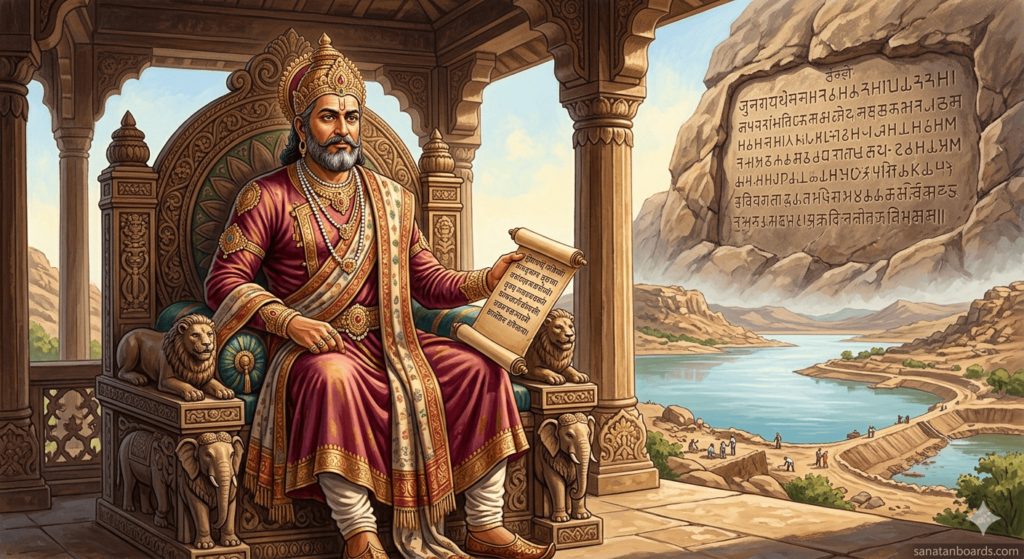
What Is Rudradaman I (Saka Ruler Promoting Sanskrit) ?
Rudradāman I was a Saka (Indo‑Scythian) ruler who governed parts of western and central India during the early part of the 2nd century CE. As a member of the Western Kshatrapas dynasty, he is historically recognized for both his military achievements and his contributions to Indian cultural life. Historically, the Sakas were Central Asian nomadic groups whose influence spread into northwestern India, where they established satrapies under the larger imperial structures of the time. Rudradāman rose to prominence as one of the most powerful rulers of this lineage, and his reign marked a turning point in the interaction between foreign ruling elites and Indian traditions.
Unlike many of his predecessors, Rudradāman was not only a conqueror but also a patron of language and scholarship. His royal inscriptions in Sanskrit prose — especially the profound Junagadh inscription — reflect a conscious adoption and promotion of Sanskrit as a language of official record and cultural identity. This was significant because Sanskrit, although ancient and prestigious as a literary and religious language, had not been widely used in royal inscriptions before his time; regional languages like Prakrit were more commonly employed. Rudradāman’s use of Sanskrit marks one of the earliest examples of royal endorsement of the language outside of elite philosophical or theological works.
This adoption of Sanskrit may be linked to broader cultural strategies: by employing the language of high art, religion, and classical knowledge, Rudradāman could strengthen his political legitimacy across diverse groups and connect his rule with the broader Indian cultural sphere. His era also saw influential works such as the Yavanajataka being translated into Sanskrit, expanding the intellectual reach of the language.
Therefore, Rudradāman I was more than a traditional king — he was a cultural influencer whose reign helped elevate Sanskrit into the domain of formal inscriptions and courtly documentation, bridging regional traditions with an inclusive, pan‑Indian cultural identity.
Who Is Required Rudradaman I ?
Rudradāman I, the Saka ruler known for promoting Sanskrit, is required in historical studies, linguistic research, and cultural analyses because he represents a critical intersection of political power, cultural influence, and language promotion. Scholars and students studying ancient India often focus on Rudradāman because his reign provides one of the earliest examples of a foreign-origin ruler adopting and actively promoting Sanskrit — a language that symbolized high culture, administration, and religious authority. This makes him a central figure in understanding the evolution of royal patronage and linguistic standardization in India. (en.wikipedia.org)
Rudradāman’s inscriptions, particularly the Junagadh rock inscription, are required for epigraphists and historians to reconstruct the political, social, and economic context of the early 2nd century CE. The inscriptions not only provide details about the ruler’s military campaigns and governance strategies but also show the repair of important infrastructure like the Sudarśana Lake, reflecting the administrative priorities and public welfare policies of his reign. This makes his record required reading for anyone examining the interplay of governance, technology, and culture in ancient India. (en.wikipedia.org)
For cultural historians and Sanskrit scholars, Rudradāman is required as an example of linguistic patronage by rulers. His decision to use Sanskrit instead of Prakrit set a precedent for later dynasties, such as the Guptas, who elevated Sanskrit as the language of imperial administration and classical literature. The study of Rudradāman is required for understanding the diffusion of Sanskrit across regions and social classes, illustrating how political authority and cultural endorsement work together to promote a language. (prepp.in)
Thus, Rudradāman I is required not only for military and political history but also for linguistic, cultural, and administrative research, highlighting the multifaceted role of rulers in shaping language and heritage.
When Rudradaman I Is Required ?
Rudradāman I is required when studying the early 2nd century CE period of western India, a time of significant political consolidation, cultural development, and linguistic evolution. His reign, roughly from 130 to 150 CE, provides a clear chronological reference for historians investigating the transition of power from regional rulers to larger dynastic entities like the Guptas. During this period, the Western Kshatrapas held substantial influence over regions including Gujarat, Malwa, and surrounding territories, and Rudradāman’s leadership was instrumental in stabilizing governance and expanding political control through both diplomacy and military campaigns.
He is particularly required when analyzing the emergence of Sanskrit as a language of governance and culture. Before Rudradāman, most royal inscriptions and administrative records were written in Prakrit or other vernaculars. The Junagadh rock inscription, composed during his reign, marks a milestone in the institutional adoption of Sanskrit for official purposes. This makes his period required for linguistic historians, epigraphists, and cultural researchers seeking to understand how Sanskrit transitioned from a primarily religious and literary language to one of administrative significance.
Rudradāman is also required when studying hydraulic and civic infrastructure in ancient India. During his reign, he oversaw the repair of the Sudarśana Lake, which had suffered damage over centuries. The recording of such projects in Sanskrit inscriptions shows that public works were considered important enough to be documented in the highest literary form, linking civic administration with cultural sophistication.
Moreover, his era is required for understanding the interaction between foreign-origin rulers and local Indian traditions. Rudradāman, a Saka, embraced Indian cultural norms, Sanskrit, and inscriptions as a strategy to legitimize his rule and integrate with local societies. Therefore, any historical inquiry into cross-cultural governance, linguistic adoption, and cultural patronage in ancient India finds his reign essential.
Where Rudradaman I Is Required ?
Rudradāman I is required in western and central India, particularly in the areas ruled by the Western Kshatrapas, which included present-day Gujarat, Malwa, and parts of Maharashtra and Rajasthan. His inscriptions, especially the Junagadh rock inscription located in Junagadh, Gujarat, are physical evidence of his governance, administration, and cultural patronage. These sites are required for historians, archaeologists, and epigraphists studying early historic India, as they provide concrete locations where Sanskrit was first used extensively in royal proclamations.
He is required in the administrative centers and capitals of the Western Kshatrapas because these were hubs where governance, military organization, and public works were executed. These locations illustrate how Rudradāman centralized authority and maintained control over a multi-regional kingdom, balancing local traditions with overarching imperial policies. Studying these areas provides insights into the logistics of ancient rule, taxation, and civic management.
Rudradāman is also required in cultural and scholarly centers where Sanskrit literature, philosophy, and inscriptions flourished. By promoting Sanskrit, he established these regions as sites of linguistic prestige and intellectual exchange, attracting scholars, poets, and scribes who contributed to the literary and epigraphic heritage. This required presence in educational and religious centers helps researchers map the spread and influence of Sanskrit in society.
Furthermore, his required locations extend to infrastructure projects, such as the Sudarśana Lake in Junagadh. The sites of repairs and constructions indicate the integration of engineering, civic planning, and royal authority in ancient India. His inscriptions at these sites demonstrate where administration intersected with public welfare, marking physical locations as records of governance and cultural policy.
How Rudradaman I Is Required ?
Rudradāman I is required through multiple approaches, including historical, linguistic, cultural, and administrative perspectives. Historically, he is required to understand how a Saka ruler from Central Asian origin established authority over western India, unified territories, and conducted military campaigns. Scholars study the chronology of his reign, battles, and alliances, analyzing how he secured and maintained power in a competitive political environment.
Linguistically, Rudradāman is required through his Sanskrit inscriptions, which are studied to trace the evolution of Sanskrit as an official language. The Junagadh rock inscription, written in classical Sanskrit prose, illustrates how language was employed as a tool of legitimacy, governance, and cultural influence. Epigraphists and linguists examine the syntax, style, and vocabulary of these inscriptions to understand early royal Sanskrit usage.
Culturally, Rudradāman is required through his patronage of scholars and translators, such as Yavanesvara, who translated astronomical texts into Sanskrit during his reign. This demonstrates how rulers could influence intellectual life, integrate foreign knowledge, and foster literary and scientific growth. Researchers use these examples to analyze how leadership and scholarship intersected in ancient India.
Administratively, he is required by examining projects like the repair of Sudarśana Lake, which highlight how rulers managed water resources, civic infrastructure, and public welfare. Historians and archaeologists study such works to see how governance addressed both political and social needs, and how royal inscriptions served as permanent records of achievements.
Rudradāman I is also required methodologically, as a case study in bridging cultural traditions. Through archaeological surveys, epigraphic analysis, and textual study, scholars reconstruct his reign to understand cross-cultural governance, linguistic strategy, and integration of foreign rulers into local culture.
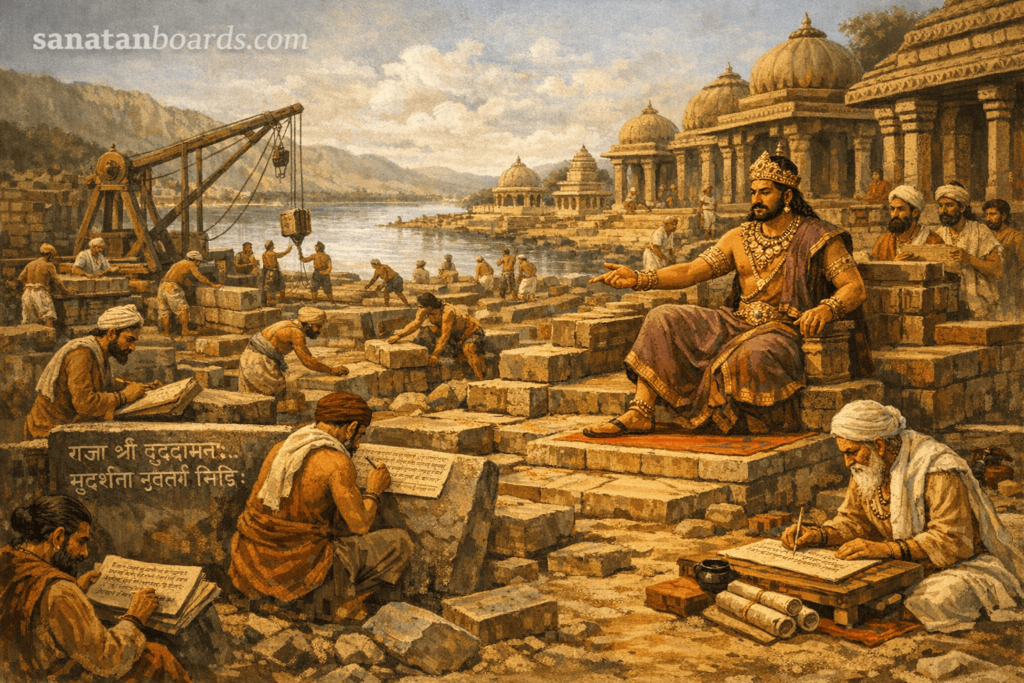
Case Study On Rudradaman I (Saka Ruler Promoting Sanskrit)
Rudradāman I’s reign provides a compelling case study of how a ruler can combine military power, administrative strategy, and cultural patronage to create a lasting legacy. Belonging to the Western Kshatrapas dynasty, Rudradāman inherited a politically fragmented region and faced the challenge of establishing authority over territories previously contested by local rulers and foreign powers. His success can be analyzed through several dimensions: military consolidation, promotion of Sanskrit, public infrastructure, and diplomatic integration.
Military Consolidation: Rudradāman I conducted extensive campaigns to reclaim lost territories and consolidate power. He defeated the Satavahanas in strategic battles, thereby securing the fertile and economically significant regions of Gujarat and Malwa. Military strength was not only a tool for territorial expansion but also a means of demonstrating legitimacy to local populations who were accustomed to established dynasties. Through careful planning, he fortified key locations, strengthened garrisons, and maintained a robust army, establishing political stability necessary for cultural and administrative initiatives.
Promotion of Sanskrit: One of Rudradāman’s most remarkable contributions was the promotion of Sanskrit as a language of administration and record. The Junagadh rock inscription, detailing his military victories and public works, was composed in classical Sanskrit rather than the more commonly used Prakrit. This was significant because it represented a conscious effort to link his foreign-origin rule with India’s prestigious cultural traditions. By choosing Sanskrit, Rudradāman aligned himself with learned Brahmins and scholars, enhancing his legitimacy and creating a model for subsequent Indian rulers.
Public Works and Civic Planning: Rudradāman’s reign was also marked by the repair of the Sudarśana Lake, a vital water reservoir for agriculture and daily life. The lake had suffered damage from natural events, and its restoration required meticulous planning, resource allocation, and labor management. Documenting the repair in Sanskrit inscriptions showcased how public welfare and cultural prestige were intertwined, making civic projects not only functional but symbolic of good governance.
Diplomatic and Cultural Integration: Beyond military and civic strategies, Rudradāman engaged in diplomatic alliances, often through marriages and treaties with neighboring rulers. He fostered cultural integration by encouraging Sanskrit scholarship and translation of foreign texts, such as astronomical works by Greek scholars, into Sanskrit. This strengthened cross-cultural knowledge exchange and established western India as a hub of intellectual activity.
Impact and Lessons: The case study of Rudradāman I illustrates how leadership involves a balance of force, culture, and administration. Modern leaders and scholars can study his model to understand how integrating cultural strategy with governance can reinforce legitimacy. Rudradāman’s use of Sanskrit demonstrates the importance of language as a political and cultural tool, while his infrastructure projects highlight the enduring value of public service in consolidating rule.
Conclusion: Rudradāman I’s reign exemplifies a holistic approach to rulership, combining military strength, cultural promotion, civic responsibility, and diplomatic engagement. By examining his methods, historians and students gain insights into early Indian governance, linguistic strategy, and the interplay between culture and power, making his reign a benchmark for understanding the multifaceted role of rulers in shaping society.
White Paper On Rudradaman I (Saka Ruler Promoting Sanskrit)
Executive Summary:
Rudradāman I, a Saka ruler of the Western Kshatrapas dynasty, reigned circa 130–150 CE and is renowned for promoting Sanskrit in royal inscriptions and administrative practices. His reign represents a key case in early Indian history where foreign-origin rulers successfully integrated into local culture, elevated the status of Sanskrit, and executed public infrastructure projects. This white paper explores his contributions in historical, linguistic, administrative, and cultural contexts, offering a comprehensive framework for understanding leadership strategies in ancient India.
Historical Context:
During the early 2nd century CE, western India experienced political fragmentation with multiple regional powers vying for dominance. The Western Kshatrapas, of Saka origin, controlled large areas including Gujarat, Malwa, and parts of Maharashtra. Rudradāman I emerged as a decisive leader who consolidated these regions through strategic military campaigns against rival Satavahana forces. By doing so, he not only expanded his territorial reach but also ensured political stability necessary for administrative and cultural initiatives.
Linguistic and Cultural Contribution:
Rudradāman I’s deliberate use of Sanskrit for royal inscriptions is a defining aspect of his legacy. The Junagadh rock inscription, composed in classical Sanskrit prose, reflects both linguistic sophistication and political strategy. Sanskrit, previously associated mainly with religious and scholarly texts, became a medium for documenting governance, military achievements, and public works. His patronage of scholars and translators also contributed to the cross-cultural dissemination of knowledge, including translations of foreign astronomical texts into Sanskrit, highlighting his commitment to intellectual integration.
Administrative Achievements:
Public welfare was a priority during Rudradāman’s reign. The repair of the Sudarśana Lake illustrates the intersection of engineering, governance, and cultural symbolism. This project required mobilizing resources, managing labor, and ensuring long-term sustainability, demonstrating a methodical approach to infrastructure management. Documenting these achievements in Sanskrit elevated the act from mere administration to a cultural statement of ruler responsibility and civic leadership.
Strategic Integration:
Rudradāman’s reign exemplifies strategic integration of foreign rulers into indigenous society. By adopting Sanskrit and supporting cultural initiatives, he bridged his Saka heritage with Indian traditions. Military success, combined with cultural patronage, enhanced his legitimacy and provided a model for subsequent rulers seeking to combine political authority with cultural influence.
Implications for Modern Scholarship:
The study of Rudradāman I has applications for historians, linguists, and political scientists. It offers insights into how language can serve as a tool of governance, how rulers use public works to reinforce authority, and how cultural integration can consolidate political legitimacy. Scholars can also draw lessons on cross-cultural exchange, leadership strategy, and the promotion of intellectual activity in governance.
Conclusion:
Rudradāman I’s reign demonstrates the multifaceted approach required for successful rulership: combining military prowess, cultural patronage, infrastructure development, and strategic integration. His promotion of Sanskrit set a precedent for #rudradaman1inmumbai later dynasties, while his civic projects illustrate effective governance. This white paper establishes Rudradāman I as a model for understanding the synergy of culture, administration, and power in early Indian history.
Industry Application Of Rudradaman I (Saka Ruler Promoting Sanskrit)
The study of Rudradāman I’s reign has practical applications across multiple modern industries, particularly in education, cultural heritage, governance, linguistics, technology, and tourism. His strategies of language promotion, administration, and infrastructure development provide lessons that can be adapted to contemporary organizational and cultural contexts.
- Education and Academic Research:
- Rudradāman I’s promotion of Sanskrit and documentation of governance in inscriptions serve as case studies for history, archaeology, and linguistics programs.
- Universities and research institutes can develop curricula around his reign to explore early Indian governance, cross-cultural integration, and language strategy.
- His inscriptions can be analyzed for teaching ancient scripts, classical language structure, and epigraphy.
- Governance and Public Administration:
- His approach to infrastructure development, like the repair of Sudarśana Lake, can be applied in modern civic planning and water resource management.
- Public administration programs can study his methods to understand strategic resource allocation, project documentation, and integration of cultural legitimacy in governance.
- Cultural Heritage Management:
- Preservation of sites such as the Junagadh rock inscription provides guidance for heritage conservation, museum curation, and archival practices.
- Policies for protecting and promoting ancient monuments can draw from Rudradāman’s integration of public works with cultural documentation.
- Linguistics and Language Technology:
- His use of Sanskrit demonstrates how language can serve as a tool of administration and influence, which is relevant for language planning, preservation, and computational linguistics.
- AI applications can analyze inscriptions for text recognition, historical linguistic mapping, and digital humanities projects.
- Tourism and Cultural Industry:
- Sites associated with Rudradāman, including Junagadh and Sudarśana Lake, can be leveraged for historical tourism and educational tours, boosting local economies while promoting cultural awareness.
- Storytelling around his reign can enhance cultural festivals, exhibitions, and immersive experiences focused on ancient Indian history.
- Corporate Strategy and Leadership Training:
- Rudradāman I’s model of strategic integration of culture, administration, and infrastructure can be adapted for corporate leadership programs, emphasizing the importance of combining operational efficiency with cultural and ethical values.
Conclusion:
The study of Rudradāman I’s reign demonstrates that lessons from history can be applied to modern industries. From education and governance to #Sanatandharmaaccreditationboardsinmumbai cultural tourism and technology, his strategies of language promotion, civic planning, and cultural integration provide actionable insights #Sanatandharmaaccreditationboardsinvasai for contemporary challenges, proving that ancient leadership practices can inform today’s organizational, technological, and societal solutions.
sourece : Rig – History Extended
ASK FAQ
Who was Rudradāman I?
Rudradāman I was a Saka ruler of the Western Kshatrapas dynasty (130–150 CE) known for promoting Sanskrit inscriptions and consolidating western India through military and administrative achievements.
Why is Rudradāman I important in Indian history?
He is important for being one of the first rulers to use Sanskrit for royal inscriptions, restoring the Sudarśana Lake, and strengthening political authority while integrating foreign-origin rulers into Indian culture.
What is the Junagadh rock inscription of Rudradāman I?
The Junagadh rock inscription is a classical Sanskrit inscription documenting Rudradāman’s victories, governance, and public works, marking one of the earliest examples of Sanskrit in royal records.
How did Rudradāman I promote Sanskrit?
He promoted Sanskrit by composing royal inscriptions in classical prose, supporting scholars, and translating foreign knowledge into Sanskrit, elevating it as a language of administration and culture.
Where did Rudradāman I rule and leave his legacy?
Rudradāman I ruled western India, mainly in Gujarat, Malwa, and surrounding regions, leaving a legacy of Sanskrit inscriptions, restored infrastructure, and cultural integration that influenced later Indian dynasties.
Table of Contents
Disclaimer
The content provided above is intended for educational, learning, and informational purposes only. It does not constitute professional advice and is based on historical research and publicly available sources. Readers should consult primary sources or subject-matter experts for academic or professional use.