
Rajadhiraj Chola
Rajadhiraj Chola holds a distinctive place in the annals of South Indian history. Translating to “King of Kings of the Chola dynasty,” this honorific was more than a mere designation; it was a symbol of supreme authority, political dominance, and cultural influence. The Chola dynasty, one of the most powerful dynasties in medieval South India, used titles like He to denote rulers who had achieved unparalleled success in administration, military campaigns, and governance.
Historically, the title is most prominently associated with Rajadhiraj Chola I, a remarkable emperor of the early 11th century CE. As the son of Rajendra Chola I, he inherited an empire that had already expanded its frontiers significantly. The title emphasized his position not just as a sovereign over his lands, but as an overlord acknowledged by other kings across South India and beyond.
In addition to political significance, the title symbolized military prowess. The emperor was recognized for direct involvement in campaigns, leading armies to defend the empire and expand its influence. It also indicated the responsibility to sustain administrative efficiency and economic prosperity. Temples, cultural institutions, and trade networks all flourished under such leadership.
Thus, king was more than a name — it was a statement of imperial ambition, legacy, and leadership.
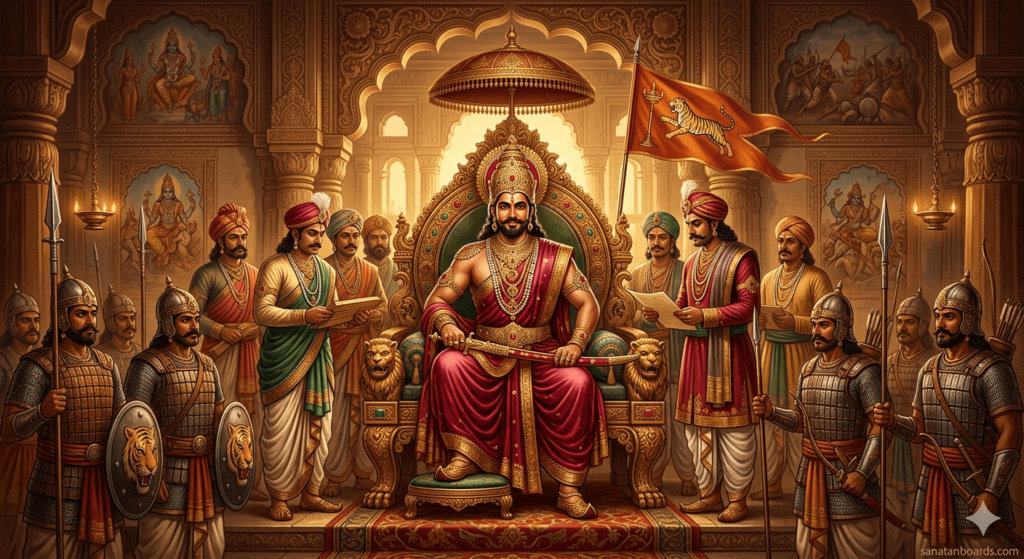
What is Rajadhiraj Chola ?
Rajadhiraj Chola was not merely a person but a title representing the highest echelon of Chola authority. Literally meaning “King of Kings of the Chola dynasty,” it symbolized supreme power over both territories and subordinate rulers.
The title is most famously associated with Rajadhiraj Chola I, the son of Rajendra Chola I. He ascended the throne during the early 11th century CE and was tasked with maintaining the vast empire his father had established. The reign combined military prowess, administrative sophistication, and cultural patronage.
Expansion of boundaries occurred through campaigns in South India and Sri Lanka, along with influence over overseas territories. The title underscored a dual role as both a military strategist and a visionary ruler. Beyond conquest, economic growth, trade expansion, and temple-based cultural activities were strengthened.
Who Is Required ?
Rajadhiraj Chola is required in history to represent the epitome of imperial leadership in medieval South India. The person associated with this title, Rajadhiraj Chola I, was essential for consolidating and expanding the empire during a critical period.
Required primarily for military leadership, campaigns were led to secure contested territories, protect borders, and assert supremacy over rival dynasties such as the Pandyas, Cheras, and Western Chalukyas.
Required for administrative consolidation, governance systems, revenue collection, and legal structures were maintained across a vast empire.
Required to maintain cultural and economic influence, temples, literature, and trade networks thrived under imperial patronage.
Required for symbolic and strategic legitimacy, the title represented supreme rulership and unity.
When Is Required ?
Rajadhiraj Chola was required during the early 11th century CE, a time marked by intense political competition, territorial expansion, and cultural development in South India. This period followed the extensive conquests of Rajendra Chola I, which created a vast empire that needed strong leadership to maintain stability and continuity.
During this era, frequent conflicts with rival dynasties such as the Pandyas, Cheras, and Western Chalukyas made military strength essential. Rajadhiraj Chola was required to respond to these challenges by leading campaigns, defending strategic territories, and ensuring that the authority of the Chola Empire remained unchallenged. The presence of Rajadhiraj Chola during such conflicts ensured that expansion was not only preserved but also strengthened.
Rajadhiraj Chola was also required at a time when maritime trade was rapidly growing. The Chola Empire depended heavily on trade routes across the Indian Ocean, connecting South India with Southeast Asia, China, and the Middle East. Protection of these routes required naval coordination and strategic oversight. Rajadhiraj Chola played a crucial role in ensuring that commerce remained uninterrupted, which directly contributed to the empire’s economic prosperity.
In addition, Rajadhiraj Chola was required during a phase of administrative consolidation. After large-scale territorial expansion, maintaining governance systems across diverse regions became critical. Efficient revenue collection, law enforcement, and coordination between local and central authorities were necessary to sustain order. Rajadhiraj Chola ensured that administrative mechanisms functioned effectively across the empire.
Culturally, the early 11th century was a period of temple construction, artistic growth, and literary development. Rajadhiraj Chola was required to continue the tradition of patronage, supporting institutions that reinforced the empire’s cultural identity and social cohesion.
Where Is Required ?
Rajadhiraj Chola was required across a vast and strategically significant geography that reflected the extensive reach of the Chola Empire. The need for leadership extended from the core regions of South India to distant maritime territories, making the role both complex and crucial.
At the center of the empire was Tamilakam, corresponding to present-day Tamil Nadu. This region formed the political and economic foundation of the empire. Rajadhiraj Chola was required here to oversee governance, manage agricultural production, and ensure coordination among local administrative bodies. Effective control over this core region ensured the stability of the entire empire.
Southern India was another key area where Rajadhiraj Chola was required. Rival kingdoms such as the Pandyas and Cheras posed continuous challenges. Maintaining authority in these regions required military presence and strategic planning. Rajadhiraj Chola ensured that these territories remained under imperial control, preventing fragmentation and rebellion.
Sri Lanka was also a critical region. Control over this island was important for both political dominance and economic advantage. Rajadhiraj Chola was required to suppress resistance, maintain administrative structures, and secure trade routes linked to the island. This ensured long-term stability and integration within the empire.
Maritime regions across the Indian Ocean represented another important area. Trade routes connecting South India with Southeast Asia and beyond required protection. Rajadhiraj Chola was required to maintain naval strength and oversee overseas interactions, ensuring safe passage for merchants and extending influence beyond the subcontinent.
Cultural and religious centers across the empire also required attention. Temples served as hubs of social, economic, and educational activity. Rajadhiraj Chola was required to support these institutions, reinforcing both cultural identity and political legitimacy.
How Is Required ?
Understanding how Rajadhiraj Chola is required involves examining the methods through which leadership was exercised to sustain and expand the Chola Empire. The approach combined military strength, administrative efficiency, economic strategy, and cultural patronage.
Rajadhiraj Chola was required through direct military leadership. Campaigns against rival dynasties demanded strategic planning and execution. Leading armies ensured discipline, coordination, and morale among troops. This active involvement strengthened the empire’s military position and secured its territories.
Administrative oversight was another crucial method. Rajadhiraj Chola was required to manage governance systems that included local assemblies, revenue collection, and judicial processes. Maintaining efficiency in administration allowed the empire to function smoothly despite its size and diversity.
Maritime control played a significant role in economic stability. Rajadhiraj Chola was required to maintain a strong navy that protected trade routes and ensured uninterrupted commerce. Naval strength also allowed expansion of influence into overseas regions, enhancing both wealth and prestige.
Cultural patronage formed another important aspect. Rajadhiraj Chola was required to support temple construction, literature, and the arts. These institutions not only promoted cultural development but also reinforced the legitimacy of rule and social cohesion within the empire.
Diplomacy and strategic interaction were also essential. Rajadhiraj Chola was required to manage relationships with neighboring states through alliances and negotiations. This reduced prolonged conflicts and ensured political balance.
Finally, symbolic authority played a vital role. Rajadhiraj Chola was required to represent imperial power through ceremonies, inscriptions, and public presence. This strengthened loyalty among subjects and projected dominance to rival powers.
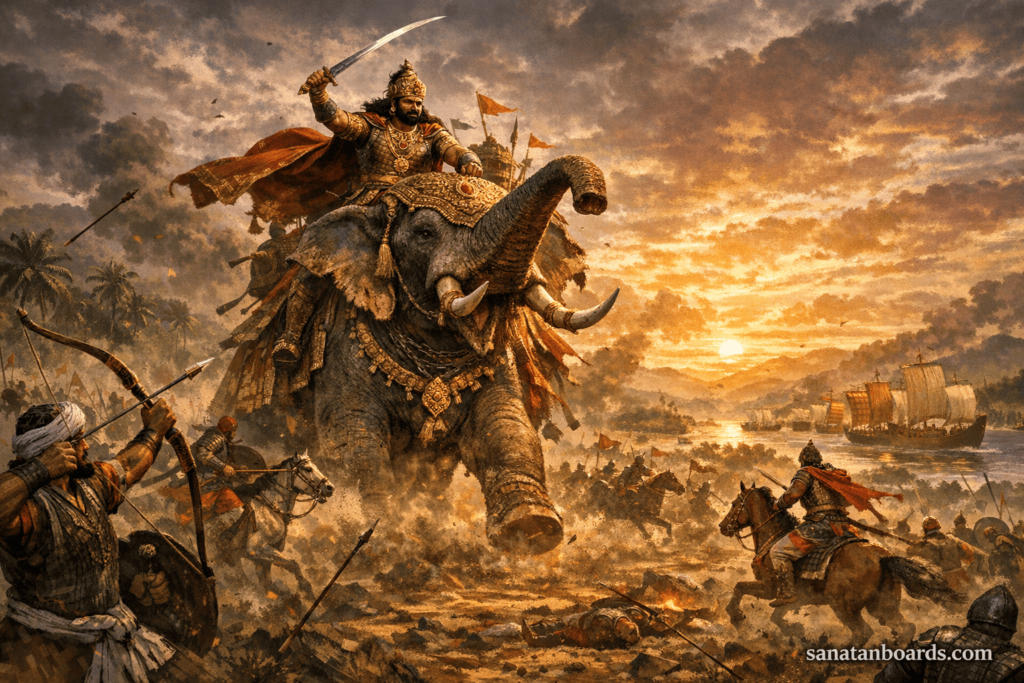
Case Study
The Chola Empire, one of the most powerful dynasties in South Indian history, reached its peak between the 9th and 13th centuries CE. Among its rulers, Rajadhiraj Chola I stands out as a significant figure who played a crucial role in maintaining and expanding imperial power. This case study examines how Rajadhiraj Chola demonstrated leadership across military, administrative, economic, and cultural domains.
Rajadhiraj Chola inherited a vast empire from Rajendra Chola I, which already extended across South India and beyond. However, such expansion brought challenges, including maintaining control over distant territories and dealing with rival dynasties. Rajadhiraj Chola was required to consolidate this power while ensuring continued dominance. Military campaigns formed a central part of this effort. Conflicts with the Western Chalukyas, Pandyas, and Cheras required strategic planning and execution. Rajadhiraj Chola led campaigns to secure contested regions and reinforce authority, demonstrating active involvement rather than passive rule.
One of the most notable aspects of Rajadhiraj Chola’s leadership was the ability to integrate newly conquered territories into the existing administrative framework. The Chola system relied on decentralized governance through local assemblies such as ur and sabha, while maintaining central oversight. Rajadhiraj Chola ensured that these systems functioned efficiently, allowing local participation while preserving imperial control. This balance reduced resistance and strengthened loyalty across the empire.
Economic strength was another pillar of the empire during this period. Maritime trade played a vital role in connecting South India with Southeast Asia, China, and the Middle East. Rajadhiraj Chola maintained a strong naval presence to protect trade routes and ensure uninterrupted commerce. Ports became centers of economic activity, facilitating the exchange of goods, culture, and ideas. The ability to sustain economic growth contributed significantly to the stability of the empire.
Cultural patronage under Rajadhiraj Chola also played an important role in reinforcing imperial identity. Temples were constructed and supported not only as religious centers but also as hubs of education, administration, and economic activity. Literature and arts flourished under this patronage, strengthening cultural cohesion and projecting prestige. Rajadhiraj Chola recognized the importance of cultural investment as a tool for maintaining unity within a diverse empire.
Another key aspect of this case study is leadership visibility. Rajadhiraj Chola was known for direct involvement in governance and military affairs. This visible leadership helped establish authority and build trust among subjects. It also ensured that decisions were implemented effectively across different regions.
The legacy of Rajadhiraj Chola highlights the importance of integrated leadership. By combining military strength, administrative efficiency, economic planning, and cultural patronage, Rajadhiraj Chola ensured that the empire remained stable and influential. This case study demonstrates how a ruler can successfully manage a large and complex system by balancing multiple responsibilities.
White Paper
Executive Summary
Rajadhiraj Chola represents a model of effective leadership within the Chola Empire during the 11th century CE. This white paper analyzes the governance, military strategy, economic development, and cultural contributions associated with Rajadhiraj Chola. The objective is to understand how a balanced approach to leadership contributed to the empire’s stability and growth.
Introduction
The Chola Empire required strong leadership to maintain its extensive territories and influence. Rajadhiraj Chola inherited a vast domain that demanded consolidation and strategic expansion. The leadership approach during this period reflects a combination of military capability, administrative structure, and cultural investment.
Military Strategy
Military strength formed the foundation of imperial stability. Rajadhiraj Chola conducted campaigns against rival powers such as the Western Chalukyas and Pandyas. These operations required coordination of multiple forces and strategic planning. Control over Sri Lanka further strengthened political and economic influence. Naval power ensured the protection of trade routes and extended influence across maritime regions.
Administrative Governance
The governance system under Rajadhiraj Chola was decentralized yet coordinated. Local assemblies managed regional affairs, while central authority ensured consistency in taxation, law enforcement, and policy implementation. This structure allowed efficient administration across a large empire. Integration of newly acquired territories was achieved through standardization of administrative practices.
Economic Development
Economic prosperity during this period was driven by agriculture and trade. Maritime commerce connected the empire with distant regions, creating opportunities for wealth generation. Rajadhiraj Chola maintained security along trade routes, ensuring stability for merchants. Ports functioned as centers of economic exchange, contributing to overall growth.
Cultural and Religious Patronage
Cultural investment was a defining feature of leadership. Rajadhiraj Chola supported temple construction, literature, and artistic development. Temples served as centers for education and social organization, reinforcing cultural identity. This patronage strengthened internal cohesion and enhanced external prestige.
Strategic Insights
Key insights derived from this analysis include the importance of integrated leadership, balancing decentralization with central control, and investing in long-term cultural and economic assets. Rajadhiraj Chola demonstrated how multiple domains of governance can work together to create a stable and prosperous system.
Conclusion
Rajadhiraj Chola I exemplifies the qualities of a strategic leader whose decisions ensured the Chola Empire’s longevity, prosperity, and influence. #rajadhirajcholainmumbai His governance provides valuable insights into statecraft, demonstrating how leadership, strategy, and culture interact to shape enduring empires.
Industry Application
The leadership approach associated with Rajadhiraj Chola provides valuable insights for modern industries and organizational management. By examining historical governance practices, parallels can be drawn with contemporary business strategies and leadership models.
One of the key lessons from Rajadhiraj Chola is strategic leadership and vision. Expansion and consolidation required careful planning and execution. In modern organizations, this translates to long-term planning, market analysis, and the ability to adapt to changing conditions. Rajadhiraj Chola demonstrated how clear objectives and decisive action can lead to sustained success.
Organizational governance is another important area. The administrative system balanced decentralization with central oversight. Local units were empowered to manage operations while remaining aligned with overall objectives. This approach is relevant to modern corporations that operate across multiple regions. Decentralized decision-making improves efficiency, while central coordination ensures consistency.
Risk management and operational resilience can also be linked to leadership practices. Military campaigns and protection of trade routes required proactive identification of threats. In today’s context, businesses face risks such as market fluctuations, supply chain disruptions, and competition. The approach associated with Rajadhiraj Chola highlights the importance of preparedness and adaptability in managing such challenges.
Infrastructure and long-term investment played a significant role in sustaining growth. Development of ports, trade networks, and cultural institutions ensured stability and prosperity. In modern industries, investment in infrastructure, technology, and research is essential for maintaining competitiveness and achieving long-term goals.
Cultural influence and stakeholder engagement are equally relevant. Support for temples and cultural activities strengthened unity and identity within the empire. In business, this can be compared to brand building, corporate culture, and engagement with stakeholders. Organizations that invest in their identity and relationships are more likely to achieve loyalty and trust.
Global expansion is another area where parallels can be drawn. Maritime trade networks connected the empire with distant regions, facilitating economic growth. Similarly, modern businesses expand into international markets to increase reach and profitability. The ability to manage cross-border operations and build partnerships is essential for success in a globalized economy.
Leadership visibility and accountability also emerge as important factors. Direct involvement in key activities ensured effective implementation of policies. In contemporary organizations, leadership engagement fosters transparency and builds confidence among employees and stakeholders.
Overall, Rajadhiraj Chola provides a comprehensive framework for understanding leadership in complex systems. The integration of strategy, governance, risk management, cultural investment, and global outreach offers valuable lessons for modern industries. By applying these principles, organizations can enhance efficiency, resilience, and long-term success.
Conclusion
The reign of Rajadhiraj Chola provides a historical model for integrating strategic vision, operational excellence, risk management, innovation, #Sanatandharmaaccreditationboardsinmumbai and cultural influence. Industries and organizations can apply these principles to enhance leadership effectiveness, optimize governance #Sanatandharmaaccreditationboardsinvasai structures, and achieve long-term success in competitive environments.
source : The Civillians
ASK FAQ
Who was Rajadhiraj Chola?
He was a powerful emperor of the Chola dynasty in the 11th century CE, known for his military leadership, administrative skills, and cultural patronage. He expanded the empire across South India and overseas territories.
What does the title mean?
The title “Rajadhiraj Chola” means “King of Kings of the Chola dynasty.” It signifies supreme authority, military prowess, and leadership over subordinate rulers within the empire.
When did King rule?
Rajadhiraj Chola ruled in the early 11th century CE, following the reign of his father Rajendra Chola I, during a period of territorial expansion and cultural development.
What were the major achievements of King ?
His major achievements include successful military campaigns in South India and Sri Lanka, strengthening Chola administration, expanding maritime trade, and supporting temples, arts, and literature.
How is The King relevant today?
Rajadhiraj Chola’s leadership principles—strategic planning, administrative efficiency, cultural investment, and global trade management—offer valuable lessons for modern leadership and organizational management.
Table of Contents
Disclaimer
The content provided is intended solely for educational, learning, and knowledge purposes. Historical interpretations are based on available sources and research. Variations may exist in scholarly accounts, and this material should not be considered definitive historical fact.