
NARASIMHAVARMAN II (PALLAVA)
NARASIMHAVARMAN II (PALLAVA), also known by his regal names Rajasimha and Rajamalla, was one of the most celebrated monarchs of the Pallava dynasty in Southern India. He ascended to the throne around 695 CE and ruled until approximately 728 CE, succeeding his father Paramesvaravarman I and preceding Paramesvaravarman II. He lived during a time when the Pallava kingdom was among the most influential powers in the subcontinent.
Born into a prestigious royal lineage enriched with strong traditions in governance, religion, literature and art, NARASIMHAVARMAN II inherited a realm that had already achieved military and cultural prominence under earlier kings. His reign is most widely remembered not for battles and conquest, but for ushering in a period of cultural prosperity and architectural grandeur that would deeply influence South Indian heritage.
Extending beyond mere political authority, NARASIMHAVARMAN II was also an accomplished patron of culture. Under his leadership, the Pallava court became a center of intellectual activity attracting leading writers, artists, and scholars. He himself engaged with literature and drama and his court gave refuge to renowned Sanskrit litterateurs. Religious devotion was central to his character — he was a devoted worshipper of Shiva and a supporter of temple construction across his realm.
Many of NARASIMHAVARMAN II’s architectural projects remain standing today as masterpieces of early medieval Dravidian style. These include temples and religious complexes that embody the sophistication of Pallava architectural innovation. His contributions significantly shaped the cultural identity of the region and helped establish architectural standards that would influence later dynasties in South India.
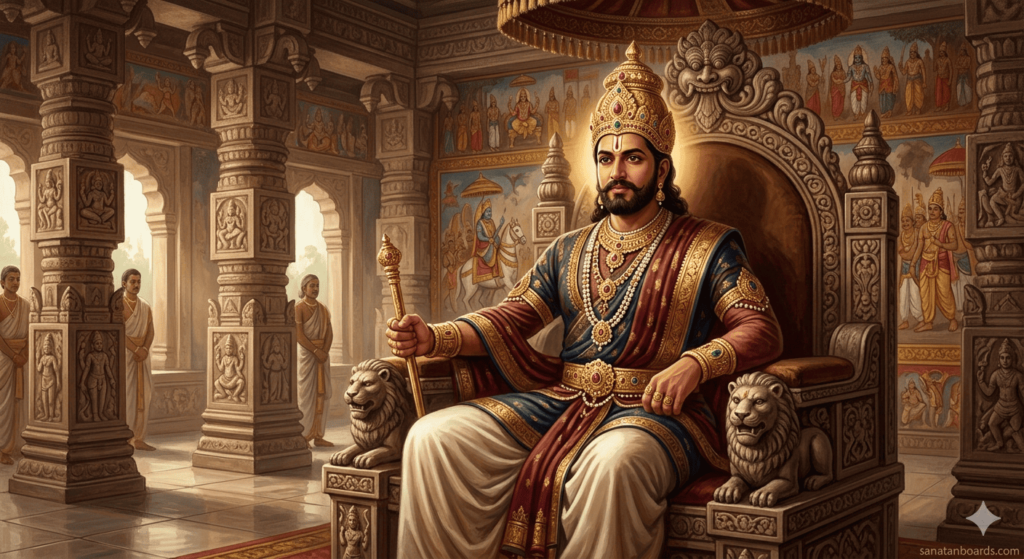
What Is Narasimhavarman Ii (Pallava) ?
NARASIMHAVARMAN II (PALLAVA) was a Pallava emperor who ruled a leading South Indian kingdom during the late 7th and early 8th centuries. He belonged to the Pallava dynasty a royal house whose influence extended over much of modern-day Tamil Nadu and surrounding regions. His reign exemplified an era of relative peace, strong governance, and flourishing cultural output.
Unlike some predecessor rulers who are remembered primarily for military campaigns, NARASIMHAVARMAN II’s legacy is closely tied to the arts, religion, and architecture of his age. He commissioned several architectural marvels that stood as symbols of Pallava aesthetic and spiritual achievement. The Kailasanathar Temple at Kanchipuram — one of the finest surviving examples of early Dravidian temple architecture — is credited to his initiative. He also constructed the Shore Temple complex at Mamallapuram, which later became a UNESCO‑recognized cultural monument.
His rule was also distinguished by significant literary engagement. He supported poets and scholars, and Sanskrit literature flourished in his court. Some sources suggest that his own works as a dramatist contributed to the development of traditional Indian theatre and influenced cultural forms that persisted for centuries.
Religiously, he maintained devotion to major Hindu traditions while also sponsoring religious sites that reflected broader spiritual engagements, including constructions associated with both Shiva worship and Buddhist patronage in some areas. The religious policies of his reign fostered a climate of spiritual diversity and royal dedication.
Overall, NARASIMHAVARMAN II’s reign is remembered as a defining era for Pallava art, temple architecture, and cultural prosperity — setting hallmarks that would deeply influence subsequent South Indian traditions.
Who Is Required Narasimhavarman Ii (Pallava) ?
NARASIMHAVARMAN II serves as a central figure for historians, art scholars, and those interested in the evolution of South Indian temple architecture. His reign represents a peak period in the artistic development of the Dravidian temple form — a tradition that influenced many later regimes, including the Cholas and beyond. Students of traditional Indian architecture frequently reference his projects, such as the Kailasanathar and Shore temples, as cornerstones of early temple design and symbolism.
For literary scholars and historians of culture, NARASIMHAVARMAN II is a touchstone for understanding the intellectual life of early medieval India. His patronage of Sanskrit poets and scholars contributed to a rich milieu that anchored the role of classical languages in courtly and religious contexts. His own literary pursuits underscore the interconnected roles of royalty and cultural expression in shaping ancient intellectual traditions.
Religious scholars also regard him as a model of devotional kingship. His deep engagement with Shaivism and temple establishment illustrates how political authority and religious life were intertwined in South Indian society. Temples were not only places of worship but also centers of community life, land grants, and artistic production — all of which required long‑term royal backing.
In the broader cultural continuum of India, NARASIMHAVARMAN II helps define the Pallava era as more than a series of rulers — but as a period that shaped architectural canons, religious landscapes, and the symbolic union of spiritual and temporal leadership.
When Narasimhavarman Ii (Pallava) Is Required ?
NARASIMHAVARMAN II became emperor of the Pallava kingdom around 695 CE, succeeding his father Paramesvaravarman I. This period was significant because the Pallava dynasty, established centuries earlier in South India, was by then one of the most stable and influential powers in the region. Prior decades had seen intense conflicts with rival kingdoms like the Chalukyas, but by the end of the 7th century, political tensions had eased sufficiently to allow for a focus on cultural and religious expression.
The late 7th and early 8th centuries were marked by a shift from purely militaristic expansion to cultural consolidation. This made the presence of a ruler with both administrative skills and cultural vision essential for preserving the Pallava legacy and enhancing its achievements. NARASIMHAVARMAN II fulfilled this role by emphasizing temple building, artistic innovation, and literary patronage rather than engaging in protracted warfare.
His reign corresponds to a broader regional transformation in South India, when temple architecture became an increasingly visible demonstration of political legitimacy and spiritual identity. The Kailasanathar Temple at Kanchipuram, whose construction began under his patronage, reflects this fusion of royal authority with religious symbolism. The Shore Temple complex in Mamallapuram — another of his enduring legacies — also illustrates the period’s architectural advances.
The stability of NARASIMHAVARMAN II’s era allowed for long‑term projects that required consistency and extended royal attention. These conditions were present precisely between the late 7th and early 8th centuries, making his rule crucial for transitioning the Pallava dynasty from a period of frequent conflict towards one of cultural expression
Where Narasimhavarman Ii (Pallava) Is Required ?
The heartland of NARASIMHAVARMAN II’s influence was the Pallava kingdom centered on Kanchipuram in present‑day Tamil Nadu, India. Kanchipuram served as the political capital of the Pallava rulers and was a major center of religion, administration, and culture during his reign. Here, the Kailasanathar Temple stands as an iconic testament to his patronage — a structure that continues to draw attention for its early Dravidian style and intricacy.
Mamallapuram (Mahabalipuram), located on the Coromandel Coast, is another crucial locus of his architectural legacy. The Shore Temple and adjoining temple structures there are among the earliest examples of fully developed stone temple architecture in South India. These monuments formed part of a coastal sacred landscape that served both religious and symbolic functions and continue to be key heritage sites today.
Beyond physical sites, NARASIMHAVARMAN II’s influence was required in religious and cultural spaces where temple rituals, devotional practices, and artistic performances unfolded. His support of Shaivism and his encouragement of Sanskrit and performance traditions embedded his impact in temple communities, dance drama, and sacred art. These cultural “places” were often integrated into temple complexes, palace spaces, and educational gatherings at court.
In the broader regional context, his era’s architectural and cultural patterns spread throughout what is now Tamil Nadu and parts of neighbouring states as Pallava artisans and traditions influenced subsequent dynasties. The artistic vocabulary pioneered under his patronage became part of the foundation upon which later temple architecture — such as that of the Cholas — was built.
In modern times, sites associated with NARASIMHAVARMAN II are located in archaeological parks, world heritage locations, and cultural heritage zones that attract scholars and visitors from around India and the world, underscoring the far‑reaching relevance of his work.
How Narasimhavarman Ii (Pallava) Is Required ?
NARASIMHAVARMAN II played a crucial role in institutionalizing temple architecture that became central to South Indian aesthetics. His construction initiatives — such as the Kailasanathar Temple at Kanchipuram and the Shore Temple — exemplify how royal patronage was translated into monumental stone structures that combined religious symbolism with artistic innovation. This approach “required” sustained royal investment, architects, sculptors, patrons, and dedicated artisans working in unison over many years.
He also “required” and created cultural spaces that nurtured literature and performance. Sanskrit poets and dramatists found patronage in his court, which helped preserve classical literary traditions and produced works that informed temple rituals and religious narratives. In supporting these cultural actors, NARASIMHAVARMAN II contributed to a vibrant intellectual ecosystem around the Pallava court.
His reign “required” balanced governance that placed emphasis on peace and cultural production rather than prolonged warfare. Unlike earlier eras marked by conflicts with neighboring dynasties, his period allowed the kingdom to channel resources into artistic and religious projects. This equilibrium between stability and creative investment shaped a legacy that survived well beyond his lifetime.
In ensuring that the religious identity of his subjects found expression through grand temples, performances, and devotional practices, NARASIMHAVARMAN II also “required” a community of priests, devotees, and artisans whose lives intertwined with these sacred institutions. By fostering these relationships, his patronage strengthened the social and spiritual fabric of South Indian society.
Finally, his era “required” documentation and scholarship — inscriptions, grants, literary commentary, and architectural study — which enabled later generations to understand the Pallava legacy. These records, though fragmented, serve as vital sources for reconstructing the history of early medieval South India.

Case Study On Narasimhavarman Ii (Pallava)
Background and Context
NARASIMHAVARMAN II’s reign emerged at a point when the Pallava dynasty had already established itself as a dominant force in South India. While earlier rulers like Mahendravarman I and Narasimhavarman I had engaged in martial competition and cultural expression, the transition into the 8th century saw a need for consolidated cultural investment rather than purely military conquest. This created an opportunity for NARASIMHAVARMAN II to focus on architectural expression as a form of political and spiritual authority.
Architectural Innovation: Kailasanathar Temple
Perhaps the most celebrated achievement of NARASIMHAVARMAN II’s reign was the Kailasanathar Temple at Kanchipuram. Built as an extensive complex with numerous shrines and pillared halls, it represents one of the earliest examples of a fully stone Dravidian temple form. Prior temple structures were often rock cut or smaller in scale. The Kailasanathar Temple’s scale, stylistic coherence, and carved ornamentation set a new architectural standard.
The temple’s design reflects a nuanced understanding of space, symbolism, and ritual sequence. The central shrine dedicated to Shiva is surrounded by subsidiary shrines and corridors that allow devotees to circumnavigate the sacred space — an architectural move that enhanced ritual experience. The detailed carvings combine mythological themes with symbolic motifs, reflecting a deep integration of religion and craft.
Shore Temple Complex and Coastal Expression
In addition to the Kailasanathar Temple, NARASIMHAVARMAN II initiated the construction of the Shore Temple complex at Mamallapuram (Mahabalipuram). This group of temples — positioned near the Bay of Bengal — marks one of the earliest attempts to situate temple architecture within a coastal sacred landscape. The iconic Shore Temple now serves as an enduring symbol of early medieval Indian temple design.
The positioning and composition of the Shore Temple signal an expanded notion of temple architecture that incorporates geographical context with spiritual meaning. Its orientation, stone carvings, and structural articulation reflect an understanding of temple design as a symbol of both divine presence and royal authority.
Literary and Cultural Dimensions
NARASIMHAVARMAN II’s court was also a cultural hub. He patronized scholars and poets, particularly in Sanskrit, contributing to a renaissance of literary output. His own engagement with literature and performance helped foster traditions that influenced manuscript production and dramatized worship practices.
Temples were more than static monuments; they served as venues for dance, music, learning, and ritual performance. By investing in temple architecture, NARASIMHAVARMAN II simultaneously provided infrastructure for a complex cultural ecosystem that strengthened community involvement and artistic expression.
Political Strategy and Symbolic Power
The shift from aggressive warfare to architectural patronage during his rule can be seen as a deliberate political strategy. Monumental architecture served to signal stability, legitimacy, and divine endorsement. Temples functioned as centers of economic activity and religious life, creating long‑term social anchoring for his dynasty’s influence.
In this way, NARASIMHAVARMAN II’s architectural engagement should be understood not just as artistic pursuit but as a sophisticated exercise in statecraft. His temples were embodiments of religious sanction and royal presence across the territory.
Legacy and Enduring Impact
The architectural forms established under NARASIMHAVARMAN II’s patronage influenced successive dynasties, particularly the Cholas, #narasimhavarman11pallava who expanded upon Pallava design principles in their own monumental constructions. The Kailasanathar and Shore temples remain enduring testaments to early Dravidian architecture, studied by architects, historians, and art enthusiasts alike.
White Paper On Narasimhavarman Ii (Pallava)
Executive Summary
This white paper examines the reign of NARASIMHAVARMAN II (PALLAVA), focusing on his profound impact on architectural innovation, cultural sponsorship, religious identity, and legacy formation in early medieval South India. Through systematic analysis of historical records, temple architecture, and cultural practices, this document highlights how his rule shaped emerging norms in temple design and cultural expression that continue to inform contemporary understanding of Indian history.
Historical Background
The Pallava dynasty emerged as a dominant political and cultural power in Southern India by the 6th century CE. Its rulers wielded authority in governance, military affairs, trade, and cultural patronage, with Kanchipuram serving as a central capital. When NARASIMHAVARMAN II ascended the throne around 695 CE, he inherited a stable yet culturally evolving kingdom ready for transformative investment in religious and artistic domains.
Architectural Innovation as Policy
One of the most remarkable aspects of NARASIMHAVARMAN II’s rule was his strategic use of architectural patronage to reinforce political legitimacy and cultural identity. The Kailasanathar Temple at Kanchipuram exemplifies this approach. Built entirely of stone in a distinctive early Dravidian style, this temple introduced architectural features that became templates for future constructions across the region.
The temple’s layout — including its sanctum, ambulatory passages, pillared halls, and sculptural detail — reflects a sophisticated fusion of ritual requirements with artistic expression. Ornamentation combining mythological scenes and symbolic motifs served both devotional and narrative functions.
Sacred Geography and Coastal Expression
The Shore Temple complex at Mamallapuram (Mahabalipuram) further illustrates his strategic use of sacred geography in architectural design. Perched near the coast, these temples integrate natural landscape with sacred symbolism, creating a setting where devotees could engage both environmental and spiritual dimensions of worship.
This approach marked a departure from purely inland temple forms and emphasized temples as landmarks of spiritual presence visible from both land and sea. The Shore Temple’s longevity and visibility highlight its role as a symbol of Pallava artistic achievement.
Cultural and Literary Patronage
Beyond stone and mortar, NARASIMHAVARMAN II’s reign was characterized by substantial support for literature and performance traditions. #Sanatandharmaaccreditationboardsinvasai His court attracted Sanskrit poets and dramatists whose works contributed to a vibrant cultural milieu. The integration of literary motifs into temple art and ritual further underscores the interdependence of textual tradition with architectural expression.
Religious Integration and Community Life
Religious devotion was a core dimension of his reign. Temples served not only as structures for worship but also as centers of community engagement, land management, and education. In supporting temple institutions, NARASIMHAVARMAN II simultaneously reinforced religious identity and civic cohesion in Pallava society.
Long‑Term Influence and Legacy
The architectural innovations of NARASIMHAVARMAN II influenced later dynasties such as the Cholas, who built on Pallava design #Sanatandharmaaccreditationboardsinmumbai principles to define the grand temple complexes of the medieval period. His legacy is evident in how temples are studied, preserved, and revered as crucial cultural artifacts in India today.
Industry Application On Narasimhavarman Ii (Pallava)
NARASIMHAVARMAN II (PALLAVA) lived over a millennium ago, the principles and achievements of his reign have direct relevance to modern industries, particularly those involving architecture, cultural preservation, education, and organizational leadership. His focus on innovation, cultural investment, and legacy building provides a blueprint for contemporary applications:
- Heritage Architecture and Restoration
The temples commissioned by NARASIMHAVARMAN II, such as the Kailasanathar Temple and Shore Temple, serve as key case studies for the restoration and conservation industry. Modern architects and engineers study Pallava structural techniques, stone carving methods, and spatial design principles to preserve ancient monuments, design museum replicas, and develop culturally sensitive construction projects. - Tourism and Cultural Economy
The historical sites associated with NARASIMHAVARMAN II are central to heritage tourism. Tourism boards and cultural organizations leverage his architectural legacy to attract visitors, develop guided experiences, and promote local crafts inspired by temple art. This fosters economic development while maintaining cultural authenticity. - Arts and Creative Industries
By patronizing literature, drama, and visual arts, NARASIMHAVARMAN II exemplifies how investment in creative ecosystems stimulates innovation. Contemporary industries in film, theater, animation, and design draw lessons from his model of integrating artistic vision with institutional support. - Educational Programs and Curriculum Development
His reign provides a rich source of material for history, architecture, art, and cultural studies. Educational institutions use examples from his period to teach topics such as Dravidian architecture, ancient governance, and the interplay between religion and art, applying these insights to pedagogy and research programs. - Urban Planning and Civic Design
The integration of temples into civic life under his rule offers guidance for urban planners and city developers. Modern projects that aim to combine community spaces, cultural landmarks, and functional infrastructure can adopt Pallava principles of aesthetic appeal, symbolic representation, and public engagement. - Organizational Leadership and Strategic Vision
His model of long-term cultural investment and multi-stakeholder engagement can inspire modern corporate and governmental strategy. Leaders can apply lessons from his governance to balance operational efficiency with visionary projects that leave enduring legacies.
source : Ungal Anban Hemanth
ASK FAQ
Who was NARASIMHAVARMAN II (PALLAVA)?
NARASIMHAVARMAN II (PALLAVA), also known as Rajasimha, was a Pallava king who ruled from 695–728 CE. He is famous for his contributions to Dravidian temple architecture and the promotion of arts and literature.
What are the major achievements of NARASIMHAVARMAN II (PALLAVA)?
He commissioned iconic temples like the Kailasanathar Temple and Shore Temple, advanced Dravidian architecture, and patronized Sanskrit scholars, contributing to cultural and religious development.
When did NARASIMHAVARMAN II (PALLAVA) rule?
NARASIMHAVARMAN II ruled the Pallava dynasty between 695 CE and 728 CE, a period marked by peace, cultural growth, and temple construction.
Where can we see the legacy of NARASIMHAVARMAN II (PALLAVA) today?
His legacy is visible in Kanchipuram and Mamallapuram (Mahabalipuram), where temples like Kailasanathar and the Shore Temple remain as UNESCO-recognized heritage monuments.
How did NARASIMHAVARMAN II (PALLAVA) influence Indian culture?
He influenced Indian culture by integrating temple architecture, religious devotion, literature, and performance arts, establishing design and cultural standards followed by later dynasties.
Table of Contents
Disclaimer
The above information is based on historical records and scholarly sources available online and may reflect interpretations from those sources. Every effort has been made to provide accurate and well‑sourced content, but historical reconstructions can evolve with new research.