
NARASIMHAVARMAN I (PALLAVA)
Narasimhavarman I (Pallava) was one of the most celebrated monarchs of the Pallava dynasty, which ruled parts of South India from the 3rd to 9th centuries CE. Known for his valor, devotion, culture, and strategic brilliance, Narasimhavarman I is often hailed as Mahamalla (great champion) and remembered in inscriptions and historical records as a king who combined the qualities of a warrior and a patron of arts. His reign marks a defining phase in Pallava history during the 7th century CE, a period that saw the consolidation of Pallava power, especially against the formidable Chalukya adversaries of the Deccan region.
He succeeded his father, Simhavishnu, and continued the expansionist policy, but his legacy is often most associated with his military confrontation with the Chalukya king Pulakeshin II. The struggle between the Pallavas and Chalukyas defined much of the political landscape of peninsular India at that time. Narasimhavarman’s campaign against Pulakeshin II culminated in one of the most remarkable military achievements of the era — the destruction of Vatapi (modern-day Badami) the Chalukya capital.
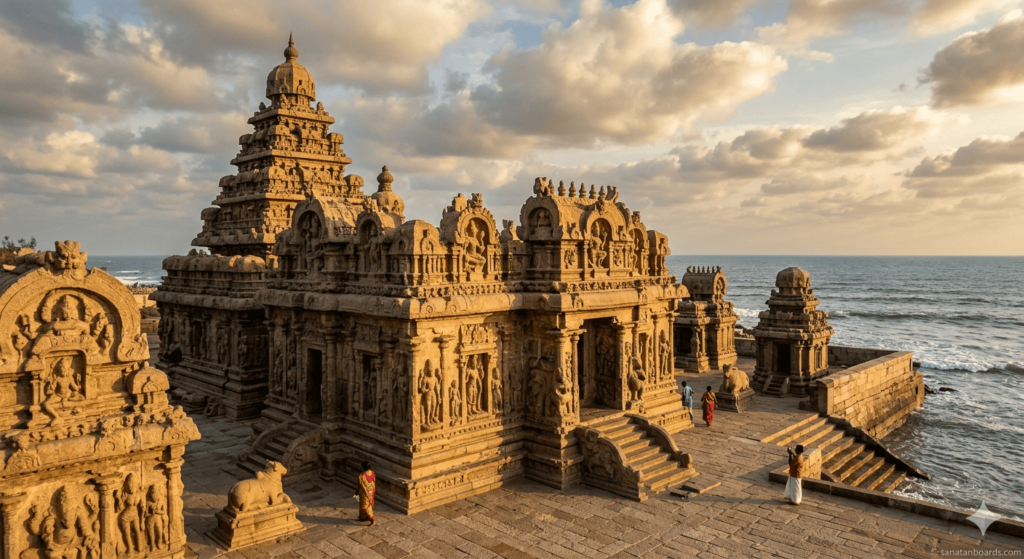
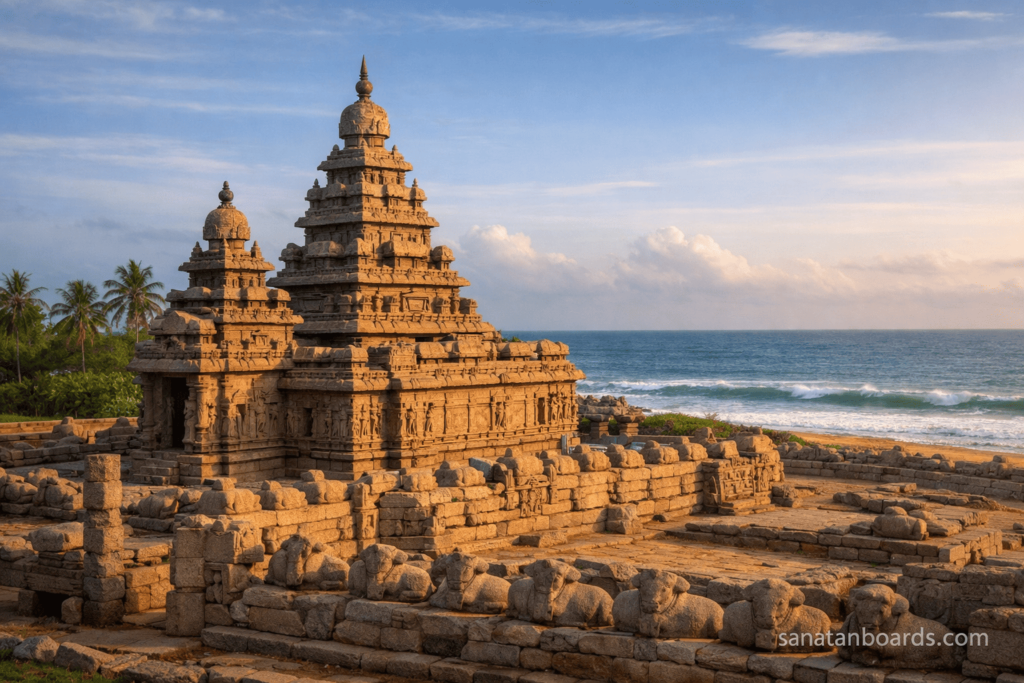
Beyond warfare, Narasimhavarman I is also renowned for his contributions to Pallava art, architecture and religion. He furthered the development of the rock-cut and structural temples at Mahabalipuram, an ancient port city famous for its monolithic carvings and shore temples. These architectural marvels showcase not just technical skill but also an aesthetic sensibility that influenced South Indian temple architecture for centuries.
His reign represents the synthesis of martial skill, religious patronage, and artistic innovation, which are key pillars of the Pallava legacy. Narasimhavarman I’s story continues to be celebrated in South Indian cultural memory, temple inscriptions, and classical literature.
What Is Narasimhavarman I (Pallava) ?
Narasimhavarman I (Pallava) was a South Indian ruler of the Pallava dynasty during the early 7th century CE. The Pallavas were powerful sovereigns whose domain included parts of present-day Tamil Nadu and Andhra Pradesh. Narasimhavarman I rose to prominence after the death of his father, Simhavishnu, inheriting not only the throne but also the ongoing conflict with the rival Chalukyas. Unlike many kings of his time who were remembered mainly for territorial conquests, Narasimhavarman I’s identity is defined by his combined excellence as a strategist, a patron of religion, and a promoter of art.
The historical texts and inscriptions portray him as a king committed to strengthening the cultural foundations of his kingdom. His title “Mahamalla” reflects his prowess as a warrior and a leader admired by his subjects. Yet what makes Narasimhavarman I particularly significant in Indian history is his role in the cultural and architectural evolution of South India. Under his patronage, the artistic endeavors at Mahabalipuram flourished, resulting in rock-cut sanctuaries, monolithic sculptures, and structural temples that remain iconic to this day.
In political terms, Narasimhavarman I is best known for his successful military campaign against the Chalukya empire led by Pulakeshin II, one of the most formidable rulers of his time. The capture and destruction of Vatapi, the Chalukya capital, marked a dramatic turn in the power dynamics of the region. This victory not only enhanced Pallava prestige but also stabilized the kingdom’s northern frontiers.
Narasimhavarman I was also a devotee of Lord Shiva and maintained close ties with religious scholars and ascetics. His legacy is preserved in historical records, temple inscriptions, and the enduring stone masterpieces that stand as testament to the rich cultural heritage of the Pallavas.
Who Is Required Narasimhavarman I (Pallava) ?
Understanding Narasimhavarman I (Pallava) remains essential for historians, students of ancient Indian polity, culture enthusiasts, and anyone interested in the evolution of temple architecture in South India. Historians require a clear grasp of his reign to reconstruct political narratives of early medieval India, especially the interplay between the Pallavas, Chalukyas, and other contemporary powers. The strategies employed by Narasimhavarman I against his adversaries offer insights into early forms of warfare and diplomacy.
Students and scholars of literature and art history also benefit from studying his contributions. Narasimhavarman I’s patronage laid the groundwork for the artistic experiments at Mahabalipuram, where sculptors and architects developed new forms and techniques that influenced generations. These examples serve as primary sources for understanding stylistic developments in Dravidian architecture.
Religious and cultural scholars find relevance in his reign as well, as it reflects the symbiotic relationship between religion and statecraft during his period. His support for Shaivism and temple construction illustrates how rulers shaped religious expression and community life. Inscriptions from his period also provide data on language use, administration, and societal values.
For regional communities, particularly in Tamil Nadu and Andhra Pradesh, Narasimhavarman I is part of a shared cultural memory and identity. He represents a lineage of rulers who laid foundations for temple-centered urban culture. Educators and content creators require accurate information about his life to impart nuanced perspectives to learners.
In broader terms, anyone interested in how leadership, creativity, and cultural priorities integrate into political power finds Narasimhavarman I’s example compelling. His blend of martial success and artistic legacy makes him a figure of enduring relevance across disciplines.
When Narasimhavarman I (Pallava) Is Required ?
The period of Narasimhavarman I’s reign — early 7th century CE — corresponds to an epoch of heightened interaction between powerful kingdoms in peninsular India. His rule is required to understand several key developments in the history of the subcontinent. Politically, this era demanded a strong, strategic monarch because the Pallava kingdom was engaged in prolonged rivalry with the Chalukyas of the Deccan. The Chalukya ruler Pulakeshin II had previously thwarted Pallava ambitions and even invaded their territory. In such a climate, the need for a leader like Narasimhavarman I became essential. His reign was required at this historical juncture to challenge Chalukyan supremacy and stabilize the region.
Scholars studying military history look at his campaigns as turning points that shaped the balance of power. The assault on Vatapi in approximately 642 CE — where the Pallava forces defeated Pulakeshin II’s lineage — stands as an extraordinary instance of tactical planning and execution in medieval Indian warfare. This was required not merely as a military achievement but as a marker of a shift in regional influence from the Deccan into the Tamil country.
From an artistic and cultural perspective, Narasimhavarman I’s reign was required for setting precedents in South Indian temple architecture. Before his time, most temple structures were smaller and less elaborate. Under his patronage, the sculptural work at Mahabalipuram transitioned into complex monolithic forms and groupings that depicted mythological themes with dramatic expression. This expansion in artistic vision was required to elevate temple spaces from simple sacred sites to monumental complexes that served as cultural hubs.
Furthermore, his leadership was required at a time when religious identities were being consolidated. The Pallavas, including Narasimhavarman I, fostered a syncretic approach to Shaivism and other traditions, enabling temples to become focal points for community life, economic activity, and artistic collaboration.
In administrative terms, his reign is required to understand how early medieval South Indian states organized revenue systems, maintained armies, and facilitated trade. The maritime trade networks connecting the Coromandel Coast with Southeast Asia were expanding during his time, and a stable political environment under Narasimhavarman I helped sustain these economic flows.
Thus, the period of Narasimhavarman I’s kingship was required not only for immediate territorial and political consolidation but also for shaping long-term cultural and artistic legacies.
Where Narasimhavarman I (Pallava) Is Required ?
Narasimhavarman I (Pallava) is required in several geographical and cultural contexts that shaped the history of South India. Politically, his reign was required in the northern Tamil region and parts of Andhra Pradesh, which formed the heart of Pallava power. The capital city of Kanchipuram served as the administrative and cultural center during his rule, making it a strategic location for governance, trade, and religious activities. Kanchipuram’s prominence under his leadership underscores why Narasimhavarman I was required here—to consolidate power, oversee military campaigns, and support economic growth.
In terms of military campaigns, Narasimhavarman I was required in Vatapi (modern-day Badami), the capital of the Chalukya kingdom. His expedition and eventual victory over Pulakeshin II there not only reshaped the political map but also showcased the Pallava kingdom’s influence beyond its immediate territory. This geographic requirement highlights his role as a ruler whose impact extended across regional boundaries, influencing both the Tamil country and the Deccan plateau.
Culturally, Narasimhavarman I was required in Mahabalipuram, an ancient coastal town where his patronage resulted in the construction of the Shore Temple, Pancha Rathas, and exquisite rock-cut sculptures. These sites, now UNESCO World Heritage monuments, demonstrate the significance of his presence in specific locales that became focal points for religion, art, and trade. His leadership was required here to commission architectural innovations that would influence generations of South Indian temple builders.
Economically, his presence was required along the Coromandel Coast, where maritime trade with Southeast Asia and the Indian Ocean world flourished. Ensuring the security and prosperity of these coastal hubs demanded active engagement from the ruler, providing protection for merchants and fostering international commerce.
Lastly, Narasimhavarman I was required in temple towns across the Pallava kingdom, where religious devotion intertwined with political legitimacy. By promoting Shaivism and temple-centered communities, he reinforced social cohesion and cultural identity across multiple locations.
How Narasimhavarman I (Pallava) Is Required ?
Narasimhavarman I (Pallava) is required through strategic, cultural, and administrative interventions that shaped his legacy. Militarily, he is required through decisive leadership and battlefield tactics that allowed the Pallavas to overcome the formidable Chalukyas. His planning, coordination of forces, and knowledge of enemy terrain were essential to successfully capture Vatapi. By demonstrating how a ruler could combine courage with strategic foresight, he became a model for effective kingship.
Culturally, Narasimhavarman I is required through patronage of arts and architecture. He directly commissioned rock-cut temples, monolithic sculptures, and shore temples, emphasizing the integration of artistic vision with religious devotion. His involvement ensured that architectural projects were completed with both aesthetic sophistication and symbolic resonance, influencing the trajectory of Dravidian temple design.
Administratively, Narasimhavarman I is required through the establishment of governance mechanisms that maintained order, collected revenue, and regulated trade. By overseeing Kanchipuram and other towns, he ensured that the kingdom functioned efficiently, supporting both urban centers and rural settlements. His requirement here demonstrates the importance of a ruler actively engaging with bureaucratic and civic systems.
Religiously, he is required through the promotion of Shaivism and temple-centered life. By endorsing rituals, patronizing priests, and funding religious institutions, he strengthened the social and moral fabric of his kingdom. This religious guidance also served as a unifying force across diverse communities, highlighting the integrative role a ruler can play.
In maritime and economic spheres, Narasimhavarman I is required through oversight of trade networks. He ensured safe passage for merchants along the Coromandel Coast and maintained diplomatic contacts with neighboring regions. His presence was crucial to sustaining economic prosperity and enabling cultural exchanges with Southeast Asia.
Lastly, Narasimhavarman I is required as an enduring symbol of leadership. His combination of military success, cultural innovation, religious patronage, and administrative acumen serves as an example for understanding how rulers shaped early medieval South India. The “how” of his requirement, therefore, lies in his active engagement across multiple domains to create a cohesive, prosperous, and culturally vibrant kingdom.
Case Study On Narasimhavarman I (Pallava)
Introduction:
Narasimhavarman I (Pallava) is a quintessential example of a ruler whose leadership shaped both political and cultural landscapes. His reign, from approximately 630 CE to 668 CE, provides insights into the dynamics of South Indian kingdoms during the early medieval period. This case study examines his military, administrative, cultural, and religious strategies.
Political and Military Leadership:
One of the defining moments of Narasimhavarman I’s reign was his confrontation with Pulakeshin II of the Chalukya dynasty. After initial setbacks by the Chalukyas, Narasimhavarman I meticulously rebuilt his forces and planned a counter-offensive. The campaign against Vatapi, culminating in its capture and destruction around 642 CE, is a testament to his strategic acumen. Unlike many rulers who relied solely on brute force, he combined intelligence gathering, alliance-building, and terrain advantage to achieve a decisive victory. This not only secured the northern borders of the Pallava kingdom but also enhanced its prestige.
Cultural Contributions:
Beyond warfare, Narasimhavarman I is renowned for his patronage of arts. The shore temples, Pancha Rathas, and monolithic sculptures at Mahabalipuram exemplify a fusion of innovation and devotion. The case study highlights his method of commissioning artists, providing them autonomy while ensuring that religious symbolism remained central. These projects required coordination between architects, sculptors, and laborers, demonstrating his role as an orchestrator of large-scale cultural endeavors.
Administrative and Economic Strategies:
Narasimhavarman I’s reign involved establishing administrative frameworks to maintain stability. By strengthening Kanchipuram as an administrative hub, he facilitated governance, trade, and taxation. Maritime trade along the Coromandel Coast was encouraged, connecting the kingdom to Southeast Asia. This economic foresight not only enriched the kingdom but also financed cultural and military projects.
Religious Patronage:
His devotion to Shaivism and temple-centered society illustrates how religion was integrated into governance. By supporting temple rituals, priests, and festivals, he reinforced social cohesion and cultural continuity. Religious patronage also served as a tool for consolidating political legitimacy.
Legacy and Impact:
Narasimhavarman I’s reign offers lessons in leadership, highlighting the balance between military prowess, cultural patronage, and administrative efficiency. His successes ensured the Pallava dynasty remained influential for decades, shaping South Indian history.
Conclusion:
The case study underscores that Narasimhavarman I was more than a warrior king; he was a cultural innovator, strategic administrator, and religious patron. His integrated approach to rulership provides a model for understanding early medieval statecraft in South India.
White Paper On Narasimhavarman I (Pallava)
Executive Summary:
Narasimhavarman I (Pallava) was a pivotal ruler of the early 7th century CE whose reign exemplifies the integration of military strategy, cultural patronage, and administrative excellence. This white paper explores his life, governance, military campaigns, architectural achievements, and lasting influence on South Indian history.
Historical Context:
The Pallava dynasty, which flourished between the 3rd and 9th centuries CE, controlled large parts of present-day Tamil Nadu and Andhra Pradesh. Narasimhavarman I ascended the throne after Simhavishnu, inheriting both a prosperous kingdom and the ongoing rivalry with the Chalukya dynasty. During his reign, the political environment demanded a ruler capable of defending his territory while fostering cultural growth.
Military Strategy and Governance:
Narasimhavarman I’s military strategy was marked by intelligence-led campaigns and careful planning. His conquest of Vatapi, the Chalukya capital, demonstrates the importance of strategic foresight in early medieval warfare. He organized the army, established secure supply lines, and leveraged terrain advantages to defeat Pulakeshin II’s forces. Administratively, he centralized power in Kanchipuram, ensuring efficient taxation, law enforcement, and civic management.
Cultural and Architectural Achievements:
The artistic and architectural initiatives during his reign represent a high point in Pallava cultural history. The monolithic rathas, Shore Temple, and rock-cut sculptures of Mahabalipuram reflect technical innovation and aesthetic sophistication. These projects required coordination among craftsmen, architects, and laborers, illustrating Narasimhavarman I’s role as a visionary patron of the arts. His efforts promoted Shaivism while also strengthening the kingdom’s cultural identity.
Economic Impact:
Trade and economic stability were critical to Narasimhavarman I’s reign. By securing maritime routes along the Coromandel Coast, he facilitated commerce with Southeast Asia, ensuring resources for cultural projects and military campaigns. The kingdom’s economy flourished under his oversight, linking strategic governance with economic growth.
Social and Religious Contributions:
Narasimhavarman I reinforced social cohesion through religious patronage. Temples became centers for not only worship but also education, arts, and civic interaction. By endorsing rituals and festivals, he promoted a sense of unity and continuity within his kingdom. Religious and cultural policies were thus intertwined with governance.
Lessons and Modern Relevance:
For modern scholars, policymakers, and cultural historians, Narasimhavarman I’s reign offers valuable lessons:
- Integrated Leadership – Balancing military, cultural, and administrative responsibilities.
- Strategic Innovation – Using intelligence and planning to overcome formidable adversaries.
- Cultural Investment – Patronage of arts and architecture as tools for soft power and societal cohesion.
- Economic Foresight – Securing trade routes to sustain governance and cultural projects.
Conclusion:
Narasimhavarman I (Pallava) remains an exemplary figure in South Indian history. His integrated approach to rulership, blending martial skill with #narasimhavarman1pallava cultural patronage and governance, provides a blueprint for understanding the dynamics of early medieval kingdoms. The lessons from his reign continue to inform studies in leadership, culture, and strategic planning.
Industry Application On Narasimhavarman I (Pallava)
Narasimhavarman I (Pallava) offers insights far beyond historical study; his strategies, innovations, and cultural contributions provide valuable lessons for multiple modern industries. While he ruled in the 7th century CE, the principles of leadership, creativity, strategic planning, and community engagement from his era can be adapted to contemporary sectors.
1. Leadership and Organizational Management:
Narasimhavarman I exemplified a form of integrated leadership that balanced military strategy, administrative efficiency, and cultural patronage. Modern businesses and management professionals can draw parallels between his approach and contemporary organizational leadership. He demonstrates the importance of visionary planning, team coordination, and risk management. For example, his planning and execution of the Vatapi campaign show meticulous resource allocation, crisis management, and strategic foresight—concepts highly applicable to corporate project management and decision-making.
2. Architecture and Construction Industry:
The architectural innovations under Narasimhavarman I, particularly in Mahabalipuram, serve as inspiration for modern architects, civil engineers, and urban planners. His ability to integrate aesthetics, functionality, and symbolism is particularly relevant to contemporary design thinking. Modern industry applications include sustainable urban planning, large-scale cultural monuments, heritage-inspired construction, and public art projects. Techniques from Pallava rock-cut architecture, such as precision carving, load distribution, and artistic integration, offer lessons in both creative design and structural engineering.
3. Tourism and Cultural Heritage Management:
Narasimhavarman I’s projects at Mahabalipuram have become major tourist attractions and UNESCO World Heritage Sites. The tourism industry can leverage his legacy to enhance cultural tourism, develop immersive historical experiences, and design heritage education programs. Travel agencies, tour operators, and heritage management professionals study his contributions to promote cultural awareness, conservation strategies, and responsible tourism development.
4. Education and Academic Research:
The historical, cultural, and strategic achievements of Narasimhavarman I are applied in curriculum development across history, political science, art, and architecture disciplines. Educational institutions use his reign to teach lessons in leadership, cross-disciplinary thinking, and innovation. Researchers analyze his inscriptions, temple designs, and military campaigns to develop case studies, academic papers, and digital learning modules.
5. Strategic Planning and Defense Studies:
Military historians and defense strategists study Narasimhavarman I’s Vatapi campaign as a classic example of intelligence-led operations. The planning, logistics, and execution involved are comparable to modern strategic management exercises. Defense academies and security organizations use historical campaigns like his as examples of strategic deployment, leadership under pressure, and the integration of local knowledge into tactical planning.
6. Cultural Technology and Digital Preservation:
The digital humanities and technology sectors have applied Narasimhavarman I’s architectural legacy to 3D modeling, virtual reconstruction, and heritage preservation. His monuments are digitally preserved for educational, research, and entertainment purposes, including video games, VR tourism experiences, and AI-based cultural analysis. This intersection of history and technology provides opportunities for innovation in cultural technology startups, museum installations, and interactive learning platforms.
7. Arts and Creative Industries:
Narasimhavarman I’s patronage of sculpture, architecture, and temple arts serves as a model for creative entrepreneurship. Art institutions, design studios, and creative consultancies draw inspiration from his approach to integrating artistic vision with societal needs. His ability to commission and manage large-scale projects resonates with modern project management in the arts, cultural exhibitions, and public installations.
Conclusion:
Narasimhavarman I (Pallava) demonstrates that leadership, innovation, and cultural investment are timeless principles. Industries ranging from corporate management, #Sanatandharmaaccreditationboardsinmumbai architecture, and defense studies to tourism, digital technology, and arts can apply lessons from his reign. His legacy shows that strategic thinking, creative vision, and community-oriented governance are not just historical #Sanatandharmaaccreditationboardsinvasai achievements but practical tools for contemporary application.
source : Ungal Anban Hemanth
ASK FAQ
Who was Narasimhavarman I (Pallava)?
Narasimhavarman I (Pallava) was a 7th-century South Indian king of the Pallava dynasty, celebrated for defeating the Chalukya king Pulakeshin II and for his patronage of arts and architecture at Mahabalipuram.
What were the major achievements of Narasimhavarman I (Pallava)?
His major achievements include the conquest of Vatapi, the construction of Mahabalipuram’s rock-cut temples and Shore Temple, and strengthening Pallava political and cultural influence in South India.
When did Narasimhavarman I (Pallava) rule?
Narasimhavarman I ruled the Pallava kingdom approximately from 630 CE to 668 CE, a period marked by military victories and cultural advancements.
Where did Narasimhavarman I (Pallava) contribute to art and architecture?
He contributed primarily in Mahabalipuram (Tamil Nadu), where he commissioned the Shore Temple, Pancha Rathas, and other rock-cut monuments that became iconic examples of Pallava architecture.
Why is Narasimhavarman I (Pallava) important in history?
He is important for combining military skill, governance, religious patronage, and cultural innovation, leaving a lasting legacy in South Indian history, temple architecture, and regional politics.
Table of Contents
Disclaimer:
The content above is compiled from historical sources, inscriptions, and scholarly research for informational and blog purposes. Interpretations of Narasimhavarman I (Pallava) are based on available historical records and may vary depending on new archaeological or textual discoveries. This write-up is not intended as an authoritative historical document but as a comprehensive resource for general knowledge and understanding.