
MIHIRA BHOJA (PRATIHARA)
MIHIRA BHOJA (PRATIHARA) is the name of one of the most powerful and influential rulers of early medieval northern India. He was an emperor of the Gurjara‑Pratihara dynasty, a dynasty that played a central role in Indian history in the 8th to 10th centuries CE and is widely credited with shaping the medieval political landscape of the subcontinent.
Mihira Bhoja, also known as Bhoja I or by his regal title “Ādivarāha” (the primeval boar incarnation of Vishnu), reigned from approximately 836 to 885 CE. He ascended the throne during a turbulent period when the Pratihara empire was weakened by internal conflicts and foreign incursions. Through sustained efforts, he restored stability and expanded the kingdom, leaving a legacy as both a skillful general and an able statesman.
Under his leadership, the Pratihara empire reached impressive heights, with its influence extending from the foothills of the Himalayas in the north to the Narmada River in the south and from the Sutlej River in the northwest to the eastern regions near Bengal. The capital during his reign was Kannauj which was a key strategic and cultural centre of northern India.
Mihira Bhoja was known not only for territorial expansion but also for his strong resistance against invasions, particularly from Arab forces pushing from the west. His reign marked the golden phase of Pratihara authority, and historians regard him alongside other great empire‑builders of his age.
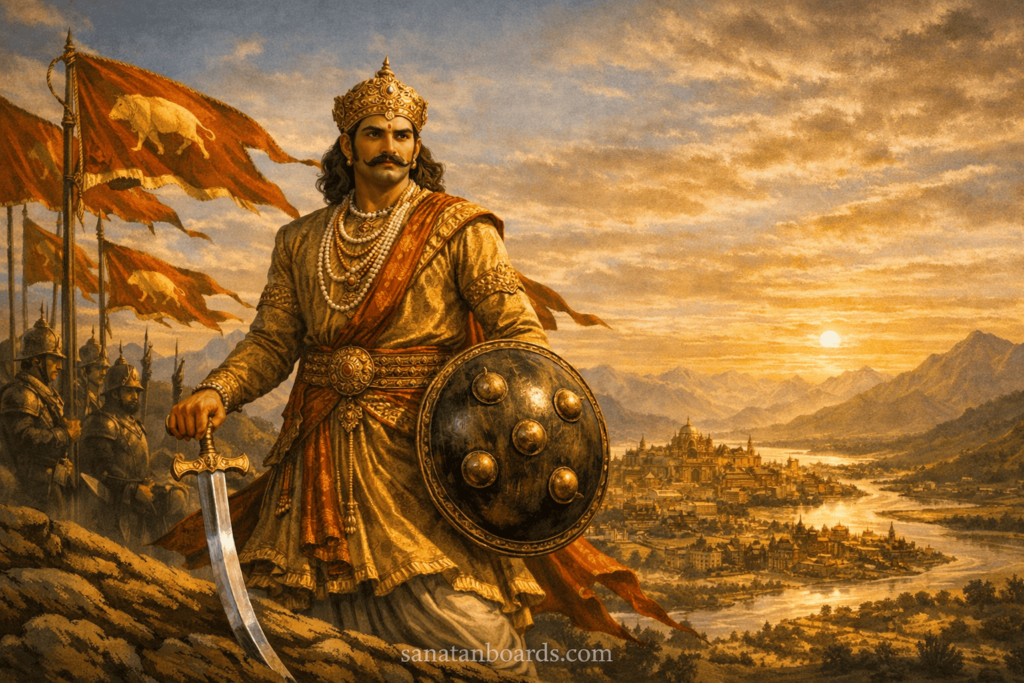
What Is Mihira Bhoja (Pratihara) ?
MIHIRA BHOJA (PRATIHARA) was a historic monarch and ruler during India’s early medieval period, belonging to the Gurjara‑Pratihara dynasty. He is often called Bhoja I and is regarded as one of the greatest emperors of his dynasty.
He became emperor around 836 CE, succeeding his father Ramabhadra. Initially, the Pratihara state was weakened due to previous losses and internal feuds. Bhoja’s first major task was to consolidate Pratihara power. He dealt with rebellious local rulers and reorganised the military to strengthen the core of his empire.
Mihira Bhoja adopted the title Ādivarāha, representing the boar incarnation of the Hindu god Vishnu, a title that also appears on some of his coins. This title signified divine support and rulership, strengthening his legitimacy among his subjects.
Politically, he was a key figure in the Tripartite Struggle, a prolonged contest for supremacy in northern India involving the Pratiharas, the Palas of Bengal, and the Rashtrakutas of the Deccan. Although he faced strong resistance, his campaigns helped secure and even extend the Pratihara domain.
Mihira Bhoja’s rule was also characterised by his defence against Arab incursions from Sindh and the western regions. These defensive efforts kept much of northern India free from foreign domination during his reign.
In historical assessments, Mihira Bhoja stands out as a ruler who restored the political stability and expanded the territorial reach of the Pratihara empire, setting the stage for sustained influence in medieval Indian history.
Who Is Required Mihira Bhoja (Pratihara) ?
MIHIRA BHOJA (PRATIHARA) was a pivotal ruler whose leadership was essential for several groups during the 9th century in northern India. His governance was not only central to the stability of the Pratihara dynasty but also crucial for the political, economic, and cultural well-being of his subjects.
The Pratihara royal family and nobility required Mihira Bhoja’s leadership to consolidate power after periods of internal instability. Before his reign, the empire faced fragmentation and challenges from rebellious feudatories. Bhoja’s ability to strengthen central authority ensured that the ruling elite could maintain their positions securely while contributing to the kingdom’s governance.
The local population and common citizens required his protection and administration to live in a stable environment. By defending against foreign invasions, particularly from Arab forces from the west and rival kingdoms like the Rashtrakutas and Palas, Mihira Bhoja ensured safety and continuity of trade, agriculture, and civic life. His policies promoted prosperity in towns and villages under Pratihara control.
Traders and merchants also required Mihira Bhoja for economic stability. The security of trade routes, especially across northern India and the Gangetic plains, enabled commerce to flourish. His protection of key cities such as Kannauj made them important commercial hubs, attracting markets, artisans, and cultural exchange.
Finally, allied states and vassals required his leadership to maintain political alliances and collective resistance against rival powers. Mihira Bhoja’s military prowess and diplomatic skills helped create a network of subordinate rulers who benefited from the overarching protection of a strong central authorit
When Mihira Bhoja (Pratihara) Is Required ?
MIHIRA BHOJA (PRATIHARA) was required most critically during periods of political instability, external threats, and internal fragmentation in northern India. His leadership became necessary when the Pratihara dynasty faced challenges that could have weakened its sovereignty and territorial integrity.
One key moment was early in his reign, when the empire had been weakened by succession disputes and local rebellions. Internal instability made it imperative for a strong ruler like Mihira Bhoja to consolidate authority, enforce administrative reforms, and stabilize relations with feudal lords. His decisive actions ensured that the Pratihara empire regained cohesion and could function efficiently as a political entity.
Mihira Bhoja was also required during external invasions, particularly from Arab forces expanding from Sindh in the northwest. Northern India was vulnerable to raids that threatened trade, agriculture, and civic life. His military campaigns and fortifications provided protection to major urban centers, trade routes, and rural settlements, preserving the prosperity of the region.
Additionally, Mihira Bhoja’s leadership was essential during the Tripartite Struggle involving the Pratiharas, the Rashtrakutas, and the Palas. This prolonged conflict over control of strategic cities, including Kannauj, demanded a ruler capable of both military strategy and diplomacy. Without his guidance, the Pratiharas might have lost dominance in the fertile Gangetic plains.
He was required during periods of economic development, as the stability he provided allowed trade and commerce to flourish. Merchants, artisans, and farmers depended on his protection to ensure safe trading routes and marketplaces, which was vital for sustaining the empire’s wealth.
Lastly, Mihira Bhoja’s reign was necessary for cultural and religious consolidation. His patronage of temples and inscriptions strengthened social cohesion, reinforced his legitimacy, and promoted a shared identity under the Pratihara dynasty.
Where Mihira Bhoja (Pratihara) Is Required ?
MIHIRA BHOJA (PRATIHARA) was required across the geographical and political expanse of northern India. His rule was not confined to a single city or region; instead, he needed to assert authority wherever Pratihara influence was significant or threatened.
The capital city of Kannauj was a central location where Mihira Bhoja was required. Kannauj was strategically located in the fertile Gangetic plains, making it crucial for administration, commerce, and military control. Maintaining dominance over this city was essential to preserve the political legitimacy of the Pratihara dynasty and to serve as a hub for regional governance.
He was also required in the frontier regions, especially along the western borders of the empire. Areas near present-day Sindh and Rajasthan faced incursions from Arab forces and local adversaries. Mihira Bhoja’s military presence and strategic fortifications were critical in defending these border territories.
In the eastern territories near Bengal, Mihira Bhoja was required to maintain influence and counter the power of the Palas. These regions were contested during the Tripartite Struggle, making his presence necessary to ensure allegiance from vassals and prevent rivals from gaining strategic advantages.
He was required in trade centers and towns along important routes. Markets, artisan communities, and commercial hubs needed protection from bandits and external threats. His governance ensured that economic activities could continue without disruption, which reinforced the empire’s prosperity.
Temples and religious sites also required Mihira Bhoja’s attention. His support for Hindu temples and inscriptions not only promoted cultural unity but also legitimized his authority. In this sense, his presence extended beyond politics and military affairs into social and religious spheres.
How Mihira Bhoja (Pratihara) Is Required ?
MIHIRA BHOJA (PRATIHARA) was required through a combination of military strategy, administrative skill, and cultural leadership. His effectiveness as a ruler depended on how he exercised power to maintain stability, protect the empire, and foster prosperity.
Military leadership was one of the primary ways he was required. Mihira Bhoja led campaigns to suppress rebellions, defend against external invasions, and expand territorial boundaries. His strategies included fortifying key cities, establishing garrisons, and using both direct and diplomatic approaches to manage conflicts. These actions ensured security for citizens and maintained the empire’s territorial integrity.
He was also required through administrative reforms. Mihira Bhoja reorganized governance structures to centralize power and improve efficiency. This included overseeing taxation systems, ensuring the loyalty of local governors, and maintaining law and order. His administration provided the framework for a stable state that could withstand both internal and external challenges.
Economic regulation was another way he was required. By protecting trade routes and markets, Mihira Bhoja facilitated commerce, encouraged agriculture, and supported artisans. His policies helped sustain economic growth, which in turn reinforced the authority of the Pratihara dynasty.
Culturally and religiously, he was required through patronage of temples, inscriptions, and religious institutions. This helped consolidate social unity and promoted a shared identity under his rule. By supporting religious practices and cultural expressions, Mihira Bhoja strengthened his legitimacy and created a cohesive society.
Diplomatic engagement was another method. Mihira Bhoja maintained alliances with subordinate rulers and neighboring kingdoms. Through negotiations and displays of strength, he managed conflicts without overextending his empire, demonstrating how a ruler was required not only in war but also in peace.
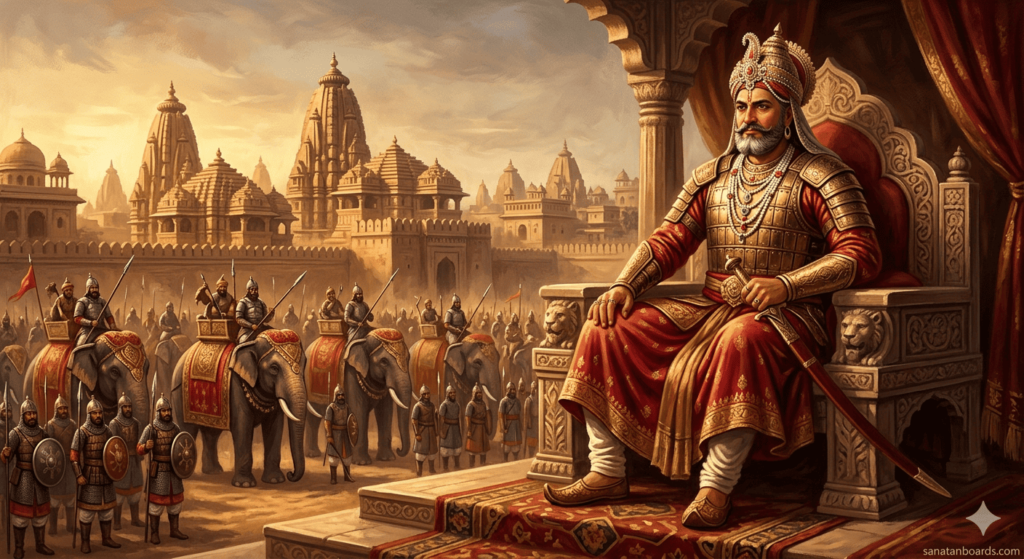
Case Study On Mihira Bhoja (Pratihara)
Introduction
The following case study examines the reign of MIHIRA BHOJA (PRATIHARA), focusing on his leadership, challenges, strategies, and outcomes. It is meant to provide a holistic picture of how his rule shaped the Pratihara dynasty and influenced broader political, economic, and cultural developments in early medieval India.
Historical Context
By the early 9th century CE, northern India was characterized by fragmented powers. The Gurjara‑Pratihara dynasty had established itself as a strong regional power, but internal feuds, decentralized governance, and threats from foreign incursions weakened it. This environment set the stage for Mihira Bhoja’s reign.
Challenge: Political Instability
At the beginning of his rule around 836 CE, the Pratihara state lacked unified control. Several feudatories operated semi‑independently, and rival kingdoms like the Rashtrakutas and Palas challenged Pratihara influence. Kannauj — a strategic and affluent city — was contested and symbolic of imperial dominance.
Strategic Response:
Mihira Bhoja moved to centralize authority through military campaigns and diplomatic alliances. Instead of merely relying on force, he blended coercive actions with negotiations, reinstating loyal governors and integrating resistant territories back into the empire.
Outcome:
The result was a strengthened political core, with Kannauj functioning as the central capital and symbol of Pratihara unity. This consolidation discouraged immediate internal rebellion and strengthened his grip over the region.
Challenge: External Threats
The 9th century marked recurring incursions from Arab forces advancing from west of Sindh, threatening economic centers and trade routes in western Rajasthan and Gujarat.
Strategic Response:
Mihira Bhoja fortified frontier zones and deployed skilled commanders to strategic forts. He also built alliances with local Rajput clans and regional chieftains, creating a network of loyal defense forces.
Outcome:
Arab incursions were repeatedly checked, protecting trade networks and agricultural production in western and central territories. Citizens benefited from relative security, leading to increased commerce and rural stability.
Challenge: Tripartite Struggle
One of the most significant political contests of the time was the Tripartite Struggle among the Pratiharas, Palas of Bengal, and Rashtrakutas of the Deccan. The battle for Kannauj became central to this struggle.
Strategic Response:
Rather than relying solely on open battle, Mihira Bhoja engaged in extended diplomatic negotiations, intermittent warfare, and strategic marriages. He also strengthened internal administrative efficiency to ensure that he could sustain long campaigns without destabilizing his own governance.
Outcome:
Although control over Kannauj shifted multiple times in the struggle, Mihira Bhoja’s resilient strategies ensured that the Pratiharas remained one of the principal powers in northern India. Over time, this elevated the dynasty’s political standing and forced alliances with lesser rulers.
Economic Strengthening
Under Mihira Bhoja, economic stability became a strategic priority. Trade routes from the Gangetic plains to western ports were secured and managed through local administrators who reported directly to the central authority.
Strategic Response:
He invested in infrastructure like roads, caravanserais, marketplaces, and taxation reforms that were predictable and fair. This encouraged both internal trade and external commerce with Arabian and Southeast Asian merchants.
Outcome:
Kannauj and the surrounding trade hubs became prosperous centers of commerce, attracting artisans, scholars, and traders. This economic growth supported military expenditures and public works, reinforcing the empire’s stability.
Cultural and Religious Influence
Mihira Bhoja promoted Hindu cultural identity through temple patronage and religious sponsorship. The title “Ādivarāha” linked his kingship with divine authority, enhancing social cohesion.
Outcome:
His reign saw increased temple constructions, inscriptions celebrating royal victories, and cultural synthesis that blended martial power with religious legitimacy. This strengthened the social unity of his subjects and enriched the cultural heritage of the region.
Conclusion
The reign of MIHIRA BHOJA (PRATIHARA) demonstrates how a leader can balance military strategy, diplomatic skill, economic foresight, and cultural patronage.#mihirabhojapratihara The outcomes of his actions fortified the Pratihara dynasty’s territorial reach, economic power, and cultural legacy, creating an enduring model of governance in medieval India.
White Paper On Mihira Bhoja (Pratihara)
Executive Summary
This white paper analyzes the strategic, administrative, and socio‑economic impact of MIHIRA BHOJA (PRATIHARA), a paramount ruler of early medieval India (≈836–885 CE). By evaluating his challenges, policy frameworks, and innovations, it identifies principles relevant to governance, defense, and cultural integration.
1. Introduction
The early medieval period in northern India was marked by fragmented rule, competing kingdoms, and foreign incursions. Against this backdrop, Mihira Bhoja emerged as a transformative leader of the Gurjara‑Pratihara dynasty.
2. Governance Model
2.1 Centralization
Initially, regional autonomy within the Pratihara state weakened overall authority. Mihira Bhoja adopted a centralized governance model: placing loyal governors in strategic zones and instituting standardized administrative procedures allowed smoother resource distribution and command accountability.
2.2 Strategic Delegation
While central authority was reinforced, Mihira Bhoja recognized the importance of strategic delegation. Local chiefs were granted limited autonomy on the condition of military support and tribute — balancing control with efficiency.
2.3 Legal Frameworks
Codified tax systems and dispute resolution mechanisms were standardized, reducing corruption and enhancing internal stability.
3. Military Strategy and Defense
3.1 Frontier Fortification
Recognizing the threat from western incursions, Mihira Bhoja invested heavily in frontier fortresses. These were not just military bases but also administrative centers.
3.2 Mobile Defense Units
He organized mobile cavalry units capable of rapid response. This flexibility allowed defenses against sudden invasions without draining resources needed elsewhere.
3.3 Alliances
Strategic alliances with influential regional clans expanded his defensive capacity without stretching central resources.
4. Economic Policy
4.1 Trade Infrastructure
Protected caravan routes and marketplaces improved commerce. Stable taxation policies encouraged long‑distance trade, including exchanges with Arabian and Southeast Asian merchants.
4.2 Agricultural Support
Land reforms and irrigation projects increased agricultural output, improving food security and boosting tax revenue.
5. Cultural Integration
5.1 Religious Patronage
Temples were not merely spiritual centers but also community anchors. Mihira Bhoja’s support strengthened a shared cultural identity, increasing social cohesion across diverse populations.
5.2 Identity and Legitimacy
Adopting the title “Ādivarāha” projected both devotion and sovereign legitimacy, integrating spiritual authority with political power.
6. Strategic Diplomacy
Mihira Bhoja’s diplomatic engagements balanced conflict with negotiation — particularly in the context of the Tripartite Struggle involving Palas and Rashtrakutas. Negotiated truces and marital alliances helped maintain relative regional equilibrium.
7. Impact Assessment
7.1 Long‑Term Stability
His governance structures outlasted his rule, enabling the Pratihara dynasty to remain relevant even after his death.
7.2 Economic Flourishing
Kannauj and linked trade centers prospered, supporting cultural exchanges and technological progress.
7.3 Cultural Legacy
Temples and inscriptions from his reign remain significant markers of early medieval Indian art, religion, and polity.
8. Lessons for Modern Governance
8.1 Balanced Central Authority
Strong central policies can succeed when paired with strategic delegation.
8.2 Integrated Security
Military preparedness must be combined with economic and diplomatic foresight.
8.3 Cultural Equity
Supporting shared cultural identity strengthens national cohesion.
Conclusion
The reign of MIHIRA BHOJA (PRATIHARA) offers a model of integrated leadership — blending defense, administration, economic planning, and #Sanatandharmaaccreditationboardsinvasai cultural patronage — that resonates beyond its historical era.
Industry Aplication On Mihira Bhoja (Pratihara)
Although MIHIRA BHOJA (PRATIHARA) lived in the 9th century, his leadership, administrative acumen, and strategic vision offer valuable lessons for modern industries, governance systems, and organizational structures. By analyzing his approaches to military management, economic planning, cultural integration, and diplomacy, one can derive practical applications relevant to contemporary sectors.
1. Leadership and Organizational Management
Mihira Bhoja demonstrated centralized yet flexible leadership, balancing authority with delegation. In today’s corporate environment, this translates into effective organizational management:
- Centralized decision-making mirrors executive boards or C-suites setting strategic direction.
- Delegation to trusted subordinates is akin to empowering department heads, regional managers, or project leads to execute strategy while maintaining accountability.
- Crisis management skills applied to internal rebellion or external threats can inspire corporate risk management frameworks, ensuring organizations respond effectively under pressure.
Industries such as multinational corporations, large NGOs, and public administration can adopt these principles to streamline hierarchical yet agile governance structures.
2. Defense and Security Planning
Mihira Bhoja’s military strategy included frontier fortification, mobile cavalry units, and alliances with regional powers. These principles are directly applicable to modern defense, security planning, and risk mitigation:
- Layered defense strategies mirror modern cybersecurity or physical security planning, where threats are anticipated and neutralized before escalation.
- Mobile, flexible response units inspire rapid reaction teams in emergency management, military logistics, and disaster response.
- Alliance-building corresponds to inter-organizational cooperation, public-private partnerships, and coalition strategies in national security and large-scale projects.
Defense industries, law enforcement agencies, and strategic consulting firms can study these approaches to enhance operational preparedness.
3. Economic and Trade Infrastructure
Mihira Bhoja prioritized the protection of trade routes, marketplaces, and agricultural regions, ensuring sustainable economic prosperity. Modern applications include:
- Supply chain resilience: His methods of safeguarding key trade paths reflect modern logistics strategies to protect goods from disruption.
- Market stability and regulation: Predictable taxation and governance encouraged business confidence, similar to contemporary fiscal policy and regulatory frameworks that support private enterprise.
- Investment in infrastructure: Roads, marketplaces, and urban centers under Bhoja’s reign parallel modern industrial parks, transport networks, and trade hubs critical for economic growth.
Industries such as logistics, infrastructure development, finance, and urban planning can draw inspiration from his policies for risk management and growth optimization.
4. Cultural Integration and Human Capital Management
Bhoja’s support of temples, inscriptions, and religious institutions served as a unifying tool, integrating diverse populations under shared cultural values. In modern industry terms:
- Corporate culture development: Building a shared organizational ethos increases employee loyalty and motivation.
- Stakeholder engagement: Patronage of cultural projects is analogous to corporate social responsibility (CSR) initiatives fostering community relations.
- Human capital retention: Supporting education, arts, and societal well-being attracts talent and encourages long-term stability.
Companies in HR, CSR, education, and community development can adopt these lessons to strengthen organizational identity and cohesion.
5. Strategic Diplomacy and Negotiation
Mihira Bhoja employed diplomacy alongside warfare, maintaining alliances with vassals, regional rulers, and rivals. Modern applications include:
- Negotiation and partnership strategies: Businesses and governments must balance competition and collaboration, similar to Bhoja’s strategic alliances during the Tripartite Struggle.
- Conflict resolution frameworks: Mitigating disputes through negotiation reduces costs and fosters long-term partnerships.
- Global business strategy: His model illustrates adapting tactics to local conditions while maintaining overarching goals, essential for multinational operations.
Industries benefiting from this approach include international trade, global consulting, and political advisory services.
6. Integrated Strategic Management
Mihira Bhoja’s reign exemplified holistic management, combining military, economic, cultural, and diplomatic strategies. Modern industries can apply this integrated approach to:
- Corporate strategy: Aligning financial, operational, human, and cultural objectives for sustainable growth.
- Public sector governance: Coordinating infrastructure, security, and community engagement under a unified vision.
- Innovation and resilience planning: Anticipating threats, leveraging resources, and maintaining flexibility ensures long-term competitiveness.
In essence, Mihira Bhoja’s strategies provide a blueprint for leadership, operational efficiency, and societal engagement across industries, demonstrating that historical governance models can inform contemporary organizational excellence.
Conclusion
The industrial and organizational applications of MIHIRA BHOJA (PRATIHARA) underscore that principles of leadership, strategic planning, #Sanatandharmaaccreditationboardsinmumbai economic foresight, cultural cohesion, and diplomacy are timeless. By translating historical insights into modern frameworks, businesses, governments, and industries can foster resilience, growth, and social legitimacy — just as Mihira Bhoja did over a millennium ago.
source : Time Traveller
ASK FAQ
Who was Mihira Bhoja (Pratihara)?
Mihira Bhoja (Pratihara) was a powerful 9th-century ruler of the Gurjara-Pratihara dynasty, known for expanding the empire, defending northern India from invasions, and making Kannauj his capital.
When did Mihira Bhoja (Pratihara) rule India?
Mihira Bhoja (Pratihara) ruled from approximately 836 CE to 885 CE, a period marked by political consolidation and the Tripartite Struggle with the Palas and Rashtrakutas.
What were the major achievements of Mihira Bhoja (Pratihara)?
His major achievements include territorial expansion, protection against Arab invasions, strengthening central administration, economic growth through trade security, and cultural patronage of temples and inscriptions.
Why is Mihira Bhoja (Pratihara) historically significant?
Mihira Bhoja (Pratihara) is significant for restoring the Pratihara dynasty’s power, securing northern India, supporting trade, and leaving a lasting cultural and political legacy.
How did Mihira Bhoja (Pratihara) influence Indian governance and economy?
He influenced governance by centralizing administration and delegating authority to loyal governors, while promoting economic prosperity by protecting trade routes, marketplaces, and agricultural regions.
Table of Contents
DISCLAIMER
This content on MIHIRA BHOJA (PRATIHARA) and its industry applications is provided for educational and informational purposes only. Interpretations connecting historical strategies to modern industry are speculative and meant for academic or learning use. It does not constitute professional, financial, legal, or business advice. Readers should consult specialized sources or professionals before applying these concepts in real-world contexts.