MADHAVA VARMA (ANDHRA) refers to one of the greatest ancient rulers in the history of early Andhra political power. Specifically, this name is most associated with Madhava Varma II, who was a dominant king of the Vishnukundina dynasty, a powerful regional dynasty that ruled large portions of the Deccan and coastal Andhra regions during the 5th century CE.
Madhava Varma II ascended the throne circa 440 CE and reigned until around 460 CE, and he is widely recognized as the most successful king of his dynasty because it was under his rule that the Vishnukundina kingdom reached its greatest territorial and political extent. His reign marked a period of consolidation, military expansion, cultural patronage, and administrative organization in southern India.
The primary sources about his life and rule come from ancient inscriptions, historical texts, and later scholarly research on early Andhra politics. Under his leadership, the dynasty expanded its influence across a large geographical area from the Bay of Bengal in the east to the Arabian Sea in the west and from the Godavari–Krishna deltas into central India.
Madhava Varma II’s royal titles included Andhradhipati (Lord of Andhra), Dakshinapatha (Lord of the Southern Region), and Paramaheswara—indicating his wide authority and prestige among contemporary Indian rulers.
As a ruler, he balanced military prowess with patronage of religion and culture. Many temples and educational centers were constructed under his rule, enhancing the architectural and spiritual landscape of ancient Andhra.
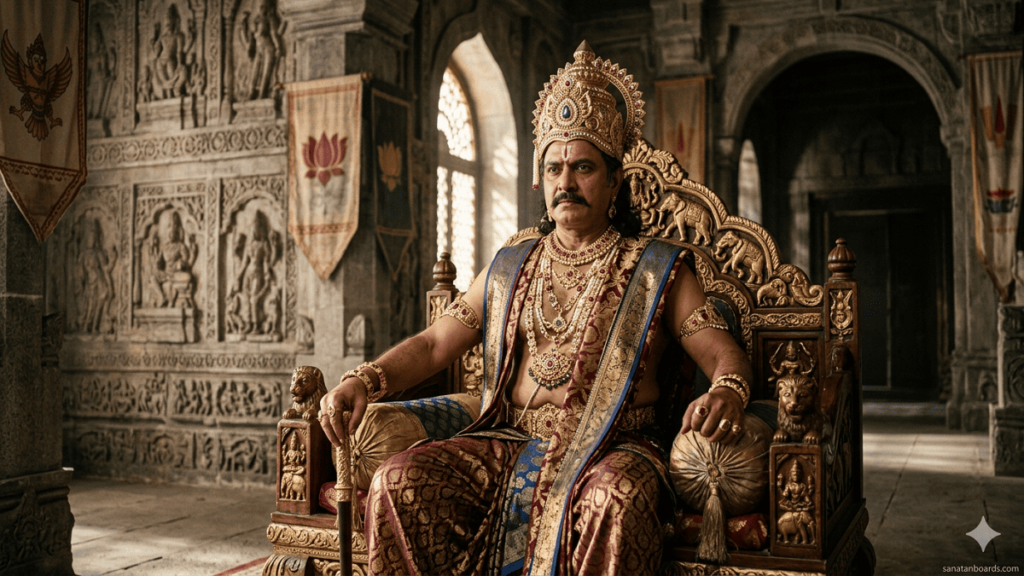
What Is Madhava Varma (Andhra) ?
MADHAVA VARMA (ANDHRA) chiefly refers to Madhava Varma II, a powerful ancient Indian monarch of the Vishnukundina dynasty—a ruling dynasty with its core region in what is now Andhra Pradesh.
In essence, Madhava Varma II was a sovereign king whose leadership and military victories enabled the Vishnukundina realm to become one of the most important political powers in south and central India during the mid-5th century CE. His reign is considered a golden age for the dynasty because of territorial reach, administrative strength, and cultural influence.
Unlike many rulers of his time whose influence was local, Madhava Varma II expanded his authority across vast regions. He fought and subdued neighboring kingdoms and chieftains, extending the kingdom from coastal Andhra across the Eastern Ghats toward central India. His military campaigns brought a measure of political unity and relative stability across the Deccan plateau during his rule.
Historical evidence suggests that he also forged important strategic alliances. One of the most notable was his marriage to the daughter of Prithvishena II, a powerful Vakataka ruler, which linked two significant royal families and strengthened regional politics.
As a ruler, he was known both for military strategy and cultural contributions, including supporting temple construction and possibly literary patronage. In ancient inscriptions he is praised with honorifics that reflect not just political strength but cultural and spiritual significance as well.
Who Is Required Madhava Varma ?
Madhava Varma II is required in history because he exemplifies a ruler whose leadership helped shape the political landscape of early medieval southern India. He remains significant for historians, scholars of South Asian history, and students of Andhra heritage because his reign represents one of the earliest examples of Andhra regional unity and influence beyond local boundaries.
Historically, his rule is a key anchor in studying the evolution of Indian polities outside the north and central plains. While many historical narratives focus on northern empires such as the Guptas, Madhava Varma II’s reign highlights the parallel stories of powerful southern dynasties that also shaped India’s subcontinental dynamics.
For regional cultural identity, Madhava Varma II is a touchstone. In Andhra Pradesh’s historical memory, he symbolizes a time when native rule held its own against contemporaries—both in war and diplomatic alliances. Scholars refer to his era when discussing early Andhra governance, military organization, and interstate diplomacy in pre-medieval India.
In architectural and religious studies, his period is important for the study of temple patronage and the spread of regional art forms. Temples and religious foundations attributed to his reign provide archaeologists with rich material for understanding 5th-century socio-religious life.
Thus, MADHAVA VARMA (ANDHRA) is required not just as a historical name but as a reference point for understanding governance, culture, military history, and identity in ancient Andhra.
When Madhava Varma (Andhra) Is Required ?
MADHAVA VARMA (ANDHRA) is required most prominently in the mid‑5th century CE, especially during the period circa 440 – 460 CE, which marks the bulk of his effective rule as a king of the Vishnukundina dynasty.
This period was pivotal in the history of the Deccan and the eastern Indian subcontinent for several reasons:
- Political Centralization: The political landscape of south India before Madhava Varma II’s rise consisted of smaller chieftains and fragmented principalities. His reign brought greater territorial unification under a strong ruler, giving administrative coherence to a wide region that included parts of modern Andhra Pradesh, Maharashtra, Odisha, and Karnataka.
- Military Expansion: The mid‑5th century saw significant conflicts among regional powers. It was required for leaders like Madhava Varma II to defend and expand their realms to maintain sovereignty. Through military campaigns against neighboring dynasties—including the Vakatakas and Pallavas—he ensured that his kingdom remained strong and influential.
- Diplomatic Alliances: The time called for strategic alliances, often solidified through marriage among ruling houses. Madhava Varma II’s marriage into the Vakataka family is a key example that highlights the interconnected diplomacy of that era. Such alliances helped stabilize relations and extend influence without constant warfare.
- Cultural and Religious Patronage: Beyond warfare, this phase required rulers to support temples, learning centers, and cultural developments. These acts played a part in forging shared cultural identities and consolidating loyalty among diverse populations.
From a broader chronological perspective, this era falls between the decline of earlier dynasties like the Satavahanas and the rise of later South Indian powers. In the historical tapestry of India, the mid‑5th century represented a transitional phase where regional identities and powers solidified their roles in shaping future medieval Indian history.
Therefore, MADHAVA VARMA (ANDHRA) is required when examining this crucial historical window—a period of consolidation, conflict, diplomacy, and cultural development that laid foundations for future regional dynamics in southern India.
Where Madhava Varma (Andhra) Is Required ?
The influence and legacy of MADHAVA VARMA (ANDHRA) are required across geographical, cultural, and academic contexts that connect ancient political landscapes to modern scholarship.
1. Geographical Context – Andhra and Beyond
Historically, Madhava Varma II’s rule was centered in the Andhra region of eastern India (present‑day Andhra Pradesh). His kingdom extended across vast territories, from the coastal regions near the Bay of Bengal to areas reaching inland toward central India. This made his rule relevant not just within Andhra but across regions that today belong to multiple Indian states.
2. Regional Historical Narratives
In the study of South Indian history, Madhava Varma’s reign is required as a key reference for understanding how early regional powers operated outside the northern Indian kingdoms that dominate much of classical Indian history. His political activities helped shape the developmental trajectory of Andhra’s early medieval political culture.
3. Archaeological and Architectural Importance
Many temples and inscriptions from his period are found in locations across Andhra and adjoining areas. These sites are crucial for archaeologists and historians because they provide physical evidence of ancient governance, religious practices, and social life.
4. Cultural Heritage and Identity
For cultural historians and regional scholars, Madhava Varma is required in discussions about early Telugu and Andhra identity formation, long before later linguistic and political movements. His reign contributes to a narrative of indigenous rule that intersects with later cultural pride in the region’s heritage.
5. Academic Scholarship
Universities and research institutes studying the Vishnukundina dynasty and South Asian political history require knowledge about Madhava Varma because his reign exemplifies the dynamics of interstate warfare, diplomacy, and governance in early medieval India
How Madhava Varma (Andhra) Is Required ?
1. As a Model of Political Leadership
Madhava Varma II’s reign illustrates how strategic military campaigns and diplomacy combined to forge a strong political structure. His victories against rival dynasties, including the Vakatakas and Pallavas, and his decision to form alliances through marriage, show how leaders of his era secured influence both on and off the battlefield.
2. As a Builder of Regional Identity
His consolidation of power across varied territories laid foundations for a regional sense of order that helped transitional societies evolve from loose chiefdoms into more centralized polities. This dynamic is important when tracing the emergence of later South Indian kingdoms and cultural identities.
3. Through Temple and Cultural Patronage
Under his rule, temples and learning centers were established or expanded, reinforcing religious practices and artistic traditions that influenced later regional culture. These institutions served as hubs for knowledge, art, and ritual, extending his impact beyond political conquest.
4. For Academic Interpretation
Historians study Madhava Varma’s reign to understand statecraft in early medieval South Asia. His methods of governance, territorial administration, and alliance‑building provide case studies for comparing political strategies across different Indian regions and periods.
5. For Linguistic and Cultural Roots
Although inscriptions of the time were mostly in Sanskrit, the socio‑political activities under his rule took place in areas that later became centers of Telugu language development. Hence, his period is often cited when historians trace the pre‑modern roots of Telugu cultural zones
Case Study On Madhava Varma (Andhra)
Background
The mid‑5th century CE was a period of dynamic political change in the Indian subcontinent. In the southern and central regions, several local dynasties competed for influence following the decline of larger imperial powers like the Satavahanas. In this context, the Vishnukundina dynasty—originally small regional chieftains—emerged as a formidable power under leaders like Madhava Varma II.
Political Strategy and Military Expansion
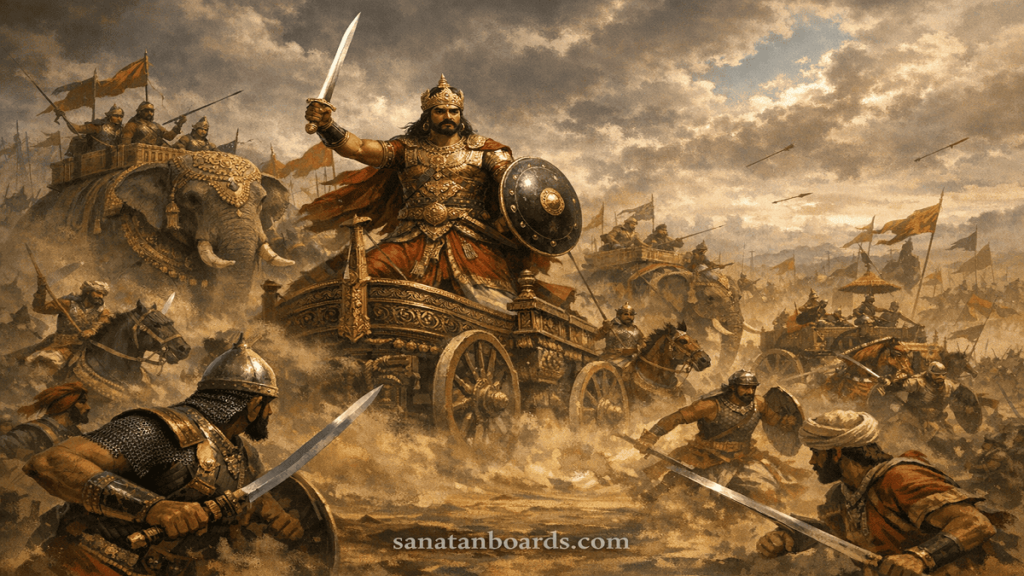
Madhava Varma II became king around 440 CE and immediately embarked on aggressive campaigns to strengthen and extend his rule. His military structure was well‑organized, with a balanced combination of infantry, cavalry, chariots, and elephant corps—standard for Indian kingdoms of that era.
One of his early notable achievements was the defeat of the Vakataka ruler Prithvishena II, a significant rival in the Deccan region. More than a mere battlefield victory, this conflict concluded with a marriage alliance: the Vakataka king’s daughter, Vakataka Mahadevi, became Madhava Varma II’s queen. This union not only cemented peace but also strengthened diplomatic ties and mutual recognition between two major powers.
Further campaigns targeted the Ananda Gotrikas, a dynasty entrenched in parts of southern Andhra, after which the Vishnukundina forces annexed key territories around Guntur, Tenali, and Ongole. These victories consolidated the Andhra region under a single authority for the first time in decades.
In his 33rd regnal year, Madhava Varma II waged war against the powerful Pallavas of Kanchipuram and succeeded in weakening their influence in the eastern Deccan. Through these campaigns, he expanded his rule from the Godavari delta to the western frontiers of the Deccan.
Administrative and Cultural Initiatives
Madhava Varma II initiated a systematic administrative model designed to govern diverse regions effectively. Capitals and administrative centers were strategically chosen—such as Amarapura (near modern Amaravati) and later Bezwada (today’s Vijayawada)—located near major river systems and trade routes.
Recognizing the importance of religion and culture in societal cohesion, he patronized temples and religious gatherings. In many towns and strategic places where major battles were fought, temples dedicated to Shiva were established, fostering spiritual continuity and communal stability. These structures also became centers for learning and local gatherings, strengthening social bonds across his territories.
Madhava Varma II also performed important Vedic rituals and sacrifices such as the Asvamedha and Rajasuya, both of which were symbols of supreme sovereign authority in ancient India. These rituals signified his unquestioned sovereignty and religious legitimacy.
Diplomatic Relations and Succession
Diplomacy was as integral to Madhava Varma’s strategy as military might. His alliance with the Vakatakas helped stabilize relations with neighboring powers, allowing him to focus resources on consolidating internal governance.
Regarding succession, Madhava Varma II prepared his realm for continuity by appointing capable family members to key administrative roles. His son Deva Varma and later his grandson Madhava Varma III were positioned in significant leadership roles, ensuring that the dynasty remained cohesive even after his passing.
Legacy and Historical Significance
By the time of his death around 460 CE, the Vishnukundina dynasty had reached unprecedented heights under Madhava Varma II. The kingdom he governed extended across vast territories, influencing political dynamics in south and central India.
Historically, his reign is studied for its blend of military acumen, diplomatic subtlety, and cultural patronage. Madhava Varma II represents a paradigm of how regional south Indian powers established sovereign authority and navigated complex inter‑dynastic relations centuries before later medieval kingdoms like the Cholas and Vijayanagara Empire rose to prominence.
Archaeological evidence, temple inscriptions, and later historical traditions continue to reference his contributions, making him an essential #madhavavarmaofandhra figure in the intellectual study of early Andhra and South Indian state formation
White Paper On Madhava Varma (Andhra)
Executive Summary
This white paper examines the reign of Madhava Varma II, a 5th‑century monarch of the Vishnukundina dynasty, to understand his strategic role in shaping regional power and governance in early southern India. Through military expansion, diplomatic alliance building, administrative reforms, cultural patronage, and religious legitimacy, Madhava Varma II established a political framework that influenced the developmental trajectory of later South Indian states.
Historical Context
The early 5th century CE was a period of significant political flux in the Indian subcontinent. The decline of pan‑Indian empires such as the Satavahanas created a vacuum that regional powers sought to fill. In this environment, the Vishnukundina dynasty, originally a smaller regional power in the Deccan, rose to prominence.
Madhava Varma II inherited a realm that was geographically significant but politically fragmented. His primary challenge was to consolidate authority over disparate territories and secure long‑term stability for his dynasty.
Strategic Military Leadership
Madhava Varma II’s military strategy was decisive and opportunistic. Leveraging a well‑organized army with elephants, cavalry, chariots, and infantry divisions, he engaged in multiple campaigns that expanded the Vishnukundina realm.
Key military engagements included:
- Defeat of the Vakataka ruler Prithvishena II, resulting in strategic territorial gains and a powerful alliance through marriage.
- Conquests over the Ananda Gotrikas, which unified the coastal Andhra regions under Vishnukundina authority.
- Campaigns against the Pallavas, which checked northern incursions and strengthened frontier defenses.
These victories not only increased territory but also established the political legitimacy of Madhava Varma II as a sovereign power capable of defending and advancing regional interests.
Diplomacy and Inter‑Dynastic Relations
Diplomacy was integral to Madhava Varma’s statecraft. The marriage alliance with the Vakataka dynasty served both political and social functions—ensuring peace on the western front and creating prestige through association with a powerful neighbor.
Such alliances reduced the frequency of prolonged conflicts and allowed resource allocation toward internal development and cultural initiatives.
Administrative Reforms
Madhava Varma II introduced administrative structures that distributed authority effectively. Capitals were chosen for strategic value, with Amarapura (near Amaravati) serving as a cultural center and Bezwada (Vijayawada) as a hub connecting internal areas with trade routes.
This multi‑nucleus governance model balanced military oversight with economic development and infrastructure management—key elements of stable statecraft in early medieval India.
Cultural Patronage and Religious Legitimacy
Madhava Varma II strategically supported religious institutions and cultural practices that fostered unity among diverse populations. Temples dedicated to Shiva and other deities were constructed in regions liberated or secured under his rule.
Additionally, performing high‑order Vedic rituals like the Asvamedha and Rajasuya not only elevated his spiritual standing but also reinforced his rightful sovereignty in the traditional Indian political order.
Legacy and Influence
By the end of his reign around 460 CE, Madhava Varma II had transformed the Vishnukundina dynasty into a dominant regional power. His combination of military success, diplomatic finesse, administrative foresight, and cultural patronage established a blueprint for governance that influenced subsequent South Indian polities.
Historians regard him as a foundational architect of early Andhra political identity—his rule symbolizing a mature form of indigenous statecraft in southern India. #Sanatandharmaaccreditationboardsoftelugu His legacy persists in archaeological sites, temple inscriptions, and scholarly discussions on early regional governance
Industry Application On Madhava Varma (Andhra)
1. Leadership and Management Consulting
The strategies Madhava Varma employed—territorial consolidation, alliance building, and effective administration—serve as case studies in strategic management and leadership programs. Companies and consulting firms use such historical examples to teach resource allocation, risk management, and long-term planning, drawing parallels between ancient statecraft and modern corporate strategy.
2. Cultural Heritage and Tourism Industry
Regions tied to Madhava Varma’s reign, including sites in Andhra Pradesh and parts of the Deccan, are leveraged for heritage tourism. Temples, fortifications, and inscriptions from his era are promoted as tourist attractions. This drives local economic development, creates jobs in hospitality and tourism, and preserves historical knowledge for global visitors.
3. Education and Academic Research
Universities, research institutions, and history programs study Madhava Varma’s reign to understand early Andhra governance, diplomacy, and cultural development. These insights are applied in courses on political science, South Asian history, archaeology, and cultural studies, providing material for research papers, conferences, and educational publications.
4. Heritage Conservation and Archaeology
Archaeologists and conservation professionals focus on preserving inscriptions, temples, and monuments from the Vishnukundina period. Madhava Varma’s patronage of architecture and religious institutions guides efforts in cultural preservation, restoration techniques, and museum curation, impacting government and NGO-led heritage projects.
5. Regional Branding and Development Planning
The historical legacy of Madhava Varma is also utilized in regional branding, particularly for Andhra Pradesh. His reign symbolizes political strength and cultural richness, which helps promote local culture, investment in historical districts, and community-based tourism initiatives.
6. Media and Content Creation
Documentaries, books, and digital media use Madhava Varma’s life and achievements to create educational content and storytelling in history-based media. #Sanatandharmaaccreditationboardsinindia This has applications in publishing, digital media platforms, and entertainment industries focused on historical narratives.
source : Tricolour TV
ASK FAQ
Who was MADHAVA VARMA (ANDHRA)?
MADHAVA VARMA (ANDHRA) refers to Madhava Varma II, a powerful 5th-century king of the Vishnukundina dynasty who expanded his kingdom across Andhra and central India.
When did MADHAVA VARMA (ANDHRA) rule?
Madhava Varma II ruled approximately from 440 CE to 460 CE, a period of political consolidation and territorial expansion in southern India.
What is the significance of MADHAVA VARMA (ANDHRA)?
He is significant for unifying Andhra territories, forming strategic alliances, promoting culture, and establishing a strong political and administrative system in the region.
Where did MADHAVA VARMA (ANDHRA) have influence?
His influence extended across modern Andhra Pradesh, parts of Maharashtra, Odisha, and central India, reaching both coastal and inland regions of the Deccan.
How did MADHAVA VARMA (ANDHRA) impact culture and governance?
He promoted temple construction, supported religious rituals, patronized learning, and implemented efficient administration, leaving a lasting legacy in Andhra’s history and culture.
Table of Contents
Disclaimer:
The above applications interpret MADHAVA VARMA (ANDHRA) through the historical figure Madhava Varma II of the Vishnukundina dynasty. The connections to modern industries are conceptual and intended for practical and cultural understanding purposes.