KRISHNA DEVA RAYA (VIJAYANAGAR) was one of the most distinguished rulers of the Vijayanagar Empire in South India during the 16th century. Born in 1509 CE, he ascended the throne in 1509 after succeeding his half-brother, Achyuta Deva Raya. His reign, which lasted until 1529 CE, is often considered the golden era of the Vijayanagar Empire, marked by remarkable achievements in politics, administration, culture, and military expansion. KRISHNA DEVA RAYA (VIJAYANAGAR) is celebrated not only for his valor as a warrior king but also for his patronage of art, literature, and religion.
Under his leadership, the empire reached its territorial zenith, encompassing large parts of present-day Karnataka, Andhra Pradesh, Tamil Nadu, and Telangana. KRISHNA DEVA RAYA (VIJAYANAGAR) implemented a robust administrative system, focusing on revenue reforms, effective governance, and promoting trade. He was a devout follower of the Hindu faith and played a crucial role in supporting temples, scholars, and poets. His court attracted literary figures like Allasani Peddana and Tenali Ramakrishna, whose works enriched Telugu literature profoundly.
The architectural landscape of the Vijayanagar Empire also flourished under KRISHNA DEVA RAYA (VIJAYANAGAR), with grand temples, water management systems and fortifications reflecting the prosperity of the period. His military campaigns secured the empire against neighboring Sultanates and maintained peace and stability in the region. Today, KRISHNA DEVA RAYA (VIJAYANAGAR) is remembered as a symbol of political acumen, cultural sophistication, and visionary leadership in South Indian history.
What Is Krishna Deva Raya (Vijayanagar) ?
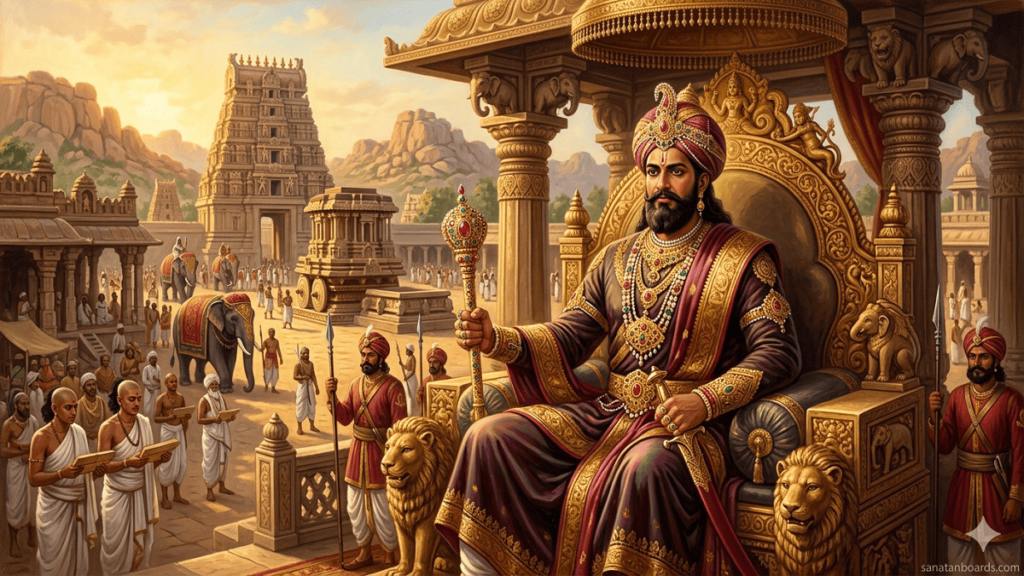
KRISHNA DEVA RAYA (VIJAYANAGAR) refers to the ruler of the Vijayanagar Empire, one of the most powerful and culturally rich kingdoms in South India. He is recognized as a sovereign who unified multiple regions under a centralized administration and promoted economic prosperity, literature, and arts. Vijayanagar is often depicted as the epitome of a philosopher-king, blending military strategy with a passion for cultural development.
During his reign, the empire thrived due to strategic trade policies, fostering relations with foreign traders from Persia, Portugal, and other regions. Agricultural productivity was enhanced through well-planned irrigation systems and land revenue reforms, which strengthened the economic base of the kingdom. KRISHNA DEVA RAYA (VIJAYANAGAR) also ensured the stability of the empire by maintaining a disciplined army and fortifying borders, which protected the kingdom from invasions and internal unrest.
Culturally, Vijayanagar played a transformative role. He was a patron of classical languages, supporting Telugu, Sanskrit, Kannada, and Tamil literary works. His court became a hub for scholars, poets, and artists, leading to innovations in music, dance, and temple architecture. Temples like the Vitthala and Hazara Rama in Hampi stand as a testament to his dedication to art and religion.
Who Is Required Krishna Deva Raya (Vijayanagar) ?
KRISHNA DEVA RAYA (VIJAYANAGAR) is required as an icon of leadership, governance, and cultural synthesis. Leaders, historians, students, and enthusiasts of Indian history study him to understand effective administration combined with cultural enrichment. His reign serves as a model for balancing military strength with civil development, making Vijayanagar a figure of relevance across disciplines.
For policymakers and administrators, Vijayanagar demonstrates the importance of revenue reforms, efficient governance, and public welfare. His methods of tax collection, irrigation development, and urban planning are still cited as examples of visionary leadership. For scholars and literary enthusiasts, he represents a period of remarkable literary and cultural activity, offering insight into the patronage of arts, literature, and architecture.
KRISHNA DEVA RAYA (VIJAYANAGAR) is also required as a symbol of resilience and strategic acumen. His military campaigns against rival sultanates highlight the significance of defense planning, diplomacy, and strategic alliances. Cultural organizations, heritage conservationists, and tourism sectors also refer to Vijayanagar to promote historical awareness and preserve architectural marvels of the Vijayanagar period.
When Krishna Deva Raya (Vijayanagar) Is Required ?
KRISHNA DEVA RAYA (VIJAYANAGAR) is required particularly when studying the golden era of South Indian history or when analyzing exemplary leadership models. His reign from 1509 to 1529 CE is a period that showcases the effectiveness of strategic governance, cultural patronage, and military success. This period is often referenced in academic curricula, historical research, and leadership studies to illustrate how centralized administration can bring stability and growth.
In the field of culture and literature, KRISHNA DEVA RAYA (VIJAYANAGAR) is required when exploring the evolution of Telugu literature and classical South Indian arts. Poets and scholars flourished under his patronage, producing works that are studied today for their literary and philosophical value. Understanding this era also helps historians and archeologists contextualize temple architecture, iconography, and city planning, especially in Hampi, the empire’s capital.
In governance and administration studies, KRISHNA DEVA RAYA (VIJAYANAGAR) is required when examining methods of revenue collection, judicial reforms, and civic infrastructure management. His ability to maintain law, order, and economic growth while defending the empire against frequent invasions provides a timeless model for public administration.
For the modern world, KRISHNA DEVA RAYA (VIJAYANAGAR) is required when addressing lessons of inclusive leadership and cultural integration. His efforts to unite diverse communities, religions, and regions under a single empire provide insights into conflict resolution and social cohesion strategies. Tourism boards and heritage preservation efforts also require references to his reign to highlight historical landmarks, temples, and forts that attract scholars and travelers alike.
Where Krishna Deva Raya (Vijayanagar) Is Required ?
KRISHNA DEVA RAYA (VIJAYANAGAR) is required in historical research, academic studies, museums, heritage sites, and tourism platforms that highlight South Indian history. His legacy is particularly relevant in the regions once part of the Vijayanagar Empire, including Karnataka, Andhra Pradesh, Telangana, and Tamil Nadu. Hampi, the capital city, serves as a living museum, where the influence of KRISHNA DEVA RAYA (VIJAYANAGAR) is observed in temples, palaces, and market structures.
In educational institutions, KRISHNA DEVA RAYA (VIJAYANAGAR) is required in history textbooks, leadership courses, and cultural studies to illustrate exemplary administration, military strategy, and patronage of arts. Universities offering programs in archaeology, literature, and political science refer to his reign for case studies on empire-building, governance, and urban development.
In the tourism industry, KRISHNA DEVA RAYA (VIJAYANAGAR) is required to promote historical heritage. His monuments in Hampi, such as the Vitthala Temple and the Hazara Rama Temple, are UNESCO World Heritage sites that attract scholars and tourists alike. Cultural festivals and historical reenactments often include his persona to educate the public about Vijayanagar history.
Moreover, KRISHNA DEVA RAYA (VIJAYANAGAR) is required in art galleries, museums, and exhibitions showcasing South Indian architecture, sculpture, and classical literature. His era is a reference point for artists, historians, and architects seeking inspiration from the harmonious blend of functionality, aesthetics, and spirituality evident in Vijayanagar structures.
How Krishna Deva Raya (Vijayanagar) Is Required ?
Vijayanagar is required by analyzing his strategies in administration, warfare, culture, and economic management. Understanding how he consolidated power over diverse regions provides a blueprint for effective governance and statecraft. Through meticulous planning of military campaigns, KRISHNA DEVA RAYA (VIJAYANAGAR) ensured territorial expansion and protection of his empire from neighboring Sultanates, demonstrating the importance of strategic defense in empire sustainability.
His approach to governance is another key aspect. By implementing a structured revenue system, land reforms, and judicial oversight, Vijayanagar established a strong economic and civic foundation. Officials were trained to oversee administration efficiently, and trade policies encouraged both domestic and foreign commerce. Learning how these policies were structured is required to understand economic stability in a historical context.
Culturally, Vijayanagar is required to study the integration of arts, literature, and religion into statecraft. His patronage of poets, artists, and temple construction helped create a cohesive cultural identity for the empire. Scholars analyze how his court encouraged creative expression while reinforcing political authority, offering lessons for modern cultural policy-making.
In the field of architecture and urban planning, Vijayanagar is required to examine the design of cities, water management systems, and temple complexes. These projects combined utility, aesthetics, and spirituality, showcasing innovative planning techniques.
KRISHNA DEVA RAYA (VIJAYANAGAR) is also required in modern leadership studies as an example of balancing military, administrative, and cultural responsibilities. His ability to lead decisively while promoting prosperity and art offers a timeless lesson in multidimensional leadership.
Case Study On Krishna Deva Raya (Vijayanagar)
Background: KRISHNA DEVA RAYA (VIJAYANAGAR) ruled from 1509 to 1529 CE during the Vijayanagar Empire’s golden age. The empire, located in South India, was a strategic hub for trade, culture, and military defense. KRISHNA DEVA RAYA (VIJAYANAGAR) inherited a prosperous kingdom but faced threats from the Deccan Sultanates, requiring immediate consolidation of power.
Administrative Achievements: KRISHNA DEVA RAYA (VIJAYANAGAR) implemented an organized revenue system based on agricultural output. Land was surveyed, taxes standardized, and officials were appointed to oversee fair collection. This system enhanced agricultural productivity and ensured funds for public works, including roads, irrigation channels, and fortifications. He also emphasized law and order, resolving disputes efficiently and maintaining stability.
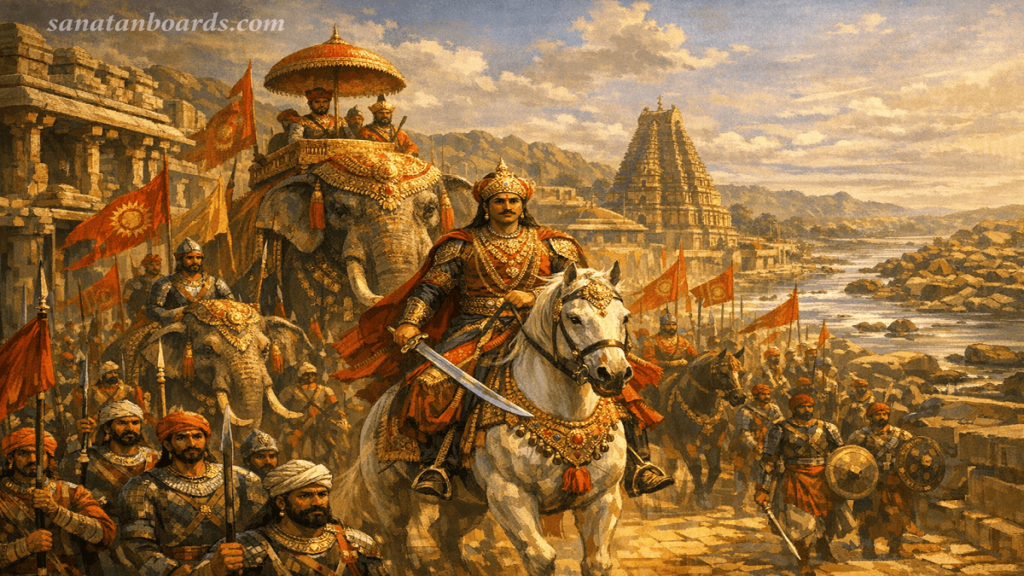
Military Strategy: His military strategy was both defensive and offensive. KRISHNA DEVA RAYA (VIJAYANAGAR) successfully repelled attacks from the Bahmani and Deccan Sultanates while expanding the empire’s influence over coastal and inland regions. He maintained a disciplined army with specialized units, including infantry, cavalry, and elephants, ensuring flexibility in warfare. Fortifications across strategic locations strengthened defense and trade protection.
Cultural Patronage: KRISHNA DEVA RAYA (VIJAYANAGAR) promoted arts, literature, and religion. He supported Telugu, Sanskrit, and Kannada literary works, attracting scholars like Allasani Peddana and Tenali Ramakrishna. Temples were not only places of worship but also centers of education and culture. Architectural projects, such as the Vitthala Temple in Hampi, showcase advanced engineering and aesthetic sensibilities. Festivals and rituals organized during his reign strengthened social cohesion.
Economic Prosperity: Trade flourished under KRISHNA DEVA RAYA (VIJAYANAGAR). Ports facilitated international trade with Persia, Arabia, and Portugal, while inland markets thrived due to agricultural surplus. Economic policies promoted artisans, merchants, and farmers, creating wealth that funded cultural and military projects.
Leadership and Legacy: KRISHNA DEVA RAYA (VIJAYANAGAR) exemplified visionary leadership. Balancing military, administrative, and cultural responsibilities, he unified a diverse population, encouraged intellectual growth, and strengthened the empire’s international standing. His governance model demonstrates the integration of multiple aspects of statecraft to achieve sustainable prosperity.
Conclusion: KRISHNA DEVA RAYA (VIJAYANAGAR) serves as a case study in effective leadership, strategic planning, and cultural patronage. His reign offers #krishnadevarayaofvijayanagar insights into empire management, integration of arts with governance, and sustainable economic growth. For historians, policymakers, and cultural enthusiasts, his example provides valuable lessons on the holistic development of a state.
White Paper On Krishna Deva Raya (Vijayanagar)
Abstract: KRISHNA DEVA RAYA (VIJAYANAGAR) is an exemplary historical figure representing the zenith of South Indian empire-building. This white paper analyzes his contributions to governance, culture, military strategy, and economic prosperity. By examining primary and secondary sources, it demonstrates how his leadership principles remain relevant for contemporary statecraft, cultural preservation, and administrative strategies.
Governance: KRISHNA DEVA RAYA (VIJAYANAGAR) established a centralized administration, employing a hierarchy of officials responsible for revenue collection, law enforcement, and civic management. His revenue reforms included detailed land surveys and standardized taxation. By delegating authority efficiently, he minimized corruption and maintained accountability. The system strengthened state capacity and allowed funding for infrastructure, defense, and cultural initiatives.
Military: Military prowess was integral to KRISHNA DEVA RAYA (VIJAYANAGAR)’s rule. He organized a well-trained army with infantry, cavalry, and war elephants. Strategic forts and garrisons protected trade routes and settlements. His campaigns ensured territorial expansion while maintaining security, creating a stable environment for economic and cultural growth.
Cultural Contributions: KRISHNA DEVA RAYA (VIJAYANAGAR) heavily patronized literature, music, dance, and temple architecture. Prominent poets like Allasani Peddana and Tenali Ramakrishna flourished under his court. Temples like Vitthala and Hazara Rama served as cultural hubs. This integrated approach to culture reinforced political authority and social cohesion.
Economic Development: Agricultural and trade policies under KRISHNA DEVA RAYA (VIJAYANAGAR) strengthened the economy. Irrigation systems improved crop yields, while trade relations with foreign merchants brought prosperity. The wealth generated supported military campaigns, infrastructure, and cultural projects.
Lessons for Modern Application: KRISHNA DEVA RAYA (VIJAYANAGAR) provides valuable lessons in governance, leadership, and cultural integration. Centralized administration, efficient revenue systems, and strategic military planning are models for modern public policy. Supporting arts and literature demonstrates the role of cultural investment in social cohesion.
Conclusion: KRISHNA DEVA RAYA (VIJAYANAGAR) represents a holistic model of leadership combining governance, economic management, military strategy, #Sanatandharmaaccreditationboardsinvasai and cultural patronage. His reign illustrates the benefits of visionary planning, inclusive policies, and investment in arts and infrastructure. Contemporary policymakers, scholars, and cultural institutions can derive actionable insights from his example.
Industry Application On Krishna Deva Raya (Vijayanagar)
The legacy of KRISHNA DEVA RAYA (VIJAYANAGAR) extends far beyond historical studies and offers valuable insights for several modern industries. His leadership, administrative acumen, cultural patronage, and strategic planning can be applied in diverse sectors today.
1. Governance and Public Administration
KRISHNA DEVA RAYA (VIJAYANAGAR)’s centralized and efficient administrative system offers a blueprint for modern public administration. His approach to tax collection, land surveys, and accountability mechanisms can be adapted to streamline governmental operations. Modern policymakers can learn from his methods to design governance frameworks that balance fiscal management with citizen welfare. For instance, his model of delegating responsibilities while maintaining oversight resonates with contemporary decentralized governance and accountability systems.
2. Tourism and Heritage Industry
The monuments, temples, and urban planning of Hampi, the Vijayanagar capital, remain major tourist attractions. Heritage tourism benefits directly from KRISHNA DEVA RAYA (VIJAYANAGAR)’s investment in grand architecture and cultural institutions. Tourism boards can develop immersive experiences such as historical reenactments, guided tours, and virtual reality exhibitions based on his reign. The hospitality industry can leverage these insights to create culturally rich travel experiences, promoting both economic growth and historical preservation.
3. Cultural and Creative Industries
KRISHNA DEVA RAYA (VIJAYANAGAR)’s patronage of arts, literature, and performance can inspire creative industries today. Publishers, filmmakers, and digital content creators can draw inspiration from the literary works of his court, including Telugu, Kannada, and Sanskrit classics. Music, dance, and architectural motifs from his era can influence contemporary design, media, and performing arts, creating products with a historical and cultural appeal.
4. Education and Research
Academic institutions can incorporate case studies of KRISHNA DEVA RAYA (VIJAYANAGAR) into curricula on leadership, economics, history, and cultural studies. His governance and military strategies serve as practical examples in leadership development programs. Research institutions focusing on archaeology, literature, or urban planning can explore Hampi’s structural innovations and temple designs as models of sustainable urban and cultural planning.
5. Urban Planning and Architecture
The city layouts, water management systems, and temple complexes under KRISHNA DEVA RAYA (VIJAYANAGAR) offer valuable lessons for modern urban planning. His integration of aesthetics, functionality, and environmental adaptation provides inspiration for sustainable city design and heritage conservation. Architects can study these examples to blend historical design principles with modern construction techniques.
6. Leadership and Management Consulting
KRISHNA DEVA RAYA (VIJAYANAGAR) exemplifies a multidimensional leader balancing military, economic, and cultural priorities. Modern management and leadership consultants can use his strategies to train executives in holistic decision-making, risk management, and employee engagement. His ability to unite diverse communities under a single administration serves as a model for corporate governance and organizational cohesion.
7. International Trade and Economic Development
KRISHNA DEVA RAYA (VIJAYANAGAR) fostered trade with foreign merchants, including Persians and Portuguese, promoting economic growth. Modern trade sectors and policymakers can study his approaches to trade diplomacy, export promotion, and #Sanatandharmaaccreditationboardsinmumbai market integration. These lessons are particularly relevant for emerging markets aiming to balance domestic production with global trade partnerships.
SOURCE : StudyIQ IAS
ASK FAQ
Who was KRISHNA DEVA RAYA (VIJAYANAGAR)?
KRISHNA DEVA RAYA (VIJAYANAGAR) was a 16th-century ruler of the Vijayanagar Empire, renowned for his military prowess, cultural patronage, and administrative excellence. He is considered one of South India’s greatest kings.
When did KRISHNA DEVA RAYA (VIJAYANAGAR) rule?
KRISHNA DEVA RAYA (VIJAYANAGAR) ruled the Vijayanagar Empire from 1509 CE to 1529 CE, leading it through a period known as its golden era.
What were the major achievements of KRISHNA DEVA RAYA (VIJAYANAGAR)?
His achievements include military victories over rival sultanates, economic prosperity through trade and agriculture, promotion of Telugu and Sanskrit literature, and construction of iconic temples and city infrastructure.
Why is KRISHNA DEVA RAYA (VIJAYANAGAR) important in Indian history?
He is important for unifying South India under a strong administration, advancing arts and literature, and leaving a legacy of architectural and cultural richness that still attracts scholars and tourists.
Where can we see the legacy of KRISHNA DEVA RAYA (VIJAYANAGAR) today?
His legacy is visible in Hampi, Karnataka, through magnificent temples, palaces, and monuments, as well as in Telugu literature and South Indian cultural traditions
Table of Contents
Disclaimer: The content provided above is intended for general informational and knowledge-sharing purposes. While historical facts are referenced, interpretations may vary and should be cross-verified with primary sources for academic or professional use.