
King Bhoja, a renowned ruler of the Paramara dynasty in Malwa, is remembered as one of the most illustrious monarchs in Indian history. Ascending the throne in the early 11th century CE, he ruled from Dhar, the capital of Malwa, and became a symbol of power, culture, and learning. Bhoja’s reign is often celebrated for its remarkable contributions to literature, architecture, philosophy, and education. He was not only a warrior but also a scholar-king who deeply valued knowledge, encouraging intellectuals, poets, and scientists to flourish under his patronage. His court became a hub of cultural exchange, attracting scholars from different parts of India.
King Bhoja is best known for his literary works in Sanskrit, including treatises on philosophy, grammar, medicine, and architecture. His treatise “Samarangana Sutradhara” is considered a monumental work on architecture, showcasing advanced knowledge of engineering and urban planning. Beyond his scholarly achievements, he also demonstrated remarkable administrative acumen, maintaining political stability in a region that was often challenged by rival kingdoms. Bhoja’s legacy reflects a synthesis of martial prowess and intellectual depth, making him a unique figure in Indian history.
Even centuries later, King Bhoja remains a cultural icon, inspiring legends, stories, and scholarly debates He is often depicted as an ideal ruler, embodying justice, wisdom, and the pursuit of knowledge. His era is considered a golden age for Malwa, marked by prosperity, learning, and artistic excellence, influencing subsequent generations in literature, architecture, and governance.

What Is King Bhoja (Paramara Dynasty, Malwa) ?
King Bhoja of the Paramara dynasty was a 11th-century ruler of Malwa, known for his combination of political power, scholarly achievements, and cultural patronage. Unlike many monarchs of his era, he balanced governance with intellectual pursuits, producing a legacy that spans literature, architecture, philosophy, and science.
He authored or commissioned many works in Sanskrit, including Samarangana Sutradhara, a treatise on architecture and urban planning, which demonstrates advanced engineering knowledge. Bhoja’s literary and scientific works covered diverse fields such as grammar, poetry, music, medicine, and philosophy, highlighting his polymathic nature.
In governance, King Bhoja strengthened the Paramara hold on Malwa, defended the kingdom against rivals, and implemented administrative systems promoting justice and public welfare. He integrated military, political, and cultural strategies to ensure the prosperity of his subjects.
His court at Dhar became a center of scholarship, attracting intellectuals and artists from across India. Bhoja’s patronage fostered creativity and knowledge, making Malwa a hub of learning.
King Bhoja’s contributions were not limited to cultural achievements; they also shaped the social and political fabric of his time. His vision combined ethical leadership, intellectual advancement, and civic responsibility. Even today, his works and governance model are studied as exemplary illustrations of a ruler who successfully merged power with scholarship.
Who Is Required: King Bhoja (Paramara Dynasty, Malwa) ?
The contributions of King Bhoja are required to understand the qualities of an ideal ruler who integrates governance, culture, and knowledge. He is required as a model for scholars, historians, and administrators studying medieval Indian history. Bhoja’s life exemplifies how leadership can simultaneously achieve political stability and cultural enrichment.
King Bhoja is required for the study of education and intellectual patronage. His support for scholars, poets, and architects is required to illustrate the creation of centers of learning in pre-modern India. The works he authored or commissioned are required resources for understanding Sanskrit literature, architecture, and science. For example, Samarangana Sutradhara is required for modern researchers to study historical engineering and urban planning techniques.
From a governance perspective, King Bhoja is required as an example of administrative foresight. His balanced approach to law, justice, and public welfare is required to demonstrate how ethical leadership can maintain societal harmony. His diplomatic strategies and military organization are required for understanding conflict resolution and territorial management in a medieval context.
Culturally, Bhoja is required to study the integration of arts, literature, and science within governance. His encouragement of intellectual discourse is required for illustrating how knowledge can be nurtured alongside political power. Bhoja’s example is required for modern applications in leadership studies, heritage preservation, and educational development, providing insights into how rulers can leave lasting legacies that extend beyond military conquest.
When Is Required: King Bhoja (Paramara Dynasty, Malwa) ?
The early 11th century, the period of King Bhoja’s reign, is required as a historical case to study the intersection of governance, culture, and intellectual growth. This era is required because it highlights a time when Malwa became a center of knowledge, literature, and architecture while maintaining political stability in a region frequently challenged by neighboring powers.
King Bhoja’s rule is required to understand when military strategy, administrative efficiency, and cultural patronage were effectively combined. The timing of his reign is required for historians to examine the development of educational institutions, temple architecture, and urban planning in central India. It is required to illustrate the impact of a ruler’s vision on societal growth during a relatively short but influential period.
The era is also required for the study of literature and scientific works. Bhoja’s authorship and sponsorship of scholarly texts during this period are required for understanding the evolution of Sanskrit literature, engineering knowledge, and philosophical discourse. The timing is required to correlate regional political events with the cultural and intellectual progress of Malwa, providing a comprehensive understanding of medieval Indian society.
Researchers, educators, and students require this period to draw parallels between leadership, culture, and societal advancement. The era of Bhoja’s reign is required as a benchmark for evaluating how historical figures shaped knowledge and governance simultaneously.
Where Is Required: King Bhoja (Paramara Dynasty, Malwa) ?
The Malwa region, ruled by King Bhoja, is required as a focal point to study the geographical, political, and cultural significance of medieval India. Malwa is required because its strategic location on the Malwa plateau enabled Bhoja to maintain economic prosperity, control trade routes, and establish defensive strongholds.
The capital, Dhar, is required for research on urban planning, temple architecture, and the creation of educational and cultural hubs. Structures commissioned by Bhoja are required to understand architectural innovation and the integration of art, science, and religious symbolism. Surrounding regions are required to study the influence of Bhoja’s rule on neighboring kingdoms and the spread of culture and knowledge.
Malwa is required to illustrate how geography influenced governance, trade, and intellectual development. Researchers require Malwa as an example of how rulers utilized location, resources, and strategic planning to promote both security and cultural growth. King Bhoja’s projects in Malwa are required to analyze the relationship between urbanization, scholarship, and administration in a medieval context.
How Is Required: King Bhoja (Paramara Dynasty, Malwa ?
The methods employed by King Bhoja are required to study how leadership can merge governance, culture, and education. Military strategies are required to understand how Bhoja defended Malwa while maintaining stability. Administrative methods are required to examine the implementation of law, revenue collection, and civic welfare.
Cultural methods are required to analyze the patronage of scholars, artists, and architects. Bhoja’s encouragement of research, writing, and architectural innovation is required for understanding the systematic support of knowledge in pre-modern societies.
The integration of these methods is required to demonstrate how a ruler can simultaneously achieve prosperity, security, and intellectual growth. Researchers and policymakers require Bhoja’s approach as a model for combining ethical leadership with strategic planning, cultural enrichment, and educational development.
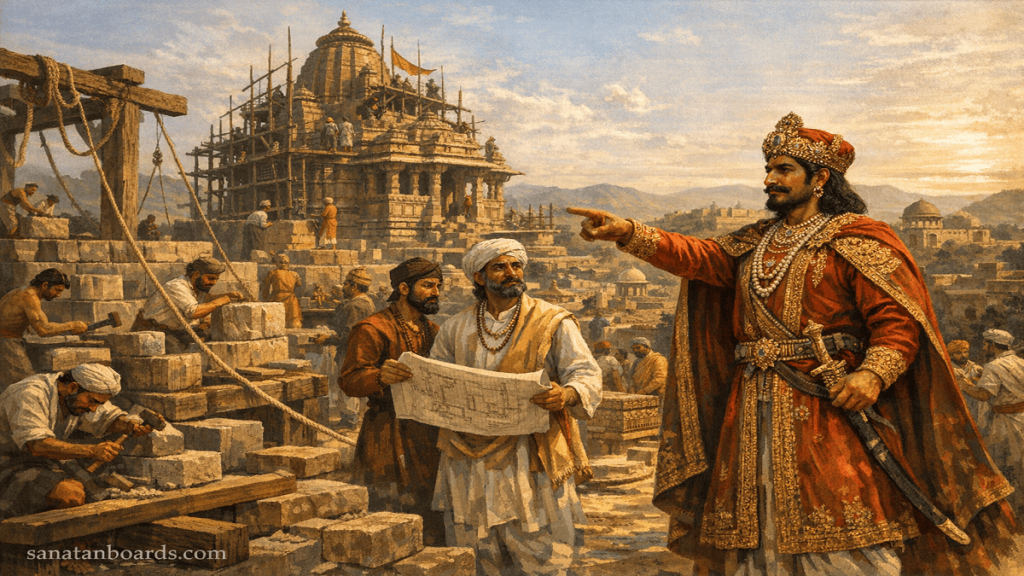
Case Study On King Bhoja (Paramara Dynasty, Malwa)
King Bhoja’s reign provides a compelling case study in the integration of political power, cultural patronage, and intellectual leadership. His governance illustrates how a ruler can maintain stability while fostering scholarship, arts, and scientific progress.
Militarily, Bhoja defended Malwa against neighboring threats through strategic fortifications and alliances. The case study is required to examine how these measures preserved regional autonomy while creating conditions for economic and cultural growth.
Administratively, Bhoja implemented systems for law, justice, and civic welfare. The case study is required to demonstrate how effective administration reinforced social trust, enabled economic prosperity, and promoted public infrastructure development. These administrative practices offer modern lessons in governance and policy implementation.
Culturally, Bhoja’s court became a center of learning. Scholars, poets, and architects were commissioned to produce works that enriched literature, science, and art. Texts like Samarangana Sutradhara are required as examples of architectural innovation, engineering expertise, and urban planning. The case study highlights how Bhoja’s intellectual patronage fostered creativity and preserved knowledge across generations.
Economically, Malwa under Bhoja benefited from trade and resource management. This period is required to examine how economic stability #kingbhojaomalwa supports cultural and intellectual advancement. Bhoja’s approach demonstrates the interconnectedness of governance, economy, and education, making his reign a relevant case study for interdisciplinary research.
White Paper On King Bhoja (Paramara Dynasty, Malwa)
Introduction
King Bhoja, ruler of the Paramara dynasty in Malwa during the early 11th century, represents a model of integrated leadership that combines governance, intellectual patronage, and cultural development. His reign, centered in Dhar, provides a unique case study of how medieval Indian monarchs could foster political stability while encouraging education, literature, science, and arts. This white paper analyzes Bhoja’s contributions, methodologies, and their relevance to modern governance, education, and cultural preservation.
Governance and Administration
King Bhoja implemented a multifaceted system of governance. His administrative policies emphasized justice, law enforcement, and public welfare. He maintained revenue systems to ensure sustainable economic growth and invested in infrastructure such as roads, forts, and water management systems. Bhoja’s governance demonstrates a balance between centralized authority and local administration, which ensured political stability in a region often challenged by neighboring kingdoms.
From a strategic perspective, Bhoja fortified Malwa and established alliances to safeguard the kingdom. His military preparedness was complemented by diplomacy, reflecting an understanding that sustainable governance requires both force and negotiation. These methods are relevant today for leadership models that balance security with societal development.
Cultural and Intellectual Patronage
Bhoja’s reign was marked by extensive support for scholarship, literature, and architecture. His court hosted poets, scientists, physicians, and architects, transforming Dhar into a hub of intellectual activity. Bhoja himself authored texts across disciplines, from architecture (Samarangana Sutradhara) to medicine and music. This patronage not only elevated Malwa’s cultural profile but also created a repository of knowledge that continues to inform modern studies.
The white paper highlights how Bhoja’s approach to cultural patronage reflects a broader principle: that knowledge and governance are mutually reinforcing. Investment in education and the arts strengthened societal cohesion, inspired innovation, and enhanced the kingdom’s prestige.
Economic and Strategic Insights
Economically, Malwa benefited from Bhoja’s strategic location on trade routes connecting northern and western India. His administration leveraged these routes to encourage commerce, resource management, and taxation policies that supported both the state and cultural initiatives. The integration of economic planning with cultural investment is a key lesson from Bhoja’s reign, showing how prosperity can underpin intellectual and artistic growth.
Modern Relevance
King Bhoja’s model has enduring relevance. Leadership that combines ethical governance, strategic planning, and cultural investment can inform modern public administration, educational policy, and urban planning. The white paper argues that Bhoja’s emphasis on holistic development—balancing military security, administration, economic planning, and intellectual patronage—is a framework applicable in contemporary leadership and policy studies.
Conclusion
King Bhoja’s reign illustrates the synergy of governance, culture, and knowledge. By analyzing his methods, policies, and achievements, #Sanatandharmaaccreditationboardsinvasai this white paper demonstrates the timeless value of integrated leadership and offers insights for scholars, policymakers, and cultural institutions seeking sustainable and enlightened development models.
Industry Application: King Bhoja (Paramara Dynasty, Malwa)
Introduction
King Bhoja’s methods in governance, culture, and intellectual patronage provide valuable lessons for modern industry applications, particularly in education, architecture, public administration, and cultural management. His reign demonstrates how leadership can foster innovation, knowledge creation, and sustainable development—principles applicable across sectors today.
Education and Knowledge Management
Bhoja’s patronage of scholars, poets, and scientists in his court provides a model for educational institutions and research organizations. His approach encourages multidisciplinary learning, combining arts, science, architecture, and philosophy. Modern universities and think tanks can apply Bhoja’s methods by promoting research hubs, interdisciplinary projects, and knowledge-sharing networks, ensuring that innovation is grounded in historical insights while addressing contemporary challenges.
Architecture and Urban Planning
The architectural principles in Bhoja’s Samarangana Sutradhara provide insights for modern urban planners, architects, and engineers. His integration of aesthetics, functionality, and environmental considerations can inform sustainable city planning, heritage conservation, and adaptive reuse of historical structures. Contemporary industries in construction, engineering, and urban development can apply Bhoja’s focus on durability, resource optimization, and structural innovation.
Public Administration and Governance
Bhoja’s administrative strategies are applicable in modern governance and corporate management. His balance of law enforcement, economic planning, and public welfare illustrates ethical leadership principles that are critical for both government agencies and large organizations. Policies promoting transparency, resource management, and civic engagement can draw inspiration from Bhoja’s integrated approach, emphasizing long-term stability and societal benefit.
Cultural and Heritage Management
The preservation of Bhoja’s monuments, texts, and intellectual contributions demonstrates how cultural heritage can be leveraged for education, tourism, and economic development. Industries in cultural management, museums, and media can apply Bhoja’s model by curating educational programs, digital archives, and exhibitions that highlight historical knowledge and inspire public engagement.
Innovation and Research Applications
Bhoja’s synthesis of military, administrative, and cultural knowledge illustrates principles of innovation that industries can emulate. For example, research and development teams can integrate cross-disciplinary insights, much like Bhoja integrated arts, science, and governance. Industries such as technology, education, and engineering can apply these strategies to promote creativity, efficiency, and problem-solving rooted in historical lessons.
Conclusion
King Bhoja’s reign offers a framework for modern industry application by emphasizing the integration of knowledge, governance, and innovation. From education and #Sanatandharmaaccreditationboardsinmumbai architecture to cultural management and governance, his principles demonstrate how leadership and intellectual investment can drive sustainable growth, innovation, and societal advancement. By applying these lessons, contemporary industries can bridge history with modern practice, ensuring that knowledge and culture remain central to progress.
source Success Plus Academy
ASK FAQ
Who was King Bhoja of the Paramara dynasty?
King Bhoja was a 11th-century ruler of the Paramara dynasty in Malwa, known for his military strength, administrative skills, and remarkable contributions to literature, architecture, and learning.
When did King Bhoja rule Malwa?
King Bhoja ruled Malwa approximately from 1010 CE to 1055 CE, a period known for cultural and intellectual growth in central India.
What are the major contributions of King Bhoja?
King Bhoja contributed to Sanskrit literature, architecture, and sciences. His famous work Samarangana Sutradhara details architecture, urban planning, and engineering practices.
Where was King Bhoja’s kingdom located?
King Bhoja ruled the Malwa region, with Dhar as the capital. Malwa, in present-day western Madhya Pradesh, became a center of culture and learning under his reign.
Why is King Bhoja considered a scholar-king?
He is considered a scholar-king because he combined governance with intellectual pursuits, authored multiple scholarly works, and patronized poets, scientists, and architects.
Table of Contents
Disclaimer:
The information presented in this blog about KING BHOJA (PARAMARA DYNASTY, MALWA) is provided for informational, educational, and research purposes only. While every effort has been made to ensure accuracy, historical interpretations may vary, and some details may be based on scholarly research, legends, or regional accounts. This content is not intended as professional, legal, or financial advice. Readers are encouraged to consult primary sources, academic references, or experts for verification or further study.