
KARIKALA CHOLA was one of the most famous early rulers of the Chola dynasty, an ancient South Indian empire known for its military strength, cultural achievements, and architectural innovations. This legendary monarch is remembered for a reign that transformed early South Indian history. The Cholas, who began as a small kingdom in the fertile Kaveri plains, rose to prominence under such visionary leadership, laying the foundation for centuries of regional influence and interstate power
The precise dates of The Chola king reign are debated among historians, but most estimates place him in the late Sangam period, around the 1st and 2nd century CE. He is mentioned in many early Tamil literary works, including the Sangam poems, which praise his bravery, administrative skills, and victories in battle. KARIKALA CHOLA is credited with leading successful military campaigns that extended the influence of the Chola kingdom beyond its original heartland, strengthening the political unity of the Tamil region.
Beyond warfare, The Chola king legacy is deeply connected with major infrastructural achievements. Most notably, he is traditionally regarded as the king who ordered the construction of the Grand Anicut (Kallanai) on the Kaveri River — one of the oldest water-regulation structures still in use today. This dam not only helped irrigate large tracts of farmland but also contributed to agricultural prosperity and rural stability.
KARIKALA CHOLA stands as a symbol of early statecraft in South India — a ruler whose vision blended military prowess with civic development. His story remains an enduring part of South Indian history and Tamil heritage.
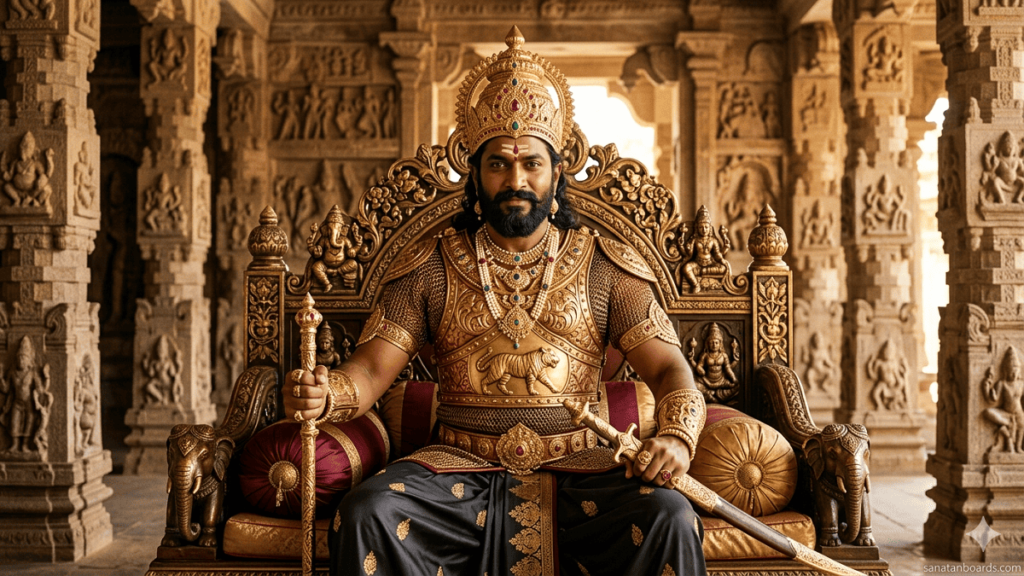
What Is Karikala Chola ?
The name KARIKALA CHOLA is associated with one of the earliest and most influential kings of the Chola dynasty, a kingdom that later rose to great power in South India. ‘Karikala’ is believed to mean ‘slayer of enemies,’ highlighting his reputation as a formidable warrior. Unlike modern leaders, this sovereign ruler also acted as a unifying force, shaping the socio‑political landscape of the region during his era
In the context of ancient Indian history, KARIKALA CHOLA is best understood as a regional monarch whose leadership significantly influenced the development of Tamil polity and culture. He is celebrated for strengthening the Chola kingdom, expanding its territories, and enhancing the kingdom’s administrative capabilities. His reign is often considered a turning point when the Cholas began transitioning from a local dynasty to a prominent power in southern peninsular India.
KARIKALA CHOLA’s role extended beyond battles and conquest. He oversaw strategic public works that improved water management and agriculture, which were central to the economy of his river‑based kingdom. The Grand Anicut on the Kaveri River is the most cited testament to his vision — a large dam built to regulate water flow and support irrigation.
Thus, KARIKALA CHOLA is not merely a name in history; he represents a blend of military strength, effective governance, and civic innovation. His legacy shaped not only the Chola dynasty’s future successes but also set precedents in infrastructure and social leadership that influenced subsequent generations.
Who Is Required Karikala Chola ?
When considering who should study KARIKALA CHOLA, the focus is on those who seek to understand his life and enduring legacy. His relevance spans a wide audience, including historians, scholars of culture, civil engineers, and modern leaders looking for lessons in governance and strategic planning.
Firstly, historians and authors who specialize in South Asian or Indian history require an understanding of This monarch because his reign represents a foundational period in early South Indian dynastic politics. His military campaigns and governance style are essential components in reconstructing the political geography of ancient Tamilakam (ancient Tamil region).
Secondly, scholars of literature and culture use references to KARIKALA CHOLA found in Sangam literature to explore early Tamil language, poetry, and societal norms. The Sangam texts in which he appears are among the earliest literary records from South India, giving researchers material to study ancient Tamil beliefs, values, and aesthetics.
Thirdly, civil engineers and environmental planners may find relevance in This monarch because of the Grand Anicut. Studying how ancient rulers approached water management sheds light on sustainable engineering practices that remain valuable today.
Finally, educators and learners from general backgrounds require knowledge about This monarch to appreciate how regional leadership influenced broader Indian civilization. His story is not isolated — it connects to themes of leadership, resource management, and societal progress.
Thus, people across disciplines require This monarch not just as a historical name, but as a case study in governance, infrastructure, and cultural influence.
When Karikala Chola Is Required ?
Understanding when KARIKALA CHOLA is required involves identifying the specific time period and historical context in which his influence became significant — as well as when his legacy continues to be relevant.
KARIKALA CHOLA is associated with the early centuries of the Common Era, particularly around the late first century CE or the second century CE. While exact dates are debated, historians generally agree that his reign occurred during the later part of the Sangam age — an era marked by rich Tamil literature, dynamic inter‑kingdom rivalries, and evolving political structures in South India.
During this period, South Indian kingdoms such as the Cholas, Cheras, and Pandyas competed for territorial control, trade advantages, and cultural dominance. KARIKALA CHOLA’s leadership stands out in this turbulent context because he successfully consolidated power, extended Chola influence into neighboring regions, and provided stability during a time of frequent conflict.
The era in which KARIKALA CHOLA lived was also transformative for agriculture and urban development. The fertile valleys of the Kaveri River were central to economic life, and effective water management became critical for rice cultivation — the backbone of food production. It was during this time that KARIKALA CHOLA is credited with building the Grand Anicut, a massive stone dam that helped regulate irrigation and ensured agricultural consistency for successive generations.
The “when” extends beyond his lifetime — KARIKALA CHOLA remains significant today whenever there is a need to explore ancient governance approaches, water conservation, and the historical roots of Tamil culture. Modern scholars refer back to his reign when studying how early kingdoms managed resources without modern technology, or how leadership influenced literary and cultural expression.
Additionally, institutions that focus on heritage conservation reference his era when contextualizing early South Indian structural ingenuity. Engineers studying historical dams or sustainable water systems often look at the time of KARIKALA CHOLA for inspiration and comparative analysis.
Where Karikala Chola Is Required ?
The significance of KARIKALA CHOLA can be located across both geographical and thematic spaces — in ancient landscapes, in historical records, and in institutions where his legacy continues to be relevant.
Geographically, KARIKALA CHOLA’s influence was centered in South India, primarily around the fertile plains of the Kaveri River in what is now the Indian states of Tamil Nadu and Kerala. It was in this region that the Chola kingdom first emerged, grew in prominence, and expanded under his leadership. The river basin was central to agricultural life, trade routes, and population centers. The construction of the Grand Anicut across the Kaveri near present‑day Tiruchirappalli serves as a permanent geographical reminder of his reign.
However, KARIKALA CHOLA’s relevance is not confined to a single locality. His story is required across multiple academic, cultural, and professional spaces:
- Historical research centers and universities where South Asian history is studied.
- Archaeological sites and museums that display artifacts, inscriptions, and cultural materials from the early Chola period.
- Engineering faculties and water resource departments that analyze ancient hydraulic structures and sustainable management techniques.
- Literary institutions focusing on Sangam poetry and early Tamil literature where references to his life and times provide insight into ancient society.
In addition, KARIKALA CHOLA is required in regional cultural consciousness in Tamil Nadu. Festivals, folklore, and local traditions often reference his achievements, keeping his legacy alive within community memory.
Beyond India, scholars of world history also reference his reign when comparing early state formation, infrastructure development, and leadership across civilizations.
How Karikala Chola Is Required ?
Historical Analysis: Historians require KARIKALA CHOLA as a subject for reconstructing political chronologies, understanding warfare strategies, and comparing leadership norms. By examining inscriptions, ancient texts, and literary works like the Sangam poems, scholars piece together the structural elements of his reign.
Literary Interpretation: Scholars of Tamil literature engage with references to KARIKALA CHOLA in ancient poems to explore how poets depicted kingship, valor, and social responsibility. Through literary criticism and translation work, his figure becomes a lens for understanding cultural values of the time.
Infrastructure & Engineering Studies: KARIKALA CHOLA’s association with the Grand Anicut allows modern engineers to study ancient dam construction techniques. By analyzing stone alignment, water flow patterns, and long‑term durability, professionals learn how ancient societies solved environmental challenges.
Cultural Legacy: Through oral histories, regional traditions, and public memory, KARIKALA CHOLA is commemorated not just as a historical figure but as a source of identity for communities in Tamil Nadu.
Educational Curricula: Schools and colleges include his life and achievements in history syllabi, providing students with narratives about early Indian polity and resource management.
Public History & Tourism: Museums and heritage sites featuring information about KARIKALA CHOLA attract visitors, blending leisure with learning.
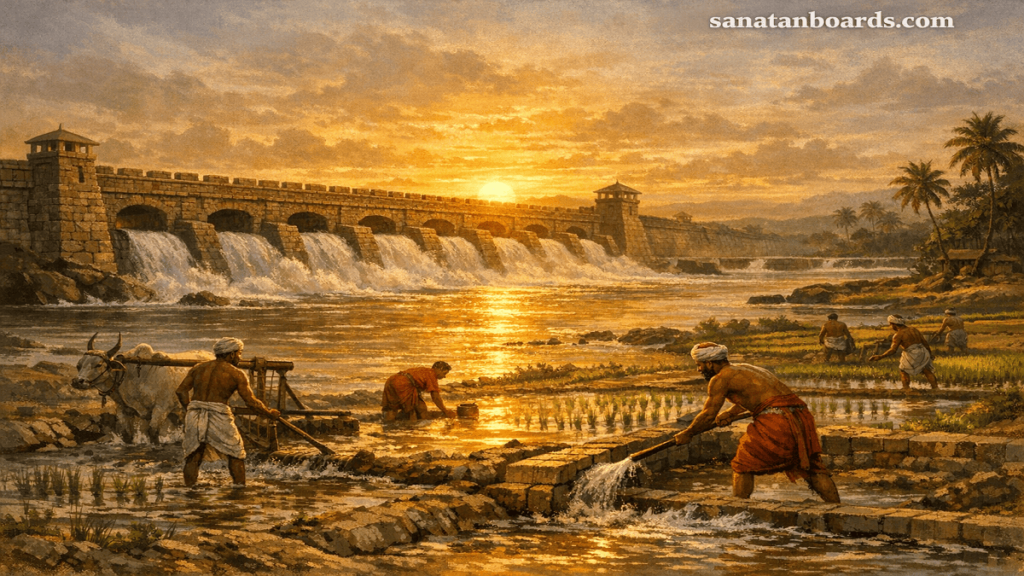
Case Study On Karikala Chola
The Grand Anicut (Kallanai): A Strategic Legacy of KARIKALA CHOLA
One of the most remarkable and enduring achievements associated with KARIKALA CHOLA is the construction of the Grand Anicut, locally known as Kallanai. This massive stone dam, built across the Kaveri River in present‑day Tamil Nadu, stands as one of the oldest water‑regulation structures still in use anywhere in the world. The project provides a powerful case study in ancient engineering, sustainable resource management, and socio‑economic development under monarchic leadership.
Historical Background
During KARIKALA CHOLA’s time — roughly around the 1st or 2nd century CE — agriculture formed the backbone of the regional economy. The Kaveri River basin was fertile land that supported widespread rice cultivation and rural settlements. However, the river’s seasonal fluctuations posed challenges: intense monsoon flows followed by dry months could damage crops or leave fields parched. A permanent solution was needed — one that would protect farmland, ensure consistent irrigation, and stabilize the livelihoods of farming communities.
Existing historical records, including references from early Tamil literature and inscriptions, suggest that KARIKALA CHOLA recognized both the challenge and the opportunity. Rather than depending solely on natural rainfall or small embankments, he envisioned a large‑scale, durable dam that could regulate water throughout the year.
Engineering Design and Construction
The Grand Anicut was constructed using massive blocks of unhewn stone, fitted together without mortar — a technique that required precise placement and deep understanding of hydraulics. Stretching across the Kaveri River near present‑day Tiruchirappalli, the dam diverted water into canals feeding agricultural lands on either side of the river.
Key engineering principles that made the project successful included:
- Optimal Placement: Built at a location where the river’s flow could be easily channeled into distributary canals.
- Structural Stability: The use of weight‑based stone construction allowed the dam to remain intact against strong monsoon currents.
- Sustainable Design: Rather than blocking the river entirely, the dam regulated and distributed water in a controlled manner, ensuring both irrigation and ecological balance.
Though precise records are limited, the effectiveness of this design is evident from the fact that the structure — with periodic maintenance through successive regimes — continues to function after nearly two millennia.
Socio‑Economic Impact
The construction of the Grand Anicut had transformative effects on society at the time:
- Agricultural Expansion: Reliable water supply led to increased rice production, higher yields, and cropping cycles that were less dependent on unpredictable rainfall.
- Population Stability: With agriculture stabilized, villages flourished, trade expanded, and the region became economically more resilient.
- Technological Adaptation: The techniques pioneered in this project influenced later water‑management systems throughout South India.
The project also reflected KARIKALA CHOLA’s broader governance philosophy — one that connected infrastructure development with social welfare and economic stability. By prioritizing a project that directly benefited agrarian communities, the king strengthened social cohesion and enhanced his own legitimacy.
Legacy and Lessons
The Grand Anicut’s endurance has made it a subject of ongoing scholarly study. Hydrologists and engineers examine its design as an example of #sanatandharmaaccreditationboardsinsouthindia ancient ingenuity, while historians view it as evidence of early state‑level planning and investment in public works.
White Paper On Karikala Chola
Executive Summary
This white paper examines the reign of KARIKALA CHOLA through the dual lenses of leadership and resource governance. Emphasizing the historical evidence surrounding his achievements, particularly the Grand Anicut project, it draws insights relevant to contemporary policymakers, planners, and scholars interested in sustainable development models rooted in historical experience.
Introduction
KARIKALA CHOLA is a figure emblematic of early South Indian governance that combined military strength with strategic civic initiatives. His reign is illustrative of how monarchs of ancient civilizations addressed core challenges — from defending territory to securing stable agricultural systems.
Leadership and Strategic Vision
Leadership under KARIKALA CHOLA was marked by clear strategic priorities:
- Territorial Stability: Military campaigns consolidated Chola influence, stabilizing borders and reducing external threats.
- Economic Growth: By enhancing agricultural infrastructure, he stimulated economic productivity.
- Social Welfare: His focus on public works reflected an understanding that societal well‑being underpins state longevity.
This model contrasts with contemporary views that sometimes separate military power from civic development — KARIKALA CHOLA integrated both.
Water Management as Economic Foundation
The Grand Anicut stands at the center of this analysis:
- Environmental Adjustment: Rather than attempting to control nature by force, the structure modulated water flow to benefit agriculture.
- Community Impact: The dam supported irrigation for broad geographic regions, reducing drought risk and enhancing food security.
- Engineering Durability: Its survival demonstrates the effectiveness of simple yet robust design principles.
These aspects reveal how infrastructure can act as a catalyst for long‑term economic resilience.
Institutional Implications
KARIKALA CHOLA’s reign suggests key institutional takeaways:
- Integrated Planning: Combining strategic defense with economic infrastructure creates stability.
- Resource‑Focused Governance: Prioritizing essential resources such as water can elevate overall socio‑economic conditions.
- Legacy Orientation: Projects must be designed not merely for short‑term gain but for long‑term impact.
Conclusions
KARIKALA CHOLA’s leadership offers a historical template for governance that remains relevant in modern contexts. His emphasis on infrastructure, sustainability, #sanatandharmaaccreditationboardsinmumbai and societal benefit underscores the enduring importance of integrated planning.
Industry Application On Karikala Chola
1. Civil Engineering and Construction
The Grand Anicut continues to influence engineers studying dam design and water‑control systems. Its longevity demonstrates effective use of local materials, gravity‑based stability, and maintenance‑friendly construction—principles that inform modern sustainable engineering.
2. Water Resource Management
Water scarcity and seasonal irregularities are global challenges. KARIKALA CHOLA’s approach — building infrastructure that regulates natural flows while serving agricultural needs — provides a case study for:
- Watershed planning
- Community irrigation schemes
- Sustainable distribution of water resources
3. Agriculture and Food Security
By ensuring year‑round irrigation, the project enhanced food production and rural stability. Modern agricultural strategists can extract lessons in aligning infrastructure with crop cycles and land‑use planning.
4. Leadership Models for Public Administration
KARIKALA CHOLA exemplifies leadership that balances defense with large‑scale infrastructure. Public administrators today can draw parallels in budget prioritization, resource allocation, and long‑term planning.
5. Heritage Conservation and Tourism
The Grand Anicut remains a living heritage site, attracting visitors and scholars. Tourism industries benefit by preserving and presenting such landmarks, contributing to local economies while educating global audiences.
6. Academic Research and Education
Institutions that study history, engineering, and environmental science use KARIKALA CHOLA’s legacy to teach interdisciplinary lessons, encouraging students to bridge humanities and technical fields.
7. Policy Development
Policy planners in water governance and rural development can derive models from historical precedents — understanding how ancient leaders grappled with environmental and societal challenges.
source : Rajeev Ranjan Prasad
ASK FAQ
Who was KARIKALA CHOLA?
KARIKALA CHOLA was an early Chola king known for his military strength, administrative skills, and building the Grand Anicut on the Kaveri River, one of the oldest dams in the world.
What are the major achievements of KARIKALA CHOLA?
His major achievements include expanding the Chola kingdom, winning important battles, and constructing the Grand Anicut to improve irrigation and agriculture.
When did KARIKALA CHOLA rule?
KARIKALA CHOLA is believed to have ruled during the late Sangam period, around the 1st to 2nd century CE.
Where is the legacy of KARIKALA CHOLA visible today?
His legacy is visible in South India, especially Tamil Nadu, through the Grand Anicut, references in Sangam literature, and cultural memory.
Why is KARIKALA CHOLA important in history?
He is important for his leadership, contributions to irrigation, economic development, and lasting impact on South Indian culture and governance.
Table of Contents
DESCRIPTION
This entire blog on KARIKALA CHOLA has been prepared to offer structured, detailed, and informative knowledge across multiple dimensions — from historical context and case studies to modern relevance and industry applications. It is crafted for learning, understanding, and gaining deeper insight into an influential figure and legacy of ancient South Indian history.