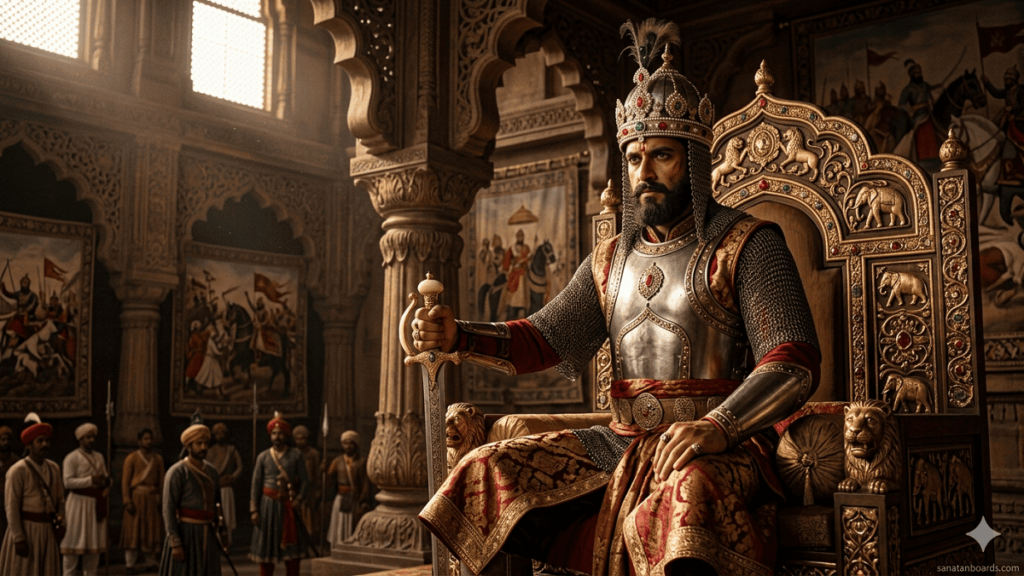
Jayachandra (sometimes anglicized as Jayachchandra or popularly known in later lore as Jaichand) was a significant ruler in northern India in the late 12th century CE. He belonged to the Gahadavala dynasty, one of the prominent Rajput lineages that held sway in the fertile Gangetic plains during the medieval period. Jayachandra’s reign extended from 1170 until his death in 1194 CE, with his power base centered in the powerful city of Kannauj (ancient Kanyakubja) and also including Varanasi (Kashi) and surrounding regions of present‑day Uttar Pradesh and parts of Bihar.
As a king, Jayachandra carried grand royal titles and was regarded as a patron of culture, religion, and learning. Inscriptions show him performing traditional Rajput rituals and supporting religious institutions, reflecting his role as both a warrior king and a ceremonial leader of his people. His era was marked by political competition among rival Rajput houses and growing external threats from invading forces in the northwest.
In later Indian folk memory, Jayachandra became widely known — and often caricatured — as a rival of the celebrated Rajput ruler Prithviraj Chauhan. In the legendary epic Prithviraj Raso, he is depicted as bitterly opposed to Prithviraj and resistant to alliance or cooperation. This narrative portrays Jayachandra in uniquely negative terms, ultimately branding him (in folklore) as a traitor for allegedly failing to unite against foreign invasions. However, historians note that much of this dramatic rivalry tale is drawn from later epic traditions rather than contemporary evidence.
What Is Jayachandra (Kannauj, Rival Of Prithviraj Chauhan) ?
Jayachandra was the king of the Gahadavala dynasty, ruling a strategic area of the northern Indian plains that included important cities along the Ganges. His reign followed that of his father Vijayachandra and Jayachandra inherited both political power and the responsibility of defending his kingdom during a turbulent era marked by shifting alliances and increasing external pressures.
The Gahadavala dynasty was among several Rajput clans that dominated northern India in the centuries after the decline of earlier imperial powers. Kannauj, Jayachandra’s seat, had historic prestige as a center of power since ancient times, though by the 12th century it was no longer the foremost capital of pan‑Indian empires — still, it remained symbolically important.
Jayachandra is perhaps best known in popular culture for his association with Prithviraj Chauhan, the Chauhan king who ruled from Ajmer and Delhi to the west. While historical sources confirm that both kings were contemporaries and both powerful rulers within their respective regions, the specific details of their rivalry have been clouded by later literary sources and folklore. In the Prithviraj Raso, Jayachandra is portrayed as refusing cooperation with Prithviraj and even opposing him regarding the marriage of his daughter Sanyogita — a story that has inspired dramatic retellings in Indian popular culture.
Modern historians often distinguish between the historical Jayachandra — an important regional king with real inscriptions and political actions — and the legendary Jayachandra of epic fame, noting that some aspects of his reputation derive from texts composed centuries after his lifetime
Who Is Required Jayachandra (Kannauj, Rival Of Prithviraj Chauhan) ?
To understand who Jayachandra was, it helps to recognize his social and political context. Jayachandra was born into the Gahadavala clan, a Rajput lineage that had established control over significant territories in northern India during the 11th and 12th centuries. He succeeded to the throne in 1170 CE, taking on both administrative duties and the defense of his realm.
As king, he embodied the traditional roles expected of a Rajput ruler: leading armies, managing royal courts, performing religious ceremonies, and patronizing scholars and poets. Inscriptions from his reign indicate he valued ritual and culture, which was important for maintaining his dynasty’s legitimacy and influence.
What makes Jayachandra particularly notable in history — and in later cultural memory — is his tangential relationship with Prithviraj Chauhan, one of the most famous warriors of medieval India. These two kings were contemporaries, each ruling strong territories and each commanding considerable military forces. Their political interactions reflect the often competitive — and sometimes cooperative — dynamics among Rajput polities of the period.
In the famous but historically debated Prithviraj Raso, Jayachandra’s daughter Sanyogita is said to have fallen in love with Prithviraj, leading to ill will between the two kings. While this story is part of literary tradition rather than contemporary documentation, it illustrates how Jayachandra’s identity in popular culture has been shaped as much by legend as by facts
When Jayachandra (Kannauj, Rival Of Prithviraj Chauhan) Is Required ?
Jayachandra’s reign spanned 1170 to 1194 CE, a crucial period in northern Indian history — years that witnessed shifting balances of power among Rajput dynasties and increasing pressure from invading forces from Central Asia.
During this era, the Indian subcontinent was not united under a single political authority, but rather divided among numerous regional powers. Rajput clans such as the Gahadavalas, Chauhans, Chandelas, and others were powerful in their respective spheres. Competition over territories and prestige was common. Kannauj, Jayachandra’s capital, was not only strategically positioned but also carried historical prestige as a city that experienced centuries of struggle among different empires before his time.
The late 12th century saw notable military activity in northern India. Simultaneously, rising threats from the Ghurid dynasty under leaders like Muhammad Ghori were beginning to impact the region more forcefully. Prithviraj Chauhan’s conflicts with Muhammad Ghori around the battles of Tarain (1191 and 1192 CE) are among the best‑known episodes from this period. Jayachandra’s own interactions with these larger forces are part of the broader narrative of Rajput responses to the looming invasions.
Historical evidence shows Jayachandra died in 1194 CE while engaging a Ghurid army led by Qutb ud‑Din Aibak near the Yamuna River. This battle marked not only the end of his personal rule but also a turning point for the Gahadavala dynasty itself. After his death, his successors were unable to retain the same political strength, and the dynasty eventually faded amidst the changing political landscape of northern India.
Though the dramatic episodes of rivalry with Prithviraj (such as Sanyogita’s elopement) are rooted in later tradition, the timeline of Jayachandra’s reign — situated at a moment of crucial change — makes his life a useful lens for understanding the transition from independent Rajput kingdoms to the era of larger incursions and political reconfiguration in the Indian subcontinent.
Where Jayachandra (Kannauj, Rival Of Prithviraj Chauhan) Is Required ?
1. Geographical and Political Location
Jayachandra was king of the Gahadavala dynasty, ruling the Antarvedi region of northern India from Kannauj and Varanasi (in present‑day Uttar Pradesh) between 1170 and 1194 CE. His kingdom included important cities like Kanyakubja (Kannauj) and Kashi (Varanasi) and parts of what are now eastern Uttar Pradesh and western Bihar.
Kannauj was strategically significant in medieval Indian politics — at various earlier times it had been the object of fierce competition among major dynasties, making its control a marker of prestige and power.
2. Historical Setting of His Reign
Jayachandra’s reign came at a time when the Indian subcontinent was made up of competing regional powers rather than a single empire. His realm lay broadly east of the Chauhan kingdom (ruled by Prithviraj Chauhan, based in Ajmer and Delhi). The two ruled large neighboring territories and shared political interests, but also had motives for rivalry and territorial caution, typical of feudal polities of that age.
3. Cultural and Literary Context
Over centuries, Jayachandra has not only remained an item in regional history books but also became a character in popular literature and epics, especially the Prithviraj Raso — a later‑dated poetic text that dramatizes his life and feud with Prithviraj. This text is historically debated but has shaped cultural memory of Jayachandra as a figure associated with romantic tragedy and political conflict.
4. Historical Interpretation vs Myth
Modern historians and scholars caution that the Prithviraj Raso’s version of Jayachandra’s rivalry with Prithviraj — including episodes like the Sanyogita elopement — emerged well after his time and is not witnessed in contemporary sources. Therefore, where Jayachandra truly stands is both in historical fact and in mythic narrative: as a major northern Rajput ruler with inscriptions and records, and later as a dramatic figure influenced by storytelling traditions.
How Jayachandra (Kannauj, Rival Of Prithviraj Chauhan) Is Required ?
1. Administration and Kingship
Jayachandra became king in 1170 CE after the death of his father Vijayachandra. He inherited a sizeable realm that included Kannauj and Varanasi, both politically important cities in the medieval north Indian plains. As king, he carried grand titles reflecting his authority over cavalry, infantry, and elephants (a Ram Rajput attribute).
His court maintained cultural activities and patronized scholars and religious institutions, indicating that he was not just a warrior but also a ruler invested in sustaining ritual, culture, and learning within his kingdom.
2. Military Responsibilities
During his reign, northern India was not at peace. Independent Rajput houses often competed and occasionally clashed while also confronting external invasions. Jayachandra’s military role involved defending his territory from incursions and asserting his influence regionally. Though not always in direct large‑scale wars with Prithviraj Chauhan, their domains were strategically close enough for military awareness and tension.
3. Relationship with Prithviraj Chauhan
While legend claims a personal feud stemming from Jayachandra’s daughter’s marriage to Prithviraj, historians emphasize that there is no contemporary evidence for that dramatic tale — the Prithviraj Raso was written much later and blends myth with history.
The real friction between Jayachandra and Prithviraj likely came from political rivalry — both were powerful rulers whose ambitions and interests sometimes overlapped in the shifting landscape of 12th‑century India.
4. End of Reign
In 1194 CE, Jayachandra’s reign ended when he was killed in battle against the invading Ghurid forces led by Qutb ud‑Din Aibak — a key general of Muhammad Ghori — near the Yamuna River. This battle marked a turning point in the decline of independent Rajput realms in the face of foreign incursions.
5. Legacy
Historically, Jayachandra remains a symbol of regional kingship on the eve of major sociopolitical change in India. Culturally, he is remembered through epic narratives that highlight personal and political drama, though historians caution against conflating those with verified history.
Case Study On Jayachandra
Context and Background
Jayachandra ascended the throne of the Gahadavala dynasty in 1170 CE, inheriting a realm that included the important cities of Kannauj and Varanasi, strategic centers in the fertile Gangetic plains.
The Gahadavala administration was structured around traditional Rajput ideals of kingship — combining military leadership with religious and cultural patronage. Jayachandra adopted titles such as Ashva‑pati (master of cavalry) and Gaja‑pati (master of the elephant corps), signaling his role as a warrior sovereign.
Internal Challenges
During his reign, Jayachandra had to manage not only external security but also internal administration. The Gahadavala kingdom was a feudal polity with complex ties to local chieftains, feudal landlords, and religious authorities. Preserving loyalty and ensuring efficient governance required constant diplomacy and ritual legitimacy, which Jayachandra attempted through public ceremonies and temple patronage.
External Pressures
The late 12th century saw growing invasions from Central Asia, particularly by the Ghurid dynasty. While other powerful Rajput leaders such as Prithviraj Chauhan engaged in direct military confrontation with invaders like Muhammad Ghori, Jayachandra faced the challenge of protecting his northern and eastern territories from similar threats.
The historical record does not present an explicit alliance between Jayachandra and any invading force, despite later narratives suggesting otherwise. Modern historians point out that such claims — particularly the allegation that Jayachandra invited Ghori against Prithviraj — appear in later texts written centuries after the events.
Military Engagements
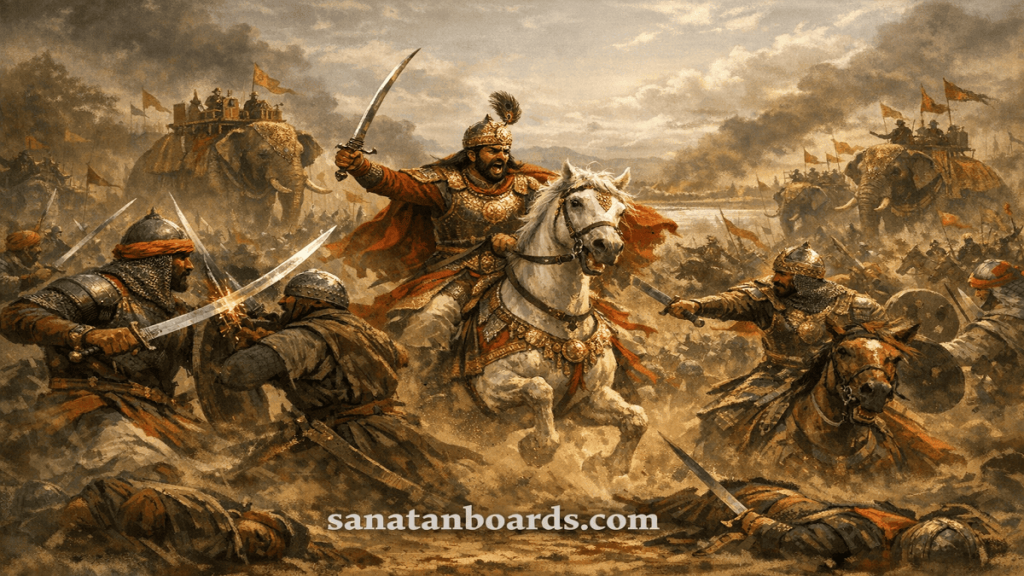
The most significant recorded military confrontation at the end of Jayachandra’s reign was his battle against the forces of Muhammad Ghori, led by his general Qutb ud‑Din Aibak, in 1194 CE. In this encounter near the Yamuna River, Jayachandra was defeated and killed, ending his dynasty’s prominence.
This battle, while a tragic end for Jayachandra, highlights the broader transitional phase of Indian history in which regional Rajput powers faced sustained pressure from well‑organized, external military forces with centralized command and cavalry tactics that differed from traditional Rajput methods.
Narrative and Myth
Jayachandra’s historical image became deeply entangled with legend through works like the Prithviraj Raso — a medieval epic attributed to Chand Bardai, which romanticizes the feud between Jayachandra and Prithviraj Chauhan. According to this tale, the rivalry was intensified by the dramatic love story of Jayachandra’s daughter Sanyogita and Prithviraj; however, scholars argue the story reflects literary embellishment rather than documented fact.
As a result, Jayachandra’s name became associated with betrayal and internal conflict, overshadowing his role as a regional monarch responding to complex political challenges.
Lessons from Jayachandra’s Rule
- Complexity of Medieval Polities
Jayachandra’s reign illustrates the fragmented and multilayered nature of regional power structures in 12th‑century India. Multiple kingdoms — from the Gahadavalas in the east to the Chauhans in the west — operated independently, creating opportunities for both rivalry and occasional coordination. Modern analysis shows that conflict or non‑assistance among these powers was influenced by political pragmatism as much as personal rivalry. - Myth vs History
The Prithviraj Raso-type narratives show how legend and literature can shape collective memory — often conflating personal drama with political events. Jayachandra’s portrayal as a “traitor” is now widely challenged by historians, demonstrating how historical reputations can be reshaped over time. - Military Evolution
Jayachandra’s defeat against the Ghori forces reflects the broader evolution of warfare in the period — where deeply entrenched regional power systems were confronted by more mobile, mounted archers and organized cavalry forces from Central Asia. This reshaped the military landscape of northern India.
Conclusion of Case Study
Jayachandra’s life and reign provide a rich example of how a regional monarch navigated internal administration, feudal alliances, external pressures, military #jayachandrakannauj challenges, and cultural legacies — all while leaving a long‑lasting imprint on history, culture, and later narratives.
White Paper On Jayachandra
Executive Summary
This white paper examines Jayachandra, the 12th‑century monarch of the Gahadavala dynasty based in Kannauj and Varanasi, his historical context, political significance, and the evolution of his legacy over time. It separates documented history from later legend, providing a clear, research‑oriented analysis of his reign, geopolitical environment, military engagements, and cultural memory.
Introduction
Jayachandra (reign: 1170–1194 CE) was a prominent ruler in northern India during a period of intense regional competition and emerging external threats. While his name is commonly associated in popular culture with rivalry against Prithviraj Chauhan, a closer look at primary and secondary historical evidence reveals a more nuanced picture of his rule and legacy.
Historical Context
In the late 12th century, northern India was not unified under a single empire. Instead, multiple Rajput clans and regional dynasties shared, contested, and defended territories. These included the Gahadavalas in eastern Uttar Pradesh, Chauhans in Ajmer–Delhi, Chandelas further south, and others across the Indo‑Gangetic plains.
The Gahadavalas derived part of their legitimacy from controlling historically symbolic cities — especially Kannauj (Kanyakubja), a city with centuries of imperial history. Varanasi (Kashi), another key center, also held religious and educational importance. Jayachandra succeeded his father in this context, inheriting both political power and the challenge of navigating a competitive landscape of feudal alliances and rivalries.
Governance, Administration, and Statecraft
Jayachandra’s reign was marked by efforts to consolidate dynastic authority across his territories. From an administrative perspective:
- His titles (for example, Ashva‑pati meaning master of cavalry) suggest formal recognition of military command over key elements of a medieval army.
- Inscriptions and copper plates from his reign show grant‑making and patronage of temples and learned Brahmins, indicating an emphasis on ritual legitimacy and religious duty, central to Rajput statecraft.
- Governance involved interplay with feudal lords and local elites, typical of the decentralized political structures of the period.
Jayachandra’s model of leadership was thus both military and ceremonial — balancing warrior prerogatives with cultural patronage to reinforce authority.
Military Engagements and External Threats
While much of later storytelling emphasizes personal rivalry with neighboring rulers, actual evidence for direct tribal or dynastic conflict between Jayachandra and Prithviraj Chauhan is limited. The more significant external pressure faced by Jayachandra emerged from invasions from the northwest.
In 1194 CE, Jayachandra confronted forces of the Ghurid Empire, led by Muhammad Ghori’s general Qutb ud‑Din Aibak. In the battle near the Yamuna River, Jayachandra was defeated and killed. This marked not only the end of his life but also a decisive turn in the decline of independent northern Rajput states as new powers began to establish dominion.
Narrative vs History — Separating Legend from Evidence
One of the most enduring aspects of Jayachandra’s legacy is the story of his supposed rivalry with Prithviraj Chauhan — especially the dramatic episode involving his daughter and the idea that he betrayed his Hindu allies against foreign invaders.
While these narratives figure prominently in later literary works (such as the Prithviraj Raso), historians caution that such texts were written centuries after the events they describe. There is little contemporary evidence of personal betrayal or conspiracy. Instead, the historical record points to:
- Political competition, common among regional polities with overlapping interests
- Strategic non‑alignment, rather than personal treachery
- Conflict with powerful invaders (Ghurids) that reshaped politics across northern India
This distinction is critical for accurate historiography — it prevents later legendary projections from overshadowing nuanced understanding of medieval Indian politics.
Legacy and Importance
Jayachandra’s legacy has two major dimensions:
- Historical Significance
He symbolizes the last era of feudal Rajput rule in parts of northern India before large‑scale political reconfiguration. His defeat illustrates how military strategies and external pressures can transform foundational political structures. - Cultural Memory and Narrative Formation
Literary traditions that depict him as a rival or traitor, though historically questionable, have deeply influenced collective memory. Studying this helps #sanatandharmaaccreditationboardsinvasai scholars explore how history is shaped into myth and how social values and narratives evolve over time.
Conclusions
Jayachandra’s reign offers rich insight into:
- The political dynamics of 12th‑century India
- The complexity of feudal statecraft
- The interplay between history and narrative in cultural memory
- How shifts in military technology and #sanatandharmaaccreditationboardsinmumbai strategy can change political landscapes
Separating myth from recorded evidence allows for a more informed and nuanced understanding of Jayachandra’s role in Indian history.
Industry Application On Jayachandra
1. Strategic Leadership and Decision Making
Jayachandra ruled during a period of intense political flux. His choices — alliances, defense priorities, and cultural positioning — reflect the complexity of decision making under uncertainty.
Industry Connection:
Modern corporate and government leaders regularly face uncertain environments. Jayachandra’s situation exemplifies:
- Balancing internal stability with external threats
- When to engage allies vs. when to pursue independent strategies
- Understanding long‑term risk even when short‑term pressures dominate
His life shows that high‑stakes decisions rarely have perfect information, highlighting the importance of contingency planning — a cornerstone of modern strategic management.
2. Risk Assessment and Competitive Positioning
Jayachandra’s reign unfolded within a competitive ecosystem of Rajput dynasties. Like businesses in a market, his kingdom had competitors, potential partners, and shared threats.
Industry Insight:
Frameworks such as Porter’s Five Forces or modern strategic frameworks similarly encourage leaders to:
- Analyze competitive threats
- Evaluate barriers to collaboration
- Assess impacts of disruptive entrants (parallels to the Ghori invasions)
Understanding how historical actors responded — successfully or not — provides case material for risk modeling and competitive intelligence training.
3. Narrative and Reputation Management
One of the most famous aspects of Jayachandra’s legacy is his portrayal in legend — particularly stories framing him as a betrayer or antagonist to Prithviraj Chauhan.
Industry Connection:
This underscores the power of narrative shaping and reputation risk — a field crucial to:
- Brand management
- Corporate communications
- Political consulting
- Social media strategy
Modern organizations invest heavily in managing perception, not just performance. Jayachandra’s example illustrates how narratives can overshadow factual performance, becoming embedded in public consciousness for centuries.
4. Organizational Culture and Institutional Memory
Jayachandra, like other feudal rulers, operated within a system where ritual, symbolism, and tradition were part of governance. Cultural norms mattered as much as military might.
Industry Insight:
Today, organizational culture is recognized as a key driver of performance. Jayachandra’s reliance on ceremony and patronage — while subject to critique — reflects awareness of stakeholder expectations and identity formation within his realm.
Modern organizations can apply this to:
- Strengthen institutional identity
- Use cultural dynamics to engender loyalty
- Align symbolic actions with strategic goals
5. Historical Data for Scenario Planning
Studying transitions such as Jayachandra’s defeat by external forces aids scenario planning and historical simulation practices used today in:
- National security consultancy
- Global risk think tanks
- Defense strategy modeling
- Corporate scenario analysis
Historical precedent allows analysts to test assumptions about how complex systems behave under stress — invaluable in high‑stakes strategic forecasting.
6. Education, Content Creation, and Knowledge Industries
Finally, Jayachandra’s story has direct application in education, curriculum design, media, and entertainment industries:
- Textbook and academic curriculum development
- Documentaries and digital learning content
- Historical gaming and virtual reality experiences
- Fiction, film, and storytelling that blends history with narrative insight
His life supplies rich material for educational engagement — demonstrating how historical case studies become tools for learning across disciplines.
source : HISTORY Khabri
ASK FAQ
Who was Jayachandra of Kannauj?
Jayachandra was a 12th-century king of the Gahadavala dynasty, ruling Kannauj and Varanasi, known for his role as a contemporary and rival of Prithviraj Chauhan.
What was the rivalry between Jayachandra and Prithviraj Chauhan?
Historical sources suggest political rivalry over territories, while later legends describe personal enmity, especially around Jayachandra’s daughter Sanyogita.
When did Jayachandra rule Kannauj?
Jayachandra reigned from 1170 CE to 1194 CE, a period marked by regional conflicts and the threat of Ghurid invasions.
How did Jayachandra die?
Jayachandra was defeated and killed in 1194 CE during a battle against the invading forces of Muhammad Ghori, led by Qutb ud-Din Aibak.
Why is Jayachandra remembered in Indian history?
He is remembered as a significant Rajput ruler, a cultural patron, and for his legendary rivalry with Prithviraj Chauhan, which has influenced folklore and literature.
Table of Contents
Disclaimer
This content is written for educational and learning purposes, based on widely accepted historical evidence and scholarly interpretation. Legends, myths, and literary traditions surrounding Jayachandra are noted separately from documented history to promote clear understanding.