JAI SINGH II (JAIPUR, ASTRONOMICAL ADVANCEMENTS) stands as one of history’s most remarkable intersections of royal leadership and astronomical ambition. Born in 1688, Maharaja Sawai Jai Singh II was the ruler of the Kingdom of Amber, which later became the princely state of Jaipur. Beyond his political and architectural accomplishments, he harbored an intense interest in celestial phenomena at a time when global astronomy was advancing rapidly.
His passion was not merely symbolic — it resulted in concrete structures that allowed systematic observation of the heavens. By the early 18th century, Jai Singh observed that traditional astronomical tables used in India were increasingly mismatched with actual celestial positions. Driven by a desire for precise measurements and cultural prominence, he initiated the construction of large-scale observatories known today as “Jantar Mantar.”
These observatories were expansive stone and marble installations, equipped with gigantic instruments that enabled observers to measure time, track the movement of stars and planets, predict eclipses, and study celestial declinations, all without telescopes.
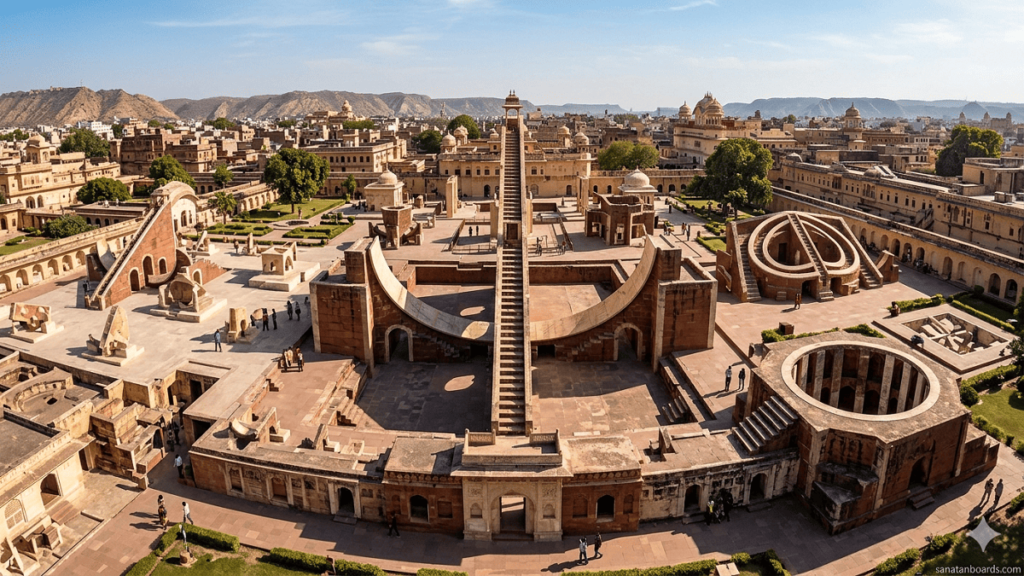
The observatory in Jaipur is the grandest of all those he commissioned and is a preserved testament to his vision. Known for housing the world’s largest stone sundial, this complex elevated Jaipur’s cultural and scientific identity while becoming a distinctive architectural hallmark. Designed with the collaboration of scholars and artisans, these instruments combine geometry, mathematics, and celestial geometry into integrated amenities that offered practical observational power far ahead of their time. Today these structures not only attract historians and astronomers but continue to influence perceptions of scientific architecture from the pre‑telescope era.
What Is Jai Singh Ii (Jaipur, Astronomical Advancements) ?
JAI SINGH II (JAIPUR, ASTRONOMICAL ADVANCEMENTS) refers to the visionary project undertaken by Maharaja Sawai Jai Singh II that led to the creation of astronomical observatories known as Jantar Mantar across northern India. Between 1724 and 1735, Jai Singh II commissioned and constructed five large observatory complexes in Delhi, Jaipur, Ujjain, Varanasi, and Mathura, although the Mathura observatory no longer survives.
The central ambition of this project was to develop precise and scalable instruments for the systematic observation of celestial objects, such as the Sun, Moon, planets, and stars. These instruments — built from stone, marble, brick, and bronze — were designed to function without optical aids like telescopes. Instead, they relied on large geometric structures calibrated to the latitude of their locations. The Jaipur site, completed between 1728 and 1734, is the most extensive and features 19 architectural instruments. It includes instruments that can measure time, calculate planetary positions, determine eclipses, and assess declinations and coordinates of celestial bodies with remarkable accuracy. This capability made the complex not only a hub of daytime solar observation but also effective for nighttime measurements.
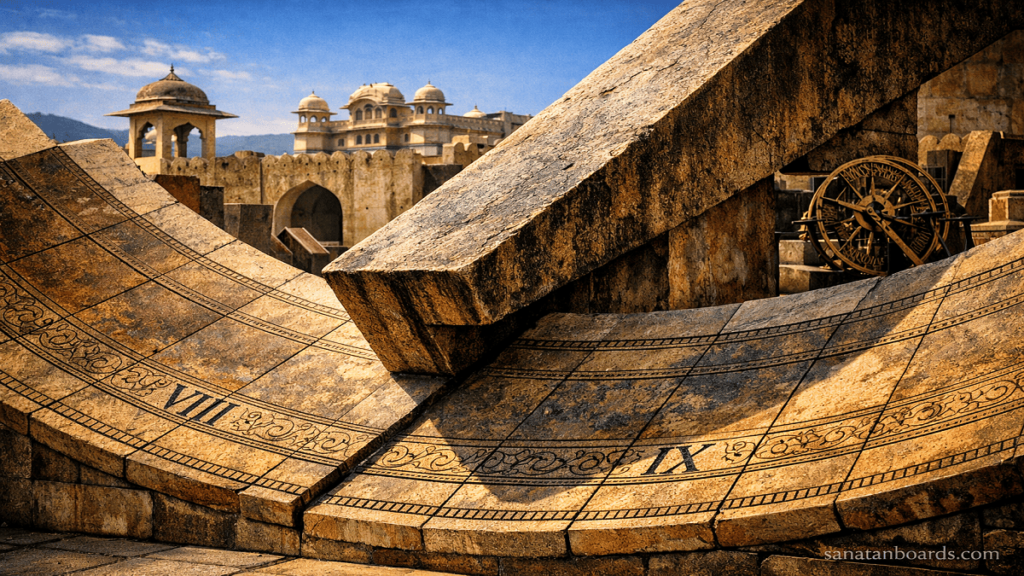
Among the most famous instruments is the Samrat Yantra, a gigantic sundial whose shadow can indicate time to the nearest 20 seconds when used skillfully. The underlying mathematics of Jai Singh’s instruments combined ideas from Hindu, Islamic, and earlier Greek observational traditions, but enlarged them into instruments unparalleled in scale. Together, these observatories constituted one of the most ambitious and successful astronomical projects of the 18th century — achieving precision in observation with methods that were durable, public, and monumental.
Who Is Required Jai Singh Ii (Jaipur, Astronomical Advancements)?
JAI SINGH II (JAIPUR, ASTRONOMICAL ADVANCEMENTS) was required by Maharaja Sawai Jai Singh II himself — a ruler of profound curiosity and dedication to improving scientific understanding of celestial phenomena. Born in 1688, Jai Singh II ascended to power at a young age and was known not just as a political leader but also as an enthusiastic student of mathematics, astronomy, and architecture. His era was characterized by significant scientific exchange between different traditions — including Hindu, Islamic, and European astronomy — and Jai Singh sought to harness and integrate these for more accurate celestial observation.
At the time, existing astronomical tables and methods relied heavily on older models that had become less accurate over centuries of use. Jai Singh recognized that such discrepancies affected calendrical predictions, timekeeping, and ritual schedules which had both practical and cultural significance. He therefore required, as part of his broader ambitions, a systematic way of improving astronomical observation without dependency on fragile or imported tools. This led him to conceptualize and commission large, enduring architectural instruments that could measure celestial parameters with precision. Recognizing that precise data required not just static instruments but also a network of observation locations at different latitudes, Jai Singh oversaw the construction of multiple observatories across India.
Additionally, Jai Singh worked closely with scholars and mathematicians at his court, including experts in trigonometry, planetary motion, and celestial mechanics. Though the ultimate initiative was his, the project’s success depended on the intellectual collaboration of astronomers who assisted with design, calibration, and interpretation of observational data. The result was a set of instruments and a methodology that elevated India’s observational capabilities within global scientific history.
When Jai Singh Ii (Jaipur, Astronomical Advancements) Is Required ?
JAI SINGH II (JAIPUR, ASTRONOMICAL ADVANCEMENTS) became required during the early decades of the 18th century — a period when celestial observation technologies were evolving worldwide. Specifically, the requirement emerged between 1724 and 1735, when Jai Singh II initiated and completed the construction of five large observatories in strategic locations across northern India. Each of these complexes served a precise observational function that was previously unavailable at this scale in the subcontinent.
The early 1700s was a transformative period in astronomy globally: telescopic observations were revolutionizing European stellar mapping, Persian and Islamic astronomical traditions further refined celestial models, and India’s own historical astronomical knowledge — rooted in ancient treatises like Sūryasiddhānta — had endured for centuries. Despite this, a noticeable mismatch between existing astronomical tables and actual observed positions of celestial objects had developed over time. For Jai Singh II, this was more than a theoretical problem; accurate celestial data influenced everything from calendrical systems and eclipse prediction to timekeeping for civic life and ritual obligations. Therefore, around 1724, when Jai Singh began construction, the need for more precise instruments had reached a critical point.
The observatories were not constructed all at once. The earliest site was in Delhi (1724), followed by Ujjain (1725), Jaipur (circa 1728–1734), and Varanasi (1737). The site in Mathura was initiated as part of the project but has since been lost. This spread across different latitudes was a deliberate choice, as positional astronomy benefits from cross‑comparative data from multiple vantage points.
In Rajasthan specifically, Jaipur’s observatory became particularly important because its completion in the 1730s coincided with the establishment of Jaipur as a newly planned capital city. As Jaipur grew into a center of political and cultural influence, the presence of such advanced astronomical infrastructure helped elevate its status among contemporary scientific hubs.
The importance of this requirement was not solely practical. It reflected a strategic vision — recognizing that celestial knowledge was more than theoretical curiosity; it could unify mathematical understanding, urban identity, religious calendars, and statecraft into a cohesive intellectual legacy. Thus, in the decades following 1724, Jai Singh’s efforts ensured that India remained an active participant in the broader scientific dialogues of the time.
Where Jai Singh Ii (Jaipur, Astronomical Advancements) Is Required ?
JAI SINGH II (JAIPUR, ASTRONOMICAL ADVANCEMENTS) was required in multiple key locations across northern India, each selected strategically for observational and scientific purposes. The observatories were constructed in Delhi, Jaipur, Ujjain, Varanasi, and Mathura, although the Mathura observatory no longer survives. These locations were chosen for their geographical, cultural, and astronomical significance, ensuring a wide coverage of latitudes for precise celestial measurements.(en.wikipedia.org)
In Delhi, the capital of the Mughal Empire at the time, the observatory allowed Jai Singh II to access the political and scholarly networks necessary to support large-scale scientific work. The Delhi observatory was crucial for observing stars and planets from a relatively central northern latitude, providing a reference point for astronomical calculations across the region.
Jaipur, the new capital of the Kingdom of Amber, was particularly important as the largest and most sophisticated of all the observatories. It included monumental instruments such as the Samrat Yantra, the world’s largest stone sundial, and structures designed to measure the declinations of celestial bodies. Its location was chosen carefully based on the latitude for maximum observational accuracy and to symbolize the city’s cultural and scientific prominence.(en.wikipedia.org)
Ujjain, historically regarded as the prime meridian reference point in ancient India, was chosen because of its long-standing astronomical traditions and its significance in Hindu cosmology. Observations from Ujjain allowed comparative studies with other sites and reinforced accuracy in astronomical tables used for calendars and rituals.
Varanasi, a spiritual and cultural hub, was selected because of its intellectual and religious importance, ensuring that the astronomical advancements had societal visibility and support.
Finally, Mathura was included for similar reasons, although its observatory has not survived. By distributing observatories across multiple latitudes and culturally significant centers, Jai Singh II ensured that JAI SINGH II (JAIPUR, ASTRONOMICAL ADVANCEMENTS) was not only a scientific project but also a symbol of integrated cultural and civic planning.
These locations collectively made the project both practical and symbolic, serving the dual purpose of advancing celestial observation and enhancing the political and cultural influence of the Jaipur state and its ruler.
How Jai Singh Ii (Jaipur, Astronomical Advancements) Is Required ?
JAI SINGH II (JAIPUR, ASTRONOMICAL ADVANCEMENTS) was required through a combination of visionary leadership, mathematical expertise, architectural innovation, and collaboration with scholars. The process began with Jai Singh II recognizing the limitations of existing astronomical tables that were outdated and inaccurate. This required developing instruments and observatories that were precise, durable, and scalable across different geographic locations.(jantarmantar.org)
The approach involved designing instruments in stone and marble that could function without telescopes, relying instead on geometry, shadow measurements, and angular scales. For example, the Samrat Yantra sundial uses the shadow of a triangular gnomon to measure time with precision up to 20 seconds. Other instruments, like the Jaiprakash Yantra and Rama Yantra, allowed astronomers to measure celestial declinations and altitudes.
Collaboration was critical: Jai Singh II worked closely with mathematicians, astronomers, and artisans, blending Indian, Islamic, and European astronomical methods. Calculations were applied to ensure the instruments were oriented correctly, calibrated to latitude, and capable of producing repeatable, precise observations.
The construction itself required careful urban planning, as these observatories had to fit within the local landscape, remain structurally stable, and allow free observation of the sky. Jaipur’s observatory, for example, occupies a large urban plot and combines practical observation with monumental architecture.
Finally, systematic observation and documentation were key to achieving the project’s goals. The observatories were actively used to record positions of planets, predict eclipses, and refine astronomical tables, ensuring that Jai Singh II’s advancements were functional and enduring.
Case Study On Jai Singh Ii (Jaipur, Astronomical Advancements)
JAI SINGH II (JAIPUR, ASTRONOMICAL ADVANCEMENTS) stands as a remarkable historical example of how visionary leadership, mathematical knowledge, architectural innovation, and sustained observational effort can come together to produce a transformative scientific initiative. The core of this case centers on the construction and use of the Jantar Mantar observatories, with the Jaipur observatory being the most complete, preserved, and studied of the complexes commissioned by Maharaja Sawai Jai Singh II in the early 18th century.
Background and Motivations
In the early 1700s India, existing astronomical tables and models had begun to diverge increasingly from actual celestial observations. Jai Singh II, born in 1688 into the Rajput Kachwaha dynasty, combined his interests in mathematics, astronomy, and architecture into a bold project aimed at refining observational accuracy and updating astronomical data. Part of his motivation was practical: to correct calendars and eclipse predictions, which were important for both ritual observances and timekeeping. Additionally, he sought to create a scientific infrastructure that embodied both empirical precision and cultural prestige.
Rather than rely on small metal or imported instruments that could wear or suffer calibration issues, Jai Singh determined to use massive masonry structures — a decision that reflected both the technologies known at the time and a desire for durability and scale. These monumental instruments were designed to be used with the naked eye and calibrated for high precision as high as possible without telescopic assistance.
The Observatory Network
Between 1724 and 1735, Jai Singh II commissioned the construction of five observatories — in Delhi, Ujjain, Jaipur, Varanasi, and Mathura. Each was strategically located across multiple latitudes to enable comparative observations of celestial positions. The first observatory was built in Delhi around 1724; the Jaipur observatory, built between 1728 and 1734, became the most ambitious in terms of size, completeness, and complexity.
The Jaipur site contains 19 distinct astronomical instruments, including the world’s largest stone sundial — the Vrihat Samrat Yantra. These structures were placed within a geometric layout that allowed observers to measure time, locate stars and planets, track movements, and calculate declinations and eclipses. They serve as architectural manifestations of astronomical models, combining empirical measurement with spatial design.
Methodology and Design
The instruments at Jaipur were not arbitrary sculptures but carefully calibrated devices. For example, the Samrat Yantra — a giant equinoctial sundial — uses a triangular gnomon oriented parallel to the Earth’s axis so its shadow indicates time to unprecedented precision for the era, with some reports noting accuracy down to a few seconds under optimal observation.
Other instruments such as the Jai Prakash Yantra, Rama Yantra, and Rashivalaya Yantra allowed observers to measure celestial coordinates, angular positions, and altitudes of stars and planetary bodies. The choice to use masonry and marble provided immense stability but also required exact geometric and mathematical planning to ensure that graduations and scales were accurate once built.
The design of these instruments reflects a deliberate synthesis of multiple astronomical traditions. Jai Singh was influenced by Islamic astronomical practices, Greek-derived positional models, and indigenous Indian systems. Rather than prioritizing telescopic methods, he focused on precise geometric forms adapted to naked‑eye observation — an approach that provided robust and repeatable measurements in a pre‑modern context.
Operation and Use
Once completed, the JAI SINGH II (JAIPUR, ASTRONOMICAL ADVANCEMENTS) observatory became a functional center of observation and record‑keeping. Trained observers used the instruments to collect data on solar declination, planetary motion, and timing of celestial events such as eclipses. These data were then used to update astronomical tables — including parameters for predicting celestial phenomena and recalibrating local timekeeping conventions.
The observatory’s design allowed for continuous measurement throughout the day and throughout the year, providing a systematic flow of data that was more reliable than small, mobile instruments subject to wear or misalignment. The large scales involved meant that even small angular changes could be detected and recorded with relative precision.
Challenges and Limitations
Despite its ingenuity, the observatory faced practical hurdles. Without telescopic magnification, certain measurements remained constrained by naked‑eye resolution. Additionally, the sheer scale of the instruments meant that construction imperfections or foundation shifts could introduce inaccuracies over time. Some instruments have shifted or settled due to structural reasons, demonstrating the challenges of monumental construction.
The Mathura observatory, part of the original plan, has not survived — a reminder that environmental and human factors can imperil even the most ambitious scientific installations.
Legacy and Influence
Today, JAI SINGH II (JAIPUR, ASTRONOMICAL ADVANCEMENTS) is most prominently remembered through the Jaipur observatory, designated a UNESCO World Heritage Site. It stands not just as a monument but as a testament to early modern scientific thought in India, reflecting a deep blend of geometric planning and celestial observation.
The case of Jai Singh’s observatories illustrates how scientific practice adapts to cultural, technological, and material contexts. By integrating architectural innovations with traditional positional astronomy, Jai Singh created a unique model of observational science.
White Paper On Jai Singh Ii (Jaipur, Astronomical Advancements)
Executive Summary:
This white paper examines JAI SINGH II (JAIPUR, ASTRONOMICAL ADVANCEMENTS) — an 18th‑century initiative led by Maharaja Sawai Jai Singh II to construct and operate monumental astronomical observatories, with a primary focus on the Jaipur observatory. It evaluates the scientific rationale, architectural design, technological implementation, and historical significance of this initiative.
1. Project Context and Objectives
JAI SINGH II (JAIPUR, ASTRONOMICAL ADVANCEMENTS) originated from a perceived need to rectify discrepancies in existing astronomical tables and observational methods prevalent in early 18th‑century India. The primary objective was to develop instruments that would produce accurate data on time, celestial positions, planetary motions, eclipses, and related parameters. This initiative also served political, cultural, and symbolic purposes, reinforcing the scientific stature and intellectual leadership of the Jaipur court.
The project diverged from the contemporary European focus on telescopic observation. Instead, the design prioritized large masonry instruments calibrated for naked‑eye observation — a choice driven by durability, precision, and the materials available at the time.
2. Architectural and Engineering Framework
The core architectural innovation in JAI SINGH II (JAIPUR, ASTRONOMICAL ADVANCEMENTS) lies in the translation of astronomical functions into geometric and structural forms. The Jaipur observatory encompasses multiple distinct devices, each engineered for specific celestial measurements. For example:
- Samrat Yantra (the world’s largest stone equinoctial sundial) measures local time and solar declination, using a massive gnomon aligned with the Earth’s axis.
- Jai Prakash Yantra consists of paired concave hemispherical bowls calibrated to map the sky’s projection.
- Rama Yantra and Rashivalaya Yantra measure altitudes and azimuths and represent the zodiacal framework for planetary tracking.
Engineering these instruments required advanced knowledge of geometry and structural design, with precise calculations for gradients, angles, and alignment. The use of local stone and marble ensured longevity, while interactions with scholars helped refine designs.
3. Scientific Methodology
The methodology integrated position‑based observation with iterative recalibration. Observers recorded shadow lengths, angular positions, and time measurements — data that were compared across multiple instruments and locations to refine accuracy. The network of five observatories in different geographic latitudes enhanced comparative analysis and reduced observational error.
This methodology was rigorous for its time, emphasizing repeatable measurement over theoretical speculation. While lacking optical magnification, the large scales of the instruments compensated by reducing relative observational error.
4. Governance, Collaboration, and Knowledge Exchange
JAI SINGH II (JAIPUR, ASTRONOMICAL ADVANCEMENTS) benefited from multidisciplinary collaboration. Jai Singh II engaged mathematicians, astronomers, and artisans — incorporating knowledge from Indian, Islamic, and European traditions. The integration of varied astronomical practices demonstrates early global dialogues in scientific practice.
Moreover, the project served as an intellectual hub, encouraging knowledge production and cross‑cultural exchange. It contributed to revised astronomical tables and enriched calendar accuracy beyond regional boundaries.
5. Outcomes and Impact
The measurable outcomes included refined celestial tables, improved timekeeping, and documented eclipse predictions. The architectural legacy — especially #sanatandharmaaccreditationboardsinmumbai the Jaipur observatory — remains a lasting record of design integrated with observational science. Its designation as a UNESCO World Heritage Site underscores its global significance and innovative character.
6. Lessons Learned
Key lessons from JAI SINGH II (JAIPUR, ASTRONOMICAL ADVANCEMENTS) include:
- The value of multidisciplinary strategies integrating architecture, mathematics, and astronomy.
- The effectiveness of large‑scale physical instruments in data collection without advanced optics.
- The importance of sustained observation in improving theoretical models.
Industry Application On Jai Singh Ii (Jaipur, Astronomical Advancements)
JAI SINGH II (JAIPUR, ASTRONOMICAL ADVANCEMENTS) may seem rooted in history, but its implications resonate with contemporary industries that intersect measurement, architecture, data precision, and cultural heritage. Though constructed well before modern industry, the principles behind Jai Singh’s innovations offer insights for today’s engineering, design, education, and heritage sectors.
1. Precision Engineering and Geospatial Measurement
The core challenge of JAI SINGH II (JAIPUR, ASTRONOMICAL ADVANCEMENTS) was precise measurement of celestial phenomena. The geometric principles applied — translating angular data into structural form — parallels modern geospatial measurement technologies such as GPS calibration, surveying instruments, and satellite data integration. Today’s engineers working in land surveying or precision agriculture can draw inspiration from the meticulous calibration methods used in large‑scale instruments like the Samrat Yantra.
The emphasis on repeatable, stable measurement mirrors how modern survey drones or terrestrial laser scanning systems require calibration against known fixed references. In an era where instruments depend on software algorithms, the fundamental idea of ensuring calibration integrity at the physical level remains central.
2. Architectural Integration in Industrial Design
The field of industrial design frequently blends form and function — a principle exemplified in the design of the astronomical structures in JAI SINGH II (JAIPUR, ASTRONOMICAL ADVANCEMENTS). Giants like Rama Yantra and Jai Prakash Yantra embody functional architecture: shapes themselves perform measurement tasks. This idea aligns with modern design disciplines such as parametric architecture, interactive installations, and sensor‑integrated structures.
Today’s architects designing smart cities or urban sensor networks can look to these instruments as examples of aesthetic utility — where built form serves analytical purposes without compromising artistic expression.
3. Cultural Heritage and Tourism Industries
The enduring popularity and UNESCO status of the Jaipur observatory demonstrate how historical scientific infrastructure can drive cultural tourism and heritage conservation industries. Modern tourism professionals focus on experiences that combine education, narrative, and authenticity — all qualities embodied by Jai Singh’s observatories.
Integrating digital media, augmented reality tours, and immersive observation simulations at sites inspired by JAI SINGH II (JAIPUR, ASTRONOMICAL ADVANCEMENTS) can enhance visitor engagement and preserve knowledge for future generations.
4. Education and Outreach
While the original campaign was pre‑modern, its strategies inform current STEM outreach efforts. Modern planetariums and science museums often build scale models or interactive exhibits to teach complex astronomical concepts — a direct #sanatandharmaaccreditationboardsinjaipur conceptual link to the way Jai Singh used monumental forms to visualize celestial geometry.
source : instaFRY Stories
ASK FAQ
Who was Jai Singh II and what were his astronomical advancements?
Jai Singh II was the 18th-century ruler of Jaipur who built monumental observatories called Jantar Mantar, designed for precise celestial observations using stone and marble instruments.
What is Jantar Mantar Jaipur and why is it important?
Jantar Mantar Jaipur is the largest of Jai Singh II’s observatories, housing 19 architectural instruments, including the world’s largest sundial, used for measuring time, eclipses, and planetary positions.
When were Jai Singh II’s astronomical observatories built?
The observatories were constructed between 1724 and 1737, with Jaipur’s observatory completed around 1734
Where can you find Jai Singh II’s astronomical observatories?
Observatories were built in Jaipur, Delhi, Ujjain, Varanasi, and Mathura, although only four remain today. Jaipur’s site is the most complete and visited.
How did Jai Singh II contribute to astronomy without telescopes?
He designed massive geometric instruments that used shadows, angles, and precise scales to measure celestial movements accurately, integrating Indian, Islamic, and European astronomical knowledge.
Table of Contents
Description
The content above is a comprehensive structured exploration of JAI SINGH II (JAIPUR, ASTRONOMICAL ADVANCEMENTS) covering its historical context, case study, white paper analysis, and modern industry relevance.