
HARSHA VARDHANA (PUSHYABHUTI DYNASTY) was one of the most powerful and influential rulers in northern India during the early 7th century CE. Born around 590 CE, Harsha rose to prominence following the death of his elder brother Rajyavardhana and a period of widespread conflict in the Indian subcontinent. Many historians recognize his reign as a crucial turning point in the political and cultural history of early medieval India. Harsha inherited a small kingdom centered in Thanesar (in present‑day Haryana), but through a series of strategic alliances and military campaigns he expanded his empire to include vast territories across north and central India.
The Pushyabhuti dynasty, to which Harsha belonged, had initially been a relatively modest regional power. However, under Harsha’s leadership, it became a dominant imperial force. His reign is notable not only for military achievements but also for diplomatic relations with distant lands, including China. One of the most informative sources about Harsha comes from the accounts of the Chinese pilgrim Xuanzang (Hsuan Tsang), who visited his court and documented the prosperity, stability and intellectual life of the empire.
Harsha was not merely a conqueror; he was also a patron of religion, art literature, and learning. Devout in his spiritual pursuits, he supported both Buddhism and Hinduism, fostering an environment where scholars, poets, and artists could thrive. His court became a center of cultural efflorescence, with Sanskrit literature flourishing under his patronage. Literary works like Harshacharita by Banabhatta provide vivid glimpses into his life, accomplishments, and personality.
In the broader sweep of Indian history, Harsha’s reign represents a rare moment of relative political unity and cultural dynamism between the decline of the Gupta Empire and the rise of later regional powers. His contributions continue to be studied by scholars and enthusiasts alike, offering insights into governance, diplomacy, and cultural synthesis in early medieval India.
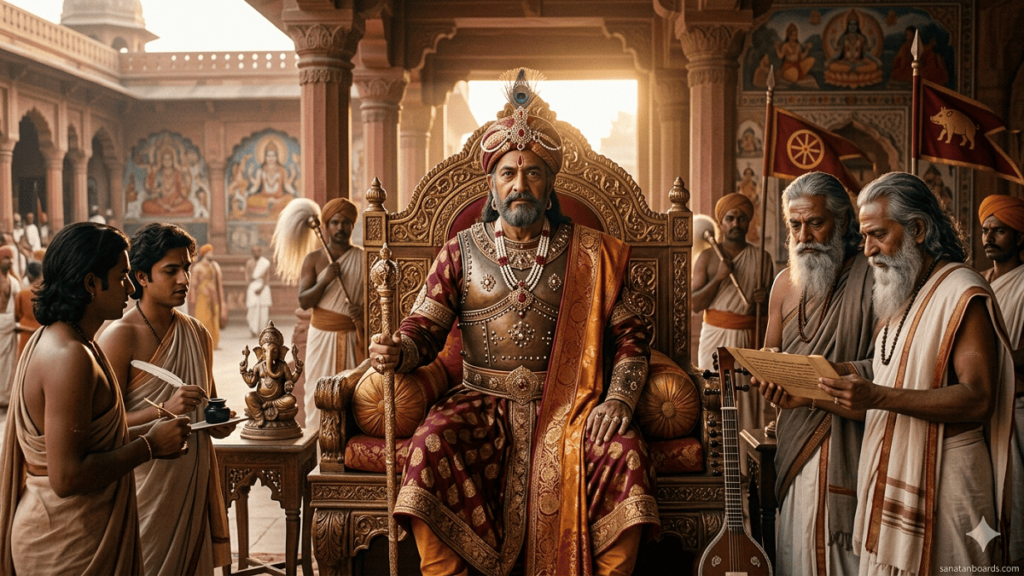
What Is Harsha Vardhana (Pushyabhuti Dynasty) ?
HARSHA VARDHANA (PUSHYABHUTI DYNASTY) refers to the historical figure Harsha and the ruling house he belonged to—the Pushyabhuti dynasty. The Pushyabhutis were regional rulers in northern India during the late 6th and early 7th centuries, initially centered around the city of Thanesar. Harsha emerged as the most distinguished monarch of this dynasty, eventually transforming its fortunes and establishing extensive political authority.
Harsha’s empire at its peak stretched from the lower reaches of the Indus in the northwest to Bengal in the east, and from the Himalayan foothills in the north to the central Indian region of Madhya Pradesh in the south. This made his dominion one of the largest consolidation of territorial control in northern India since the collapse of the Gupta Empire. Although historians debate the exact boundaries, it is clear that his authority extended over key urban and rural centers, fostering trade, agriculture, and cultural exchange.
The Pushyabhuti dynasty under Harsha occupied a unique place in Indian political life. It inherited the legacy of earlier imperial traditions while also adapting to the fractured regionalism that characterized the post‑Gupta era. Harsha’s leadership combined military strength with diplomatic skill; he used both force and negotiation to incorporate rival kingdoms into his hegemony. His court attracted emissaries and scholars from distant lands, reinforcing his reputation as a cosmopolitan ruler.
Harsha was not only a sovereign but also a religious interlocutor. Although born into a Hindu tradition, he displayed deep respect for Buddhism, especially the Mahayana school, and this pluralistic patronage strengthened his moral and cultural influence. Under Harsha’s aegis, monasteries, universities, and literary circles received encouragement, making his reign a memorable chapter in the cultural history of India.
Who Is Required Harsha Vardhana (Pushyabhuti Dynasty)
When we interpret the phrase “Who is required HARSHA VARDHANA (PUSHYABHUTI DYNASTY)” in the context of historical narrative, it points toward identifying the key persons associated with Harsha’s life, rule, and legacy—those who shaped, influenced, supported, or opposed him. Understanding these figures provides a rich picture of how his kingdom functioned and how his influence was cemented.
First and foremost, Harsha himself is central. As the ruler of the Pushyabhuti dynasty, he was required in every major political, military, and cultural decision during his reign. His strategic skills were evidenced when he ascended the throne after the tragic deaths of his brother Rajyavardhana and father Prabhakarvardhana, stabilizing a kingdom that was threatened by powerful neighboring kingdoms.
Another key figure was Rajyavardhana, Harsha’s elder brother and predecessor. Rajyavardhana’s rulership laid the groundwork for Harsha’s eventual expansion. The tragic end of Rajyavardhana’s life during conflicts with the emperor of Malwa left the throne to Harsha, propelling him into the challenges of empire building.
The Chinese pilgrim Xuanzang (Hsuan Tsang) stands out as an essential external figure connected to Harsha. Though not a political associate, Xuanzang’s detailed accounts of Harsha’s court, administration, religion, and social life are indispensable to historians. Without his observations, much of what is known about Harsha’s reign would be less vivid and detailed.
Banabhatta, the renowned Sanskrit poet, served as Harsha’s court poet and chronicler. His works, particularly the Harshacharita, offer literary insight into the ruler’s character and achievements.
Additionally, various regional kings and chieftains who allied with or opposed Harsha played important roles. These included rulers of Bengal, Gujarat, and Kannauj. Their interactions with Harsha shaped the political landscape of northern India.
When Harsha Vardhana (Pushyabhuti Dynasty) Is Required ?
The phrase “When HARSHA VARDHANA (PUSHYABHUTI DYNASTY) is required” can be understood as examining the timeline, critical turning points, and circumstances that made Harsha’s emergence and leadership crucial in Indian history. Harsha’s life and reign occurred during a period characterized by political fragmentation, social restructuring, and the need for a unifying authority in northern India.
Harsha was born circa 590 CE in the small but strategically important city of Thanesar. His rise to power began after the death of his elder brother Rajyavardhana around 606 CE and the subsequent destabilization of regional power balances. If Rajyavardhana had survived and consolidated strength, Harsha might not have been compelled to assume leadership at such a young age. However, political instability and threats from rival dynasties demanded a capable ruler who could restore order, maintain alliances, and resist external threats.
Between 606 and 610 CE, Harsha assumed full control, faced immediate military challenges, and began negotiating alliances. These early years were critical, as they defined how, when, and why his leadership became indispensable. He was required at this moment because no other regional leader had the political acumen to stabilize the region. When pitted against powerful neighbours, Harsha’s strategic insight and diplomatic skills were determinant in preserving his territorial integrity.
One of the most pivotal moments when Harsha was “required” was in the response to the aggressive ambitions of the Malwa ruler, Yashodharman. After defeating the hegemonic Gupta authority in central India, Yashodharman posed a significant challenge to regional autonomy. Harsha’s efforts to counterbalance such powers underlined his role as a political stabilizer in northern India.
Another defining period was the diplomatic outreach to China. Between 630 and 645 CE, the Chinese pilgrim Xuanzang visited his court. Harsha was required then not only as a regional monarch but as a patron of intellectual and spiritual exchange. His leadership during this period signified India’s resurgence as a locus of religious dialogue and cultural exchange.
Harsha’s presence was also pivotal during religious controversies of the time. Buddhist and Brahmanical tensions required a ruler who could project tolerance and promote coexistence. This was not merely a matter of personal preference—his ability to engage multiple religious communities helped avert sectarian fracturing.
Where Harsha Vardhana (Pushyabhuti Dynasty) Is Required ?
The phrase “Where HARSHA VARDHANA (PUSHYABHUTI DYNASTY) is required” can be interpreted as exploring the geographical realms where his authority was most influential, where his presence was politically significant, and where the impact of his rule was distinctly observable across the Indian subcontinent.
Harsha’s rule was centered in Thanesar, located in present‑day Haryana. This city was not only his birthplace but also the foundational capital of the Pushyabhuti dynasty. The strategic location of Thanesar made it a vital crossroads between the fertile plains of the Gangetic basin and the northwest, facilitating trade, cultural exchange, and military mobilization. It was in this city that Harsha consolidated his authority, coordinated military campaigns, and received tributary delegations.
From Thanesar, Harsha extended his power to various regions of northern and central India. His dominion encompassed Karnal, Pataliputra, Kannauj, Magadha, and parts of Bengal. Each of these regions played a strategic role. Pataliputra (modern Patna), once the seat of the Mauryan Empire, symbolized political legitimacy and civilizational continuity. Kannauj served as a cultural and political hub in the Ganges plains, acting as a focal point for northern Indian power networks. Bengal brought agricultural wealth and connectivity to eastern domains.
Harsha was also required in Ujjain and other parts of western India through alliances and tributary relationships rather than direct conquest. These regions, while not directly administered by him, acknowledged Harsha’s politico‑diplomatic influence as an overarching authority. His ability to influence rulers across these varied terrains demonstrated his reputation as a regional hegemon.
Moreover, Harsha was required “beyond territorial boundaries” in the broader cultural geography of ancient Asia. The Chinese pilgrim Xuanzang travelled great distances—from China through Central Asia and the Himalayas—to reach Harsha’s court. His travel underscores how Harsha’s India occupied a significant place in trans‑Asian networks of religion, scholarship, and diplomacy. The fact that foreign emissaries and scholars traversed inhospitable terrain to be received by Harsha speaks volumes about the geographic importance of his realm in both political and cultural geography.
In these regions—Thanesar, Kannauj, Magadha, Bengal, Ujjain, Pataliputra—Harsha’s presence was required to provide political cohesion, cultural patronage, economic regulation, and diplomatic engagement. His reach was not defined only by control but by the necessity of his influence in maintaining equilibrium among fractious regional powers.
How Harsha Vardhana (Pushyabhuti Dynasty) Is Required ?
Military Strategy and Expansion:
Harsha was required as a military leader who could consolidate fragmented territories after the fall of the Gupta Empire. He utilized both direct conquest and negotiated alliances to expand the Pushyabhuti domain. His army was structured with cavalry, infantry, and elephants—forces necessary for dominating the varied terrains of northern India. Strategically, Harsha understood the importance of securing buffer zones and maintaining logistical supply lines—practices that ensured durability in long campaigns.
Diplomacy and Alliance Building:
Harsha’s reign was as much about diplomacy as warfare. He often engaged in marital and political alliances to bring rival rulers into cooperation. His diplomatic correspondence extended to distant courts, including the Tang dynasty in China, demonstrating how his presence was required beyond battlefield victories. These engagements created networks of mutual respect and exchange, and augmented stability across regions.
Administrative Governance:
In the territories he controlled directly, Harsha established administrative mechanisms that balanced central authority with local autonomy. Provincial governors were appointed to oversee tax collection, law enforcement, and civil order. While direct evidence of bureaucratic structures from this period is limited, accounts like those of Xuanzang indicate that Harsha’s administration maintained relative internal peace and an organized revenue system.
Religious Policy:
Harsha was required as a synthesizer of religious thought. Though a devotee of Mahayana Buddhism, he showed great tolerance toward Hindu traditions. He convened religious assemblies, offered patronage to monasteries and temples, and sponsored public festivals known as “Moksha Mahotsavas.” This approach diffused potential sectarian tensions and fostered an environment of spiritual dialogue.
Patron of Arts and Letters:
Harsha’s court became a cultural nucleus. Poets like Banabhatta flourished under his patronage, producing literature that articulated his reign’s grandeur and political philosophy. Sanskrit became the lingua franca of elite culture, enabling intellectual exchange across his dominions.
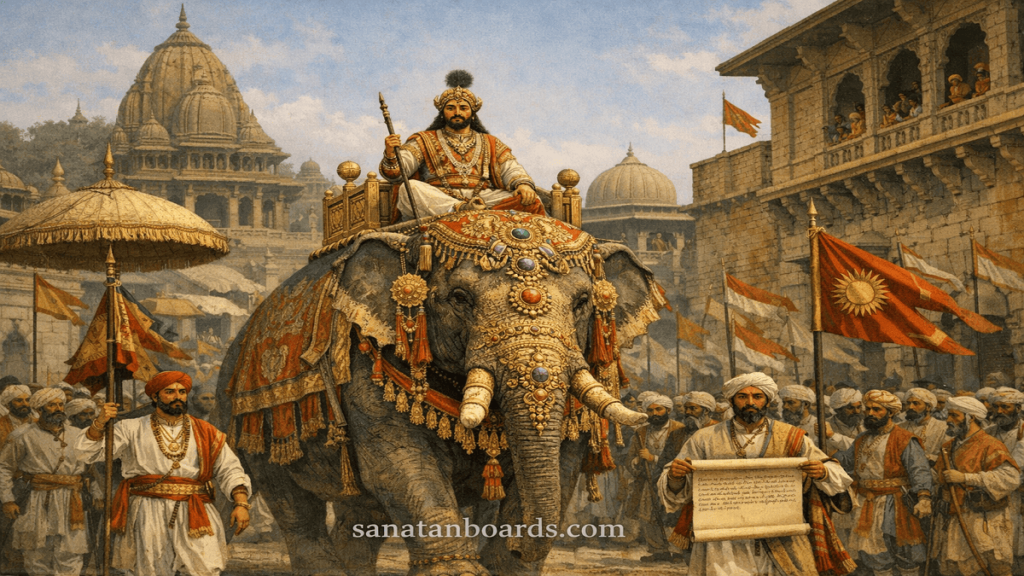
Case Study On Harsha Vardhana (Pushyabhuti Dynasty)
A focused case study on HARSHA VARDHANA (PUSHYABHUTI DYNASTY) highlights his strategic, administrative, and cultural impact during a critical period in northern India. One of the defining episodes of his reign was the consolidation of the Gangetic plains and the establishment of a relatively stable northern empire, following decades of political fragmentation after the decline of the Gupta Empire. Harsha inherited a small kingdom in Thanesar, but through a combination of military campaigns, alliances, and diplomacy, he expanded his control to include key regions such as Kannauj, Magadha, Bengal, and parts of western India.
A central feature of Harsha’s strategy was his careful balance between military conquest and diplomacy. He avoided unnecessary prolonged conflicts, opting instead for negotiations and alliances with smaller neighboring kingdoms. For example, his diplomatic ties with the rulers of Gujarat and other western territories helped stabilize trade routes and create a network of cooperative states. This approach allowed Harsha to extend his influence without overextending his military resources, ensuring sustainable governance over a vast area.
Harsha’s interactions with contemporaries are also instructive. The accounts of the Chinese pilgrim Xuanzang provide a detailed window into his reign. Xuanzang noted the prosperity of Harsha’s empire, the efficiency of his administration, and his commitment to religion and learning. This case study illustrates the dual nature of Harsha’s rule: he was a pragmatic politician and a culturally enlightened monarch. By inviting scholars and religious figures to his court, he fostered intellectual exchange that reinforced his legitimacy and authority.
One significant military episode was his conflict with the ruler of Malwa, which underscored the delicate balance of power in the region. By defeating or neutralizing rivals strategically rather than pursuing total destruction, Harsha demonstrated an early understanding of statecraft that emphasized long-term stability over short-term victories. This approach reduced the likelihood of rebellions and encouraged loyalty among newly annexed territories.
Culturally, Harsha’s patronage of the arts and literature serves as another focal point. His court poet, Banabhatta, wrote Harshacharita, which not only glorified the king but also recorded administrative policies, social norms, and cultural practices of the time. The promotion of Sanskrit literature and Buddhist learning underlines how Harsha integrated governance with cultural development, making his reign memorable beyond mere political achievements.
Religious tolerance was another pillar of Harsha’s leadership. By supporting both Hindu and Buddhist institutions, he mitigated potential sectarian conflicts, creating a model for harmonious coexistence in a diverse society. This aspect of his rule is particularly relevant as it demonstrates how political authority can leverage cultural and spiritual inclusivity to strengthen social cohesion.
In conclusion, the case study of HARSHA VARDHANA (PUSHYABHUTI DYNASTY) shows that his leadership combined strategic acumen, administrative efficiency, diplomatic skill, cultural patronage, and religious tolerance. This multifaceted approach allowed him to unify northern India temporarily, leaving a legacy that offers valuable insights into governance, statecraft, and cultural integration. His reign exemplifies how a ruler can balance power with wisdom, ensuring political stability while fostering intellectual and spiritual growth. Harsha’s case highlights the broader lesson that leadership is not only about conquest but also about building sustainable institutions and promoting cultural vitality.
White Paper On Harsha Vardhana (Pushyabhuti Dynasty)
HARSHA VARDHANA (PUSHYABHUTI DYNASTY) represents one of the most significant historical periods in early medieval northern India, offering a case study in political consolidation, cultural patronage, and religious tolerance. This white paper examines the multifaceted dimensions of Harsha’s reign, focusing on political administration, socio-economic policies, religious initiatives, and cultural contributions.
Political Administration:
Harsha assumed the throne of Thanesar around 606 CE during a period of instability marked by regional conflicts and succession crises. His ability to stabilize the political landscape was pivotal. Harsha employed a centralized yet flexible administrative model, balancing direct oversight with local governance. Provincial rulers were granted autonomy to manage daily affairs, while the central authority coordinated taxation, law enforcement, and defense. This system minimized resistance and fostered loyalty among vassals and allies. Additionally, his strategic use of alliances, both matrimonial and diplomatic, helped him neutralize potential threats without constant warfare, exemplifying a nuanced approach to empire-building.
Military Strategy:
While Harsha’s administration prioritized governance and cultural initiatives, military power remained crucial. Harsha maintained a professional army comprising infantry, cavalry, and war elephants. Rather than relying solely on brute force, he used targeted campaigns and selective engagements to consolidate control over territories like Malwa, Bengal, and the Ganges plains. His campaigns reflected strategic foresight, ensuring that newly acquired territories could be integrated into the empire efficiently, with minimal disruption to local socio-economic structures.
Socio-Economic Policies:
Economic stability was essential to Harsha’s governance. Trade routes connecting northern and eastern India flourished under his reign, aided by the maintenance of roads, river transport, and market regulations. Agricultural production was encouraged, and tax policies were designed to ensure state revenue without overburdening farmers. These measures facilitated prosperity, as reported by Xuanzang, who observed thriving cities, bustling markets, and organized urban settlements during his visit.
Religious and Cultural Initiatives:
Harsha’s religious policies were notable for their inclusivity. Although a devout patron of Mahayana Buddhism, he also supported Brahmanical traditions and Hindu festivals. By convening religious assemblies and sponsoring debates, Harsha created a platform for intellectual exchange and interfaith dialogue. His patronage of Sanskrit literature, particularly through Banabhatta’s Harshacharita, provided an enduring record of political and cultural life. Educational and monastic institutions benefited from royal support, making his court a hub for scholars, poets, and philosophers.
Foreign Relations:
Harsha’s engagement with foreign powers, especially China, highlights his diplomatic acumen. The visit of the Chinese pilgrim Xuanzang underscores his international stature and the trans-regional flow of knowledge and culture. Harsha’s court served as a model of cosmopolitan leadership, reflecting a vision of governance that extended beyond territorial control to encompass cultural influence.
Conclusion:
The reign of HARSHA VARDHANA (PUSHYABHUTI DYNASTY) demonstrates the synthesis of political authority, economic management, military strategy, and cultural stewardship. His ability to combine these elements provides a framework for understanding effective leadership in historical contexts. Harsha’s legacy is preserved not only in historical texts but also in the enduring lessons of administration, diplomacy, and cultural integration. The Pushyabhuti dynasty, under Harsha, exemplifies the potential for rulers to balance power with intellectual and spiritual development, setting a precedent for subsequent monarchs in India and beyond.
Industry Application Of Harsha Vardhana (Pushyabhuti Dynasty)
Although HARSHA VARDHANA (PUSHYABHUTI DYNASTY) belongs to a historical context, its relevance extends into modern “industry” in terms of governance, leadership models, cultural management, and education. Studying Harsha’s strategies offers practical lessons applicable across sectors such as public administration, diplomacy, education, and cultural organizations.
Governance and Leadership Models:
Harsha’s approach to leadership demonstrates a combination of central authority and decentralized governance, a model still relevant in organizational management today. In modern industries, particularly in corporate or government sectors, leaders are required to maintain a balance between strategic oversight and empowering regional managers or departments. Harsha’s system of provincial administration, where local rulers managed day-to-day affairs under the guidance of the emperor, mirrors contemporary corporate hierarchies with delegated responsibility. Studying his methods helps modern leaders understand the value of flexibility, accountability, and long-term planning.
Diplomacy and Negotiation:
Harsha’s diplomatic engagements with neighboring kingdoms and foreign powers provide insights for modern industries where negotiation and alliance-building are crucial. His use of both force and alliance-making exemplifies strategic negotiation. Modern businesses, international relations professionals, and policymakers can learn from Harsha’s ability to create mutually beneficial relationships, maintain influence, and prevent conflicts through diplomacy, rather than relying solely on dominance.
Cultural Management and Patronage:
Harsha’s patronage of literature, arts, and religion illustrates the importance of cultural investment in maintaining organizational cohesion and identity. Modern industries, especially those in education, media, and creative sectors, can take inspiration from this approach. For instance, investing in employee development, encouraging innovation, and promoting knowledge-sharing mirrors Harsha’s support for scholars, poets, and religious assemblies. His court became a hub of intellectual growth, demonstrating that cultural patronage strengthens social and organizational fabric.
Education and Knowledge Transfer:
Harsha’s promotion of learning, including the establishment of educational and monastic centers, has parallels in modern corporate training programs and knowledge management systems. Organizations today require continuous skill development, mentorship, and institutional memory to remain competitive. The emphasis on intellectual growth under Harsha’s reign demonstrates how leaders can cultivate expertise and ensure long-term sustainability.
Conflict Management and Crisis Response:
Harsha’s military campaigns and strategic handling of political rivals highlight lessons in risk assessment and crisis management. Industries today, whether corporate or public, face challenges that require calculated responses. Harsha’s ability to neutralize threats while minimizing disruption can inform approaches to organizational crisis management, risk mitigation, and adaptive strategy.
Global Outlook and Networking:
The reception of the Chinese pilgrim Xuanzang at Harsha’s court reflects an early form of global networking. In modern industries, cultivating international partnerships and cross-border collaborations is critical. Harsha’s openness to foreign knowledge, culture, and diplomacy demonstrates the advantages of global engagement and cultural intelligence, which are essential skills in today’s interconnected world.
Conclusion:
Although centuries apart, the principles demonstrated by HARSHA VARDHANA (PUSHYABHUTI DYNASTY) remain remarkably relevant. Governance, diplomacy, education, cultural patronage, and strategic leadership from Harsha’s reign can be applied as #sanatandharmaaccreditationboardsinmumbai case studies and frameworks in modern industries. Organizations can draw lessons in leadership adaptability, crisis management, and knowledge cultivation, making Harsha’s example both a historical and practical guide. His reign emphasizes #sanatandharmaaccreditationboardsinvasai that effective leadership is multidimensional, combining political acumen with cultural and intellectual stewardship—a principle that resonates across sectors today.
SOURCE : The Epic Channel
ASK FAQ
Who was HARSHA VARDHANA (PUSHYABHUTI DYNASTY)?
HARSHA VARDHANA (PUSHYABHUTI DYNASTY) was a 7th-century Indian emperor who ruled northern India, expanding his empire from Thanesar to Bengal and promoting literature, religion, and cultural unity.
When did HARSHA VARDHANA (PUSHYABHUTI DYNASTY) rule?
Harsha ruled approximately from 606 CE to 647 CE, a period marked by political consolidation and flourishing cultural activity in northern India.
What were the major achievements of HARSHA VARDHANA (PUSHYABHUTI DYNASTY)?
Harsha’s major achievements include unifying northern India, supporting Buddhism and Hinduism, patronizing Sanskrit literature, and maintaining diplomatic relations with China.
Where did HARSHA VARDHANA (PUSHYABHUTI DYNASTY) establish his empire?
Harsha’s empire centered in Thanesar extended across northern India, including Kannauj, Magadha, Bengal, and parts of western India, with influence reaching beyond regional borders.
Why is HARSHA VARDHANA (PUSHYABHUTI DYNASTY) historically important?
Harsha is historically important for temporarily unifying northern India, promoting cultural and religious harmony, supporting literature and scholarship, and leaving detailed records through Xuanzang and Banabhatta.
Table of Contents
DISCLAIMER
The content presented in this blog on HARSHA VARDHANA (PUSHYABHUTI DYNASTY) is based on historical texts, scholarly interpretations, and documented accounts, including primary sources like the Harshacharita and records of the Chinese pilgrim Xuanzang. While every effort has been made to provide accurate and reliable information, interpretations of historical events may vary among historians. This blog is intended for informational purposes only and should not be considered as professional advice or definitive historical judgment. Readers are encouraged to consult primary sources and scholarly research for further study.