Govinda III was one of the most eminent rulers of the Rashtrakuta dynasty, reigning from 793 CE to 814 CE and widely regarded as the most militarily successful emperor of his line. The Rashtrakutas were a powerful Indian dynasty that dominated large parts of the subcontinent during the early medieval period, known for their political influence, cultural patronage, and martial achievements. Govinda III inherited the throne from his father Dhruva Dharavarsha, who had already strengthened the dynasty’s hold over the Deccan plateau.
Upon ascending the throne in 793 CE, Govinda III faced immediate challenges, including internal family rivalries and succession disputes. Despite such obstacles, he consolidated power and embarked on a series of military campaigns that expanded Rashtrakuta authority across India. His reign is marked by extraordinary achievements in both strategy and statecraft, establishing the Rashtrakutas as a dominant imperial force in early medieval Indian history.
Govinda III was also a patron of religion and culture and maintained religious tolerance. Although inscriptions and historical records emphasise his martial prowess, his support for religious and scholarly activities indicates governance that blended military strength with cultural richness. By the time of his death in 814 CE, Govinda III had transformed the Rashtrakuta Empire into a power that commanded respect from southern kingdoms, northern powers like the Pratiharas and Palas and even distant regions such as Sri Lanka.
What Is Govinda Iii (Rashtrakuta) ?
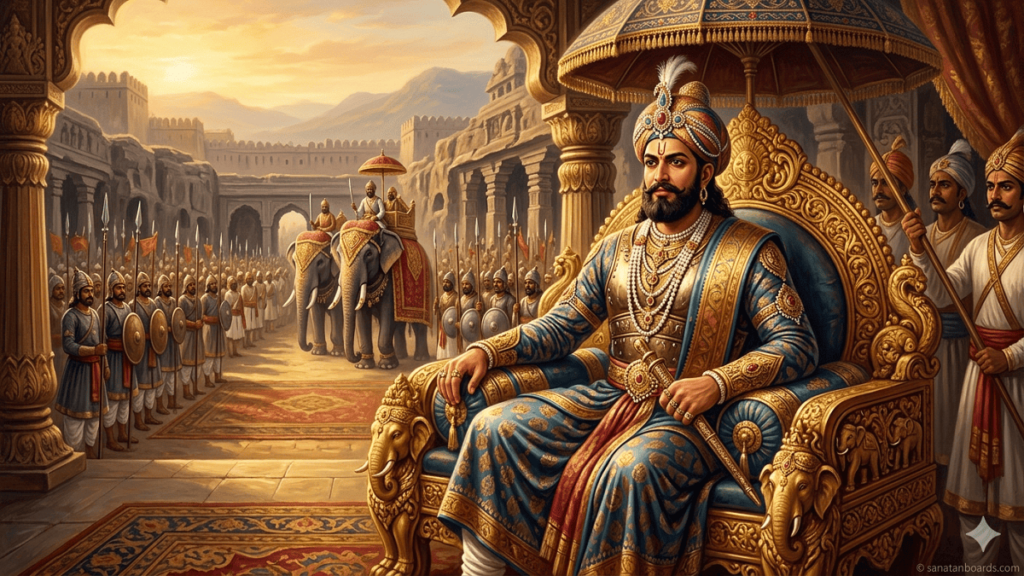
Govinda III was a Rashtrakuta emperor who ruled India during the late 8th and early 9th centuries. The Rashtrakuta dynasty itself was a formidable royal family that rose to prominence in the Deccan region, extending its influence over vast parts of the Indian subcontinent. Govinda III’s reign is best known for its military achievements, territorial expansion, political consolidation, and administrative strength.
In titles and official inscriptions, Govinda III was referred to by several lofty epithets — such as Prabhutavarsha, Jagattunga, Prithvivallabha, and Atishayadhavala — reflecting both his imperial stature and his perceived role as protector and unifier. Under his command, the Rashtrakuta domain stretched from Kanyakubja (Kannauj) in the north to the southern tip of India at Kanyakumari, and from Bharuch in the west to regions near Banaras in the east. This remarkable geographical reach illustrates how his campaigns touched nearly every major cultural and political centre of India during his reign.
Unlike rulers who focused solely on conquest without governance, Govinda III demonstrated strategic administration and diplomacy. For instance, vassal rulers were often maintained under local authority — as with his brother Indra’s installation in conquered regions such as Lata (Gujarat) — ensuring a blend of control and cooperation. His reign also saw the subjugation of powerful southern dynasties such as the Cholas, Pandyas, and Pallavas, with some states recognising Rashtrakuta supremacy through tribute and diplomatic submission.
Govinda III’s era marked the zenith of early Rashtrakuta power, setting the foundation for continued influence by his successors
Who Is Govinda Iii (Rashtrakuta) Required ?
Govinda III is required for historians, scholars, and students of Indian history, particularly those studying the early medieval period when regional dynasties competed for supremacy. His life and reign provide critical insights into the Rashtrakuta dynasty’s strategies, administration, and political expansion, making him a central figure for anyone analyzing Indian imperial history.
Beyond historians, Govinda III is required for students of leadership and governance. His ability to consolidate power immediately after his father’s death, overcome family rivalries, and execute successful military campaigns demonstrates key lessons in strategic decision-making, crisis management, and statecraft. Leaders and political theorists studying historical examples of effective rulership often refer to him as a case study for balanced leadership — combining decisiveness with diplomacy.
He is also required for cultural and religious scholars, as inscriptions from his reign reveal patronage of religious institutions, promotion of Jainism, and support for artistic endeavors. Understanding these actions helps contextualize the Rashtrakutas’ role in shaping cultural pluralism and socio-religious developments in medieval India.
Finally, Govinda III is required for regional studies enthusiasts. His campaigns and administration impacted kingdoms across northern and southern India, influencing trade, culture, and politics. By studying his interactions with the Cholas, Pallavas, Pratiharas, and Palas, researchers can understand the interconnectedness of medieval Indian states and the geopolitical significance of the Deccan.
When Is Govinda Iii (Rashtrakuta) Required ?
Govinda III is required whenever the study of strategic expansion, empire building, and political consolidation in early medieval India is undertaken. His reign from 793 CE to 814 CE marks a period when the Rashtrakutas transitioned from a regional power to a pan-Indian dynasty, making this timeframe essential for understanding the historical development of political authority in India.
He is particularly relevant during studies of dynastic succession crises. Upon ascending the throne, he faced rebellion from his elder brother and rival chiefs. His ability to stabilize internal conflict while continuing military campaigns demonstrates the importance of timely, decisive action. Scholars studying leadership under pressure, risk management, and crisis intervention consider his reign a critical example.
Govinda III is also required in the context of inter-dynastic conflicts and diplomacy. His campaigns in northern India, including the conquest of Kannauj, highlight when decisive military action was necessary to secure influence over key regions. These events provide historical markers for understanding power shifts between northern and southern kingdoms, including interactions with the Pratiharas, Palas, and regional southern dynasties.
Moreover, his reign is required when exploring the timing of cultural and religious patronage. Govinda III maintained support for Jainism and other religious institutions, reflecting the strategic role of religion in governance. Understanding when rulers invest in cultural or religious initiatives offers lessons for historians studying political legitimacy and state-building.
Where Is Govinda Iii (Rashtrakuta) Required ?
Govinda III is required wherever the study of the Rashtrakuta Empire’s geographical and political impact is undertaken. His campaigns stretched from the southern tip of India to northern cities like Kannauj, from eastern territories near Banaras to western regions like Gujarat, making him relevant across the entire subcontinent.
He is required in the Deccan region, where his father laid the foundation of Rashtrakuta power. Govinda III consolidated control over key cities, trade routes, and administrative centers, ensuring long-term dominance. Scholars examining state formation and regional governance focus on these areas to understand the dynasty’s territorial management.
In northern India, he is required for understanding military and political interventions in Kannauj, which at the time was a strategic city controlling access to major northern plains. His campaigns illustrate how southern dynasties could project power over distant regions through carefully coordinated military action and strategic alliances.
Govinda III is also required in southern kingdoms such as the Pallava and Chola territories, where his influence reshaped political hierarchies and compelled local rulers to recognize Rashtrakuta supremacy. The study of these regions demonstrates inter-dynastic diplomacy, tribute systems, and cultural integration.
Finally, Govinda III is required wherever historical lessons in cross-regional administration and cultural exchange are relevant. His reign shows how rulers managed diverse linguistic, cultural, and religious populations, making his strategies useful reference points for understanding territorial governance across complex landscapes.
How Is Govinda Iii (Rashtrakuta) Required ?
Govinda III is required through analysis of his military strategy, governance, and diplomatic policies. His approach demonstrates how a ruler can achieve consolidation and expansion simultaneously. Military historians study his rapid campaigns across north and south India, which relied on well-organized logistics, strategic troop deployment, and effective communication.
He is required in leadership studies to understand how authority is established and maintained. Govinda III balanced firmness with clemency: while suppressing rebellions decisively, he also reinstated loyal family members and vassals to positions of power, showing how diplomacy can complement military might.
In cultural and religious contexts, he is required to understand how rulers maintain social cohesion. By supporting Jain institutions and other religious bodies, Govinda III secured legitimacy and loyalty across diverse populations. This demonstrates how patronage is a tool of governance, ensuring both societal stability and long-term cultural influence.
Govinda III is also required in political education to illustrate how large empires manage distant territories. He delegated authority to trusted family members and governors while maintaining oversight through inscriptions, alliances, and tribute systems. These methods provide historical examples of effective administrative delegation and centralized oversight.
In sum, Govinda III is required by those studying how military, political, and cultural strategies intersect to create a resilient and influential empire. His reign offers practical lessons on execution of strategy, management of diverse populations, and sustainable power projection that remain relevant to both historical scholarship and comparative leadership studies.
Case Study On Govinda Iii (Rashtrakuta)
Overview
Govinda III, who reigned from 793 CE to 814 CE, stands as one of the most compelling figures in early medieval Indian history. His reign marked the high tide of Rashtrakuta power, with military conquests, political strategy, and cultural influence spreading across the Indian subcontinent. In this case study, we examine his leadership, campaigns, administrative decisions, religious policies, and the long‑term impact of his rule.
Succession and Early Challenges
Upon his father Dhruva Dharavarsha’s death, Govinda III faced a serious test — internal revolt. His elder brother Stambha led a coalition of several chiefs in rebellion against him. This crisis was not simply a dispute over throne rights but a threat to the very unity of the Rashtrakuta realm. Govinda III’s decisive military suppression of the revolt brought not only victory but also political stability. What makes this episode noteworthy is his strategic clemency: after capturing Stambha, he restored his brother as a subordinate ruler rather than executing him, thereby turning a potential enemy into an ally. This move demonstrated political prudence and long‑term statecraft that helped solidify Rashtrakuta unity.
Military Expansion and Strategic Depth
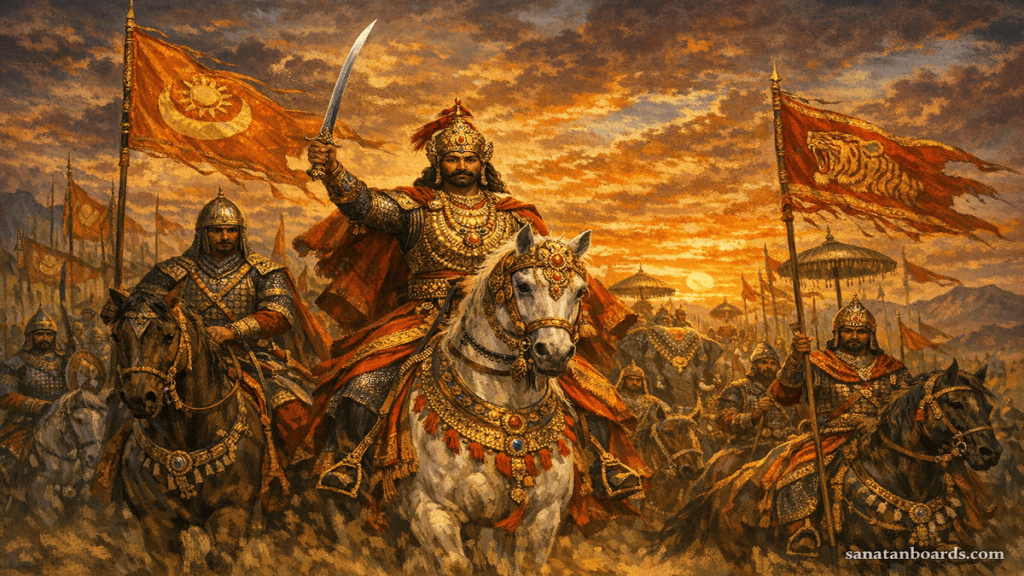
Govinda III’s reign is best known for its extraordinary military campaigns. From his capital Mayurakhandi (present‑day Bidar district), he launched a northern expedition that reshaped India’s political landscape. In 800 CE, he marched north and secured the submission of several major powers including the Gurjara‑Pratihara ruler Nagabhata II, Pala emperor Dharmapala, and the ruler of Kannauj. This achievement not only represented a monumental military success but temporarily inverted the traditional north–south power balance in India.
The symbolic language of ancient inscriptions — notably that his horses drank from Himalayan streams and his elephants tasted the sacred Ganges — emphasises the far‑reaching extent of his influence and reflects historical records that other major kings acknowledged his authority.
His southern campaigns were just as consequential. Govinda III confronted and subdued rulers across the south — from the Pallavas at Kanchi to the influential Chola and Pandya realms — and received the submission of the King of Ceylon (Sri Lanka) without direct battle, who offered statues as tokens of allegiance. These victories further indicate his strategic acumen and capacity for political dominance across diverse cultural zones.
Administration and Governance
Effective empire management requires more than battlefield success. Govinda III understood this, appointing loyal family members — such as making his brother Indra the ruler of Lata (Gujarat) — and working with local elites to maintain order. This blend of central oversight with delegated authority allowed him to govern a vast and culturally diverse empire.
Furthermore, his rule continued the Rashtrakuta tradition of support for religion and culture. Although primarily a warrior, he patronised Jain institutions and maintained religious tolerance, which helped foster social cohesion across regions with different faith traditions.
Political Significance in the Tripartite Struggle
The era of Govinda III sits within the broader context of the Tripartite Struggle — a prolonged competition among the Rashtrakutas, Pratiharas, and Palas for control of the strategic city of Kannauj. Govinda III’s northern campaigns dealt significant blows to rival dynasties and temporarily shifted the power equilibrium. Although Rashtrakuta control of Kannauj was not permanent, the fact that he could project military strength so far from the Deccan illustrates his strategic reach and logistical capability.
Legacy and Impact
Govinda III died in 814 CE, leaving behind an empire that, at its peak, stretched from Kannauj in northern India to Cape Comorin in the south, and from Banaras in the east to Bharuch in the west. His strategic vision established the Rashtrakutas as one of the most #govindarashtrakuta powerful dynasties in Indian history. His son and successor, Amoghavarsha I, inherited not only a vast realm but also a legacy of statecraft, cultural patronage, and imperial ambition.
Govinda III’s case demonstrates enduring lessons in leadership resilience, military strategy, political diplomacy, and cultural accommodation — making him a model for comparative examinations of leadership across eras.
White Paper On Govinda Iii (Rashtrakuta)
Executive Summary
This white paper analyses the reign of Govinda III, its historical significance, and broader lessons applicable to leadership, governance, and geopolitical strategy. Focused on institutional resilience, strategic expansion, and cultural integration, the paper provides a structured evaluation of how his reign shaped early medieval Indian history.
Context and Background
The Rashtrakuta dynasty was a dominant force in the Deccan and beyond from the 8th to 10th centuries CE. Govinda III, ascending the throne in 793 CE, inherited an empire poised for expansion under his father Dhruva Dharavarsha. However, succession was contested — a common feature of monarchic transitions in the era. Govinda III’s early challenges crystallised into his first test of leadership: stabilising internal discord before projecting power externally.
Strategic Leadership
Govinda III demonstrated strategic clarity in prioritising stability first, then expansion. By resolving family conflict decisively yet diplomatically, he established political unity — a foundation upon which his subsequent campaigns were conducted. This was foundational to his success and offers a lesson in internal organisational coherence as a prerequisite for external ambition.
Military and Political Objectives
Northern Campaigns
Govinda III’s northern expedition, cutting through central India and asserting authority over Kannauj, reflected an understanding of geography as power. Secure control or influence over northern plains enabled his regime to command respect among rival dynasties. In operational terms, his campaigns demonstrated rapid mobilisation, supply chain coordination, and strategic surprise, prefiguring modern military doctrines of mobility over attrition.
Southern Consolidation
While northern successes often receive historical emphasis, Govinda III’s southern campaigns were equally important. They neutralised potential opposition from powerful kingdoms in the Tamil country and ensured that political order was not fractured along regional lines. His ability to balance campaigns across different theatres was pivotal.
Administrative Structures
Govinda III’s rule utilised decentralised administration where local rulers or vassals maintained law and order under overarching Rashtrakuta sovereignty. This hybrid model reflects principles of federated governance, balancing central authority with regional autonomy — a potentially instructive model for understanding governance in large, diverse territories.
Cultural and Religious Policy
Despite his martial focus, Govinda III supported both Jain and Hindu institutions, reinforcing social legitimacy through cultural patronage. This policy ensured that diverse religious communities saw the empire as inclusive rather than coercive. Such multicultural governance contributed to long‑term stability and cultural flourishing within his realms.
Legacy and Contemporary Relevance
Govinda III’s legacy is multifaceted. Historically, he was a central figure in shaping the political map of early medieval India. His reign illustrates how military strategy, diplomatic negotiation, and administrative innovation can be integrated to sustain imperial authority.
From a contemporary perspective, Govinda III’s strategies of conflict resolution, institutional strengthening, and cultural pluralism remain relevant to discussions about modern governance systems, interstate relations, and leadership in complex societies.
Industry Application On Govinda Iii (Rashtrakuta)
A. Leadership and Management Consulting
Govinda III’s model of stabilising an organisation internally before external expansion mirrors corporate turnaround strategies. His method of integrating dissenting factions rather than eliminating them provides a case study in organisational reconciliation and talent retention.
B. Strategic Planning and Military Studies
Military academies and strategic studies programs examine Govinda III’s rapid offensive campaigns and logistical planning as historical examples of pre‑modern military expedition management. His operations across vast regions offer insights applicable to modern guerrilla logistics and high‑mobility operations.
C. Public Administration and Governance
Public administration programs can study Govinda III’s use of a hybrid administrative model combining central oversight with decentralised execution. Modern federal systems can learn from how his rule maintained cohesion without over‑centralisation.
D. Cultural and Diversity Management
Govinda III’s religious patronage strategy reinforces the importance of inclusive cultural policies. In corporate diversity programs, his balancing of support across religious communities can serve as an ancient example of institutional pluralism and stakeholder integration.
E. Project Management and Conflict Resolution
His handling of the succession conflict — decisive yet diplomatic — is a case study in conflict resolution. Project managers can derive principles of assertive but reconciliatory leadership from this episode.
F. Education and Historical Research
Govinda III’s reign is required in history curricula focusing on early medieval India, imperial politics, and cultural synthesis. His campaigns and policies serve as context for interdisciplinary studies involving politics, religion, and military history.
Conclusion
Govinda III’s life and reign, though rooted in a distant past, provide a rich source of insights across domains. His blend of #sanatandharmaaccreditationboardsinmumbai strategic planning, effective governance, cultural inclusivity, #sanatandharmaaccreditationboardsinindia and adaptive leadership offers timeless lessons for scholars and professionals alike.
SOURCE : Time Traveller
ASK FAQ
Who was Govinda III of the Rashtrakuta dynasty?
Govinda III (793–814 CE) was a prominent Rashtrakuta emperor known for expanding the dynasty’s influence across northern and southern India, defeating major kingdoms, and consolidating power after internal family disputes.
What were the major achievements of Govinda III?
Govinda III’s major achievements include conquering Kannauj, subduing the Pallavas, Cholas, and Pandyas, stabilizing internal rebellions, and promoting religious and cultural patronage, making the Rashtrakuta Empire a dominant power.
When did Govinda III rule India?
Govinda III ruled from 793 CE to 814 CE, a period marked by military expansion, administrative consolidation, and increased influence of the Rashtrakutas in both northern and southern India.
Why is Govinda III important in Indian history?
Govinda III is important for demonstrating strategic military leadership, effective governance, and cultural tolerance, contributing to the peak of Rashtrakuta power and shaping medieval Indian political and cultural landscapes.
Where did Govinda III’s campaigns extend?
His campaigns extended from Kannauj in northern India to Kanyakumari in the south, and from Bharuch in the west to Banaras in the east, highlighting the Rashtrakutas’ vast territorial reach and influence.
Table of Contents
Disclaimer:
The content in this blog is for educational and informational purposes only. While every effort has been made to ensure accuracy, historical interpretations may vary, and the blog does not provide professional advice.