
DEVARAYA I (VIJAYANAGAR) was one of the early and influential rulers of the Vijayanagar Empire, reigning during the early 15th century (1406–1423 CE). He belonged to the Sangama Dynasty, which was the founding dynasty of this powerful South Indian empire that stood as a bulwark of Hindu political power and culture in medieval India.
Devaraya I succeeded his predecessor Bukka Raya II to the throne on 5 November 1406 CE, as confirmed by copper‑plate inscriptions discovered and studied by the Archaeological Survey of India (ASI). These inscriptions, written in multiple scripts including Sanskrit and Kannada, provide direct historical evidence of his coronation and rule.
Under his leadership, the Vijayanagar Empire continued to strengthen its administration, military, and cultural patronage systems. He was personally involved in important irrigation and infrastructure projects, including the construction of barrages and aqueducts, which helped secure water resources for agriculture and improve the economy of the empire’s core region around its capital near Hampi (present‑day Karnataka).
Devaraya I was also known for modernizing the army by importing horses from Arabia and Persia and employing highly skilled archers, which significantly enhanced the military capabilities of the empire. His reign attracted the attention of foreign travelers as well, such as the Italian explorer Niccolò Conti, who described the strength and organization of Vijayanagar’s forces and city.
Moreover, he extended support to scholars, poets, and religion, promoting literature and architecture in multiple languages. Through both governance and culture, Devaraya I reinforced Vijayanagar’s position as a center of political power and learning in South India during his period.
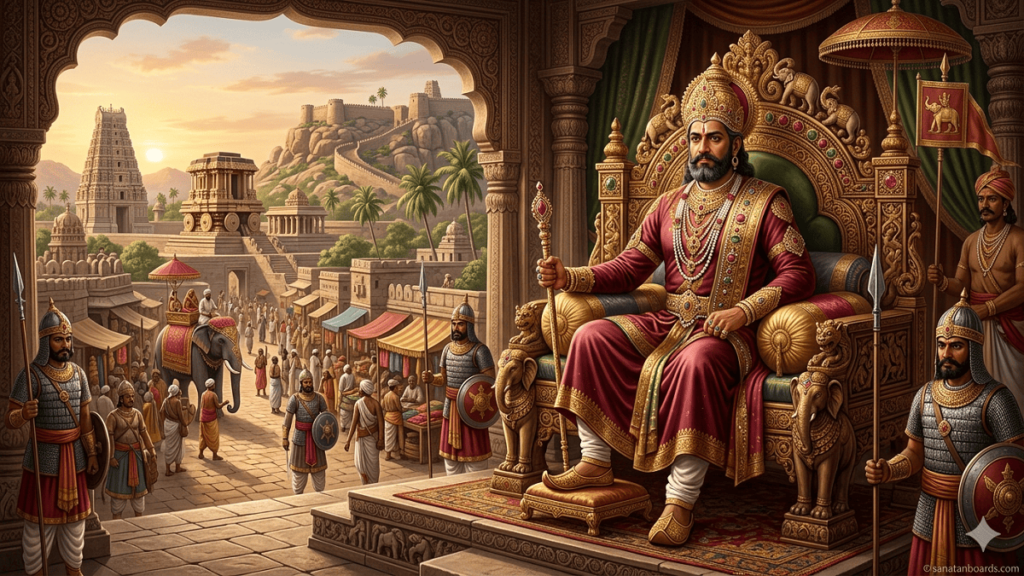
What Is Devaraya I (Vijayanagar) ?
DEVARAYA I (VIJAYANAGAR) was a monarch of the Vijayanagar Empire, one of the most significant medieval empires in Southern India. He reigned from 1406 to 1423 CE, during a period of consolidation and expansion for the empire founded in 1336 CE by Harihara I and Bukka Raya I.
As a ruler, Devaraya I is remembered for his military capabilities, administrative reforms, and cultural patronage. He came to power after a period of internal dispute among the sons of his predecessor, Harihara II, eventually emerging as emperor and stabilizing the empire’s leadership.
Devaraya I’s military reforms were particularly notable. Recognizing the need for a strong cavalry and versatile infantry, he imported horses from abroad and incorporated skilled Turkic archers into his forces, significantly enhancing the empire’s battlefield performance. This modernization made Vijayanagar’s army more capable of defending its territories and engaging rival powers, such as the Bahmani Sultanate to the north.
In governance, he undertook significant infrastructure work, including the creation of water management systems such as dams and aqueducts, vital for irrigation and boosting agricultural productivity. These projects helped sustain large populations and strengthened economic stability around the capital region near the Tungabhadra River.
At court, Devaraya I maintained a reputation as a patron of literature and religion. He supported poets, philosophers, and scholars, fostering an environment where Kannada literature and temple architecture flourished. His reign saw the continuation of the empire’s cultural investments, which helped define Vijayanagar not just as a political power but also as a center of artistic and intellectual life.
Overall, Devaraya I is regarded as a capable ruler who strengthened the foundation of the Vijayanagar Empire through military innovation, administrative projects, and cultural support, setting the stage for further growth under subsequent monarchs.
Who Is Required — Devaraya I (Vijayanagar) ?
DEVARAYA I (VIJAYANAGAR) refers to identifying the key figures and groups connected to his reign, including those who played crucial roles in the administration, military, and cultural spheres. Devaraya I, as an emperor, required capable advisors, generals, and administrators to effectively govern the Vijayanagar Empire.
In the military domain, he depended on generals skilled in the latest warfare strategies. He required a strong cavalry and archers, including foreign recruits like Turkic archers, to strengthen the empire’s defense. These military leaders were essential in protecting the empire’s borders from rival powers, particularly the Bahmani Sultanate in the north.
Administratively, Devaraya I required ministers proficient in managing revenue, trade, and agriculture. His ambitious irrigation projects demanded engineers and planners who could design and implement canals, aqueducts, and reservoirs. These officials ensured that agricultural productivity increased, which in turn supported both the urban population and military infrastructure.
Culturally, Devaraya I required scholars, poets, and artisans. By patronizing literature, temple architecture, and religious institutions, he reinforced the empire’s cultural prestige. Artists and scholars were not merely ornamental—they contributed to a legacy that legitimized his rule and strengthened social cohesion across a diverse empire.
Finally, as a ruler, Devaraya I required the support of the general population, including landowners, traders, and villagers. Their cooperation, through taxes, military service, and participation in civic projects, was crucial to sustaining the empire’s stability. In essence, “who is required” extends beyond the court—it encompasses every individual whose skills, loyalty, or labor contributed to the functioning and success of the Vijayanagar Empire under Devaraya I.
When Is Required — Devaraya I (Vijayanagar) ?
when DEVARAYA I (VIJAYANAGAR) is required involves placing his reign in the broader historical, political, and cultural timeline of South India. Devaraya I ascended the throne in 1406 CE, a period when the Vijayanagar Empire was consolidating after its establishment by Harihara I and Bukka Raya I in the mid-14th century.
This period was marked by significant geopolitical challenges. The Bahmani Sultanate, located north of Vijayanagar, was an expansionist power, frequently engaging in skirmishes and demanding vigilant military preparedness. It was during this era that Devaraya I’s military reforms and strategic alliances became crucial. His reign is “required” in history because it represents a phase of stabilization and strengthening after earlier internal disputes over succession.
Economically, the early 15th century was a time of agricultural and trade expansion in South India. Devaraya I’s reign was required to implement large-scale irrigation works, ensuring water security and agricultural productivity. These interventions were timely because they sustained growing urban centers and allowed the empire to project power both militarily and economically.
Culturally, this was also a period when patronage of arts, literature, and religion became increasingly important for rulers. Devaraya I’s reign is required to mark the continuity of support for Kannada and Sanskrit literature, temple construction, and religious institutions, consolidating Vijayanagar as a cultural as well as a political power.
In sum, the period 1406–1423 CE is required in South Indian history because it exemplifies a phase where leadership, infrastructure, military strategy, and cultural patronage intersected to secure the Vijayanagar Empire’s long-term stability. Devaraya I’s contributions in this timeframe were pivotal for subsequent rulers like Devaraya II, under whom the empire reached new heights.
Where Is Required — Devaraya I (Vijayanagar) ?
pertains to the geographical and strategic locations where his leadership and policies had significant impact. Devaraya I ruled primarily from the capital region near Hampi (present-day Karnataka), which was the administrative, cultural, and military heart of the Vijayanagar Empire.
Hampi was not only a political center but also a hub for trade, art, and religious activity. Devaraya I required this region to serve as the base for his administrative apparatus, with ministers, scholars, and military officials coordinating governance across the empire’s territories. This “where” underscores the capital as the center from which policy, military campaigns, and cultural initiatives radiated.
Strategically, the Tungabhadra River valley was another location where Devaraya I’s interventions were required. His irrigation and infrastructure projects focused on this region, enhancing agricultural productivity and supporting population centers. The river network allowed for efficient movement of troops and goods, making these areas critical to the empire’s economic and military security.
Furthermore, Devaraya I required border regions to be fortified and monitored, particularly along the northern frontier adjacent to the Bahmani Sultanate. Fortresses, watch posts, and garrisoned towns in these areas were essential for defending the empire and asserting territorial control.
Trade centers along the Coromandel Coast and inland trade routes were also locations where Devaraya I’s policies were required. Maintaining these hubs ensured a steady flow of revenue from taxes, facilitated trade with other South Indian and foreign entities, and strengthened the empire’s overall economic base.
How Is Required — Devaraya I (Vijayanagar ?
Understanding how DEVARAYA I (VIJAYANAGAR) is required involves examining the methods, strategies, and approaches he used to govern, expand, and strengthen the Vijayanagar Empire. His reign (1406–1423 CE) demonstrates the practical mechanisms by which leadership, administration, military prowess, and cultural patronage intersected to consolidate power.
Governance and Administration: Devaraya I implemented a structured administrative system. He divided the empire into provinces (rajyas), each overseen by trusted officials responsible for revenue collection, law enforcement, and local governance. These administrators reported directly to the central court, ensuring accountability and efficient implementation of policies. By creating clear hierarchical structures, he maintained control over diverse regions, including rural areas and urban trade centers.
Military Strategy: Devaraya I required a modernized army to defend and expand his territory. He imported horses from Arabia and Persia, emphasizing mobility and cavalry strength. The integration of foreign archers and skilled infantry improved battlefield efficiency. Fortifications along strategic border points, particularly near the Bahmani Sultanate, ensured the empire could resist invasions. The combination of defensive fortresses and an agile military allowed him to secure internal stability while projecting power externally.
Economic Development: Infrastructure projects, such as dams, canals, and aqueducts along the Tungabhadra River, were central to his approach. These projects not only improved agricultural productivity but also sustained growing urban populations and military settlements. Revenue generated from agriculture, trade, and taxation funded both governance and cultural endeavors, illustrating how economic planning reinforced political stability.
Cultural Patronage: Devaraya I promoted literature, arts, and religion. He invited poets, scholars, and artisans to his court, encouraging the production of Kannada and Sanskrit literary works and temple architecture. By integrating cultural initiatives with governance, he enhanced the empire’s legitimacy and social cohesion, creating a legacy that endured beyond his reign.
Diplomacy and Alliances: Devaraya I used diplomacy to maintain favorable relationships with neighboring kingdoms, negotiating alliances and marriages when strategic. These alliances reduced conflict risk and opened opportunities for trade and cultural exchange.
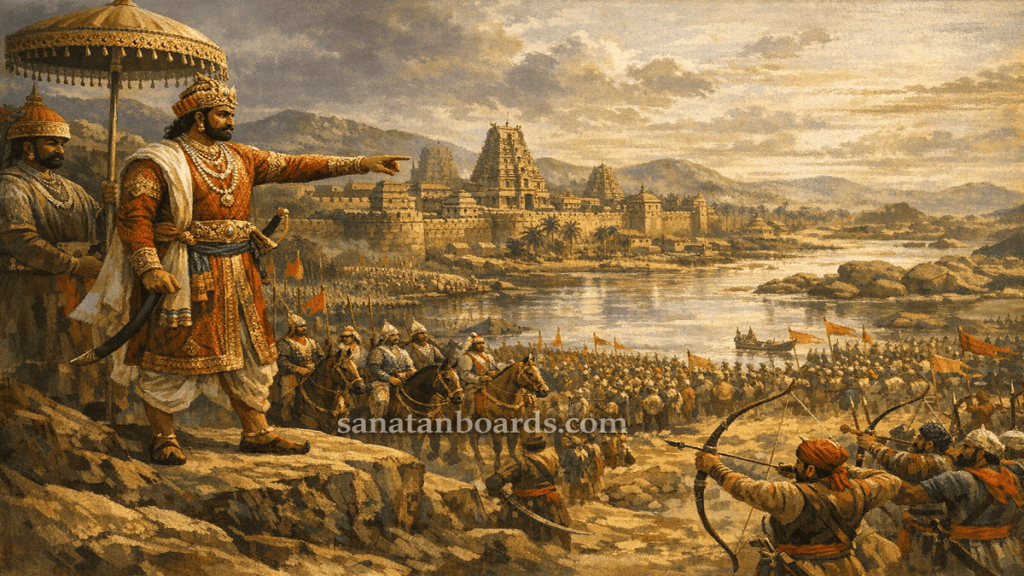
Case Study On Devaraya I (Vijayanagar)
Background
DEVARAYA I (VIJAYANAGAR) ascended the throne in 1406 CE during a period of transition in the Vijayanagar Empire. His predecessor Bukka Raya II had left the empire politically fragmented, with regional governors exercising significant autonomy Devaraya I faced the dual challenge of stabilizing internal administration and defending against external threats, primarily from the Bahmani Sultanate.
Administrative Strategy
Devaraya I implemented a centralized administrative framework. Provinces were supervised by appointed governors who coordinated tax collection, legal oversight, and infrastructure maintenance. He introduced detailed records of land ownership and revenue, enabling more predictable taxation and reducing corruption. The administration prioritized agricultural sustainability, trade facilitation, and urban development, ensuring economic stability.
Military Innovations
The Vijayanagar army underwent major reforms under Devaraya I. He imported Arabian and Persian horses, emphasizing cavalry mobility. Skilled Turkic archers were employed to enhance ranged capabilities, complementing the traditional infantry. Strategic fortifications were established at border towns, ensuring defense against Bahmani incursions. Military training and strict discipline created a professional army capable of both defense and limited territorial expansion.
Economic and Infrastructure Initiatives
Devaraya I focused heavily on irrigation and infrastructure. Aqueducts, dams, and canals were constructed along the Tungabhadra River to improve water distribution for agriculture. These projects increased crop yields, supported population growth, and secured food supply for both civilian and military populations. Trade flourished, with markets in Hampi, the capital, and surrounding towns handling goods ranging from spices to textiles. The improved economic base funded both governance and cultural projects.
Cultural and Religious Patronage
A defining feature of Devaraya I’s reign was cultural investment. He patronized poets and scholars writing in Kannada and Sanskrit, commissioning literary works that chronicled his reign and celebrated religious devotion. Temple construction was also emphasized, with architectural innovations integrating Hindu iconography and regional design. Religious institutions became centers of learning, reinforcing social cohesion and legitimizing imperial authority.
Diplomatic Relations
Devaraya I employed strategic diplomacy. Alliances with neighboring rulers, sometimes reinforced through marital ties, reduced the likelihood of conflict and expanded trade opportunities. Diplomatic correspondence ensured recognition of Vijayanagar as a regional power and helped negotiate peace treaties when necessary.
Outcomes and Legacy
By the end of his reign in 1423 CE, Devaraya I had strengthened the empire politically, economically, and culturally. His reforms stabilized administration, modernized the military, and enhanced agricultural productivity. Vijayanagar emerged as a resilient empire capable of sustaining growth under subsequent rulers like Devaraya II, who expanded territorial reach and further enhanced cultural achievements.
Key Takeaways:
- Strategic governance and centralized administration can stabilize politically fragmented regions.
- Military modernization, including foreign techniques and technology, strengthens defensive and offensive capability.
- Infrastructure development is integral to economic prosperity and state sustainability.
- Cultural patronage reinforces legitimacy and unites diverse populations.
- Diplomacy complements military and administrative strategies to maintain regional dominance.
White Paper On Devaraya I (Vijayanagar)
Executive Summary
This white paper explores DEVARAYA I (VIJAYANAGAR), examining his reign (1406–1423 CE) through governance, military innovation, economic policy, and cultural patronage. Devaraya I exemplifies how strategic leadership consolidates political power while promoting societal development.
Historical Context
The Vijayanagar Empire was established in 1336 CE, rising in response to political fragmentation in South India. By 1406, internal disputes and external threats required a decisive ruler capable of consolidating authority. Devaraya I ascended to the throne in this context, inheriting both opportunities and challenges.
Governance and Administration
Devaraya I implemented a tiered administrative system dividing the empire into provinces. Governors reported to the central authority in Hampi, overseeing tax collection, legal enforcement, and infrastructure projects. Record‑keeping and accountability reduced corruption and increased administrative efficiency. Policies prioritized agricultural sustainability and urban trade facilitation.
Military Strategy
Devaraya I recognized the importance of a modernized, disciplined army. Key innovations included:
- Importing Arabian and Persian horses for superior cavalry mobility.
- Employing skilled foreign archers to complement infantry units.
- Constructing fortifications and strategic garrisons at key border points.
These measures protected the empire against Bahmani Sultanate incursions and provided the capacity for limited expansion.
Economic Development
Agricultural productivity was bolstered through dams, aqueducts, and irrigation systems. Hampi became a center for trade, attracting merchants and artisans. Increased revenue funded governance, military operations, and cultural endeavors.
Cultural Patronage
Devaraya I invested in Kannada and Sanskrit literature, temple construction, and scholarly institutions. Patronage reinforced imperial legitimacy, nurtured intellectual growth, and promoted social cohesion.
Diplomatic Initiatives
Alliances with neighboring states, facilitated through treaties and marital ties, reduced conflict risk and enabled trade and cultural exchange.
Strategic Analysis
Devaraya I’s integrated approach—combining governance, military reform, infrastructure, culture, and diplomacy—strengthened the Vijayanagar Empire’s resilience and prosperity. His reign provides a model for leadership that balances power, economic development, and societal enrichment.
Conclusion
DEVARAYA I (VIJAYANAGAR) demonstrates that effective leadership requires both vision and execution. His policies stabilized the empire and #devaraya1vijayanagar created a foundation for future expansion under his successors, making his reign a case study in strategic governance in medieval South India.
Industry Application On Devaraya I (Vijayanagar)
1. Governance and Administration: Modern corporations can learn from Devaraya I’s hierarchical yet accountable administrative system. Delegation of authority, reporting structures, and oversight mechanisms can improve organizational efficiency.
2. Military and Security Strategy: Modern defense institutions study historical campaigns for insights into logistics, mobility, and technological integration. Devaraya I’s use of foreign cavalry and archers parallels modern multinational collaborations and technological adoption in defense.
3. Infrastructure Management: Irrigation, aqueducts, and urban planning during his reign offer lessons for sustainable infrastructure development, water resource management, and regional planning in industries like civil engineering and environmental management.
4. Economic Planning: Devaraya I’s focus on agriculture and trade provides models for supply chain management, resource allocation, and economic diversification relevant to modern agribusiness and commerce.
5. Cultural Enterprise: Patronage of arts and literature highlights the role of cultural investment in branding, social cohesion, and corporate social responsibility. Companies in media, tourism, and cultural sectors can draw inspiration from his approach.
6. Diplomacy and Negotiation: Alliances and treaties during his reign offer strategies for international business negotiations, partnerships, and conflict resolution.
7. Leadership Training: Devaraya I’s integrated approach—combining vision, execution, and people management—serves as a case study in leadership programs across management schools and executive education.
Conclusion: The historical strategies of Devaraya I provide actionable insights for modern industries. By translating his approaches in governance, #sanatandharmaaccreditationboardsinmumbai military organization, economic planning, #sanatandharmaaccreditationboardsinvijayanagara infrastructure, culture, and diplomacy into contemporary frameworks, organizations can enhance operational effectiveness, strategic planning, and cultural engagement.
SOURCE :BYJU’S
ASK FAQ
Who was DEVARAYA I (VIJAYANAGAR)?
DEVARAYA I was a ruler of the Vijayanagar Empire from 1406–1423 CE, known for military reforms, administrative efficiency, and cultural patronage in South India.
When did DEVARAYA I (VIJAYANAGAR) rule?
DEVARAYA I ruled the Vijayanagar Empire between 1406 and 1423 CE, a period of consolidation and growth for the empire.
What were the major achievements of DEVARAYA I (VIJAYANAGAR)?
His major achievements include modernizing the army, constructing irrigation systems, promoting trade, supporting literature and temple architecture, and strengthening political stability.
Where did DEVARAYA I (VIJAYANAGAR) focus his administration and projects?
He focused on the capital near Hampi, the Tungabhadra River valley, strategic border towns, and trade centers to enhance governance, agriculture, and commerce.
How did DEVARAYA I (VIJAYANAGAR) influence culture and economy?
Through patronage of literature, temple building, and scholars, combined with irrigation and trade policies, he boosted cultural development and economic prosperity in the empire.
Table of Contents
Disclaimer: This content is intended for educational and informational purposes only. The views presented are based on historical research and sources. The author and website are not responsible for any interpretations or uses of this information.