CHANDRAGUPTA II VIKRAMADITYA (GUPTA EMPIRE) stands out as one of the most illustrious rulers in Indian history, presiding over the Gupta Empire during its golden age. Known for his military prowess, administrative skills, and cultural contributions, he significantly expanded the empire’s territory and strengthened its political and economic foundations. His reign, which is often dated from around 380 CE to 415 CE, marked a period of prosperity, stability, and cultural flourishing that left a lasting legacy in Indian civilization.
Under CHANDRAGUPTA II VIKRAMADITYA (GUPTA EMPIRE), the empire reached its territorial zenith, extending across northern and central India and establishing control over key trade routes. This expansion not only enhanced the empire’s wealth but also facilitated the growth of art, literature, and science. His patronage of scholars, poets, and artists created an environment where intellectual pursuits thrived, leading to remarkable achievements in Sanskrit literature, astronomy, and mathematics.
The title “Vikramaditya,” meaning “Sun of Valor,” reflected CHANDRAGUPTA II VIKRAMADITYA (GUPTA EMPIRE)’s reputation as a courageous and just ruler. Historical records, coins, and inscriptions reveal his commitment to governance, justice, and religious tolerance, fostering social harmony across the diverse population of his empire. Trade flourished under his reign connecting India with distant regions through both land and maritime routes, and cities became hubs of cultural and economic activity.
CHANDRAGUPTA II VIKRAMADITYA (GUPTA EMPIRE) is remembered not only as a military strategist and administrator but also as a cultural icon whose reign set the benchmark for subsequent Indian kings. His era exemplifies how leadership, culture, and economic growth can intertwine to produce a golden age, leaving a legacy that continues to inspire scholars, historians, and enthusiasts of Indian heritage.
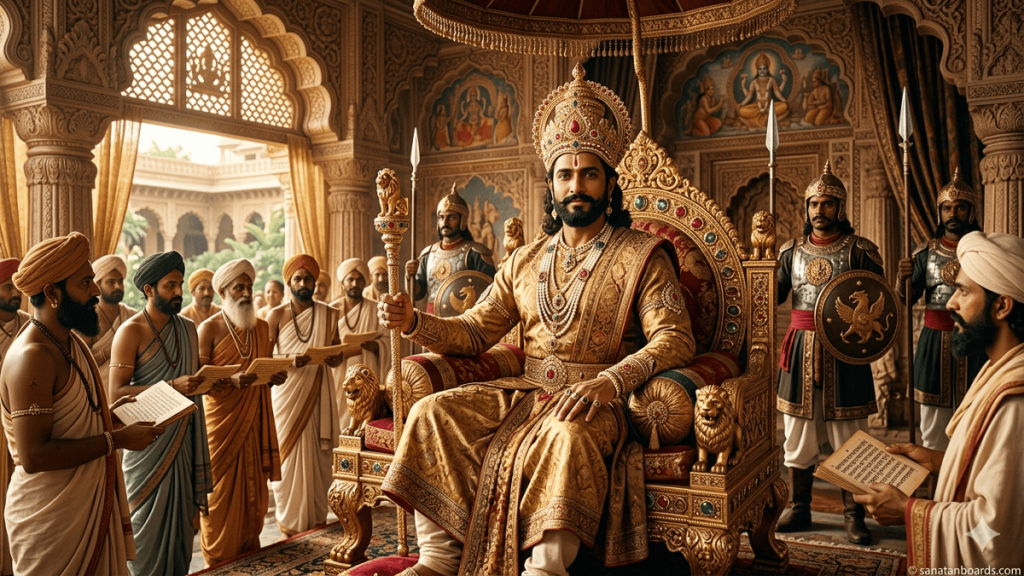
What Is Chandragupta Ii Vikramaditya (Gupta Empire)?
CHANDRAGUPTA II VIKRAMADITYA (GUPTA EMPIRE) was the third ruler of the Gupta dynasty and one of the most celebrated monarchs in Indian history. The Gupta Empire, under his reign, achieved political stability, territorial expansion, and cultural prosperity that historians often describe as India’s “Golden Age.” The empire encompassed vast regions of northern and central India, including present-day Uttar Pradesh, Bihar, Madhya Pradesh, and parts of Rajasthan and Gujarat.
CHANDRAGUPTA II VIKRAMADITYA (GUPTA EMPIRE) is recognized not only for his conquests but also for his administrative vision. He implemented an efficient governance system that balanced central authority with local autonomy, ensuring that the empire remained unified and prosperous. The ruler also emphasized economic growth through trade, both inland and via maritime routes, linking India with Southeast Asia, the Middle East, and beyond. This economic expansion strengthened the empire’s treasury, enabling large-scale patronage of arts, literature, and architecture.
His reign witnessed remarkable cultural achievements. Sanskrit literature flourished with poets and playwrights producing enduring works, while the arts, particularly sculpture and coinage, reached new heights of refinement. CHANDRAGUPTA II VIKRAMADITYA (GUPTA EMPIRE) also fostered religious tolerance, supporting Hinduism, Buddhism, and Jainism, which contributed to social cohesion and intellectual exchange.
Overall, CHANDRAGUPTA II VIKRAMADITYA (GUPTA EMPIRE) represents a fusion of military strength, administrative acumen, economic foresight, and cultural vision. He is a central figure in understanding the historical and cultural evolution of India, with his reign serving as a benchmark for rulers who followed. His contributions shaped the identity of the Gupta Empire and left a legacy of governance, culture, and prosperity that continues to be studied and admired.
Who Is Required Chandragupta Ii Vikramaditya (Gupta Empire) ?
CHANDRAGUPTA II VIKRAMADITYA (GUPTA EMPIRE) is required for historians, scholars, and students who seek to understand the political, cultural, and economic development of ancient India. His reign represents a defining period in Indian history, where governance, military strategy, and cultural patronage combined to create what is often called the Gupta Golden Age. Those studying the evolution of Indian civilization, empire-building, and classical art and literature find his life and policies particularly relevant.
Educators and researchers require CHANDRAGUPTA II VIKRAMADITYA (GUPTA EMPIRE) as a case study in effective leadership. His ability to consolidate power, expand territories, and maintain social cohesion provides lessons in statecraft, strategic planning, and administration that remain relevant even in contemporary governance studies. Military historians also study him to understand the tactics and campaigns that secured his empire, especially his victories over the western Kshatrapas and other regional powers.
Students of culture, literature, and religion require CHANDRAGUPTA II VIKRAMADITYA (GUPTA EMPIRE) because his patronage led to a flourishing of Sanskrit literature, classical arts, and architectural development. Poets, sculptors, and scholars thrived under his reign, producing works that form the foundation of India’s classical cultural heritage. Religious studies scholars also find his reign significant for the study of tolerance and coexistence, as he supported Hinduism, Buddhism, and Jainism, fostering an inclusive society.
In addition, policymakers and economists examining historical models of trade, urbanization, and economic prosperity can draw insights from CHANDRAGUPTA II VIKRAMADITYA (GUPTA EMPIRE). His ability to leverage geography, trade routes, and resource management exemplifies early economic strategy and regional integration.
When Chandragupta Ii Vikramaditya (Gupta Empire) Is Required ?
CHANDRAGUPTA II VIKRAMADITYA (GUPTA EMPIRE) is required to understand the historical and cultural context of classical India, particularly the period between the 4th and 5th centuries CE. His reign, beginning around 380 CE and extending to approximately 415 CE, represents a defining moment in the Gupta Empire, often referred to as India’s Golden Age. This period is marked by political stability, territorial expansion, economic growth, and extraordinary cultural achievement.
Studying CHANDRAGUPTA II VIKRAMADITYA (GUPTA EMPIRE) is necessary to comprehend how a ruler can balance military conquest with internal administration and cultural patronage. During his reign, he consolidated the achievements of his father, Samudragupta, and extended the empire’s influence into western India by defeating the Shaka rulers. These military campaigns were crucial not only for territorial gain but also for securing trade routes and resources, demonstrating the strategic timing and necessity of strong leadership during a formative era.
The period under CHANDRAGUPTA II VIKRAMADITYA (GUPTA EMPIRE) is also required for understanding the flourishing of Sanskrit literature, arts, and architecture. It was under his patronage that poets like Kalidasa created works that became foundational to Indian literature. Cities and urban centers prospered, trade routes thrived, and artisans produced iconic sculptures and coins, making this a period of immense economic and cultural significance.
Furthermore, CHANDRAGUPTA II VIKRAMADITYA (GUPTA EMPIRE) is required for examining the role of religious tolerance and social cohesion in sustaining an empire. By supporting Hinduism, Buddhism, and Jainism, he created an inclusive society that facilitated learning, philosophical debate, and cross-cultural exchange. This era also provides a temporal benchmark for comparing the evolution of Indian administration, military strategy, and economic practices.
Where Chandragupta Ii Vikramaditya (Gupta Empire) Is Required ?
CHANDRAGUPTA II VIKRAMADITYA (GUPTA EMPIRE) is required across the Indian subcontinent, particularly in regions that formed the core and expanded territories of the Gupta Empire. His influence was most prominently felt in northern and central India, covering areas that correspond to modern-day Uttar Pradesh, Bihar, Madhya Pradesh, Rajasthan, and Gujarat. These regions benefited from his administrative reforms, cultural patronage, and economic policies.
The western expansion, particularly the conquest of the Shaka rulers in Gujarat and surrounding areas, was critical. This region became a hub for trade, connecting inland markets to maritime routes leading to Southeast Asia, the Middle East, and beyond. CHANDRAGUPTA II VIKRAMADITYA (GUPTA EMPIRE) is required to understand how strategic geographic control enabled the Gupta Empire to dominate commerce and politics during his reign.
Urban centers under his rule, such as Pataliputra, Ujjain, and Mathura, became focal points for learning, art, and governance. These cities required strong administrative oversight, and CHANDRAGUPTA II VIKRAMADITYA (GUPTA EMPIRE) played a central role in ensuring that infrastructure, markets, and cultural institutions thrived. His coins and inscriptions found across these areas demonstrate the geographic spread of his influence and the unity he maintained across diverse regions.
In addition to urban and economic centers, CHANDRAGUPTA II VIKRAMADITYA (GUPTA EMPIRE) is required in understanding cultural geography. Temples, educational institutions, and patronized artistic works were spread across the empire, highlighting the integration of cultural influence with political control. The spread of Sanskrit literature and art reflects his deliberate effort to influence not just governance but also intellectual and aesthetic life throughout his territories.
CHANDRAGUPTA II VIKRAMADITYA (GUPTA EMPIRE) is therefore required to study the interplay between geography, politics, and culture. His reign illustrates how controlling key regions, urban hubs, and trade networks can consolidate power while fostering an environment of prosperity, learning, and artistic achievement. The geographic and cultural impact of his rule continues to provide insights into the territorial and intellectual organization of classical India.
How Chandragupta Ii Vikramaditya (Gupta Empire) Is Required ?
CHANDRAGUPTA II VIKRAMADITYA (GUPTA EMPIRE) is required through a combination of military strategy, administrative governance, economic policy, and cultural patronage. The empire’s success under his reign depended on these interlinked approaches, which collectively demonstrate how an effective ruler consolidates power and fosters societal advancement.
Militarily, CHANDRAGUPTA II VIKRAMADITYA (GUPTA EMPIRE) is required to understand conquest as a tool for strategic expansion. His campaigns against the Shakas of western India and other neighboring powers extended the empire’s boundaries, secured trade routes, and enhanced resources. These victories were not merely territorial but also economic, enabling control over key commercial hubs and facilitating wealth accumulation.
Administratively, he is required as an example of effective governance. CHANDRAGUPTA II VIKRAMADITYA (GUPTA EMPIRE) implemented a decentralized yet cohesive system, allowing local rulers autonomy while maintaining overall imperial authority. This model ensured political stability, efficient tax collection, law enforcement, and infrastructure development, which were essential for sustaining a large and diverse empire.
Economically, he is required for promoting trade, agriculture, and urban development. By securing key trade routes and encouraging markets, CHANDRAGUPTA II VIKRAMADITYA (GUPTA EMPIRE) boosted both internal commerce and international exchange. Cities thrived as centers of production, art, and scholarship, demonstrating how economic policies can reinforce cultural and political strength.
Culturally, CHANDRAGUPTA II VIKRAMADITYA (GUPTA EMPIRE) is required as a patron who integrated arts, literature, and religion into the fabric of society. He supported Sanskrit scholars, poets, and artists, while encouraging religious tolerance. This not only enriched intellectual life but also enhanced social cohesion and loyalty to the empire.
Through this multidimensional approach—military, administrative, economic, and cultural—CHANDRAGUPTA II VIKRAMADITYA (GUPTA EMPIRE) is required to study the mechanics of empire-building, governance, and cultural leadership. His methods illustrate how a ruler can achieve lasting impact by simultaneously advancing political stability, economic prosperity, and cultural flourishing, making his reign a model for understanding classical Indian civilization.
Case Study On Chandragupta Ii Vikramaditya (Gupta Empire)
Introduction
CHANDRAGUPTA II VIKRAMADITYA (GUPTA EMPIRE) represents a benchmark in classical Indian history, where military expansion, administrative innovation, economic management, and cultural patronage converged to create a Golden Age. This case study examines his strategies, governance, societal impact, and enduring legacy, drawing lessons from his reign that are relevant to scholars, historians, and policymakers.
Political Consolidation and Administration
Upon ascending the throne around 380 CE, CHANDRAGUPTA II VIKRAMADITYA (GUPTA EMPIRE) inherited a strong foundation from his father, Samudragupta. However, he faced the challenge of consolidating and stabilizing a large and diverse empire. He established a hierarchical administration, with regional governors maintaining local autonomy under imperial oversight. This system ensured law and order, efficient tax collection, and smooth implementation of royal directives. Historical evidence, such as inscriptions and coinage, demonstrates the uniformity and reach of his governance.
Military Strategy and Expansion
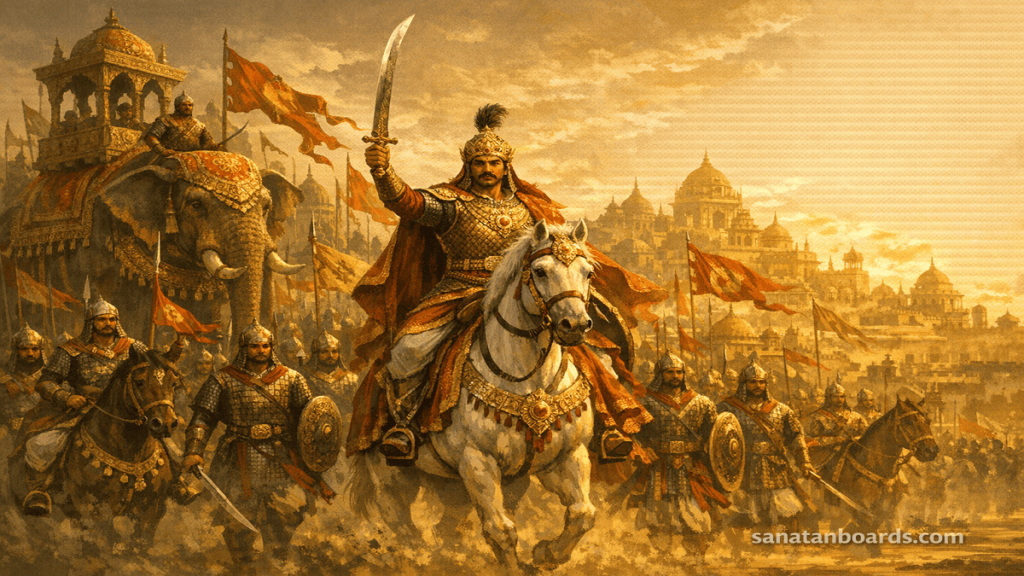
CHANDRAGUPTA II VIKRAMADITYA (GUPTA EMPIRE) conducted campaigns that extended the empire westward, most notably against the Shaka rulers in Gujarat and western India. These conquests secured trade routes, increased resource access, and enhanced the empire’s strategic position. His military success relied on careful planning, alliances, and an understanding of the geography and politics of neighboring regions. These victories also allowed for greater economic and cultural integration across the empire.
Economic Policies and Trade
Economic prosperity under CHANDRAGUPTA II VIKRAMADITYA (GUPTA EMPIRE) was fueled by agricultural productivity, trade, and urban growth. The conquest of western India opened maritime trade routes to the Middle East and Southeast Asia, enabling the flow of goods such as textiles, spices, and precious metals. Urban centers like Pataliputra, Ujjain, and Mathura became hubs of commerce, administration, and culture. Taxation and standardized coinage supported economic stability and encouraged domestic and international trade.
Cultural Patronage and Literature
CHANDRAGUPTA II VIKRAMADITYA (GUPTA EMPIRE) is remembered for his patronage of arts and literature. Under his reign, Sanskrit literature flourished with figures like Kalidasa producing works that remain foundational. Sculpture, architecture, and numismatic art reached new heights, reflecting both aesthetic sophistication and political messaging. Religious tolerance fostered the coexistence of Hinduism, Buddhism, and Jainism, encouraging intellectual exchange and social cohesion.
Societal Impact
The reign of CHANDRAGUPTA II VIKRAMADITYA (GUPTA EMPIRE) improved literacy, education, and artistic production, while maintaining social stability. By supporting multiple religions and cultural expressions, he strengthened the legitimacy of his rule and created a sense of unity among diverse populations. His policies demonstrated the importance of integrating governance, culture, and economy to sustain long-term societal prosperity.
Legacy and Lessons
CHANDRAGUPTA II VIKRAMADITYA (GUPTA EMPIRE) left a lasting legacy that serves as a model for governance, military strategy, economic planning, and cultural leadership. His reign illustrates how strategic expansion, coupled with domestic stability and cultural investment, can generate enduring prosperity. Modern scholars and policymakers can draw lessons in leadership, resource management, and societal development from this classical Indian example.
White Paper On Chandragupta Ii Vikramaditya (Gupta Empire)
Executive Summary
CHANDRAGUPTA II VIKRAMADITYA (GUPTA EMPIRE) presided over the Gupta Empire during one of its most influential periods, characterized by territorial expansion, economic growth, and cultural flourishing. This white paper analyzes his governance, military strategy, economic policies, and cultural patronage, drawing insights for modern leadership, policy-making, and historical scholarship.
Historical Context
During the late 4th and early 5th centuries CE, India experienced political consolidation under the Gupta dynasty. CHANDRAGUPTA II VIKRAMADITYA (GUPTA EMPIRE) inherited an empire with substantial resources but faced challenges in managing diverse regions, maintaining trade routes, and fostering stability across a large population. His strategies were instrumental in transforming the Gupta Empire into a model of prosperity and cultural achievement.
Governance Model
CHANDRAGUPTA II VIKRAMADITYA (GUPTA EMPIRE) implemented a decentralized yet cohesive administrative system. Regional governors were responsible for local governance while adhering to imperial directives. This model allowed flexibility in local administration, ensured efficient tax collection, and minimized rebellions. Standardized coinage and uniform inscriptions reinforced the emperor’s authority across distant territories.
Military and Strategic Planning
CHANDRAGUPTA II VIKRAMADITYA (GUPTA EMPIRE) conducted carefully planned military campaigns to consolidate power and expand territory. By defeating the Shakas in western India, he secured economic resources, trade routes, and strategic strongholds. His military policies combined diplomacy, alliances, and tactical superiority, offering lessons in strategic leadership relevant to both historical and contemporary studies.
Economic Framework
Economic policies under CHANDRAGUPTA II VIKRAMADITYA (GUPTA EMPIRE) focused on trade expansion, urban development, and resource management. Control over key trade hubs enabled domestic prosperity and international commerce. Agricultural productivity, taxation systems, and coinage standards contributed to a sustainable economic framework. Urban centers like Pataliputra became thriving hubs for administration, commerce, and culture.
Cultural and Educational Policies
CHANDRAGUPTA II VIKRAMADITYA (GUPTA EMPIRE) emphasized cultural patronage, supporting Sanskrit literature, sculpture, and architecture. Scholars, poets, and artists thrived under royal patronage. Religious tolerance allowed Hinduism, Buddhism, and Jainism to coexist, promoting intellectual diversity. These policies enhanced societal cohesion and contributed to the empire’s long-lasting cultural legacy.
Implications for Modern Studies
Studying CHANDRAGUPTA II VIKRAMADITYA (GUPTA EMPIRE) offers valuable lessons in leadership, administration, economic planning, and cultural integration. His reign demonstrates how strategic governance and cultural investment can produce sustainable prosperity, offering insights applicable to historical analysis, public administration, and economic policy studies.
Conclusion
CHANDRAGUPTA II VIKRAMADITYA (GUPTA EMPIRE) exemplifies the intersection of military strategy, administrative innovation, economic foresight, and cultural patronage. His reign provides a framework for understanding classical Indian civilization and offers lessons for leadership, governance, and societal development across historical and contemporary contexts.
Industry Application On Chandragupta Ii Vikramaditya (Gupta Empire)
Introduction
While CHANDRAGUPTA II VIKRAMADITYA (GUPTA EMPIRE) is a historical figure, his strategies and policies have modern relevance for various industries, including governance, education, culture, trade, urban planning, and leadership development. By studying his reign, modern enterprises and institutions can draw lessons in strategic planning, resource management, innovation, and cultural engagement.
Governance and Leadership Models
Industries in leadership development, corporate strategy, and public administration can apply lessons from CHANDRAGUPTA II VIKRAMADITYA (GUPTA EMPIRE). His decentralized yet cohesive governance model demonstrates the effectiveness of balancing autonomy with central oversight. Businesses and government agencies can use this framework to manage complex organizations, ensuring both efficiency and flexibility. Leadership programs can study his military strategy and administrative decisions as examples of tactical decision-making, risk assessment, and stakeholder management.
Economic and Trade Applications
CHANDRAGUPTA II VIKRAMADITYA (GUPTA EMPIRE)’s emphasis on trade routes and resource management provides insights for modern commerce, logistics, and supply chain industries. Securing key trade hubs, as he did with Gujarat and western India, mirrors modern strategies for strategic market positioning. Urban development and resource distribution during his reign can inform contemporary urban planning, infrastructure development, and sustainable economic growth strategies.
Education and Cultural Industries
His patronage of literature, art, and education underlines the value of investing in human capital. Modern educational institutions, cultural organizations, and creative industries can apply these principles to foster innovation, talent development, and cultural entrepreneurship. Encouraging intellectual and artistic growth, as he did with scholars and artists, parallels today’s investment in research, creativity, and knowledge-based industries.
Tourism and Heritage Management
CHANDRAGUPTA II VIKRAMADITYA (GUPTA EMPIRE) also has applications in heritage, tourism, and cultural preservation industries. Promoting awareness of historical sites, inscriptions, coins, and art from his reign can generate cultural tourism, create educational content, and preserve intangible heritage. Heritage management strategies can learn from how his administration integrated culture, religion, and politics to create cohesive societies.
Strategic and Analytical Applications
Modern strategy consultants and historical analysts can use CHANDRAGUPTA II VIKRAMADITYA (GUPTA EMPIRE) as a case study for decision-making under uncertainty, resource allocation, and balancing competing objectives. His reign illustrates integrating multiple domains—military, economic, cultural, and social—into a unified strategy, which is directly applicable to cross-functional business planning and project management.
Conclusion
CHANDRAGUPTA II VIKRAMADITYA (GUPTA EMPIRE) offers insights across leadership, trade, education, cultural industries, urban planning, and #sanatandharmaaccreditationboardsinmumbai strategic analysis. By translating historical strategies into modern frameworks, industries can benefit from lessons in governance, resource optimization, talent development, and #sanatandharmaaccreditationboardsinvasai cultural engagement. His reign demonstrates the timeless value of integrated planning, foresight, and cultural investment for sustainable growth and societal advancement.
SOURCE : Bookstawa
ASK FAQ
Who was CHANDRAGUPTA II VIKRAMADITYA (GUPTA EMPIRE)?
CHANDRAGUPTA II VIKRAMADITYA (GUPTA EMPIRE) was the third ruler of the Gupta dynasty, known for expanding the empire, promoting trade, and fostering arts and culture during India’s Golden Age (c. 380–415 CE).
When did CHANDRAGUPTA II VIKRAMADITYA (GUPTA EMPIRE) rule India?
He ruled from around 380 CE to 415 CE, a period marked by political stability, cultural flourishing, and economic prosperity in northern and western India.
What were the major achievements of CHANDRAGUPTA II VIKRAMADITYA (GUPTA EMPIRE)?
His achievements include defeating the Shaka rulers, expanding the Gupta Empire, promoting Sanskrit literature, supporting arts and architecture, and encouraging religious tolerance.
Why is CHANDRAGUPTA II VIKRAMADITYA (GUPTA EMPIRE) considered a great ruler?
He is considered great due to his military victories, strong governance, economic policies, cultural patronage, and promotion of social harmony across his diverse empire.
Where did CHANDRAGUPTA II VIKRAMADITYA (GUPTA EMPIRE) expand his empire?
He expanded the Gupta Empire across northern and central India, including Uttar Pradesh, Bihar, Madhya Pradesh, Rajasthan, and western India, securing key trade routes and urban centers.
Table of Contents
Disclaimer: The information provided on CHANDRAGUPTA II VIKRAMADITYA (GUPTA EMPIRE) is for educational and informational purposes only. While we strive for accuracy, historical interpretations may vary, and readers should consult additional sources for research or academic use.