
The Gupta Empire is often referred to as the Golden Age of Ancient India due to its remarkable achievements in politics, culture, science, and art. It was founded by Chandragupta I around the early 4th century CE. He strengthened the empire through strategic alliances, including marriage which helped expand his territory and influence.
His successor, Samudragupta, is known as the “Napoleon of India” because of his extensive military campaigns. He expanded the empire across much of the Indian subcontinent and promoted peace, trade, and cultural development.
Later, Chandragupta II, also known as Vikramaditya, brought the empire to its peak. His reign saw advancements in literature, astronomy, mathematics, and art. Scholars like Kalidasa flourished during this time.
What is GUPTA EMPIRE – CHANDRAGUPTA I, SAMUDRAGUPTA, CHANDRAGUPTA II (VIKRAMADITYA)?
The Gupta Empire refers to a powerful dynasty in ancient India that existed between the 4th and 6th centuries CE. It represents a period of political stability, economic prosperity, and cultural advancement.
The empire began with Chandragupta I, who laid the foundation by uniting regions and forming strong alliances. His leadership marked the beginning of a centralized political system.
The expansion of the empire is mainly associated with Samudragupta. He conducted successful military campaigns across India and established dominance over many regions. His policies helped maintain peace and stability.
The period reached its peak under Chandragupta II. His reign is known for cultural and intellectual growth. Significant advancements were made in mathematics, astronomy, literature, and art. The court of Vikramaditya became a center for scholars and thinkers.
The Gupta Empire is also known for religious harmony, supporting Hinduism, Buddhism, and Jainism. Its contributions to science and education have had a lasting impact on the world.
Who is Required GUPTA EMPIRE – CHANDRAGUPTA I, SAMUDRAGUPTA, CHANDRAGUPTA II (VIKRAMADITYA) ?
The study of the Gupta Empire requires focusing on several key figures who played pivotal roles in the establishment, expansion, and cultural development of the empire.
Firstly, Chandragupta I is required as the founder. He united several small kingdoms, established political alliances through marriage, and laid the administrative framework for the empire. Chandragupta I’s role is required to understand the origin of the Gupta dynasty and the strategies used to consolidate power.
Secondly, Samudragupta is required for his exceptional military achievements. Often called the “Napoleon of India,” he expanded the empire to its largest territorial extent. His leadership and campaigns illustrate the importance of military strategy combined with diplomatic negotiations. Samudragupta is required to study the dynamics of empire-building and political influence in ancient India.
Thirdly, Chandragupta II is required to understand the height of cultural and intellectual prosperity. Under his rule, arts, literature, science, and mathematics reached unprecedented levels. Scholars like Kalidasa (poetry and drama) and Aryabhata (mathematics and astronomy) flourished, showing the significance of patronage. Chandragupta II’s contributions are required to appreciate the Gupta Empire as a model of cultural achievement.
Besides the three rulers, other figures are required to be studied, including ministers, generals, and scholars who contributed to governance, military campaigns, education, and scientific discovery. These individuals provide a complete picture of how the Gupta Empire maintained stability, fostered intellectual growth, and became a beacon of prosperity.
Understanding who is required in studying the Gupta Empire is essential for students, historians, and educators to grasp the human and intellectual forces behind one of India’s greatest historical periods. The combination of political leadership, military skill, and cultural patronage is what makes these figures indispensable in the study of ancient Indian history.
When is GUPTA EMPIRE – CHANDRAGUPTA I, SAMUDRAGUPTA, CHANDRAGUPTA II (VIKRAMADITYA) Required ?
The period required to study the Gupta Empire spans approximately 320 CE to 550 CE. This timeline captures the foundation, expansion, peak, and eventual decline of the empire, making it essential for historical and educational study.
The early period under Chandragupta I (c. 320–335 CE) is required to understand how the empire was founded. Chandragupta I’s strategic alliances, administrative framework, and consolidation of territories laid the foundation for subsequent rulers. Studying this period is required to analyze the methods used to establish political stability in a fragmented region.
The reign of Samudragupta (c. 335–375 CE) is required to examine military expansion and diplomatic relations. Samudragupta’s campaigns across northern India and parts of central India demonstrate how conquest and administration ensured unity and stability. This period is also required to understand the integration of conquered regions into the empire’s political and economic systems.
The period of Chandragupta II (c. 375–415 CE) is required to study the peak of the Gupta Empire. Cultural, scientific, and economic achievements during this period exemplify why it is called the Golden Age of India. Understanding this period is required to appreciate advancements in literature, mathematics, astronomy, architecture, and the arts.
The later period, c. 415–550 CE, is required to understand the gradual decline of the empire. Factors such as regional autonomy, invasions, and succession issues are crucial to study the full lifecycle of the Gupta Empire.
Where is GUPTA EMPIRE – CHANDRAGUPTA I, SAMUDRAGUPTA, CHANDRAGUPTA II (VIKRAMADITYA) Required ?
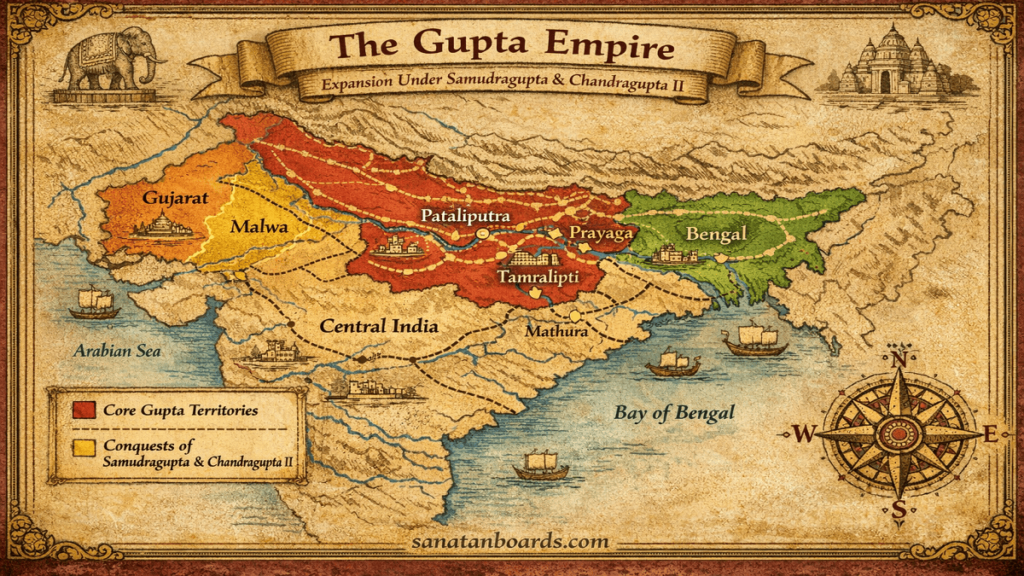
The study of the Gupta Empire requires focusing on geographical regions where the empire originated, expanded, and flourished. Understanding where is required helps students and historians analyze the political, cultural, and economic significance of the empire in ancient India.
The empire was initially centered in Magadha, present-day Bihar. This region is required because it served as the political and administrative core under Chandragupta I. Magadha’s fertile land, strategic location, and river systems allowed the empire to consolidate power effectively and maintain control over surrounding territories.
The northern regions of India, including parts of Uttar Pradesh and Bengal, are required for study because they were key areas of military campaigns under Samudragupta. Samudragupta expanded the empire into these territories through a combination of warfare and alliances. These regions are required to understand how political control and trade routes contributed to the empire’s prosperity.
Western India, including regions like Gujarat and Malwa, is required during the reign of Chandragupta II. These areas were important for trade, cultural exchange, and economic development. Studying these regions shows how the empire integrated diverse cultures, encouraged commerce, and promoted architectural and artistic growth.
Central India is required to understand how the Gupta Empire managed administration and governance across vast territories. The presence of important cities, trade routes, and cultural centers in these regions illustrates the empire’s strategic planning and influence.
Finally, some southern regions, though not fully under direct control, are required to study because of tributary relationships and cultural exchange. These areas reflect how the Gupta Empire maintained influence without direct administration, highlighting diplomacy as a key strategy.
How is GUPTA EMPIRE – CHANDRAGUPTA I, SAMUDRAGUPTA, CHANDRAGUPTA II (VIKRAMADITYA) Required ?
Understanding how the Gupta Empire developed and thrived is required to appreciate its success in governance, culture, and intellectual advancement. The study focuses on methods of leadership, military expansion, administration, and cultural patronage.
The foundation of the empire was laid through strategic alliances and governance by Chandragupta I. How the empire grew required understanding Chandragupta I’s use of diplomacy, marriage alliances, and consolidation of territories. His approach combined political skill with administrative foresight, ensuring stability in the formative years.
The military expansion of the empire is required to be studied under Samudragupta. How he conducted campaigns, integrated conquered regions, and maintained loyalty was crucial for unifying northern India. His strategy combined force with diplomacy, allowing the empire to expand without overextending resources. Studying his military methods shows how planning and leadership contributed to long-term political control.
The cultural and intellectual peak under Chandragupta II demonstrates how the empire achieved prosperity through patronage of arts and sciences. How literature, mathematics, astronomy, and art flourished under his reign is required to understand the Golden Age. Scholars such as Kalidasa and Aryabhata exemplify how intellectual growth was supported by the state.
Administrative policies, taxation systems, trade networks, and religious tolerance are also required to understand how the empire functioned smoothly. How governors, ministers, and local rulers maintained order and facilitated commerce explains the empire’s economic success.
Finally, understanding how social and cultural integration was achieved is required. How diverse communities were united under a common political and cultural framework illustrates the empire’s effective management and cohesive identity.
Case Study on GUPTA EMPIRE – CHANDRAGUPTA I, SAMUDRAGUPTA, CHANDRAGUPTA II (VIKRAMADITYA)
Introduction
The Gupta Empire serves as one of the most significant examples of political, military, and cultural success in ancient India. This case study examines the empire under its three major rulers: Chandragupta I, Samudragupta, and Chandragupta II, highlighting strategies, governance, cultural contributions, and long-term impact.
Foundation under Chandragupta I
Chandragupta I established the Gupta dynasty around 320 CE, uniting several small kingdoms. He focused on political alliances, including marriages and strategic partnerships, to consolidate power. Chandragupta I’s administration emphasized stability, efficient tax collection, and maintaining law and order. The foundation laid by him created conditions for military expansion and cultural flourishing in subsequent reigns.
Expansion under Samudragupta
Samudragupta, known as the “Napoleon of India,” expanded the empire across northern and central India. His military campaigns relied on careful planning, rapid mobility, and strategic use of alliances. He integrated conquered regions through tribute systems rather than total subjugation, ensuring loyalty and minimizing resistance. Samudragupta’s reign also promoted economic growth through trade and infrastructure development, making expansion sustainable.
Cultural Apex under Chandragupta II
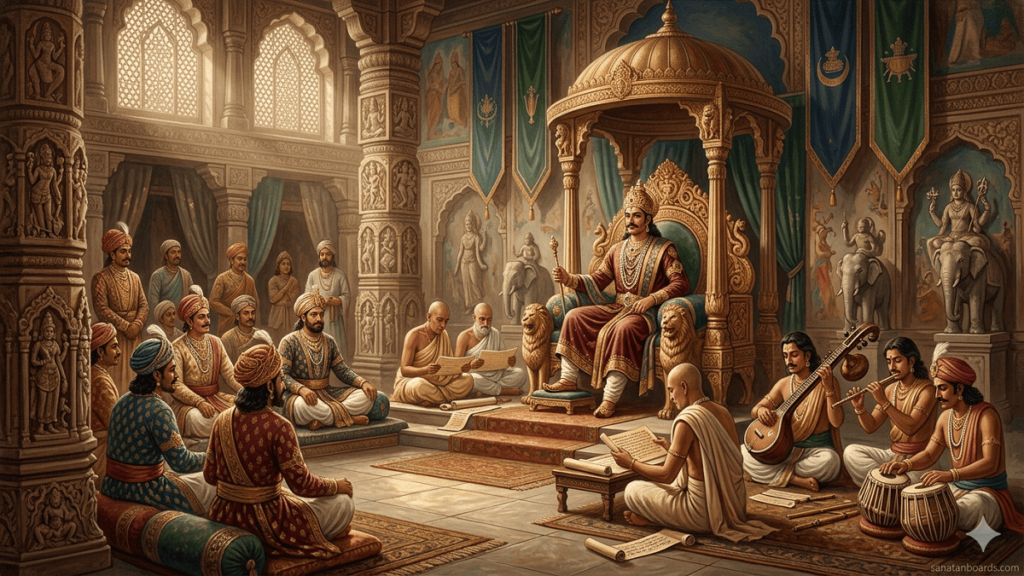
Chandragupta II, or Vikramaditya, brought the empire to its peak. He patronized scholars, poets, and scientists, creating a vibrant cultural environment. Works by Kalidasa in literature and Aryabhata in mathematics and astronomy flourished during this period. Architecture, including temples and coins, reflected both aesthetic excellence and economic prosperity. Religious tolerance under his reign allowed diverse communities to coexist peacefully.
Administration and Governance
The Gupta Empire had a highly organized administration with governors overseeing provinces, revenue collection systems, and law enforcement. Local autonomy under central supervision ensured effective governance. Trade routes connecting northern and western India strengthened the economy, while urban centers became hubs of commerce, learning, and culture.
Social and Economic Aspects
Agriculture was the backbone of the economy, supplemented by trade in spices, textiles, and metals. Coinage standardized under Chandragupta II facilitated commerce. Socially, the caste system existed but was complemented by educational opportunities, enabling scholars and artisans to contribute to the empire’s prosperity.
Decline and Lessons
The Gupta Empire gradually declined due to weak successors, invasions, and regional autonomy. However, the case study of this empire provides lessons in leadership, governance, strategic planning, cultural investment, and integration of diverse populations.
Conclusion
The Gupta Empire demonstrates a successful #sanatandharmaaccreditationboardsofguptaempire model of political stability, military strategy, cultural patronage, and economic prosperity, offering valuable insights for historians #sanatandharmaaccreditationboardsofguptaempireinmumbai and educators.
White Paper On GUPTA EMPIRE – CHANDRAGUPTA I, SAMUDRAGUPTA, CHANDRAGUPTA II (VIKRAMADITYA)
Introduction
The Gupta Empire represents a model of governance, cultural excellence, and intellectual achievement in ancient India. This white paper analyzes the political structure, administration, economic policies, cultural contributions, and lasting legacy of the Gupta Empire under its key rulers: Chandragupta I, Samudragupta, and Chandragupta II. The purpose is to provide a comprehensive understanding of how this empire achieved stability, prosperity, and intellectual growth.
Political Structure and Governance
Chandragupta I established a centralized monarchy, bringing together several smaller kingdoms through alliances and diplomacy. He implemented administrative divisions that allowed local governance under the oversight of central authority, a method required to maintain order and efficiency. Samudragupta expanded the empire, using a combination of military campaigns and tribute systems, which allowed conquered regions autonomy while securing loyalty. Chandragupta II consolidated governance by appointing governors, ministers, and officials to manage provinces, ensuring efficient tax collection, law enforcement, and infrastructure development.
Economic Policies
Trade, agriculture, and taxation formed the backbone of the Gupta economy. Standardized coinage introduced during Chandragupta II facilitated trade across northern and western India. Key trade routes connected Magadha, Malwa, Gujarat, and central India, allowing the empire to benefit from commerce in textiles, spices, metals, and luxury goods. The white paper highlights how economic planning underpinned political stability and cultural investment.
Cultural and Intellectual Contributions
The Gupta Empire achieved its Golden Age through patronage of literature, arts, and sciences. Chandragupta II’s court supported scholars like Kalidasa (literature) and Aryabhata (mathematics and astronomy). Temples, sculptures, and architecture demonstrated the integration of religion and aesthetics. Literature and arts flourished due to state encouragement, creating enduring cultural legacies. Religious tolerance under all three rulers encouraged diverse beliefs, including Hinduism, Buddhism, and Jainism.
Military Strategy
Samudragupta’s military prowess was instrumental in expanding the empire. His campaigns were carefully planned, combining strategic sieges, rapid troop movements, and diplomacy. How conquered territories were integrated through tribute systems rather than total domination demonstrates a balance of force and governance.
Education and Knowledge Systems
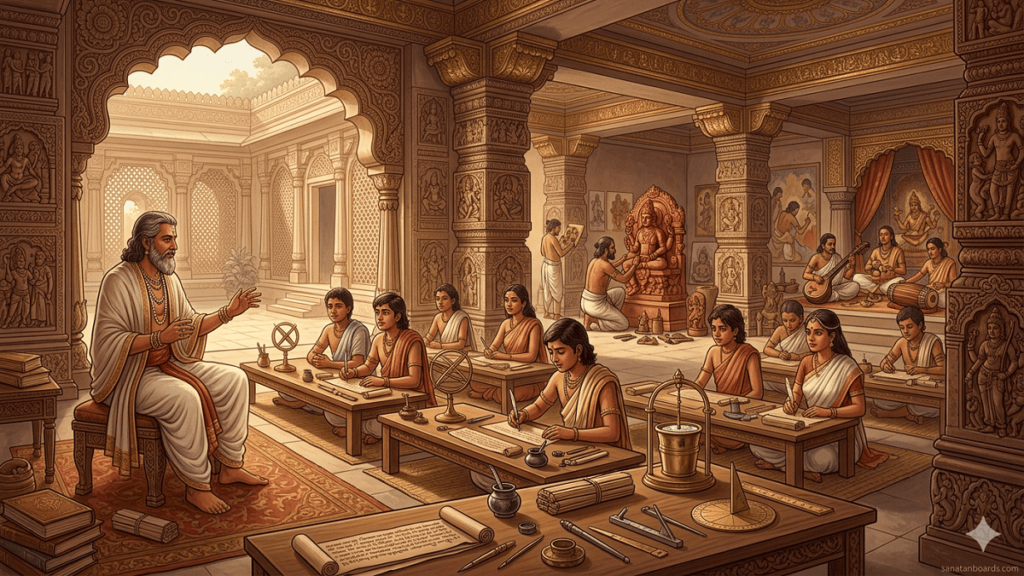
Centers of learning and universities developed under Gupta patronage. Education was required to train scholars, administrators, and priests. The white paper emphasizes the correlation between intellectual growth and political stability.
Conclusion
The Gupta Empire demonstrates a successful integration of #sanatandharmaaccreditationboardsinbihar governance, military strategy, economic planning, and cultural investment. Lessons from this empire remain relevant for policymakers, educators, #sanatandharmaaccreditationboardsinuttarpradesh and historians seeking models of sustainable growth and societal prosperity.
Industry Application of GUPTA EMPIRE – CHANDRAGUPTA I, SAMUDRAGUPTA, CHANDRAGUPTA II (VIKRAMADITYA)
Introduction
Although the Gupta Empire existed over 1,500 years ago, its principles have modern relevance. Leadership, strategic planning, administration, cultural patronage, and education under Chandragupta I, Samudragupta, and Chandragupta II provide lessons applicable in today’s industries.
Leadership and Governance in Business
Chandragupta I’s strategic alliances and governance model demonstrate the importance of clear leadership and structured decision-making. Modern corporate governance can learn from this centralized yet flexible approach, emphasizing delegation and oversight for efficiency.
Strategic Expansion and Market Penetration
Samudragupta’s military campaigns mirror strategies in corporate expansion and market penetration. Using diplomacy alongside strategic action, companies can expand into new regions while maintaining local partnerships. His integration of conquered territories reflects modern practices of mergers, acquisitions, and stakeholder management.
Innovation and Cultural Investment
Chandragupta II’s patronage of arts, science, and literature parallels modern investment in research, innovation, and employee development. Just as his empire thrived through intellectual growth, companies today benefit from fostering creativity, continuous learning, and R&D.
Economic Planning and Trade
The Gupta Empire’s economic policies, trade networks, and standardized coinage offer lessons for supply chain management, trade optimization, and financial standardization. Business leaders can study how infrastructure, currency stability, and trade connectivity enhance prosperity.
Education and Knowledge Systems
Education was integral to the Gupta Empire’s success. Modern industries benefit from structured training, skill development programs, and knowledge-sharing platforms, similar to how the empire cultivated scholars and administrators.
Cultural and Ethical Frameworks
Religious tolerance and cultural integration under the Gupta rulers can guide corporate social responsibility initiatives and multicultural workplace management. Respect for diversity strengthens cohesion and productivity.
Sustainability and Legacy
The Gupta Empire’s careful balance of expansion, governance, and cultural patronage ensured long-term stability. Modern businesses can emulate this through sustainable practices, ethical growth, and innovation-driven strategies that leave lasting impact.
Conclusion
The Gupta Empire offers valuable lessons for leadership, strategic planning , #sanatandharmaaccreditationboardsinmumbai economic management, innovation, education, and cultural integration. Applying these historical principles can enhance #sanatandharmaaccreditationboardsinvasai organizational growth, sustainability, and legacy in modern industries.
source : Kings and Generals
ASK FAQ
What is the Gupta Empire?
The Gupta Empire was an ancient Indian dynasty (c. 320–550 CE) known as the Golden Age for its advancements in governance, arts, science, and culture.
Who were the key rulers of the Gupta Empire?
Chandragupta I, Samudragupta, and Chandragupta II were the main rulers responsible for its foundation, expansion, and cultural peak.
When did the Gupta Empire exist?
The empire existed approximately from 320 CE to 550 CE, spanning the foundation, expansion, peak, and decline periods.
Where was the Gupta Empire located?
The Gupta Empire was centered in Magadha (modern Bihar) and extended across northern, central, and western India, including regions like Uttar Pradesh, Bengal, Gujarat, and Malwa.
Why is the Gupta Empire important?
It is important for its political stability, military achievements, economic prosperity, cultural and scientific advancements, and promotion of education and religious tolerance.
Table of Contents
Disclaimer
This content is intended solely for educational and informational purposes. It is designed to provide historical knowledge about the Gupta Empire and its key rulers, including Chandragupta I, Samudragupta, and Chandragupta II. While efforts have been made to ensure accuracy, this material does not substitute professional historical research or advice. Any references, interpretations, or analyses are for learning purposes and general knowledge only, and readers should consult scholarly sources for academic or research-related use.