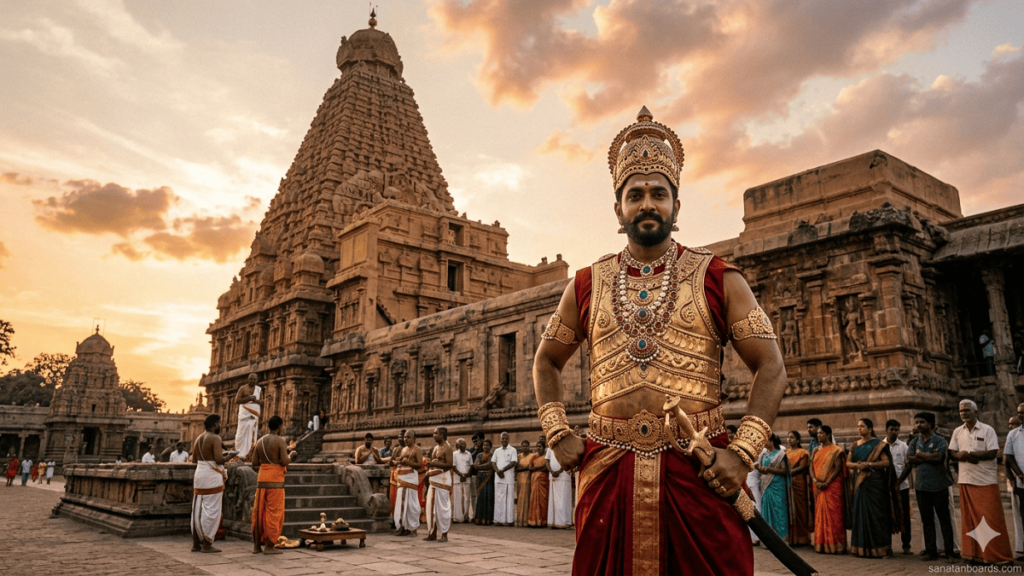
The Chola Dynasty was one of the most powerful and influential empires in South Indian history. It reached its peak under the leadership of Rajaraja Chola I and his son Rajendra Chola I. Rajaraja Chola I who ruled from 985 to 1014 CE, transformed the Chola kingdom into a vast empire through strong military campaigns and efficient administration. He is best known for constructing the Brihadeeswarar Temple in Thanjavur, a UNESCO World Heritage site that reflects the architectural brilliance of the Chola period.
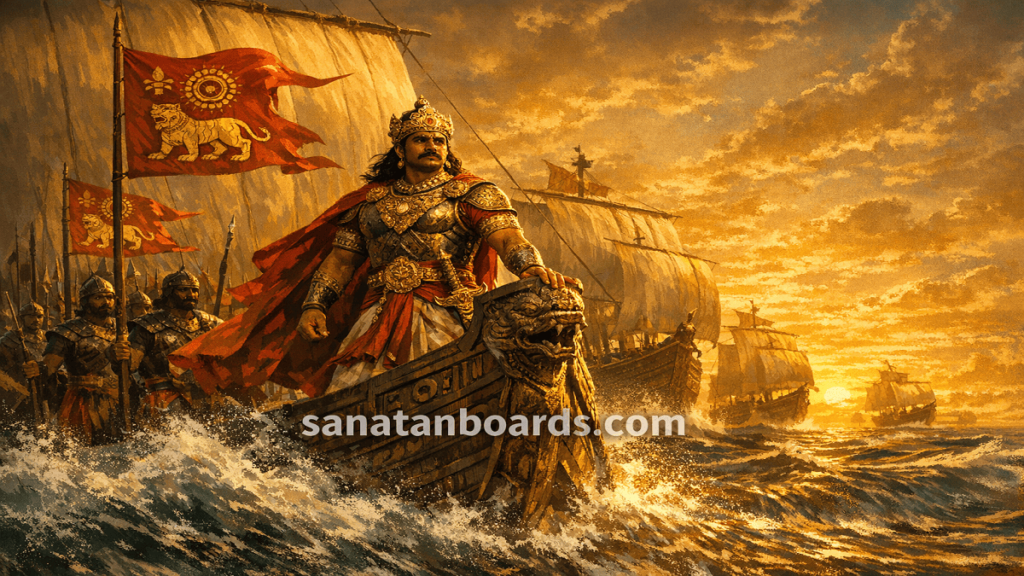
Rajendra Chola I, his successor, expanded the empire even further beyond India. He led successful naval expeditions to Southeast Asia, including regions like Srivijaya, making the Cholas one of the earliest Indian powers to establish overseas dominance. He also established a new capital called Gangaikonda Cholapuram.
Both rulers contributed significantly to governance, temple architecture, trade, and cultural development. Their reign marked a golden age in South Indian history, characterized by prosperity, administrative efficiency, and cultural richness. The legacy of the Chola Dynasty continues to influence Indian art, architecture, and history today.
What Is The Chola Dynasty – Rajaraja Chola I, Rajendra Chola I ?
The Chola Dynasty refers to a powerful South Indian imperial dynasty that ruled large parts of southern India and beyond between the 9th and 13th centuries. Among its greatest rulers were Rajaraja Chola I and Rajendra Chola I, who played a crucial role in shaping its identity and expanding its influence.
Rajaraja Chola I is considered the architect of the Chola Empire’s greatness. He strengthened the military, improved administrative systems, and expanded the empire across Tamil Nadu, Kerala, and parts of Sri Lanka. His reign also emphasized temple construction, especially the iconic Brihadeeswarar Temple, which symbolized both religious devotion and political power.
Rajendra Chola I continued his father’s legacy but took it even further. He extended the empire’s reach into North India and Southeast Asia. His naval expeditions demonstrated the Cholas’ maritime strength, establishing trade and cultural links with regions like Indonesia, Malaysia, and Thailand.
The Chola Dynasty under these rulers is known for its efficient governance system, including local self-governance through village assemblies. It also promoted art, literature, and Dravidian temple architecture. The dynasty maintained strong trade networks with China and the Arab world, boosting economic prosperity.
Who Required Chola Dynasty – Rajaraja Chola I, Rajendra Chola I ?
The topic Chola Dynasty – Rajaraja Chola I, Rajendra Chola I is required by a wide range of individuals and groups who are involved in education, research, governance studies, and cultural understanding. It is especially important for students, historians, researchers, and professionals who seek knowledge about Indian history and ancient administrative systems.
Firstly, this topic is required by students at school and university levels. It forms an essential part of history and social science curricula. By studying the achievements of Rajaraja Chola I and Rajendra Chola I, students gain insights into empire-building, leadership, and cultural development. It also helps them understand how historical events have shaped modern society.
Secondly, historians and researchers require this topic for in-depth analysis of ancient Indian civilizations. They study inscriptions, temple architecture, and historical records to understand the political, economic, and social systems of the Chola Empire. The reigns of these rulers provide valuable case material for academic research.
Thirdly, this topic is required by professionals in fields such as archaeology, tourism, and heritage management. Archaeologists study monuments and artifacts from the Chola period, while tourism professionals use this knowledge to promote historical sites like Thanjavur. Heritage managers rely on this information to preserve and protect cultural landmarks.
Additionally, policymakers and scholars in governance studies require this topic. The Chola system of local self-governance is often studied as an early model of decentralized administration. It provides useful lessons for modern governance and public administration.
Educators and content creators also require this topic to develop learning materials, blogs, and educational resources. It helps them present accurate and meaningful information to a wider audience.
When Chola Dynasty – Rajaraja Chola I, Rajendra Chola I Is Required ?
The topic Chola Dynasty – Rajaraja Chola I, Rajendra Chola I is required in various academic, historical, and analytical contexts, especially when studying the development of powerful empires in medieval India. This subject becomes particularly important when examining the period between the 10th and 11th centuries, which marks the golden age of the Chola Empire under the rule of Rajaraja Chola I and Rajendra Chola I.
This topic is required in school and university education when learners explore Indian history, political science, and cultural studies. It helps students understand how strong leadership, strategic planning, and administrative efficiency contributed to the growth of a powerful empire. Rajaraja Chola I’s reforms and military expansion provide insight into how a regional kingdom can transform into a dominant force.
The topic is also required when studying global history, especially in understanding early international relations and maritime activities. Rajendra Chola I’s naval expeditions to Southeast Asia demonstrate India’s early involvement in overseas trade and diplomacy. This makes the topic essential when analyzing ancient globalization and trade networks.
Furthermore, this subject is required when exploring temple architecture, art, and cultural heritage. The temples built during this period, such as the Brihadeeswarar Temple, reflect not only religious devotion but also economic and social organization. These structures are important case examples in architecture and archaeology studies.
In modern contexts, the topic is required when discussing governance models. The Chola system of local self-governance through village assemblies provides an early example of decentralized administration. This is relevant for understanding modern democratic systems and grassroots governance.
Where Chola Dynasty – Rajaraja Chola I, Rajendra Chola I Is Required ?
Chola Dynasty – Rajaraja Chola I, Rajendra Chola I is required in multiple geographical, academic, and research contexts. It is especially relevant in regions connected to the historical influence of the Chola Empire and in institutions where history and cultural studies are taught.
Geographically, this topic is required in South India, particularly in Tamil Nadu, where the Chola Empire was centered. Cities such as Thanjavur and Gangaikonda Cholapuram are historically significant locations associated with Rajaraja Chola I and Rajendra Chola I. These places serve as important sites for historical research, tourism, and cultural preservation.
The topic is also required in regions outside India, particularly in Southeast Asia, including countries like Indonesia, Malaysia, and Thailand. This is because Rajendra Chola I led naval expeditions that extended the influence of the Chola Empire to these regions. Therefore, the topic is important in understanding cultural exchange and historical connections between India and Southeast Asia.
Academically, this topic is required in schools, colleges, and universities across India and globally. It is included in history, archaeology, political science, and cultural studies courses. Researchers and historians study this topic to analyze ancient governance systems, trade networks, and military strategies.
The topic is also required in museums, heritage sites, and cultural institutions. Artifacts, inscriptions, and temple architecture from the Chola period are preserved and studied in these places. They provide valuable information about the social, economic, and cultural life of that era.
How Chola Dynasty – Rajaraja Chola I, Rajendra Chola I Is Required ?
Chola Dynasty – Rajaraja Chola I, Rajendra Chola I is required in a structured and analytical way to understand the development and success of one of the greatest empires in Indian history. It is studied through multiple approaches, including historical analysis, archaeological research, and comparative studies.
Firstly, the topic is required through historical study methods, where scholars examine inscriptions, records, and literary sources. These sources provide detailed information about the शासन (administration), military campaigns, and achievements of Rajaraja Chola I and Rajendra Chola I. By analyzing these records, historians understand how the empire functioned and expanded.
Secondly, the topic is required through archaeological methods. Temples, sculptures, and monuments built during the Chola period serve as physical evidence of their achievements. Structures like the Brihadeeswarar Temple help researchers study architecture, engineering, and cultural practices of that time.
Thirdly, the topic is required through comparative analysis. Scholars compare the Chola Dynasty with other contemporary empires to understand differences in governance, military strategy, and economic systems. This helps in identifying what made the Cholas unique and successful.
The topic is also required through educational frameworks. Teachers use this subject to explain concepts like empire-building, trade networks, and decentralized governance. It is taught using maps, timelines, and case studies to make learning more effective.
In modern contexts, the topic is required through practical application. Concepts such as local governance, trade management, and leadership strategies derived from the Chola period are used as examples in management and political studies.
Case Study On Chola Dynasty – Rajaraja Chola I, Rajendra Chola I
Chola Dynasty – Rajaraja Chola I, Rajendra Chola I represents one of the most successful examples of empire-building, governance, and cultural expansion in Indian history. This case study analyzes how Rajaraja Chola I and Rajendra Chola I transformed the Chola kingdom into a powerful and influential empire.
Background
Before the rise of Rajaraja Chola I, the Chola kingdom was one among several regional powers in South India. However, through strong leadership and strategic planning, Rajaraja Chola I expanded the kingdom into a vast empire. His reign marked the beginning of a golden age in political stability, economic growth, and cultural achievements.
Leadership and Expansion
Rajaraja Chola I focused on military strength and territorial expansion. He conquered regions in South India and extended control over Sri Lanka. His military campaigns were well-organized, supported by a strong army and navy. This expansion increased the empire’s resources and influence.
Rajendra Chola I continued this expansion further. He led campaigns into North India and achieved victories that symbolized the power of the Chola Empire. One of his most significant achievements was the naval expedition to Southeast Asia, which demonstrated advanced maritime capabilities. These expeditions helped establish trade routes and strengthened international relations.
Administrative System
One of the key aspects of this case study is the efficient administrative system. The Chola Empire was divided into provinces, districts, and villages. Local governance was managed through village assemblies, which played an important role in decision-making. This decentralized system ensured effective administration and local participation.
Revenue collection was systematic and well-documented. Land surveys were conducted to assess taxes, ensuring fairness and efficiency. This strong administrative structure contributed to the stability and prosperity of the empire.
Economic Development
Trade was a major factor in the success of the Chola Dynasty. The empire maintained strong trade connections with China, Southeast Asia, and the Middle East. Ports played a crucial role in facilitating trade and commerce.
The Cholas exported goods such as spices, textiles, and precious stones. This trade brought wealth and contributed to economic growth. Temples also functioned as economic centers, supporting artisans, traders, and workers.
Cultural Contributions
The Chola period is known for its cultural achievements. Temple architecture reached new heights, with structures like the Brihadeeswarar Temple showcasing advanced engineering and artistic excellence. Bronze sculptures and inscriptions reflect the rich cultural heritage of the time.
The rulers supported art, literature, and religion, creating a vibrant cultural environment. Temples served not only as religious centers but also as hubs of social and economic activity.
Challenges and Solutions
Like any empire, the Chola Dynasty faced challenges such as maintaining control over vast territories and managing resources. However, strong leadership and efficient administration helped overcome these challenges.
The use of naval power ensured control over trade routes, while local governance systems maintained stability within the empire. Strategic planning and adaptability were key to the success of the Cholas.
Conclusion
This case study highlights how the Chola Dynasty – Rajaraja Chola I, Rajendra Chola I achieved #sanatandharmaaccreditationboardsingujrat success through strong leadership, efficient governance, economic development, and cultural advancement. Their legacy provides valuable #sanatandharmaaccreditationboardsintamilnadu lessons in administration, leadership, and sustainable growth.
White Paper on Chola Dynasty – Rajaraja Chola I, Rajendra Chola I
Abstract
The Chola Dynasty – Rajaraja Chola I, Rajendra Chola I represents a significant period in Indian history characterized by political expansion, economic growth, and cultural development. This white paper examines governance models, trade systems, and strategic leadership during this era.
Introduction
The rise of Rajaraja Chola I and Rajendra Chola I marked a turning point in South Indian history. Their leadership transformed the Chola kingdom into a powerful empire with influence extending beyond India.
Governance Framework
The Chola administrative system was highly organized and efficient. The empire was divided into administrative units, each managed by officials responsible for governance and revenue collection. Village assemblies played a crucial role in local governance, ensuring participation and accountability.
Military and Naval Strategy
The Cholas maintained a strong military and naval force. Rajaraja Chola I focused on strengthening the army, while Rajendra Chola I expanded naval capabilities. The naval expeditions to Southeast Asia demonstrated strategic planning and execution.
Economic Systems
Trade and commerce were central to the Chola economy. The empire established trade networks with international regions, facilitating the exchange of goods and culture. Ports and markets played a vital role in economic activities.
Cultural and Architectural Development
The Chola period witnessed significant advancements in art and architecture. Temples were constructed with intricate designs and served as cultural centers. These developments reflect the integration of religion, economy, and governance.
Analysis
The success of the Chola Dynasty can be attributed to:
- Strong leadership
- Efficient administration
- Strategic military planning
- Economic diversification
- Cultural integration
Conclusion
The Chola Dynasty – Rajaraja Chola I, Rajendra Chola I provides a model for understanding governance, economic systems, and cultural development. #sanatandharmaaccreditationboardsinrajasthan Its legacy continues to influence #sanatandharmaaccreditationboardsinuttarakhand modern studies in history and management.
Industry Application Of Chola Dynasty – Rajaraja Chola I, Rajendra Chola I
Leadership and Management
The leadership styles of Rajaraja Chola I and Rajendra Chola I provide lessons in strategic planning and decision-making. Modern organizations can learn the importance of vision, execution, and adaptability.
Supply Chain and Logistics
The Chola Empire’s trade networks demonstrate early examples of supply chain management. Efficient transportation, resource allocation, and trade routes can be compared to modern logistics systems.
Governance and Administration
The decentralized governance model of the Cholas is relevant to modern public administration. Local self-governance ensures efficiency and accountability, which can be applied in modern governance systems.
Tourism and Cultural Industry
The temples and monuments built during the Chola period are major tourist attractions today. The preservation and promotion of these sites contribute to the tourism industry. Cultural branding based on historical heritage is widely used in modern marketing.
Global Trade and Expansion
The Chola naval expeditions highlight the importance of international trade and expansion. Businesses today can learn from their approach to global markets and strategic partnerships.
Conclusion
The Chola Dynasty – Rajaraja Chola I, Rajendra Chola I provides #sanatandharmaaccreditationboardsinmumbai practical lessons that can be applied across various industries. Its legacy demonstrates the importance #sanatandharmaaccreditationboardsinvasai of leadership, planning, and innovation in achieving success.
source : StudyIQ IAS
ASK FAQ
Who were Rajaraja Chola I and Rajendra Chola I?
Rajaraja Chola I and Rajendra Chola I were powerful rulers of the Chola Dynasty who expanded the empire and strengthened administration, making it one of the greatest empires in South Indian history.
What made the Chola Dynasty powerful?
The Chola Dynasty became powerful due to strong military strategies, efficient governance, successful trade networks, and cultural development under Rajaraja Chola I and Rajendra Chola I.
Why is Rajendra Chola I famous?
Rajendra Chola I is famous for his naval expeditions to Southeast Asia and expanding the Chola Empire beyond India, showcasing early maritime strength.
What are the major achievements of Rajaraja Chola I?
Rajaraja Chola I is known for expanding the empire, strengthening administration, and building the Brihadeeswarar Temple in Thanjavur.
How did the Chola Dynasty influence trade and culture?
The Chola Dynasty developed strong international trade links and promoted art, architecture, and temple culture, influencing regions across South India and Southeast Asia.
Table of Contents
Disclaimer
This content is created strictly for educational and informational purposes only. It is based on historical records, interpretations, and general knowledge about the Chola Dynasty – Rajaraja Chola I, Rajendra Chola I. While every effort has been made to ensure accuracy, the information may not cover all perspectives or recent academic findings. This content is not intended for professional, legal, or scholarly advice but for learning and reference purposes. Readers are encouraged to consult additional reliable sources, books, and academic materials for deeper understanding and research on the topic. The author holds no responsibility for any misuse of the information provided.