
The Chera Dynasty was a major Tamil dynasty in ancient South India, along with the Cholas and Pandyas. It ruled large parts of present-day Kerala and western Tamil Nadu and significantly influenced trade, literature, and culture. The dynasty thrived from the early centuries BCE through the early medieval period, leaving a rich legacy recorded in Sangam literature.
Among its rulers, King Senguttuvan is one of the most celebrated. He is recognized for his administrative skills, military campaigns, cultural contributions, and religious innovations. Literary sources, particularly the Tamil epic Silappatikaram, portray him as a just, wise, and courageous ruler.
Senguttuvan is best known for establishing the Pattini (Kannagi) cult, promoting justice, purity, and moral governance. His reign reflects a unique combination of political power, economic prosperity and cultural advancement, making him an essential figure for understanding early South Indian history. Studying Senguttuvan and the Chera Dynasty provides insights not only into historical governance but also into the evolution of Tamil culture and literature.
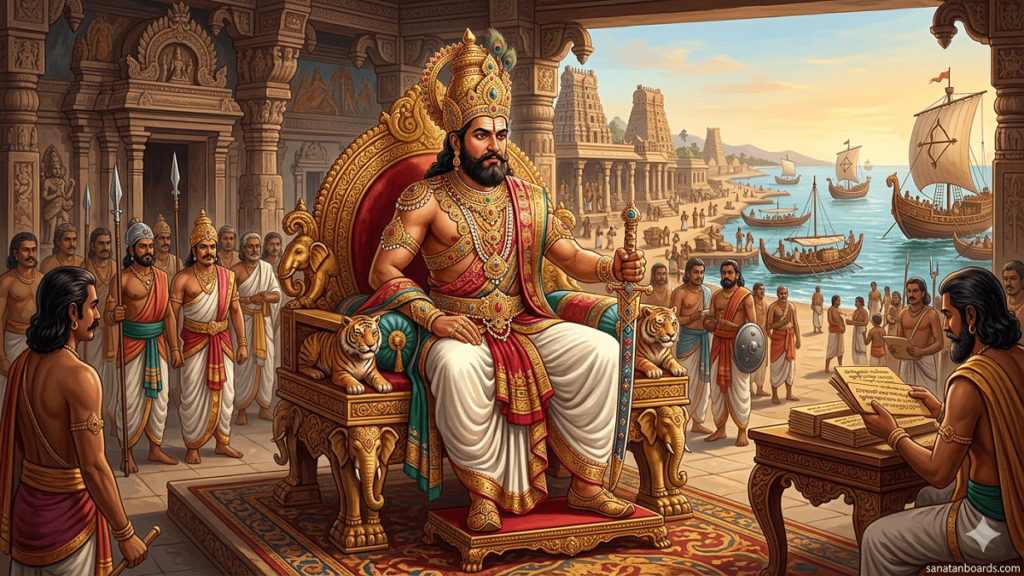
What is Chera Dynasty – King Senguttuvan?
The Chera Dynasty was one of the earliest Tamil dynasties, known for its rule over the fertile regions of present-day Kerala and western Tamil Nadu. The Cheras engaged in both inland and maritime trade, exporting spices, textiles, and precious goods to Rome, Egypt, and Southeast Asia. Their rule is well-documented in Sangam literature, which praises their governance, valor, and cultural contributions.
King Senguttuvan was one of the dynasty’s most distinguished rulers. Believed to have ruled during the 2nd century CE, he is remembered as a just and courageous king. Sources like Silappatikaram, authored by his brother Ilango Adigal, highlight Senguttuvan’s achievements in military campaigns, administration, and cultural patronage.
One of his most notable accomplishments was the consecration of a temple for Kannagi, symbolizing chastity, justice, and moral governance. This act strengthened cultural cohesion and reinforced the ethical foundations of society. Senguttuvan’s reign illustrates the intertwined nature of political authority, religion, and literature, marking him as a pivotal figure in South Indian history.
Understanding the Chera Dynasty through Senguttuvan allows learners to appreciate the social, economic, and cultural dynamics of ancient Tamil society. His contributions provide a lens to study early governance, international trade, and the role of religion and literature in political life.
Who Is Required Chera Dynasty – King Senguttuvan?
1. Political Leadership
Senguttuvan was a unifying force among Chera chieftains and extended the kingdom’s influence across Tamilakam. His intervention in nearby royal succession disputes, such as establishing his relative on the Chola throne, underscores his political acumen and influence over regional dynamics. This intervention demonstrates the complex power relations between early Tamil kingdoms.
2. Military Strategy and Expansion
Historical poems and epics describe Senguttuvan’s military successes against neighbouring regions like Kongu and possibly against “Arya” forces, though literary sources often dramatize these accounts. These descriptions help us understand how early kingdoms fought for territorial dominance, alliances, and prestige.
3. Cultural Identity and Literary Patronage
Senguttuvan significantly influenced Tamil culture through his association with the Tamil epic Silappatikaram. Written by Ilango Adigal — likely his brother — this epic not only portrays moral and ethical values but also preserves cultural memory of Senguttuvan’s reign, connecting literature with actual historical traditions.
4. Religious Significance
The epic tradition holds that Senguttuvan transported special stones from distant regions for the worship of goddess Pattini (Kannagi) in Vanchi. This act blends religion, royal duty, and cultural values. His contribution to religious practices indicates how rulers helped shape devotional traditions in ancient South India.
5. Economic and Maritime Context
The Chera dynasty’s dominance of the western coast enabled prosperous maritime trade with global powers of the era, such as Rome. While Senguttuvan is not directly noted for diplomacy with foreign powers, his reign occurred at a time when international trade was reshaping South Indian economies — making him representative of that transformative era.
Why Students Should Study Him
Understanding Senguttuvan is essential for:
- grasping ancient Tamil political history;
- linking literature and historical events;
- appreciating how myth and recorded memory intersect in early sources;
- recognizing the role of trade, religion, and warfare in shaping early Indian civilisations.
In this way, he connects empirical history with cultural narratives, making him a required subject for anyone studying South Asian history.
When Is Chera Dynasty and King Senguttuvan Required ?
Studying the Chera Dynasty and the reign of King Senguttuvan is required to understand the broader context of South Indian history, culture, and governance. The question of “when” is not just about dates—it emphasizes the relevance of historical timing in learning and applying knowledge about this period.
First, understanding the temporal context of Senguttuvan’s rule (2nd century CE, Sangam Age) is essential for students and researchers. The Sangam Age was a formative period in Tamil literature, political organization, and economic expansion. Knowing when Senguttuvan ruled allows learners to connect his achievements—like the northern expedition or the establishment of the Pattini cult—to the historical, cultural, and political circumstances of his time. Without understanding the timeline, one cannot appreciate the significance of his contributions.
Second, the “when” is required to study the economic and trade development of ancient South India. Senguttuvan’s reign coincided with the peak of Chera maritime trade with Rome, Egypt, and Southeast Asia. Recognizing the timing of his rule highlights the kingdom’s prosperity, the role of trade in political stability, and the spread of cultural ideas. This knowledge is particularly important for historians, economists, and cultural scholars analyzing ancient trade networks and their influence on society.
Third, the study of “when” is required to analyze the cultural and literary context. Tamil epics such as Silappatikaram were composed during or about Senguttuvan’s time. Understanding the historical period allows students to link literary works to real-life rulers, religious practices, and societal norms. For example, Senguttuvan’s promotion of the Pattini (Kannagi) cult reflects the ethical and moral values emphasized during that era. Recognizing the period helps learners see the interconnection between literature, religion, and governance.
Finally, the “when” is required for modern educational and examination purposes. Knowledge of the Sangam Age and key rulers like Senguttuvan is essential in history curricula and competitive exams (UPSC, state PSCs, academic research). It allows learners to place events, social reforms, and trade developments in chronological order, which is crucial for analysis and interpretation.
Where Is Chera Dynasty and King Senguttuvan Required ?
The study of Chera Dynasty and King Senguttuvan requires an understanding of geography, as the location of their kingdom significantly influenced political, economic, and cultural developments. The “where” is essential to understand why the Chera Dynasty became powerful and how Senguttuvan was able to consolidate his rule.
The Chera Dynasty controlled the western coast of South India, primarily the regions corresponding to modern Kerala and parts of western Tamil Nadu. This region was uniquely advantageous due to its fertile river valleys, dense forests, and proximity to the Western Ghats. Agriculture flourished in these fertile lands, providing a stable economic base that allowed the kingdom to focus on trade, military campaigns, and cultural activities.
One of the most important geographical factors was access to the Arabian Sea, which allowed the Cheras to establish major ports like Muziris, historically renowned as a hub for international trade. These ports enabled the kingdom to export valuable commodities such as black pepper, spices, ivory, and textiles to far-off regions including the Roman Empire, Egypt, and Southeast Asia. Understanding the location of these ports is crucial for comprehending the economic power that Senguttuvan leveraged to strengthen his administration.
The geography also played a role in strategic defense and military planning. The Western Ghats provided natural fortifications, while rivers like the Periyar facilitated transportation and communication. Senguttuvan could secure his borders effectively, maintain control over inland regions, and ensure safe trade routes—factors directly tied to the kingdom’s prosperity and stability.
Cultural and religious practices were also shaped by geography. Temples and sacred sites, including those associated with the Pattini cult, were often located near rivers or fertile lands, demonstrating the link between environment, society, and spiritual life. The spread of culture, literature, and religious ideas was easier due to the kingdom’s access to both inland routes and maritime channels.
How is Chera Dynasty and King Senguttuvan Required ?
Understanding how the Chera Dynasty, particularly under King Senguttuvan, is required involves examining the multiple dimensions in which his legacy continues to influence historical studies, cultural learning, and educational practices. Senguttuvan’s reign provides insight into political, military, economic, cultural, and religious frameworks of early South India, and understanding his contributions helps us reconstruct the social and political fabric of the Sangam Age.
1. Political and Governance Insight
King Senguttuvan’s rule illustrates how early Tamil dynasties consolidated power through strategic alliances and military campaigns. By intervening in neighboring kingdoms like the Cholas, he not only expanded the Chera influence but also demonstrated diplomacy intertwined with military authority. Learning about his political strategies is required for students of history and political science to understand early governance models, succession practices, and statecraft in ancient India. His reign exemplifies centralized authority alongside decentralized administration through chieftains, providing a model for analyzing early political systems.
2. Military Strategy and Expansion
Senguttuvan’s military campaigns are essential for understanding how territorial expansion was achieved in South India. Through battles against Kongu chieftains and rival powers, he secured key territories that enabled the Cheras to dominate trade routes and inland regions. Studying his campaigns is required for military historians and strategists to examine ancient warfare techniques, logistics, and the role of naval and land forces in regional control.
3. Cultural and Literary Relevance
Senguttuvan is immortalized in the Tamil epic Silappatikaram, written by his brother Ilango Adigal. The epic portrays Senguttuvan not just as a king, but as a patron of literature, ethics, and Tamil culture. Understanding how he supported literature is required to appreciate the interconnection between political power and cultural patronage. His reign also provides insights into how royal sponsorship influenced the creation of literary masterpieces, shaping Tamil identity and moral values.
4. Religious and Social Influence
Senguttuvan’s establishment of worship for Kannagi (Pattini) reflects the intersection of politics and religion. By institutionalizing religious rituals, he reinforced social cohesion and moral authority. Learning how this occurred is required for anthropologists and religious scholars studying the evolution of devotional practices and their social impact in early South India.
5. Economic and Maritime Significance
The Chera kingdom, under Senguttuvan, controlled ports like Muziris, facilitating international trade. Understanding how the dynasty leveraged trade networks is required to analyze the economic underpinnings of political power, regional prosperity, and cultural exchange with the Roman Empire and Arabian Peninsula. Students of economics and history can trace trade, taxation, and urban development through this lens.
6. Educational and Research Applications
King Senguttuvan’s life and reign are required as a case study in schools, colleges, and research institutes, helping learners explore Sangam literature, archaeology, and historical methodology. His example demonstrates how historical figures embody multidimensional learning — from governance to culture, religion, and economics.
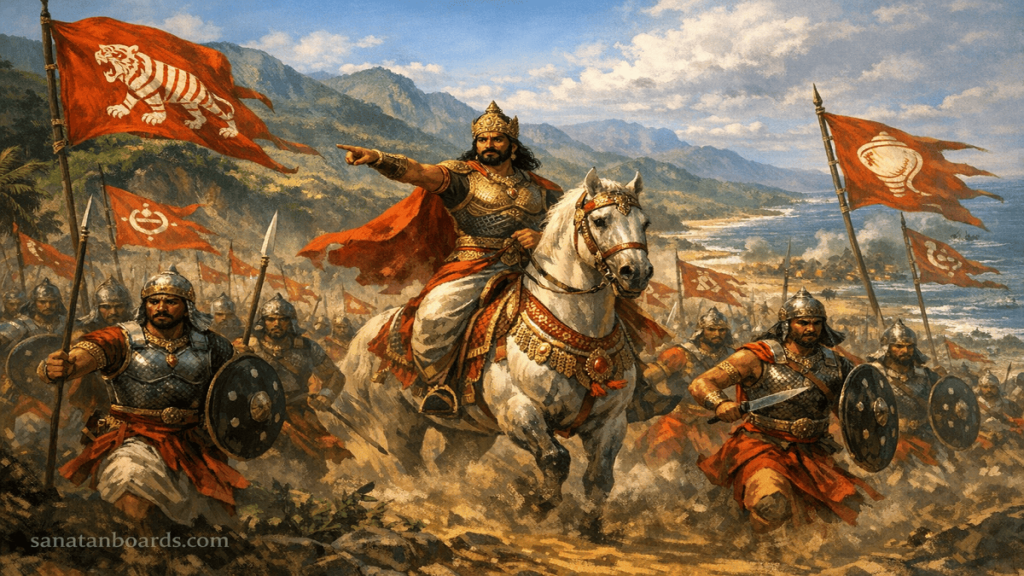
Case Study on Chera Dynasty and King Senguttuvan
The Chera Dynasty was one of the three prominent Tamil dynasties of ancient South India, alongside the Cholas and Pandyas. Among its rulers, King Senguttuvan stands out as a model of leadership, governance, and cultural patronage. This case study examines Senguttuvan’s rule through multiple dimensions, including political strategy, administration, military campaigns, economic management, cultural and religious influence, and literary contributions.
1. Political Leadership
Senguttuvan’s leadership reflects a balance of centralized authority and decentralized administration. The Chera kingdom was geographically diverse, encompassing fertile river valleys, forests, and coastal areas. Senguttuvan delegated authority to local chieftains while maintaining overall control, ensuring efficient governance across all regions. This system allowed local issues to be addressed swiftly while central policies maintained cohesion and stability.
One of Senguttuvan’s key political achievements was the symbolic northern expedition, mentioned in Silappatikaram. Although some accounts suggest it was ceremonial, the expedition represented the king’s assertion of authority and his connection to the larger Indian cultural and political landscape. Such acts reinforced his legitimacy and the influence of the Chera dynasty within South India.
2. Military Campaigns and Security
A strong military was essential for the Chera kingdom’s success. Senguttuvan’s campaigns served multiple purposes:
- Defending borders from rival kingdoms such as the Pandyas and Cholas.
- Securing trade routes critical for the kingdom’s economy.
- Demonstrating authority through symbolic expeditions.
The army was well-organized and disciplined, ensuring that internal rebellions were suppressed and external threats were deterred. This military strength contributed directly to the stability and prosperity of the kingdom, allowing Senguttuvan to focus on cultural and economic development.
3. Economic Management and Trade
Trade was the backbone of the Chera economy, and Senguttuvan recognized its importance. The kingdom’s access to the Arabian Sea and major ports such as Muziris facilitated active maritime commerce. Goods exported included:
- Black pepper and spices
- Textiles and garments
- Ivory, pearls, and precious stones
Imports brought wealth, luxury items, and foreign cultural influences. Senguttuvan implemented policies to secure trade routes, regulate port activities, and maintain strong relationships with foreign merchants. This economic strategy allowed for infrastructure development, temple construction, and patronage of arts and literature.
4. Cultural and Religious Influence
Senguttuvan’s reign is particularly noted for the promotion of the Pattini (Kannagi) cult, emphasizing virtue, chastity, and moral justice. The consecration of Kannagi’s idol symbolized the integration of ethical values into governance, strengthening social cohesion and reinforcing the king’s moral authority.
In addition to religious initiatives, Senguttuvan patronized Tamil literature, most famously through Silappatikaram, authored by his brother Ilango Adigal. This epic not only immortalizes his reign but also provides valuable insights into the social, political, and economic life of the time. By supporting literature and religion, Senguttuvan ensured that his kingdom was remembered as a center of culture, ethics, and intellectual achievement.
5. Governance and Administrative Practices
Senguttuvan’s administrative practices combined central oversight with local autonomy. Officials were appointed to manage taxation, agriculture, law enforcement, and trade regulation. The king’s emphasis on justice and fairness created a stable societal structure, earning him admiration from subjects and chroniclers alike.
Infrastructure, including roads connecting ports to inland areas, facilitated trade and mobility, reflecting a strategic approach to economic and administrative planning. Governance under Senguttuvan demonstrates how careful organization, delegation, and moral authority can sustain a large and diverse kingdom.
6. Legacy and Educational Significance
The legacy of Senguttuvan is multi-dimensional:
- Historical: As a key ruler of the Chera Dynasty, he exemplifies the political and military strength of South India during the Sangam Age.
- Cultural: Through the promotion of Tamil literature and religious practices, Senguttuvan reinforced Tamil identity and values.
- Educational: Students, researchers, and scholars study his reign to understand governance, trade, culture, and ethical leadership in ancient India.
Senguttuvan’s example demonstrates the integration of power, culture, economy, and ethics, which is relevant for understanding leadership in both historical and modern contexts.
7. Analysis and Insights
Several key insights emerge from this case study:
- Balanced Governance: Decentralized administration combined with central oversight is crucial for managing diverse regions.
- Economic Strategy: Trade and maritime commerce are central to state prosperity and cultural exchange.
- Cultural Patronage: Promoting literature and religion strengthens societal cohesion and lasting legacy.
- Ethical Leadership: Incorporating moral values into governance enhances legitimacy and public support.
These insights make Senguttuvan’s reign an exemplary model for studying leadership, statecraft, and cultural integration in ancient civilizations.
Conclusion
The reign of King Senguttuvan within the Chera Dynasty demonstrates how effective leadership combines political authority, military strategy, economic planning, cultural patronage, and ethical governance. This case study highlights why #sanatandharmaaccreditationboardsinmumbai Senguttuvan’s rule remains a critical subject for education, research and understanding the evolution of South Indian civilization.
Studying Senguttuvan and the Chera Dynasty provides timeless lessons in leadership, strategic governance, and cultural integration, making it required knowledge for anyone exploring ancient Indian history.
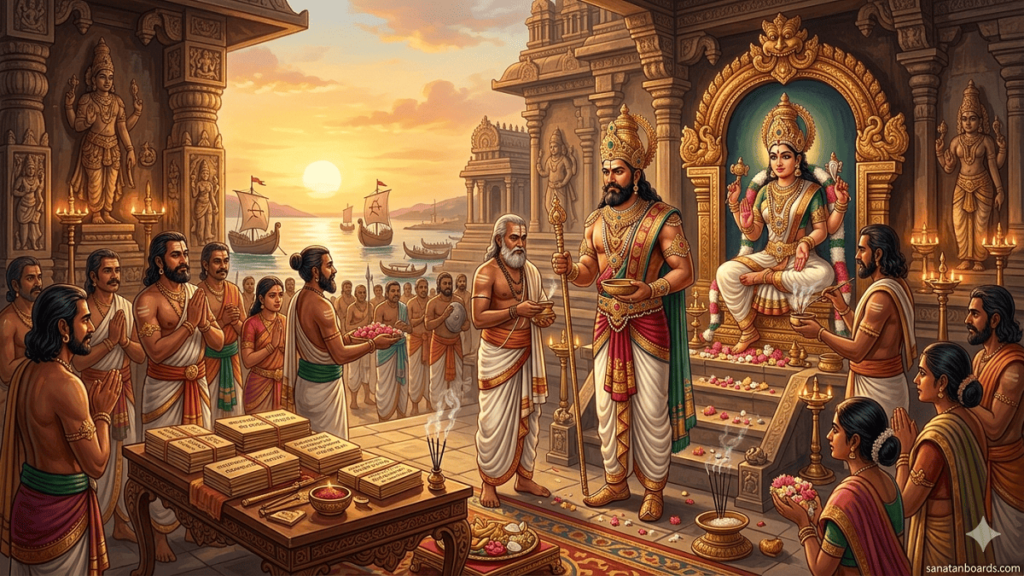
White Paper On Chera Dynasty – King Senguttuvan
Executive Summary
This white paper explores the reign of King Senguttuvan, a key ruler of the Chera Dynasty during the Sangam Age of South India (2nd century CE). It examines his governance, trade strategies, cultural and religious contributions, and military organization. The purpose is to analyze how Senguttuvan maintained stability, prosperity, and a lasting legacy, providing insights for historical, cultural, and educational study.
1. Introduction
The Chera Dynasty was one of the major Tamil dynasties that shaped South India’s early history. Among its rulers, Senguttuvan is particularly noted for integrating political authority, military power, economic management, and cultural leadership. Literary sources like Silappatikaram document his reign, providing insights into governance, social organization, and cultural achievements.
This white paper focuses on the following aspects of Senguttuvan’s rule:
- Administration and governance
- Economic and trade policies
- Cultural and religious initiatives
- Military strategies
- Legacy and educational relevance
2. Objectives
The objectives of this white paper are:
- To understand Senguttuvan’s governance style and administrative strategies.
- To examine the economic policies and trade networks under his rule.
- To study religious and cultural contributions that strengthened social cohesion.
- To analyze the military strategies used to maintain stability.
- To assess the educational and historical significance of his reign.
3. Administration and Governance
Senguttuvan implemented a centralized leadership with decentralized administration. Local chieftains were appointed to manage taxation, law enforcement, and regional affairs, while the king retained ultimate authority. This system allowed the Chera kingdom to maintain order across a geographically diverse territory consisting of river valleys, forests, and coastal regions.
His rule emphasized justice and ethical governance. The establishment of the Pattini (Kannagi) cult reflected his commitment to moral authority and social harmony. Temples and religious institutions reinforced governance by promoting shared societal values.
4. Economic and Trade Policies
Trade was central to the Chera economy. Senguttuvan ensured that major ports, particularly Muziris, were secure and efficiently managed. This facilitated international trade with Rome, Egypt, and Southeast Asia, exporting commodities such as spices, textiles, and ivory, and importing luxury goods.
Revenue from trade funded infrastructure development, including roads connecting ports to inland regions, public works, and cultural projects. The integration of economic management with governance ensured both wealth accumulation and societal stability.
5. Cultural and Religious Contributions
Senguttuvan’s reign is notable for literary and religious patronage. His brother, Ilango Adigal, authored Silappatikaram, which immortalizes the king’s achievements. Senguttuvan also promoted the Pattini cult, emphasizing chastity, justice, and ethical behavior.
These initiatives strengthened cultural identity and societal cohesion, linking governance with religious and literary development. Such integration contributed to the enduring legacy of the Chera Dynasty.
6. Military Organization
A strong military was vital for Senguttuvan’s rule. He conducted campaigns to:
- Protect borders from rival dynasties such as the Pandyas and Cholas
- Secure trade routes and ports
- Demonstrate political authority through symbolic expeditions
The combination of a disciplined army and strategic planning ensured stability and prosperity, enabling him to focus on governance, trade, and culture.
7. Legacy and Educational Significance
Senguttuvan’s legacy is multifaceted:
- Historical: Demonstrates the strength and influence of the Chera Dynasty.
- Cultural: Reinforces Tamil literature, religious practices, and social ethics.
- Educational: Serves as a case study in leadership, governance, and trade in ancient South India.
His reign provides timeless lessons on integrating political power, economic strategy, military readiness, and cultural patronage.
8. Findings
Analysis of Senguttuvan’s reign reveals key insights:
- Decentralized administration enhances efficiency across diverse regions.
- Strategic trade and maritime commerce strengthen political and economic power.
- Cultural and religious integration reinforces societal cohesion.
- Ethical governance increases legitimacy and public support.
9. Conclusion
The reign of King Senguttuvan exemplifies holistic leadership, combining governance, trade, military strategy, and culture. The Chera #sanatandharmaaccreditationboardsinvasai Dynasty thrived due to deliberate policies linking economics, society, and ethics. This white paper underscores the educational value of studying Senguttuvan for historical research, l#sanatandharmaaccreditationboardsintamil eadership analysis, and understanding ancient South Indian civilization.
Industry Application Of Chera Dynasty – King Senguttuvan
Introduction
The study of King Senguttuvan’s reign is not only academically significant but also has practical applications in modern industries, including tourism, education, cultural heritage, media, and research.
1. Tourism and Cultural Heritage
Sites associated with Senguttuvan, such as Vanchi (Karur), Muziris, and shrines for Kannagi, have potential for heritage tourism. Tourists can experience:
- Historical tours of Chera capitals
- Cultural festivals related to Tamil epics
- Maritime trade history museums
Economic Impact: Boosts local economies, preserves heritage, and raises awareness of ancient South Indian civilizations.
2. Education and Research
Senguttuvan’s life serves as a case study for history, literature, archaeology, and political science. Educational applications include:
- Incorporating Sangam literature and inscriptions into curricula
- Research on ancient governance, trade, and cultural practices
- Comparative studies of ancient kingdoms globally
Outcome: Trains scholars, promotes cultural literacy, and preserves historical knowledge.
3. Media and Cultural Productions
The king’s story has been adapted in films, documentaries, and literature, allowing industries to:
- Create historically accurate media
- Develop educational content for schools and online platforms
- Engage audiences through cultural storytelling
Example: Dramatizations of Silappatikaram and Senguttuvan’s campaigns for visual media.
4. Archaeology and Preservation
Industries involved in archaeology, museum curation, and historical research can use Senguttuvan’s legacy to:
- Locate ancient trade ports
- Preserve inscriptions and monuments
- Study urban planning and temple architecture of the Cheras
Impact: Encourages heritage preservation and sustainable tourism.
5. Economic and Trade Studies
Senguttuvan’s protection of ports like Muziris provides insights into ancient maritime trade. Modern industries can:
- Study historical trade networks
- Simulate supply chain management based on historical precedents
- Promote educational trade simulations
Benefit: Bridges history with modern economic models.
6. Digital Humanities
Digitizing Sangam texts, inscriptions, and cultural artifacts allows global access. Applications include:
- Virtual museum tours
- Online education platforms
- Cultural archives for research and storytelling
Result: Expands global understanding of ancient South Indian history.
Conclusion
King Senguttuvan’s reign has #sanatandharmaaccreditationboardsingujrat diverse industry applications, ranging from tourism and media to education and research. Leveraging his historical and cultural legacy provides#sanatandharmaaccreditationboardsinindia economic, educational, and societal benefits, emphasizing the enduring relevance of the Chera Dynasty in modern contexts.
source : Ungal Anban Hemanth
ASK FAQ
Who was King Senguttuvan of the Chera Dynasty?
King Senguttuvan, also called Vel Kelu Kuttuvan, ruled the Chera Dynasty around the 2nd century CE. He is known for military campaigns, cultural patronage, and establishing Kannagi worship.
When did the Chera Dynasty flourish under Senguttuvan?
The Chera Dynasty reached its peak during Senguttuvan’s reign in the 2nd century CE, during the Sangam Age, marked by political consolidation and maritime trade expansion.
What were King Senguttuvan’s major achievements?
Senguttuvan expanded Chera territories, intervened in neighboring kingdoms, promoted Tamil literature, supported religious practices, and secured trade routes along the Malabar Coast.
Where did the Chera Dynasty rule during Senguttuvan’s reign?
The Chera Dynasty controlled present-day Kerala, western Tamil Nadu, coastal ports like Muziris, and inland regions, with the capital at Vanchi (modern Karur).
Why is King Senguttuvan important in Tamil history?
Senguttuvan is significant for linking politics, military power, literature, religion, and trade, shaping early Tamil culture and preserving historical and moral traditions through epics like Silappatikaram.
Table of Contents
Disclaimer
This content is intended solely for educational and informational purposes. The historical information provided is based on scholarly research, literary sources, and archaeological evidence, but interpretations may vary depending on sources. It is not a substitute for professional historical consultation or academic research. Readers and users should verify facts and consult authoritative texts or peer-reviewed studies when using this information for scholarly work, teaching, or research. All opinions, analyses, and interpretations presented here are for learning, knowledge enhancement, and cultural awareness only, and should not be used as definitive legal, religious, or commercial guidance.