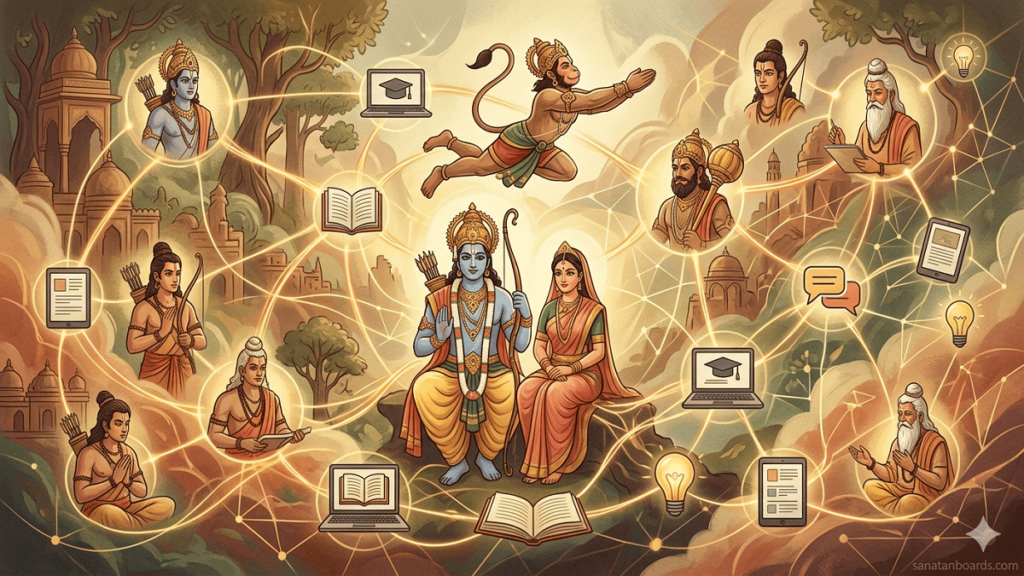
The Ramayana is one of the most influential texts in Indian tradition, offering timeless lessons on ethics, duty, and righteous living. The concept of a “Ramayana Dharma Network” can be understood as a framework that connects these teachings to modern life for educational and knowledge purposes. It emphasizes the importance of dharma—moral responsibility—in personal, social, and global contexts.
Through this perspective, the values demonstrated by Lord Rama, such as truth, discipline, compassion, and justice, are not just historical or mythological ideas but guiding principles that remain relevant today. A Ramayana Dharma Network symbolically represents the sharing of these values across communities, institutions, and learning platforms.
In today’s fast-changing world, where ethical dilemmas are common, revisiting such classical frameworks can provide clarity and direction. Educational discussions around the Ramayana help individuals understand cultural heritage while also developing moral reasoning skills.
This blog explores the idea of a Ramayana Dharma Network from multiple perspectives—what it is, who needs it, when and where it is applicable, and how it can be implemented. All content is intended purely for educational learning and knowledge purposes.
What Is Ramayana Dharma Network ?
A Ramayana Dharma Network is a conceptual system that brings together the ethical teachings and life lessons from the Ramayana and applies them to modern educational and social frameworks. It is not necessarily a physical network but rather an intellectual and cultural structure that promotes the understanding and practice of dharma.
Dharma, as illustrated in the Ramayana, refers to duty, righteousness, and moral order. Characters like Sita and Hanuman embody virtues such as loyalty, courage and devotion. A Ramayana Dharma Network seeks to connect these virtues with contemporary life, encouraging individuals to adopt ethical behavior in everyday situations.
This network can exist in various forms, such as educational curricula, discussion forums, cultural programs, or digital platforms that share knowledge about the Ramayana. It promotes learning through storytelling, analysis, and interpretation, helping people understand how ancient wisdom can guide modern decision-making.
Importantly, the concept is inclusive and educational rather than religiously prescriptive. It focuses on universal values that transcend boundaries, making it relevant to diverse audiences.
In essence, a Ramayana Dharma Network acts as a bridge between tradition and modernity. It ensures that the lessons of the Ramayana continue to inspire ethical thinking, personal growth, and social harmony in a structured and accessible way.
Who Is Required Ramayana Dharma Network ?
The idea of a Ramayana Dharma Network is relevant to a wide range of individuals and groups, especially those seeking ethical guidance and cultural understanding. Students are among the primary beneficiaries, as learning about the Ramayana helps them develop moral reasoning and a deeper appreciation of literature and history.
Educators also play a crucial role in this network. By incorporating stories of Lakshmana and Bharata into teaching, they can illustrate concepts like loyalty, sacrifice, and responsibility. This makes learning more engaging and meaningful.
Parents and families can use the principles of the Ramayana Dharma Network to instill values in children. Stories from the epic provide relatable examples of right and wrong, helping young minds understand the importance of ethical behavior.
Professionals and leaders can also benefit from these teachings. In decision-making roles, the concept of dharma can guide actions toward fairness, integrity, and accountability. The leadership qualities of Lord Rama serve as a model for ethical governance and management.
Moreover, individuals interested in cultural studies, philosophy, or personal development can find value in this network. It offers insights into human behavior, relationships, and societal structures.
Overall, the Ramayana Dharma Network is required by anyone who seeks knowledge, ethical clarity, and a connection to timeless wisdom. It serves as a universal educational tool that supports both personal growth and collective well-being.
When Is Ramayana Dharma Network Required ?
The need for a Ramayana Dharma Network arises in various situations, particularly when individuals or societies face ethical dilemmas or moral uncertainty. In today’s rapidly evolving world, people often encounter complex decisions that require a strong moral foundation. The teachings of the Ramayana provide valuable guidance during such times.
For students, this network is especially useful during their formative years. As they develop their understanding of right and wrong, exposure to the values demonstrated by Lord Rama helps shape their character. It encourages discipline, respect, and responsibility.
In professional settings, the Ramayana Dharma Network becomes relevant when leaders and employees must make decisions that impact others. Ethical challenges in business, governance, or social work require principles that prioritize fairness and integrity. The concept of dharma helps individuals act with accountability and compassion.
The network is also important during times of social conflict or cultural disconnection. When communities face misunderstandings or divisions, revisiting shared values from the Ramayana can promote unity and mutual respect. It serves as a reminder of the importance of harmony and cooperation.
Additionally, the Ramayana Dharma Network is required during personal crises or life transitions. Situations such as loss, change, or uncertainty often lead individuals to seek guidance and meaning. The resilience and strength shown by characters like Sita provide inspiration and emotional support.
In educational contexts, this network is needed when there is a gap between theoretical knowledge and practical ethics. Integrating Ramayana-based teachings helps bridge this gap by offering real-life examples of moral decision-making.
Ultimately, the Ramayana Dharma Network is required whenever there is a need for ethical clarity, personal growth, or social harmony. It ensures that timeless values continue to guide individuals and communities in meaningful ways.
Where is Ramayana Dharma Network Required ?
A Ramayana Dharma Network is applicable in a variety of settings where education, ethics, and cultural understanding are important. One of the primary places is educational institutions, such as schools and universities. By integrating lessons from the Ramayana into curricula, educators can provide students with both academic knowledge and moral guidance.
Homes and families are another important setting. Parents can use stories of Hanuman to teach children about devotion, courage, and humility. These lessons help build strong character and positive behavior from an early age.
Workplaces also benefit from the principles of a Ramayana Dharma Network. In professional environments, ethical practices are essential for success and sustainability. Applying the concept of dharma can improve teamwork, leadership, and decision-making.
Community centers and cultural organizations are ideal places for promoting this network. Through events, discussions, and storytelling sessions, people can come together to explore the teachings of the Ramayana and their relevance to modern life.
Digital platforms have become increasingly important in spreading knowledge. Online forums, blogs, and educational websites can act as virtual Ramayana Dharma Networks, making information accessible to a global audience. This allows individuals from different backgrounds to learn and engage with these teachings.
The network is also relevant in public institutions and governance. Leaders and policymakers can draw inspiration from the values of justice and fairness exemplified in the Ramayana to create policies that benefit society as a whole.
How Is Ramayana Dharma Network Required ?
The implementation of a Ramayana Dharma Network involves integrating the teachings of the Ramayana into various aspects of life in a structured and meaningful way. This begins with education, where schools and universities can include courses or modules that explore the ethical lessons of the Ramayana.
Storytelling is one of the most effective methods. Narratives about Lord Rama and other characters help convey complex moral ideas in a simple and engaging manner. Discussions and reflections on these stories encourage critical thinking and deeper understanding.
Workshops and seminars can also play a key role. By organizing interactive sessions, individuals can explore how the concept of dharma applies to real-life situations. This helps bridge the gap between theory and practice.
Digital tools are essential in modern implementation. Online platforms, mobile apps, and social media can be used to share content, host discussions, and connect learners. These tools make the Ramayana Dharma Network accessible to a wider audience.
In families, the network can be implemented through regular discussions and storytelling sessions. Parents can guide children in understanding the values of honesty, respect, and responsibility.
In professional settings, organizations can incorporate ethical training programs inspired by the Ramayana. Leaders can model behavior based on integrity and fairness, creating a positive work culture.
Community involvement is another important aspect. Cultural events, reading groups, and public discussions can foster a sense of shared learning and collective growth.

Case Study On Ramayana Dharma Network
This case study explores the conceptual implementation of a Ramayana Dharma Network as an educational and ethical learning framework inspired by the Ramayana. The focus is on how such a network can function as a system of knowledge-sharing centered around the principle of dharma, or righteous conduct.
In this model, a group of learners, educators, and community members form a structured network dedicated to studying and discussing the teachings of the Ramayana. The network operates through regular sessions where stories of Lord Rama, Sita, and Hanuman are explored not just as narratives, but as sources of ethical insight. Participants reflect on themes such as duty, loyalty, sacrifice, and justice.
The network includes multiple channels of engagement: in-person discussions, reading circles, and digital platforms where members share insights and interpretations. Each participant contributes to the collective understanding, creating a dynamic and interactive learning environment. The emphasis is on dialogue and critical thinking rather than one-way instruction.
Over time, the network develops a shared repository of knowledge, including interpretations, case reflections, and value-based discussions. This repository becomes a valuable educational resource for both current and future participants. The collaborative nature of the network ensures that learning is continuous and evolving.
One key observation from this case is the role of storytelling in enhancing engagement. Participants find it easier to relate to ethical concepts when they are presented #ramayanadharmanetworkinchennai through characters and situations. Another important aspect is #ramayanadharmanetworkinuttarpradesh inclusivity—the network is designed to focus on universal values, making it accessible to individuals from diverse backgrounds.
Challenges include maintaining consistency in participation and ensuring that discussions remain focused on educational objectives. Facilitators play a crucial role in guiding conversations and maintaining the quality of learning.
Overall, this case study demonstrates that a Ramayana Dharma Network can function as a meaningful platform for ethical education and knowledge-sharing, rooted in timeless wisdom and adapted for contemporary understanding.
White Paper On Ramayana Dharma Network
This white paper presents a conceptual framework for the Ramayana Dharma Network, an educational and knowledge-oriented system inspired by the teachings of the Ramayana. The objective of this framework is to promote the understanding and dissemination of ethical values derived from the concept of dharma.
The Ramayana Dharma Network is envisioned as a structured yet flexible ecosystem that connects individuals, educators, and communities through shared learning experiences. At its core, the network is built on the study of key characters such as Lord Rama, whose actions exemplify righteousness and leadership. These narratives serve as foundational elements for exploring moral and philosophical questions.
The network operates through multiple layers, including content creation, knowledge sharing, and collaborative learning. Content may include textual analysis, storytelling sessions, discussion forums, and reflective exercises. These components are designed to encourage active participation and critical thinking.
A key principle of the Ramayana Dharma Network is accessibility. By leveraging both traditional and digital platforms, the network ensures that knowledge is available to a wide audience. Online tools can facilitate discussions, store learning materials, and connect participants across geographical boundaries.
Another important aspect is adaptability. The network is not limited to a single format or methodology; it can evolve based on the needs of its participants. This flexibility allows it to remain relevant in changing educational and social contexts.
The framework also emphasizes ethical neutrality and inclusivity. While rooted in a specific cultural text, the focus is on universal values such as truth, compassion, duty, and integrity. This approach ensures that the network serves as an educational resource rather than a prescriptive system.
Evaluation and feedback mechanisms are integral to the network’s sustainability. Regular assessments, participant feedback, and continuous improvement strategies help maintain the quality and effectiveness of the learning experience.
In conclusion, the Ramayana Dharma Network represents a holistic approach to ethical education and knowledge-sharing. By combining #ramayanadharmanetworkinmumbai traditional wisdom with modern learning practices, it provides a sustainable and inclusive framework for exploring the #ramayanadharmanetworkinvasai principles of dharma in a structured and meaningful way.
Industry Application Of Ramayana Dharma Network
The concept of a Ramayana Dharma Network, inspired by the teachings of the Ramayana, can be understood in industry as a value-driven framework that guides behavior, communication, and decision-making. It focuses on integrating ethical knowledge into professional environments for learning and awareness purposes.
In corporate organizations, the Ramayana Dharma Network can shape leadership approaches. The qualities demonstrated by Lord Rama—such as integrity, commitment to duty, and fairness—can serve as guiding principles for managers and executives. Leaders who align with these values tend to foster trust, transparency, and accountability within teams.
In human resource management, the network can influence organizational culture. By embedding values like respect, loyalty, and responsibility—reflected in characters such as Hanuman—companies can promote positive workplace relationships. This contributes to better teamwork, employee satisfaction, and conflict resolution.
The Ramayana Dharma Network also plays a role in training and development. Organizations can design learning modules that use storytelling and ethical scenarios derived from the Ramayana to enhance employees’ moral reasoning and critical thinking skills. This approach makes training more engaging and meaningful compared to purely technical instruction.
In knowledge management, the network supports the creation of shared ethical frameworks. Employees can participate in discussions, workshops, and digital forums where they exchange perspectives on values and responsibilities. Over time, this builds a repository of insights that guide consistent behavior across the organization.
The network can also influence decision-making processes. In situations involving ethical dilemmas, the concept of dharma encourages individuals to consider long-term consequences, fairness, and the greater good. This leads to more responsible and sustainable choices.
Additionally, the Ramayana Dharma Network can strengthen organizational identity. By connecting modern practices with timeless values, companies can create a sense of purpose that goes beyond profit. Employees are more likely to feel motivated when their work aligns with meaningful principles.
However, it is important to ensure that the implementation remains inclusive and educational. #sanatandharmaaccreditationboardsinmumbai The focus should be on universal values rather than cultural or religious specificity, making #sanatandharmaaccreditationboardsinvasai the framework accessible to diverse workforces.
Overall, the Ramayana Dharma Network provides a structured approach to embedding ethical awareness and knowledge-sharing within industry, contributing to more responsible and value-oriented professional environments.
source : VEDIC DISCOVERY
ASK FAQ
What is Ramayana Dharma Network?
The Ramayana Dharma Network is a knowledge and educational framework inspired by the Ramayana. It focuses on teaching the principles of dharma, such as duty, integrity, and ethical living, through stories of characters like Lord Rama, Sita, and Hanuman, making ancient wisdom accessible for learning and personal growth.
Who needs a Ramayana Dharma Network?
Students, educators, parents, professionals, and anyone seeking ethical guidance or cultural knowledge can benefit from a Ramayana Dharma Network. It helps in developing moral reasoning, leadership skills, and personal discipline while providing insights into timeless values from the Ramayana.
When should one use the Ramayana Dharma Network?
The network is useful during personal growth, education, professional development, ethical decision-making, or when seeking guidance in challenging situations. It provides clarity and direction by connecting ancient principles to modern life challenges.
Where can the Ramayana Dharma Network be applied?
It can be applied in schools, universities, workplaces, community centers, cultural forums, and online platforms. Essentially, any setting where learning, ethical guidance, and value-based discussions are needed can benefit from this network.
How does the Ramayana Dharma Network work?
It works through storytelling, discussions, workshops, digital platforms, and collaborative learning. Participants analyze characters and scenarios from the Ramayana to derive ethical lessons and practical applications for everyday life, fostering knowledge-sharing and moral development.
Table of Contents
Disclaimer:
This content is intended solely for educational and knowledge purposes. It is not a religious or prescriptive guide.