
The Chandogya Upanishad, one of the oldest and most profound Upanishads of ancient India, forms a cornerstone of Vedic wisdom. Part of the Sama Veda, it emphasizes knowledge, meditation, and self-realization as paths to understanding the ultimate reality, or Brahman. The text is structured as dialogues between teachers and students, offering deep insights into the nature of consciousness, ethics, and the universe.
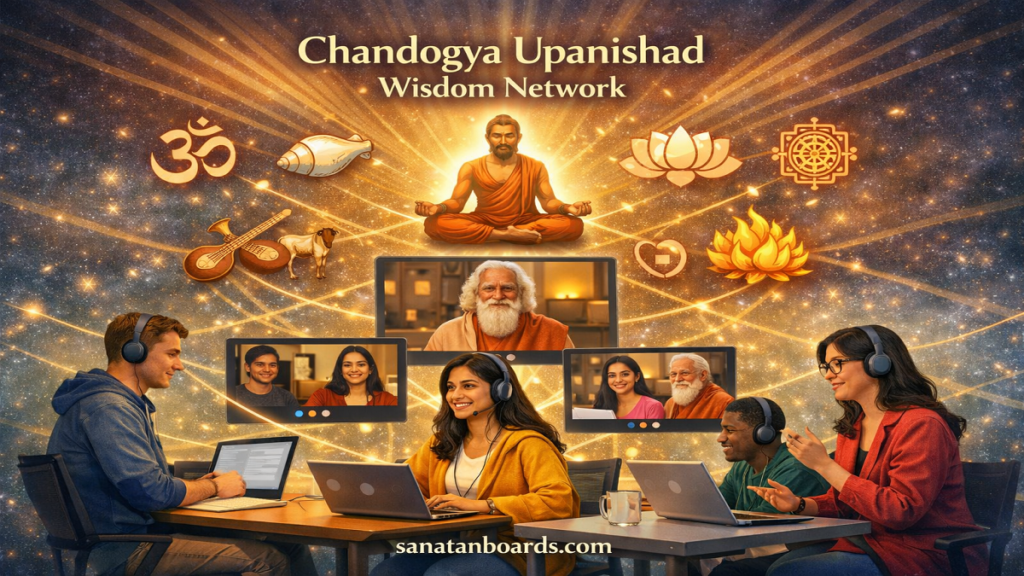
The Chandogya Upanishad Wisdom Network represents a modern initiative to make this ancient knowledge accessible to learners worldwide. Through digital platforms, interactive sessions, and guided interpretations, it connects seekers with authentic teachings of the Upanishad. Core concepts such as Tat Tvam Asi (“That Thou Art”), the importance of meditation, and the pursuit of self-knowledge are explained in ways relevant to contemporary life.
By combining traditional wisdom with modern technology, the network encourages critical thinking, spiritual growth, and ethical awareness. It fosters a learning environment where students not only study scriptures but also reflect on their practical application in daily life. Ultimately, the Chandogya Upanishad Wisdom Network acts as a bridge, connecting timeless Vedic insights with today’s educational and spiritual needs, nurturing knowledge, self-awareness, and a deeper understanding of existence.
What Is Chandogya Upanishad Wisdom Network ?
The Chandogya Upanishad is one of the principal Upanishads, forming part of the Sama Veda, and is considered a treasure trove of ancient Indian wisdom. Composed over 2,500 years ago, it emphasizes the pursuit of knowledge (Vidya), meditation, ethical living, and self-realization as the ultimate path to understanding the nature of reality, or Brahman. Through engaging stories and dialogues between teachers and students, it presents profound philosophical teachings that are still highly relevant in modern life. One of its most famous declarations, Tat Tvam Asi (“That Thou Art”), highlights the essential unity between the individual self (Atman) and the universal consciousness.
The Chandogya Upanishad Wisdom Network is a contemporary platform that brings this ancient knowledge into the digital age, making it accessible to learners and seekers worldwide. This network focuses on spreading the timeless teachings of the Upanishad through online courses, discussion forums, webinars, and interactive study sessions. It is designed to help students understand complex philosophical concepts in a simplified, practical manner, bridging the gap between traditional Vedic wisdom and modern life applications.
Core topics explored in the network include the nature of consciousness, ethical decision-making, meditation techniques, and the pursuit of self-awareness. The platform also encourages learners to reflect on these teachings in their daily lives, fostering not only intellectual understanding but personal growth and spiritual development. By leveraging technology, the network ensures that ancient wisdom is no longer confined to texts or temples but is available to anyone eager to learn, regardless of geographic or cultural barriers.
Ultimately, the Chandogya Upanishad Wisdom Network serves as a bridge between the past and present. It empowers individuals to engage with Vedic philosophy in a meaningful way, offering guidance on ethical living, mindfulness, and the realization of inner potential. For students, scholars, and spiritual seekers, it provides a structured yet flexible environment to explore the deepest truths of existence and experience the transformative power of knowledge.
Who Is Required For Chandogya Upanishad Wisdom Network ?
The Chandogya Upanishad Wisdom Network is designed for anyone interested in exploring ancient Indian philosophy, self-realization, and ethical living. It is not limited to scholars or spiritual practitioners but welcomes learners from all walks of life who seek deeper understanding and personal growth.
Primarily, the network is ideal for students of philosophy, religion, and cultural studies. Those pursuing academic knowledge of Vedic literature or comparative philosophy can gain authentic insights directly from the teachings of the Chandogya Upanishad. Through structured courses and interactive discussions, they can understand core concepts like Tat Tvam Asi (“That Thou Art”), meditation, and the nature of consciousness in a clear and practical way.
Additionally, the network is beneficial for spiritual seekers and mindfulness practitioners. Individuals who wish to deepen their meditation practice, reflect on ethical living, and explore the nature of self and universal consciousness will find the teachings highly relevant. The network provides guidance on applying these age-old insights in modern life, fostering personal growth and self-awareness.
Educators, mentors, and lifelong learners can also benefit from the platform. Teachers can use the network as a resource for curriculum design, while adults pursuing lifelong learning can engage in discussions, study sessions, and reflective exercises to expand their knowledge and understanding.
Ultimately, the Chandogya Upanishad Wisdom Network is for anyone curious about life’s deeper questions: Who am I? What is my purpose? How can I live ethically and consciously? By offering a combination of scholarly interpretation, practical guidance, and interactive learning, the network ensures that seekers of all backgrounds—students, professionals, or spiritual aspirants—can connect with this ancient wisdom and apply it meaningfully in their lives.
When Is Chandogya Upanishad Wisdom Network Required ?
The Chandogya Upanishad Wisdom Network becomes particularly relevant at times when individuals seek clarity, guidance, and deeper understanding in life. In today’s fast-paced world, many people face challenges related to stress, ethical dilemmas, and the search for meaning. During such periods of personal or intellectual questioning, the teachings of the Chandogya Upanishad offer profound insights into self-awareness, meditation, and ethical living.
This network is required during educational and spiritual pursuits, especially for students, scholars, or lifelong learners who wish to explore Vedic literature and ancient Indian philosophy systematically. It provides structured learning and interactive discussions that make complex philosophical ideas understandable and applicable. Whether one is studying philosophy academically or as a personal interest, the network serves as a crucial resource for authentic interpretation and knowledge.
It is also required when individuals seek personal growth and self-realization. The Chandogya Upanishad emphasizes understanding the true self (Atman) and its connection to universal consciousness (Brahman). For anyone looking to develop mindfulness, deepen meditation practices, or cultivate ethical decision-making in daily life, the network provides practical guidance and exercises to integrate these teachings meaningfully.
Moreover, the network is valuable at any stage of life—whether in youth, adulthood, or later years—whenever a person feels the need for reflection, spiritual insight, or ethical orientation. By connecting timeless wisdom with modern contexts, the Chandogya Upanishad Wisdom Network ensures that learners can engage with these teachings whenever they feel the need for clarity, guidance, or personal transformation.
Where Is Chandogya Upanishad Wisdom Network Required ?
1. Educational Institutions: Universities, colleges, and schools offering courses in philosophy, religious studies, or cultural history can benefit from this network. It provides students and educators with authentic interpretations of the Chandogya Upanishad, making ancient wisdom relevant and accessible. Classrooms can use the network for interactive learning sessions, debates, and discussions on ethics, meditation, and self-awareness.
2. Spiritual Centers and Meditation Retreats: The network is valuable in ashrams, yoga centers, and meditation retreats where participants explore self-realization and mindfulness. By integrating the Upanishadic teachings into guided sessions, learners gain a structured approach to understanding consciousness and the principles of Tat Tvam Asi (“That Thou Art”).
3. Professional and Personal Development: Organizations focused on leadership, ethics, and personal growth can incorporate the network to cultivate mindfulness, ethical decision-making, and reflective thinking among employees. Similarly, individuals seeking self-improvement, stress management, or life guidance can use the network at home or online.
4. Online and Digital Spaces: Given its virtual presence, the network is accessible globally, allowing learners anywhere to connect, study, and discuss teachings interactively. This makes it particularly relevant in today’s digital age, where remote learning and self-paced spiritual growth are increasingly in demand.
How Is Chandogya Upanishad Wisdom Network Required ?
The Chandogya Upanishad Wisdom Network is required through a structured and mindful approach that enables learners to engage deeply with ancient Indian philosophy while applying it in modern life. Unlike traditional rote learning, this network emphasizes understanding, reflection, and practical application, ensuring that the wisdom of the Chandogya Upanishad becomes a living experience rather than just theoretical knowledge.
Firstly, the network is required through guided learning programs. It provides structured courses, webinars, and interactive discussions where experienced teachers or scholars explain complex philosophical concepts in simple, relatable terms. Topics like Tat Tvam Asi (“That Thou Art”), meditation practices, the nature of consciousness, and ethical living are presented systematically. Learners can follow step-by-step instructions and examples that help integrate these teachings into daily life.
Secondly, the network is required through reflective practice. It encourages participants to not only study the texts but also meditate, contemplate, and journal about their insights. This active engagement helps internalize the principles of the Upanishad, transforming knowledge into practical wisdom. By asking learners to apply the teachings in ethical decision-making, self-awareness exercises, and interpersonal interactions, the network ensures that learning is experiential rather than purely theoretical.
Thirdly, the network is required through collaborative learning and discussions. Digital platforms allow students, scholars, and spiritual seekers to connect globally, exchange ideas, and debate interpretations. This collective engagement enriches understanding and creates a supportive community where knowledge is shared, clarified, and expanded. It also fosters critical thinking, helping participants question assumptions and explore deeper truths.
Finally, the network is required through its accessibility and adaptability. Whether in educational institutions, personal homes, spiritual centers, or online forums, the network ensures that anyone with a genuine interest can access the teachings. Its flexible approach allows learners to progress at their own pace, choosing topics most relevant to their personal or professional life.

Case Study On Chandogya Upanishad Wisdom Network
The Chandogya Upanishad Wisdom Network represents a pioneering effort to bring ancient Indian philosophy into modern educational and spiritual contexts. As one of the oldest Upanishads, the Chandogya Upanishad forms part of the Sama Veda and emphasizes self-realization, meditation, and ethical living. Its teachings, especially the principle of Tat Tvam Asi (“That Thou Art”), highlight the unity of the individual soul (Atman) with the universal consciousness (Brahman). The Wisdom Network leverages these timeless teachings to create a global learning platform accessible to scholars, spiritual seekers and lifelong learners.
Background
With the growing interest in mindfulness, ethical living, and philosophical inquiry, educators and spiritual leaders identified a gap in accessible, structured learning resources for ancient Vedic wisdom. Traditional study of Upanishads often required guidance from a teacher in a temple or ashram, making it difficult for modern learners to engage meaningfully. In response, the Chandogya Upanishad Wisdom Network was established as a digital and interactive platform to bring these teachings to a global audience.
Objectives
The main objectives of the network include:
- Educational Access: Providing structured courses and interactive sessions on the Chandogya Upanishad for students, scholars, and educators.
- Spiritual Growth: Helping individuals understand meditation, self-awareness, and ethical living in practical terms.
- Global Reach: Using online tools to make ancient wisdom accessible to learners worldwide, breaking geographical barriers.
- Community Engagement: Encouraging discussion, reflection, and collaborative learning among participants.
Implementation
The network offers a combination of live webinars, recorded lectures, discussion forums, and guided reflective exercises. Participants engage with stories, dialogues, and philosophical concepts from the Upanishad, learning how to apply these principles in daily life. For example, exercises on mindfulness and meditation are paired with explanations of key concepts like the connection between Atman and Brahman.
Outcomes
The impact of the network has been significant:
- Enhanced Understanding: Learners report improved comprehension of complex philosophical ideas.
- Practical Application: Participants incorporate meditation, ethical decision-making, and reflective practices into personal and professional life.
- Global Community: The platform has connected thousands of learners worldwide, fostering discussion and cultural exchange.
- Bridging Tradition and Modernity: By combining ancient wisdom with modern technology, the network ensures that timeless teachings are relevant and accessible.
Conclusion
The Chandogya Upanishad Wisdom Network demonstrates how ancient knowledge can be adapted to modern educational and spiritual needs. By providing structured guidance, practical exercises, and global accessibility, the network transforms philosophical study into an interactive, life-enhancing experience. This case study highlights the potential for similar initiatives to preserve cultural heritage while promoting intellectual growth, self-awareness, and ethical living in the contemporary world.
White Paper On Chandogya Upanishad Wisdom Network
Executive Summary
The Chandogya Upanishad Wisdom Network is an innovative initiative designed to bridge ancient Indian philosophical teachings with contemporary educational and spiritual practices. Drawing from the Chandogya Upanishad, one of the oldest and most revered Upanishads of the Sama Veda, the network leverages digital platforms, interactive learning modules, and reflective practices to make timeless wisdom accessible globally. This white paper explores the purpose, scope, methodology, and potential impact of the network on learners, educators, and spiritual seekers.
Background
The Chandogya Upanishad is a foundational text of Vedantic philosophy. It emphasizes self-realization, meditation, ethical living, and understanding the ultimate reality (Brahman). Its teachings, especially the concept of Tat Tvam Asi (“That Thou Art”), highlight the intrinsic unity between the individual soul (Atman) and the universal consciousness (Brahman). Despite its depth, traditional study methods limited access to scholars and students familiar with Sanskrit or under the guidance of teachers.
The Wisdom Network addresses this gap by providing structured learning resources, digital accessibility, and practical guidance to integrate Upanishadic principles into modern life.
Objectives
- Accessibility: Make Chandogya Upanishad teachings available globally through online platforms.
- Educational Integration: Support formal and informal learners in philosophy, cultural studies, and mindfulness practices.
- Spiritual and Ethical Growth: Encourage reflective learning, meditation, and ethical decision-making.
- Community Engagement: Foster interactive discussion, collaborative learning, and cultural exchange.
Implementation Strategy
- Digital Learning Modules: Courses covering key philosophical concepts, stories, and dialogues.
- Interactive Webinars and Workshops: Guided sessions with scholars and experienced practitioners.
- Reflective Practices: Meditation, journaling, and mindfulness exercises to apply teachings practically.
- Discussion Forums: Online platforms for collaborative learning, Q&A, and sharing experiences.
Impact and Outcomes
- Improved comprehension of Vedic philosophy for learners of all levels.
- Application of ethical principles and mindfulness in daily personal and professional life.
- Creation of a global learning community promoting cultural understanding and intellectual growth.
- Bridging traditional wisdom with modern technology, ensuring relevance in contemporary society.
Conclusion
The Chandogya Upanishad Wisdom Network exemplifies how ancient philosophy can be adapted to meet modern educational and spiritual needs. By combining structured learning, interactive engagement, and practical application, it empowers learners to explore self-awareness, ethical living, and intellectual growth. The network is a model for integrating cultural heritage into global, modern learning frameworks.
Industry Applications Of Chandogya Upanishad Wisdom Network
The Chandogya Upanishad Wisdom Network, while rooted in ancient Indian philosophy, has significant relevance across multiple modern industries. Its focus on self-awareness, ethical decision-making, mindfulness, and reflective learning makes it applicable not only in education and spirituality but also in corporate, healthcare, technology, and leadership sectors.
1. Education and E-Learning Industry
Educational institutions, from universities to online learning platforms, can integrate the Wisdom Network to enrich curricula on philosophy, ethics, and cultural studies. Students studying religious studies, philosophy, or comparative literature gain access to authentic Upanishadic teachings in a structured, interactive format. E-learning platforms can use the network to create modules that teach meditation, mindfulness, and ethical reasoning alongside traditional academics.
2. Corporate and Leadership Development
In corporate sectors, principles from the Chandogya Upanishad such as ethical decision-making, mindfulness, and self-awareness can be applied in leadership training, employee wellness programs, and team-building initiatives. Executives and employees can learn reflective practices that improve focus, reduce stress, enhance emotional intelligence, and foster ethical leadership.
3. Healthcare and Wellness Industry
Healthcare practitioners, wellness coaches, and therapists can leverage the Wisdom Network to incorporate meditation, mindfulness, and holistic approaches into patient care and personal wellbeing. Techniques derived from Upanishadic teachings can support mental health, stress management, and overall wellness, aligning with modern integrative medicine practices.
4. Technology and Knowledge Management
Digital platforms and tech companies can adopt the network as a model for knowledge dissemination, interactive learning, and cultural preservation. Using AI-driven learning tools, apps, and virtual communities, organizations can deliver philosophical education to global audiences while preserving the integrity of ancient texts.
5. Spiritual and Personal Growth Sector
Retreats, yoga studios, meditation centers, and spiritual organizations can use the network to provide structured guidance in self-realization, meditation, and ethical living. Participants can combine traditional wisdom with modern practices to achieve personal growth, mindfulness, and ethical alignment.
Conclusion
The Chandogya Upanishad Wisdom Network demonstrates that ancient philosophy has practical relevance beyond academic or spiritual study. By translating Vedic insights into actionable tools for education, corporate leadership, wellness, and technology, it becomes a versatile resource with cross-industry applicability. Organizations adopting this network can cultivate mindful, ethical, and reflective practices in both individuals and teams, bridging the gap between timeless wisdom and modern industry needs.
SOURCE : SacredSutra
ASK FAQ
What is Chandogya Upanishad Wisdom Network?
It is a digital and educational platform that makes the teachings of the Chandogya Upanishad accessible globally, focusing on self-awareness, meditation, and ethical living.
Who can join Chandogya Upanishad Wisdom Network?
Students, scholars, spiritual seekers, educators, and anyone interested in philosophy, mindfulness, and personal growth.
Why is Chandogya Upanishad Wisdom Network important?
It bridges ancient Indian wisdom with modern life, helping learners apply meditation, ethical decision-making, and self-realization in practical ways.
How does Chandogya Upanishad Wisdom Network work?
Through online courses, webinars, interactive discussions, meditation exercises, and reflective practices that teach Upanishadic principles.
Where can I access Chandogya Upanishad Wisdom Network?
It is available online, allowing global access through digital platforms, educational institutions, spiritual centers, and e-learning apps.
Table of Contents
Disclaimer: This content is for educational and informational purposes only. It is not a substitute for professional spiritual, academic, or psychological guidance. Users should verify details and consult qualified teachers or experts when applying philosophical or spiritual practices.