
Agastya Rishi, one of ancient India’s most revered sages, represents a profound network of knowledge that spans spiritual, scientific, and cultural domains. He is considered a pioneering teacher, whose wisdom shaped the Vedic, Puranic, and Tamil traditions. Agastya’s contributions are multidimensional: he composed hymns in the Rigveda, developed insights in Ayurveda and Siddha medicine, and influenced early Tamil grammar, highlighting the integration of language, logic, and culture.
The “Agastya Knowledge Network” symbolizes the transmission of knowledge through generations, emphasizing learning not only through texts but also through practice, observation, and mentorship. His teachings demonstrate the importance of holistic education, combining intellectual, spiritual, and practical skills. Agastya Rishi encouraged curiosity, critical thinking, and disciplined study, qualities essential for lifelong learning.
For students and educators, his legacy offers lessons on interdisciplinary learning—blending science, philosophy, language, and ethics. By studying his teachings and the network of knowledge associated with him, learners can appreciate the value of connecting traditional wisdom with modern education, fostering analytical thinking, creativity, and ethical understanding.
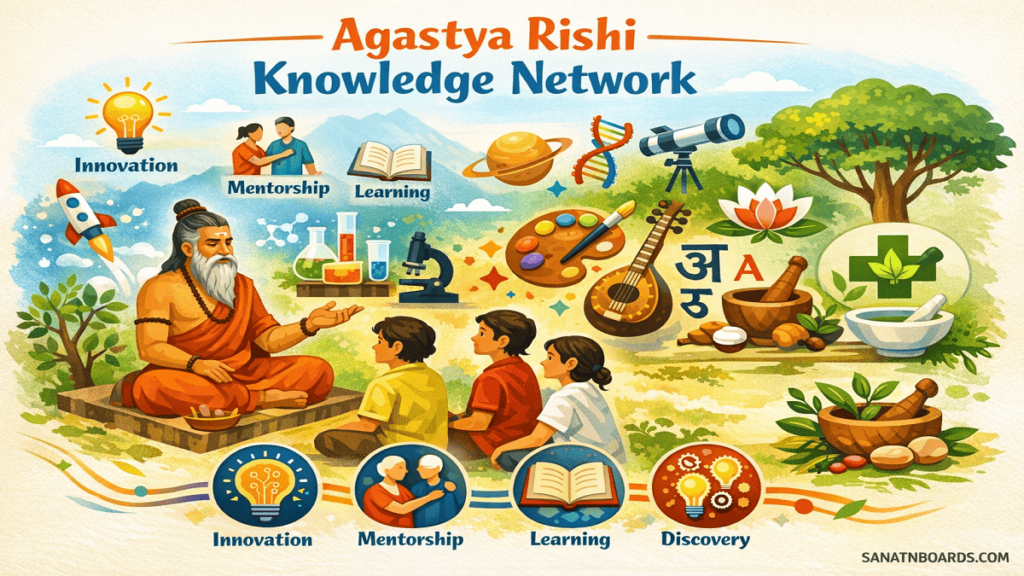
What Is AGASTYA RISHI KNOWLEDGE NETWORK ?
The Agastya Rishi Knowledge Network refers to the expansive and enduring legacy of wisdom, learning, and cultural insight associated with Rishi Agastya, one of ancient India’s most respected sages. Rather than a modern institution, this “network” is a conceptual web of knowledge transmission—spanning disciplines such as philosophy, language, medicine, and spirituality—rooted in the teachings and influence of Agastya as recorded in Indian tradition and texts.
Agastya is a revered Vedic sage, mentioned in early Indian scriptures like the Rigveda, where he and his wife Lopamudra authored several hymns. He is traditionally honored for bringing spiritual and intellectual traditions from northern to southern India, bridging cultures and knowledge systems. His journey throughout the Indian subcontinent symbolizes the spread and integration of diverse learning traditions across regions.
The knowledge network attributed to Agastya includes contributions to language and literature. For example, in Tamil tradition Agastya is linked with Agattiyam, an early text on Tamil grammar, underscoring the sage’s role in linguistic development and cross‑cultural scholarship.
Another important aspect of this conceptual network is Agastya’s association with Siddha medicine, a traditional healing system from South India. He is often revered as a father figure in Siddha and is believed to have explored early ideas in botany, medicine, and natural sciences, demonstrating a holistic approach to learning that blends empirical insight with spiritual practice.
In modern times, the legacy of Agastya’s wisdom inspires educational initiatives such as the Agastya International Foundation, which adopts his philosophy of curiosity‑driven, hands‑on learning to ignite creativity and confidence in millions of students, especially in underserved communities. The Foundation emphasizes experiential learning, critical thinking, and innovation, closely reflecting the timeless values associated with Agastya’s teachings.
Who Is Required AGASTYA RISHI KNOWLEDGE NETWORK ?
The Agastya Rishi Knowledge Network is relevant for anyone seeking holistic learning, combining traditional wisdom with modern education. While it originates from the teachings of Rishi Agastya, its applications extend far beyond spiritual or religious contexts, offering guidance in education, science, language, and culture.
Students and learners benefit greatly from this knowledge network. Agastya’s teachings emphasize critical thinking, observation, and interdisciplinary understanding. By exploring his legacy, learners can connect ancient insights in medicine, botany, linguistics, and philosophy with modern concepts, fostering both intellectual and practical skills.
Educators and teachers can also draw from this network to enrich teaching methods. Agastya’s approach encourages hands-on learning, experiential education, and mentorship, providing a model for creating classrooms that cultivate curiosity, problem-solving, and creativity. This is particularly valuable in rural or resource-limited settings, where innovative learning methods inspired by Agastya can make education more accessible and impactful.
Researchers and cultural scholars find the network invaluable for studying the intersections of language, literature, medicine, and spirituality. Agastya’s contributions to Vedic texts, Tamil grammar, and Siddha medicine offer a framework for understanding knowledge transmission across generations.
Finally, the network is significant for policy makers and educational innovators. Modern initiatives, like the Agastya International Foundation, demonstrate how the principles of Agastya’s knowledge—curiosity, creativity, and interdisciplinary learning—can shape educational programs that empower millions of students.
When Is The Agastya Rishi Knowledge Network Required?
The Agastya Rishi Knowledge Network becomes especially relevant in situations that demand holistic, interdisciplinary, and experiential learning. It is required whenever there is a need to integrate traditional wisdom with modern education.
- During Early Education and Learning: Introducing children to curiosity-based learning, critical thinking, and creative problem-solving aligns with Agastya’s teaching philosophy. Hands-on experiments, storytelling, and practical applications of knowledge help learners develop both intellect and character.
- In Rural or Resource-Limited Education: In areas where access to modern educational infrastructure is limited, Agastya-inspired methods—using low-cost, practical learning tools—can make science, technology, and cultural education more accessible.
- For Teachers and Educators: It is required when designing teaching methods that encourage exploration, mentorship, and interdisciplinary understanding, helping students grasp complex concepts through observation and practice rather than rote memorization.
- For Researchers and Cultural Scholars: When studying ancient texts, traditional medicine, linguistics, or cultural history, Agastya’s network offers a framework for tracing knowledge transfer across generations and regions.
- In Innovation and Skill Development Programs: Modern educational initiatives, like the Agastya International Foundation, apply his philosophy to ignite creativity, problem-solving, and scientific thinking in students, particularly in contexts where conventional teaching alone may not be sufficient.
Where Is The Agastya Rishi Knowledge Network Required?
The Agastya Rishi Knowledge Network is a conceptual framework representing the vast and diverse knowledge of Rishi Agastya, an ancient sage revered for his contributions to education, language, medicine, philosophy, and culture. This network is not tied to a single location; rather, it is required wherever learning, creativity, and holistic education are emphasized. Its application spans classrooms, research centers, rural communities, innovation labs, and cultural programs.
1. Schools and Educational Institutions
Agastya’s philosophy is particularly relevant in schools, colleges, and universities where education goes beyond rote memorization. The network promotes hands-on learning, critical thinking, and experiential education, allowing students to explore concepts in science, arts, and language through observation, experimentation, and practice. Science labs, language classes, and cultural programs benefit from adopting Agastya-inspired approaches, helping students connect theory with real-world application.
2. Rural and Remote Areas
One of the most impactful applications of this knowledge network is in villages and under-resourced regions. Traditional classrooms may lack infrastructure, and here, Agastya’s philosophy of low-cost, experiential learning can be transformative. Practical demonstrations in science, technology, and arts can ignite curiosity among students, ensuring that education becomes accessible, engaging, and meaningful, even in places with limited resources.
3. Research Centers and Libraries
Agastya’s knowledge is crucial for researchers and scholars studying ancient Indian texts, Tamil grammar, Vedic literature, or traditional medical systems like Ayurveda and Siddha medicine. His network provides a framework for understanding knowledge transfer across generations, enabling researchers to explore the connections between language, culture, science, and spirituality in historical contexts.
4. Innovation and Learning Labs
Modern educational and innovation centers can benefit from applying Agastya-inspired methods. The network emphasizes experiential learning, problem-solving, and creativity, which are essential in STEM education, entrepreneurship programs, and skill-development workshops. By creating environments where learners experiment, innovate, and apply knowledge practically, Agastya’s approach ensures education is dynamic and forward-looking.
5. Community Learning Programs
The knowledge network is also required in community centers, cultural workshops, and public educational initiatives. Programs that aim to teach ethical understanding, cultural literacy, practical skills, or scientific knowledge can leverage Agastya’s interdisciplinary philosophy. This ensures that learning is lifelong, inclusive, and applicable across age groups.
How Is the Agastya Rishi Knowledge Network Required?
1. Through Experiential Learning
Agastya emphasized learning by doing and observing, rather than rote memorization. This network is required when students, researchers, or learners engage in hands-on experiments, practical demonstrations, and real-world problem-solving. For instance, science concepts can be taught through simple experiments, while language and grammar can be taught through interactive storytelling—reflecting Agastya’s approach to connecting theoretical knowledge with practice.
2. Through Interdisciplinary Integration
The network is required when different disciplines are connected for comprehensive understanding. Agastya’s teachings link philosophy, language, medicine, science, and arts, showing that learning is more effective when subjects are not studied in isolation. This is applied in schools, universities, and innovation labs where cross-disciplinary projects, research assignments, or integrated learning modules are encouraged.
3. Through Teacher Mentorship and Guidance
Agastya’s knowledge network is required in educational settings that emphasize mentorship. Teachers and trainers act as guides, helping learners discover insights, develop critical thinking, and cultivate curiosity, rather than merely delivering content. Mentorship ensures that knowledge is transferred effectively, replicating the way Agastya trained his disciples.
4. Through Community and Accessible Learning
The network is required in community programs, rural education, and outreach initiatives. Agastya’s principles are applied to make education accessible to all, especially in areas lacking conventional infrastructure. Workshops, mobile labs, or demonstration-based teaching bring practical knowledge and life skills directly to students and communities.
5. Through Modern Educational Innovations
Today, the Agastya network is required in innovation hubs, skill development centers, and science labs, where his philosophy inspires creativity, problem-solving, and experimentation. Initiatives like the Agastya International Foundation apply his principles to spark curiosity, encourage self-learning, and nurture talent, especially in underprivileged areas.

Case Study On Agastya Rishi Knowledge Network
The Agastya Rishi Knowledge Network is rooted in the ancient wisdom of Rishi Agastya, a revered sage known for his holistic approach to learning and knowledge. His teachings emphasize curiosity, observation, and practical application, integrating philosophy, language, science, medicine, and the arts. In modern education, these principles are applied through initiatives like the Agastya International Foundation in India, which aims to bring hands-on, curiosity-driven learning to students, particularly in rural and underserved areas. The foundation’s work exemplifies how Agastya’s knowledge network can be translated into real-world educational programs that are inclusive, practical, and transformative.
Traditional education in many parts of India relies heavily on rote memorization, often leaving students with little opportunity to explore, experiment, or engage creatively. Many schools, especially in rural areas, lack science labs, interactive tools, and resources for practical learning, limiting students’ ability to understand concepts deeply or apply knowledge in meaningful ways. These challenges make the Agastya Rishi Knowledge Network highly relevant, as it promotes learning by doing, critical thinking, and interdisciplinary education.
To overcome these challenges, the Agastya International Foundation implements programs designed to make learning interactive and experiential. Mobile science labs bring hands-on experiments directly to schools, enabling students to observe, build, and experiment with scientific models. Innovation and creativity labs provide spaces for STEAM activities, problem-solving projects, and design thinking, encouraging students to ask questions and find solutions to real-world challenges. Teachers are trained in low-cost, hands-on teaching methods, emphasizing mentorship, guidance, and active engagement rather than passive lectures. Community workshops and science fairs further extend these learning opportunities, connecting students, teachers, and local communities in collaborative educational experiences.
The results of these programs are significant. Students participating in Agastya initiatives demonstrate greater curiosity, confidence, and engagement with their studies. Hands-on learning improves their conceptual understanding in science, mathematics, and technology, while collaborative projects enhance communication, leadership, and problem-solving skills. By reaching millions of students and hundreds of thousands of teachers across India, the Agastya model makes education accessible, practical, and inspiring, even in areas where traditional resources are scarce.
In conclusion, the Agastya Rishi Knowledge Network bridges ancient wisdom and modern education by emphasizing experiential learning, interdisciplinary exploration, and holistic development. It provides a framework that fosters creativity, curiosity, and lifelong learning. By applying these principles, students not only gain knowledge but also develop the skills, confidence, and mindset needed to navigate the modern world. The Agastya approach demonstrates that education is most effective when it combines practical experience, critical thinking, and cultural understanding, making this knowledge network a timeless model for both rural and urban learning environments.
White Paper On Agastya Rishi Knowledge Network
Executive Summary
The Agastya Rishi Knowledge Network represents the educational and cultural wisdom of Rishi Agastya, an ancient Indian sage renowned for his holistic approach to learning. This network emphasizes experiential learning, interdisciplinary knowledge, and practical application, spanning subjects like science, language, philosophy, medicine, and arts. In contemporary education, these principles have been applied through initiatives such as the Agastya International Foundation, which brings hands-on, curiosity-driven learning to students, particularly in rural and underserved communities. This white paper explores the background, significance, applications, and impact of the Agastya Knowledge Network in modern educational contexts.
Background
Rishi Agastya is a revered figure in Vedic and Tamil traditions, credited with contributions to Vedic hymns, Tamil grammar, Ayurveda, and Siddha medicine. His teachings emphasize holistic education, combining intellectual, practical, and ethical knowledge. The “network” refers to the intergenerational transmission of knowledge, integrating multiple disciplines and fostering critical thinking, creativity, and problem-solving.
The Agastya International Foundation, inspired by his philosophy, operationalizes this knowledge network in modern settings. Its goal is to bridge traditional wisdom with contemporary learning, providing access to hands-on, practical education for students who might otherwise be excluded due to geographic, economic, or infrastructural barriers.
Challenges Addressed
- Rote Learning Dominance: Many schools rely heavily on memorization, limiting students’ curiosity and engagement.
- Infrastructure Limitations: Rural and under-resourced areas often lack laboratories, teaching aids, and experiential learning opportunities.
- Limited Teacher Training: Educators may not have the resources or skills to implement interactive and inquiry-based learning.
Applications and Implementation
The Agastya Knowledge Network is applied through:
- Mobile Science Labs: Bringing practical experiments to schools, allowing students to interact with models and conduct experiments.
- Innovation and Creativity Labs: Providing spaces for STEAM education, problem-solving projects, and design-thinking activities.
- Teacher Training Programs: Training educators in low-cost, hands-on teaching methodologies to facilitate curiosity-driven learning.
- Community Engagement: Workshops, science fairs, and outreach programs connect students, teachers, and local communities.
Impact and Outcomes
- Enhanced Curiosity and Confidence: Students demonstrate increased interest in learning and self-directed inquiry.
- Deeper Conceptual Understanding: Hands-on activities improve comprehension in science, mathematics, and language.
- Skill Development: Collaboration fosters leadership, communication, and problem-solving skills.
- Scalability and Reach: Millions of students and hundreds of thousands of teachers across India have benefited, making education inclusive, accessible, and meaningful.
Conclusion
The Agastya Rishi Knowledge Network exemplifies a timeless model of holistic education. By integrating experiential learning, interdisciplinary knowledge, and community engagement, it bridges ancient wisdom and modern educational practices. Its application demonstrates that learning is most effective when it is practical, interactive, and inspiring, providing students with the knowledge, skills, and confidence required to navigate the challenges of the 21st century.
Industry Applications Of The Agastya Rishi Knowledge Network
1. Education and EdTech Industry
Agastya’s emphasis on hands-on and curiosity-driven learning directly informs the design of educational tools, e-learning platforms, and experiential learning programs. EdTech companies can adopt these principles to create interactive STEM modules, gamified learning apps, and low-cost educational kits, enabling students to explore, experiment, and learn actively rather than passively. This approach aligns with the growing global demand for personalized, experiential, and hybrid learning solutions.
2. Innovation and R&D Industries
The network’s philosophy of problem-solving, creativity, and interdisciplinary exploration is highly relevant for research and development sectors. Organizations in technology, engineering, and product design can implement Agastya-inspired methods through innovation labs, hackathons, and prototype-based learning. These methods encourage employees and students to think critically, experiment, and collaborate on real-world solutions.
3. Healthcare and Life Sciences
Agastya’s contributions to Ayurveda and Siddha medicine provide a framework for integrating traditional knowledge with modern healthcare practices. Hospitals, wellness startups, and pharmaceutical companies can apply these principles to research herbal formulations, develop preventive care programs, and educate communities about holistic health practices.
4. Skill Development and Vocational Training
Industries focused on vocational education, rural skill training, and workforce development can use the Agastya model to design experiential and hands-on curricula. For example, training programs in agriculture, renewable energy, or engineering can include practical experiments, mentorship and community-based learning, enhancing employability and applied knowledge.
5. Corporate Training and Organizational Learning
Corporations can implement Agastya-inspired methods in employee training programs, emphasizing creative problem-solving, team-based learning, and applied knowledge. By integrating practical exercises and mentorship, companies can enhance innovation, leadership, and adaptive thinking among employees.
Conclusion
The Agastya Rishi Knowledge Network demonstrates that ancient educational wisdom can be adapted for modern industries. Its principles of hands-on learning, interdisciplinary exploration, and mentorship are applicable not only in schools but also in technology, healthcare, corporate, and skill-development sectors, providing a roadmap for fostering creativity, innovation, and practical expertise in today’s rapidly evolving industrial landscape.
SOURCE : Katha
ASK FAQ
What is the Agastya Rishi Knowledge Network?
The Agastya Rishi Knowledge Network is a framework of holistic, experiential, and interdisciplinary learning inspired by sage Agastya, integrating science, language, culture, and practical skills.
Who can benefit from the Agastya Rishi Knowledge Network?
Students, teachers, researchers, and innovators can benefit, as it promotes hands-on learning, critical thinking, and creativity across education and skill development.
How is the Agastya Rishi Knowledge Network applied in modern education?
It is applied through mobile science labs, creativity hubs, teacher training, and community workshops, fostering experiential and curiosity-driven learning.
Where is the Agastya Rishi Knowledge Network implemented?
:Primarily in rural and underserved schools in India, innovation labs, research centers, and community education programs that focus on practical and interactive learning.
Why is the Agastya Rishi Knowledge Network important today?
It bridges ancient wisdom and modern education, promoting problem-solving, creativity, and lifelong learning, making education accessible, meaningful, and engaging.
Table of Contents
Disclaimer: This content is for educational and informational purposes only. It is based on historical texts, cultural interpretations, and publicly available sources. The information should not be considered professional, medical, or legal advice.