
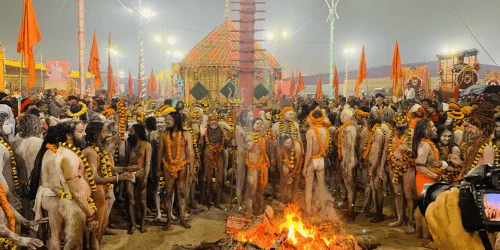
Sanatan Dharma 13 Akhara Pramukh
Guardians of Dharma, Warriors of the Spirit
Abstract:
Within the vast and intricate tapestry of Sanatan Dharma (often referred to as Hinduism), the Akharas stand as unique and formidable institutions. More than just monastic orders, they are socio-spiritual-military encampments, historically charged with the protection of faith, the pursuit of extreme asceticism, and the preservation of a militant yogic tradition. While their public presence is most vividly seen during grand pilgrimages like the Kumbh Mela, where they process with majestic splendor, their internal structures, philosophies, and historical roles are profound and complex.
At the helm of each of these powerful bodies sits the Akhara Pramukh (also called Mahant, Shri Mahant, or President)—the supreme authority and spiritual general. This exploration delves into the world of the thirteen recognized Akharas, unraveling their origins, their distinctive paths, the immense responsibility of their leaders, and their evolving role in contemporary India.
Introduction: The Meaning of “Akhara”
The term “Akhara” (Sanskrit: अखाड़ा) originally denotes a wrestling ground or a place of training for physical and martial contest. This etymology is central to understanding their identity. For the Akharas, life itself is a spiritual wrestling match—a struggle (sadhana) against the inner enemies of ignorance, ego, and attachment. The Akhara is the training ground where the Sadhu (ascetic) transforms into a Shastra-dhari (weapon-wielding) or Astra-dhari (weapon-wielding) warrior of Shiva or Vishnu, as well as a Danda-dhari (staff-bearing) guardian of Dharma.
The Akhara system formalized between the 8th and 16th centuries CE, partly as a response to periods of significant social upheaval and challenges to indigenous spiritual traditions. They became the organized defensive and offensive arm of Hindu asceticism, protecting temples, scriptures, pilgrims, and philosophical discourse. Today, they are broadly divided along sectarian lines into three major streams: Shaiva (devotees of Lord Shiva), Vaishnava (devotees of Lord Vishnu and his incarnations), and Udasin (originally following the teachings of Guru Nanak’s son Sri Chand, but now deeply syncretic). Within these are seven main Akharas and six sub-branches, making the “Thirteen Akharas” a collective term for this organized hierarchy.
The Structural Hierarchy of an Akhara
To comprehend the stature of the Akhara Pramukh, one must understand the military-like discipline within an Akhara:
- Mahamandaleshwar: The highest spiritual title, often held by senior saints who may have oversight over multiple monasteries (mathas) and are revered as enlightened teachers. Many Pramukhs also hold this title.
- Akhara Pramukh (Shri Mahant): The elected or traditionally appointed head and supreme commander of the entire Akhara. He is the final authority on all spiritual, organizational, and strategic matters.
- Mahant: The head of a specific monastery or temple affiliated with the Akhara.
- Sachiv (Secretary): Handles the administration, correspondence, and records of the Akhara.
- Kothari (Treasurer): Manages the finances, properties, and resources of the Akhara.
- Sena Nayak (Army Commander): A title that harks back to the martial past; oversees security and the order of processions.
- Sadhu/Sannyasi: The general monastic members, further divided into various grades of initiation and seniority.
The Pramukh’s authority is absolute within the Akhara’s domain. His directives are followed without question, reflecting a blend of spiritual devotion and martial obedience.
The Thirteen Akharas and Their Pramukhs: A Detailed Exposition
Here, we explore each of the thirteen Akharas, their sectarian affiliations, distinctive features, and the contemporary role of their Pramukhs.
THE SHAIVA AKHARAS
The Shaiva Akharas, dedicated to Lord Shiva, are the oldest and most numerous. They follow the Dashanami Sampradaya (Order of Ten Names) established by Adi Shankaracharya in the 8th century, organized under four cardinal monasteries (Mathas). They are known as Naga Sadhus – ascetics who traditionally renounce clothing as a symbol of complete renunciation. They are further classified as Dandi (staff-bearing) and Shastra-dhari (armed).
1. Shri Panchayati Akhada Mahanirvani (आखाड़ा महानिर्वाणी)
- Pramukh (as of 2024): Mahant Ravindra Puri (also a Mahamandaleshwar).
- Significance: Considered the oldest and most powerful Akhara. It was formally established in 748 CE by Adi Shankaracharya, according to their tradition, though historical consolidation likely happened later. Its name “Nirvani” signifies the state of liberation (Nirvana).
- Affiliation: Jyotir Math (Badrinath).
- Notable Role: They have the privilege of leading the Shahi Snan (Royal Bath) processions at the Kumbh Mela. The Pramukh of Mahanirvani is often seen as a primus inter pares (first among equals) among Akhara heads. Their leadership involves managing vast assets, intricate rituals, and a massive membership of Naga Sadhus.
2. Shri Panchayati Akhada Niranjani (आखाड़ा निरंजनी)
- Pramukh: Mahant Dharamdas Ji Maharaj.
- Significance: Established in 904 CE, according to tradition, in Karnaprayag. They are a major force and chief rivals to the Mahanirvani in terms of influence and protocol. The name “Niranjani” refers to the pure, unstained nature of the soul.
- Affiliation: Jyotir Math.
- Distinct Feature: Their Naga Sadhus are known for a distinctive mark: a large black vertical tilak (Urdhva Pundra). The Pramukh here balances a fierce independent streak with the need for cooperation in larger Dharmic matters.
3. Shri Panchadashnam Juna Akhada (जूना आखाड़ा)
- Pramukh: Mahamandaleshwar Hari Giri Maharaj.
- Significance: “Juna” means “old,” and it is considered a sister branch of the Niranjani Akhara, from which it separated centuries ago. It is now the largest Akhara in terms of membership, encompassing a wide array of ascetics, including the famous Aghoris (who transcend conventional purity rules) within its fold.
- Affiliation: Jyotir Math.
- Notable Aspect: Known for its inclusivity and radical ascetic practices. The Pramukh of Juna oversees a vast, diverse, and often unpredictable constituency, requiring a leadership style that is both authoritative and accommodating of extreme paths.
4. Shri Panchayati Akhada Atal (अटल आखाड़ा)
- Pramukh: Mahant Prem Giri Maharaj.
- Significance: A smaller but historically significant Shaiva Akhara, said to have been established in 646 CE, making it possibly older than the Mahanirvani in origin stories. “Atal” means immovable or firm.
- Affiliation: Jyotir Math.
- Unique Role: Traditionally, the Atal Akhara did not maintain a standing army of Nagas but focused on scholarly and meditative pursuits. Their Pramukh is often a guardian of specific philosophical texts and practices.
5. Shri Panchadashnam Aahan (आहन आखाड़ा)
- Pramukh: Position often held within the leadership structure of the Mahanirvani or Niranjani.
- Significance: It is a subsidiary Akhara, traditionally linked to and functioning under the guidance of one of the major Akharas. Its independent operational role is limited.
6. Shri Panchadashnam Aanand (आनंद आखाड़ा)
- Pramukh: Similarly, a subsidiary Akhara with its leadership intertwined with a primary Akhara.
- Significance: Along with Aahan, it represents the sub-branches within the Dashanami Naga structure, often formed around a specific saint or lineage.
7. Shri Panchayati Akhada Agni (अग्नि आखाड़ा)
- Pramukh: Considered a subsidiary, with its head aligned to a major Akhara.
- Significance: This is the smallest and rarest of the Shaiva Akharas. Some traditions hold that it was created for ascetics who perform perpetual fire rituals (Agnihotra). Its existence and independent status are sometimes debated among scholars.
THE VAISHNAVA AKHARAS
The Vaishnava Akharas, devoted to Lord Vishnu and his incarnations (Rama, Krishna), were formed later, between the 15th and 17th centuries, partly as a counterbalance to the influential Shaiva Nagas. They follow the Bairagi (dispassionate) tradition and are always clothed. They are divided into two major sub-sects: the Ramanandi (followers of saint Ramananda, devoted to Rama) and the Nirmohi (followers of the Haridasi tradition).
8. Shri Panchayati Akhada Bada Udasin (बड़ा उदासीन)
- Pramukh: Mahant Gopal Das Ji.
- Significance: Although grouped with Vaishnavas due to their devotional nature, the Udasins are a syncretic order founded by Sri Chand (1494-1643), son of Guru Nanak. They incorporate elements from Sikh, Vedantic, and Bhakti traditions. “Bada” means big, indicating its primary status.
- Philosophy: They emphasize detachment (Udasinta) and see the divine in all forms. Their Pramukh navigates a unique identity at the intersection of Hindu and Sikh ascetic traditions.
9. Shri Panchayati Akhada Naya Udasin (नया उदासीन)
- Pramukh: Mahant Mohan Das Ji.
- Significance: A later formation that split from the Bada Udasin. “Naya” means new. The distinction often relates to lineage and monastic properties rather than core philosophy.
10. Shri Digambardhan Panchayati Akhada Nirmohi (निर्मोही आखाड़ा)
– Pramukh: Mahant Sushil Das Ji.
– Significance: “Nirmohi” means “free from attachment.” This Akhara is closely associated with the worship of the child form of Krishna (Balakrishna) and the preservation of the Braj culture around Mathura-Vrindavan. They are the custodians of the famous Banke Bihari Temple in Vrindavan for six months of the year. Their Pramukh is as much a cultural ambassador as a spiritual head.
11. Shri Digambar Ani Shri Panchayati Akhada Nirvani (वैष्णव निर्वाणी)
– Pramukh: Mahant Vidyabhaskar Ji.
– Significance: The principal Akhara of the Ramanandi Sampradaya, one of the largest Vaishnava ascetic communities in North India. They are devotees of Rama and Sita. The term “Nirvani” here, like its Shaiva counterpart, signifies the goal of liberation through devotion (Bhakti).
– Note: It is crucial to distinguish this Vaishnava Nirvani from the Shaiva Mahanirvani Akhara.
12. Shri Panchayati Akhada Khaki (खाकी आखाड़ा)
– Pramukh: Its leadership is typically integrated with the Nirmohi Akhara.
– Significance: A subsidiary Akhara of the Nirmohi order. The name “Khaki” (dust-colored) may refer to the simple, earth-toned garments of its ascetics.
THE UDASIN AKHARA (A Separate Stream)
13. Shri Panchayati Akhada Bada Udasin (and Naya Udasin)
– As listed above (8 & 9), these are the two primary Udasin Akharas. They are sometimes counted separately to complete the number thirteen, acknowledging their distinct origin from both Shaiva and Vaishnava traditions.
The Role, Power, and Challenges of an Akhara Pramukh
The position of Akhara Pramukh is not merely administrative; it is a multifaceted role requiring the wisdom of a sage, the acumen of a CEO, the tact of a diplomat, and the courage of a general.
1. Spiritual Supreme: He is the ultimate spiritual guide (Guru) for every member of the Akhara. He presides over initiations (Diksha), esoteric rituals, and theological interpretations. His word on matters of doctrine is final.
2. Commander-in-Chief: During the Kumbh Mela, this role becomes paramount. The Pramukh leads the Shahi Snan procession, a carefully choreographed display of the Akhara’s power and prestige. He commands the order of march, with Naga Sadhus in the vanguard, followed by mahants on elephants or chariots, and thousands of ascetics behind. Any breach of protocol between Akharas can lead to conflict, requiring immense diplomatic skill from the Pramukhs.
3. Administrative Head: Akharas are massive economic entities. They own vast tracts of land, temples, ashrams, banks, and businesses across India (especially in holy cities like Allahabad, Varanasi, Haridwar, Ujjain). The Pramukh oversees this empire, ensuring its financial health and proper utilization for the welfare of Sadhus and Dharma-based activities. The Kothari (Treasurer) and Sachiv (Secretary) are his key executives.
4. Legal and Political Entity: The Akharas are recognized as legal bodies. The Pramukh represents the Akhara in courts, in disputes over property, and in negotiations with government authorities. They wield significant political influence, especially in regions like Uttar Pradesh and Uttarakhand. Politicians often seek their blessings and support during elections, making the Pramukh a key power broker.
5. Guardian of Tradition and Agent of Change: This is the Pramukh’s most delicate balancing act. He must preserve the ancient, often austere and secretive, traditions of the Akhara—from martial arts (like the use of swords, spears, and clubs) to rigorous ascetic practices. Simultaneously, he must navigate the 21st century: dealing with media scrutiny, addressing issues of modernization, and sometimes reforming internal practices (such as addressing allegations of corruption or succession disputes). Some Pramukhs have embraced social media and environmental causes, while others remain cloistered in tradition.
Contemporary Issues and the Future
The Akharas and their Pramukhs face several modern challenges:
- Succession Disputes: The election or appointment of a new Pramukh can lead to intense, sometimes violent, internal factionalism, as the position commands immense spiritual and material authority.
- Commercialization and Corruption: The vast wealth of some Akharas has led to accusations of financial misappropriation and a drift away from ascetic ideals. The Pramukh is at the center of these allegations or reform efforts.
- Relevance in a Democratic State: With a professional military and police, the Akharas’ historical martial role is obsolete. Their challenge is to redefine their social purpose—increasingly focusing on education, healthcare, environmental conservation (e.g., cleaning the Ganga), and disaster relief.
- Public Perception: The sensationalized image of the “Naga Sadhu” sometimes overshadows their philosophical depth. Pramukhs now engage in public discourse, interfaith dialogues, and cultural showcases to present a more holistic picture of their tradition.
Conclusion: The Living Fortresses of Dharma
The thirteen Akharas of Sanatan Dharma are not relics of a bygone era but living, breathing organisms that have continuously adapted for over a millennium. The Akhara Pramukh is the linchpin of this adaptation. He is the custodian of a fearsome and glorious tradition that seamlessly blends the path of the yogi with that of the warrior. In his person resides the authority to interpret ancient vows, command thousands of renunciants, manage multi-million rupee assets, and influence the spiritual landscape of India.
They remind us that Sanatan Dharma has never been a passive philosophy. It possesses, within its core, a disciplined, organized, and courageous dimension—the Kshatriya spirit incarnated in ochre robes. As long as the Akharas endure, with their Pramukhs standing guard at the crossroads of spirituality and temporal power, they will continue to be the formidable guardians of a faith that has, time and again, defended its right to exist and evolve. Their story is an essential, though often overlooked, chapter in the epic history of India’s spiritual quest.
Top 100 name of Sanatan Dharma 13 Akhara Pramukh
A complete list of the Top 100 Pramukhs (leaders) of the 13 Akharas in Sanatan Dharma is not publicly available in a single source. However, I can provide a list of some of the known and prominent Mahamandaleshwars and Pramukhs from these Akharas.
Courtesy: Oneindia Plus | वनइंडिया प्लस
13 Akharas & Their Prominent Leaders (Mahamandaleshwars & Pramukhs)
1. Juna Akhara (Oldest and Largest)
- Acharya Mahamandaleshwar Swami Avdheshanand Giri (Current Head)
- Swami Pragyananand Giri
- Swami Shivanand Giri
- Swami Arun Giri
- Swami Satyamitranand Giri
2. Niranjani Akhara
- Acharya Mahamandaleshwar Swami Kailashanand Giri (Current Head)
- Swami Anand Giri
- Swami Prabodhanand Giri
- Swami Maheshwaranand Giri
3. Mahanirvani Akhara
- Acharya Mahamandaleshwar Swami Vishwadevanand Puri (Current Head)
- Swami Avimukteshwaranand Saraswati
- Swami Govindanand Puri
- Swami Madhavanand Giri
4. Atal Akhara
- Mahamandaleshwar Swami Satyendra Nath Giri
- Swami Swaroopanand Giri
- Swami Yogeshwaranand Giri
5. Avahan Akhara
- Swami Hariharanand Saraswati
- Swami Shivbhaktanand Giri
- Swami Balakanand Giri
6. Agni Akhara
- Swami Keshavanand Giri
- Swami Omkaranand Giri
Courtesy: HISTORY TV18
7. Anand Akhara (Branch of Niranjani Akhara)
- Swami Akhandanand Giri
- Swami Anant Giri
8. Nirmohi Akhara (Vaishnav Sect)
- Swami Dharam Das
- Swami Rajendra Das
9. Digambar Ani Akhara (Vaishnav Sect)
- Swami Mahant Bhakti Dutt Ji
10. Nirvani Ani Akhara (Vaishnav Sect)
- Swami Mahant Premanand Das
11. Nirmal Akhara (Sikh Tradition)
- Swami Mahant Gopal Das
12. Bada Udasin Akhara
- Swami Mahant Pranavanand Giri
13. Udasin Akhara
- Swami Mahant Mohan Das
Where to Find the Full List?
For an updated and detailed list of all 100+ leaders, you can check:
- Akhil Bharatiya Akhara Parishad (ABAP) official sources
- Kumbh Mela announcements, where these leaders gather
- Sanatan Dharma publications and news reports

Table of Contents