
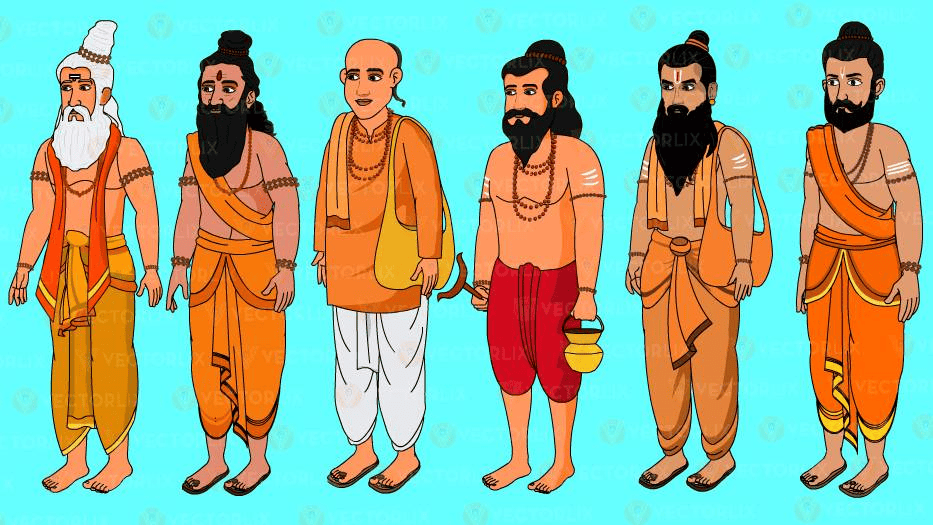
Sanatan Dharma Rishi Muni
The Eternal Wisdom of the Rishis and Munis
The Rishis and Munis of Sanatan Dharma are not founders or prophets, but discoverers. Their authority stems not from divine command, but from direct perception (darshana) of the eternal principles governing existence—the cosmic order known as Ṛta. They functioned as flawless instruments, their minds purified through intense discipline (tapas), to “hear” (śruti) and articulate the fundamental vibrations of reality itself. This process gave birth to the Vedas, which are considered apauruṣeya, “not of human origin,” but revealed through these refined human consciousnesses.
The Rishi (from dṛś, “to see”) is primarily the seer of sacred knowledge. Sitting in deep meditation, they perceived the metaphysical architecture of the universe—the interplay of consciousness (Brahman), the individual self (Atman), and the moral law of karma. Their legacy is the monumental scriptural edifice: the Vedic hymns, the philosophical discourses of the Upanishads, and the structured wisdom of the darshanas. They provided the map of reality.
The Muni (linked to mauna, “silence”) is the embodiment of that knowledge. Often a wandering ascetic, the Muni represents the path of radical inner experimentation. Through fierce austerity, renunciation, and unwavering meditation in forests and caves, they sought to directly experience the truths the Rishis had seen. Their contribution is the science of transformation—the practical paths of yoga, tantra, and sannyasa. They walked the territory.
Together, these archetypes established a complete ecosystem of wisdom. The Rishi provided the revelation in the guru-kula; the Muni demonstrated its realization in the tapo-vana. One gave the timeless principles; the other lived their timeless application. Their unified message is that the purpose of human life is to awaken from ignorance (avidya) through disciplined inquiry and experience, realizing one’s true nature as infinite consciousness. To engage with Sanatan Dharma is to enter a dialogue with their enduring, experiential wisdom, which continues to offer a profound compass for navigating the human journey toward truth and liberation.
I. The Archetypes: Distinguishing the Rishi and the Muni
While often used interchangeably, the terms Rishi and Muni denote subtly different archetypes of the realized being, each representing a distinct path and mode of consciousness.
The Rishi (Ṛṣi): The Seer of the Sacred Syllables
The word “Rishi” derives from the root “dṛś,” meaning “to see.” A Rishi is not a thinker or a philosopher in the intellectual sense; he is a seer of truth. His consciousness, through intense tapas (austerity), meditation, and purity, attunes itself to the fundamental vibrations of the universe. He “hears” or “sees” the eternal, non-personal truths—the Śruti, “that which is heard.” The most monumental contribution of the Rishis is the Vedas, the apauruṣeya (not of human agency) scriptures.
The Vedic hymns are not compositions but discoveries. The Rishis, sitting in deep states of contemplation, perceived the sacred syllables (Mantras) that structure reality itself. They became the transparent mediums for these vibrations, articulating them into the language of their time. The famous Saptarishis (Seven Great Rishis)—like Vashishtha, Vishwamitra, Bharadvaja, and Gautama—are not just individuals but represent the seven primordial seers, the mind-born sons of Brahma, who established the different lineages of Vedic knowledge (Gotras). Their “seeing” encompassed the macrocosm and microcosm: the laws of nature (Ṛta), the psychology of sacrifice (Yajna), and the intricate connections between the individual soul (Jiva) and the cosmic soul (Brahman).
The Muni (Muni): The Silent Sage of Inner Fire
The term “Muni” comes from the root “man,” meaning “to think,” but in a deeply introspective, contemplative sense. It is also linked to “mauna,” meaning silence. If the Rishi is the seer of outward-reaching cosmic truths, the Muni is the sage of profound inner silence and ascetic power. The Muni is often depicted as a wandering ascetic, clad in rags or bark, with matted hair (jata), immersed in the fire of tapas.
Tapas is not mere physical austerity; it is the concentrated heat of spiritual discipline that burns away impurities and leads to the dawning of inner illumination. The archetypal Muni is one who has withdrawn from societal structures to dwell in forests (Aranya), mountains, or caves, engaging in fierce self-inquiry and meditation. While Rishis gave us the structured knowledge of the Vedas, Munis are often the progenitors of the more experimental, experiential, and ascetic traditions that crystallized into the Upanishadic wisdom and the various schools of Yoga and Tantra.
They sought the direct experience of the truth the Rishis had seen. A famous example is the young seeker Nachiketa from the Katha Upanishad, who through his steadfastness confronts Yama (the lord of death) and becomes a Muni of wisdom.
In essence, the Rishi provides the revelation; the Muni embodies the realization. One gives the map (the Veda), the other walks the path (the Sādhana).
II. The Laboratories of Realization: From Ashramas to the Himalayas
The spiritual pursuits of the Rishis and Munis did not happen in isolation but within a sophisticated ecological and societal framework designed to support their quest.
The Gurukula System: The Seedbed of Wisdom
From a young age, potential seekers were initiated into the household of a Guru, often a Rishi himself. This was the Gurukula—a familial school in a forest hermitage (Ashram). Education was not vocational but holistic, centered on Dharma (righteous living), Brahmacharya (celibacy and discipline), the memorization of Vedic mantras with perfect intonation, and service to the Guru.
The disciple (shishya) learned through osmosis, observing the Guru’s every action. This intimate, residential system ensured the flawless oral transmission of knowledge for millennia and shaped the character of the seeker. Great epics like the Ramayana and Mahabharata are replete with scenes of princes like Rama and Arjuna learning in the ashramas of Rishis Vashishtha and Drona, respectively.
The Ashrama: The Hermitage as a Cosmic Center
An ashram was more than a school; it was a self-sufficient spiritual ecosystem. Located in serene forests, near rivers, it was a place where the Rishi, his family, and disciples lived in harmony with nature. The ashram was a bridge between society and the wilderness. Kings and commoners would visit these ashramas for counsel, healing, and solutions to dilemmas, as seen in the countless stories where sages like Rishi Kanva or Rishi Valmiki provide sanctuary and wisdom. The ashrama was a living example of sustainable living and a constant reminder of higher goals beyond material pursuits.
The Aranya and the Himalayas: The Ultimate Wilderness of Transformation
For the Muni seeking absolute transcendence, society and even the structured ashrama were left behind. The deep forest (Aranya) and the formidable heights of the Himalayas were considered the ultimate tapovana (forest of austerity). These were spaces of radical simplicity and direct confrontation with the elements and one’s own mind. The Himalayas, in particular, are revered as Devabhumi (Land of the Gods).
Their towering, immutable presence symbolized the ascent to the highest consciousness. It is here that Shiva, the Adi Yogi (the first Yogi) and Adi Guru, is said to have transmitted the science of yoga to the Saptarishis. Caves like Amarnath and peaks like Kailash are eternal symbols of the Muni’s quest. This retreat into absolute nature was not an escape but a plunge into the raw reality of existence to discover the Self within.
III. The Monumental Contributions: The Literary Legacy
The insights of the Rishis and Munis were systematically compiled into a vast corpus of literature that forms the scriptural foundation of Sanatan Dharma.
The Vedas: The Sruti of the Rishis
The four Vedas (Rig, Yajur, Sama, Atharva) are the primary record of the Rishis’ visions. They encompass:
- Samhitas: Hymns and mantras praising the divine forces (Devas) which are aspects of the One Reality.
- Brahmanas: Ritualistic and theological explanations of the ceremonies.
- Aranyakas: “Forest treatises” that begin the inward turn, linking external rituals to internal meditation.
- Upanishads: The pinnacle of Vedic thought, emerging from the dialogues between Munis and their disciples. Texts like the Brihadaranyaka, Chandogya, and Mandukya Upanishads delve into the nature of Brahman (the absolute), Atman (the individual self), and their non-dual identity (Tat Tvam Asi – “Thou art That”).
The Itihasas and Puranas: History as Divine Narrative
The Rishis also composed the great epics and mythologies to make profound truths accessible. Valmiki, a transformed hunter turned Muni, authored the Ramayana, the story of the ideal man (Rama) and the play of Dharma. Veda Vyasa, the colossal sage who classified the Vedas, is credited with composing the Mahabharata, the epic containing the Bhagavad Gita, and the 18 major Puranas. These texts embed philosophical and spiritual teachings within narratives of kings, gods, and demons, making the eternal Dharma relevant to every age (Yuga).
The Darshanas: The Systems of Philosophy
The foundational inquiries of the sages later crystallized into six orthodox (Āstika) schools of philosophy (Shad-Darshanas): Nyaya (logic), Vaisheshika (atomism), Samkhya (enumeration of reality), Yoga (meditation and practice), Mimamsa (ritual analysis), and Vedanta (end of the Vedas). Each represents a systematic “view” (darshana) of reality developed by lineages of sage-philosophers like Patanjali (Yoga) and Adi Shankaracharya (Advaita Vedanta).
Auxiliary Sciences (Vedangas)
The Rishis’ intellectual prowess extended to creating ancillary disciplines to preserve the Vedas: Shiksha (phonetics), Vyakarana (grammar, perfected by Rishi Panini), Chandas (meter), Nirukta (etymology), Jyotisha (astronomy/astrology for timing rituals), and Kalpa (ritual manuals).
IV. The Paths They Charted: Diverse Yogas for Diverse Seekers
The Rishis and Munis understood the diversity of human temperament. Thus, they articulated multiple paths (Yogas) to the same goal.
- Jnana Yoga: The path of knowledge and discernment, emphasized in the Upanishads. It involves intense self-inquiry (Vichara) to realize one’s true nature as Brahman. Adi Shankaracharya is its foremost exponent.
- Bhakti Yoga: The path of loving devotion to a personal deity (Ishvara). While present in the Vedas, it was championed by sage-poets like Narada (author of the Bhakti Sutras) and later by the Alwars and Nayanars of South India.
- Karma Yoga: The path of selfless action, immortalized in the Bhagavad Gita by Krishna (himself a Yogeshwara, the Lord of Yogis). It teaches performing one’s duty (Dharma) without attachment to results.
- Raja Yoga: The “royal path” of meditation and mind control, systematically codified by Rishi Patanjali in the Yoga Sutras. It outlines the eight limbs (Ashtanga) leading to Samadhi.
- Hatha Yoga: A preparatory system for Raja Yoga, developed by Munis like Matsyendranath and Gorakhnath, focusing on purifying the body and vital energies (prana) through postures (asanas), breath control (pranayama), and gestures (mudras).
V. The Living Legacy: From Ancient Times to the Modern World
The legacy of the Rishis and Munis is not confined to history books; it is a living, breathing tradition that continues to shape spiritual thought globally.
The Guru-Shishya Parampara: The unbroken chain of transmission from teacher to disciple remains the core mechanism for preserving and transmitting subtle wisdom, from Vedic chanting to advanced meditation techniques.
Modern Sages and the Global Reach: In the modern era, figures like Ramakrishna Paramahamsa, a mystic Muni in the truest sense; Swami Vivekananda, who brought Vedanta to the world; Sri Aurobindo, who synthesized yoga and evolution; Ramana Maharshi, the epitome of the silent, Self-inquiring Muni; and countless others have translated the ancient wisdom for contemporary seekers. Their ashramas in Rishikesh, Tiruvannamalai, and Pondicherry are modern-day tapovanas.
Scientific Resonance: Remarkably, concepts intuited by the Rishis find echoes in modern science. The idea of a single, unified field of reality (Brahman), the vibrational nature of the universe (Nada Brahman, Spanda), the interconnectedness of all life, and the role of the observer in meditation—all are subjects of inquiry in quantum physics, cosmology, and consciousness studies.
Environmental Ethic: The Rishi-Muni worldview is inherently ecological. Seeing divinity in rivers (Ganga as goddess), mountains (Himalayas as Shiva’s abode), trees (Peepal as sacred), and animals (the cow as Kamadhenu) fostered a culture of reverence and sustainability. The concept of Vasudhaiva Kutumbakam (the world is one family) stems from this perceptual unity.
Conclusion: The Eternal Call of the Silent Ones
The Rishis and Munis of Sanatan Dharma are not relics of a bygone era. They are the eternal archetypes of the awakened human potential. The Rishi represents the highest faculty of intuition—the capacity to perceive truth directly, beyond the senses and intellect. The Muni represents the highest faculty of will—the capacity to direct one’s entire being toward that truth with unwavering discipline and silence.
Their message is as urgent today as it was millennia ago: The universe is conscious, orderly, and meaningful. The core of reality is Sat-Chit-Ananda (Existence-Consciousness-Bliss). The purpose of human life is to realize this truth within oneself through discipline, inquiry, devotion, or selfless action. They teach that peace is found not in rearranging the external world but in discovering the inexhaustible source of joy and stillness within.
In a fragmented, hyper-connected world facing existential crises, the sanatan (eternal) wisdom of these seers and sages offers a profound compass. It calls us to look beyond the ephemeral, to cultivate inner silence (mauna), to see the divine unity behind diversity, and to live a life of Dharma—aligned with the eternal order. The tapasya of the Rishi-Muni is ultimately an invitation to every human being: to awaken from the slumber of separation and recognize one’s own true nature as limitless, eternal consciousness. That is the perennial, living heart of Sanatan Dharma.
Top 100 name of Sanatan Dharma Rishi Muni
Sanātan Dharma (Hinduism) has a vast lineage of Rishis (Sages) and Munis (Ascetics) who contributed to spiritual knowledge, the Vedas, Upanishads, Puranas, and other scriptures. Below is a list of 100 prominent Rishis and Munis:
Courtesy: Gyan Villa
Saptarishi (Seven Great Sages)
- Vashishtha
- Vishwamitra
- Bharadwaja
- Atri
- Gautama
- Jamadagni
- Kashyapa
Other Renowned Rishis and Munis
Courtesy: The Mystica Land
- Agastya
- Angiras
- Bhrigu
- Dadhichi
- Durvasa
- Markandeya
- Parashara
- Vyasa (Ved Vyasa)
- Shukracharya
- Chyavana
- Kapila Muni
- Jaimini
- Kanada
- Patanjali
- Valmiki
- Lomasha
- Mudgala
- Garga
- Samvartaka
- Shandilya
- Satyakama Jabali
- Paila
- Bodha
- Bhadra
- Aruṇi
- Narada Muni
- Shounaka
- Kakbhushundi
- Yajnavalkya
- Harita
- Mandavya
- Sharadvan
- Uddalaka Aruni
- Asita Devala
- Raibhya
- Trita
- Vibhandaka
- Yaska
- Paingala
- Pingala
- Sanatkumara
- Sanaka
- Sanandana
- Sanatana
- Ribhus
- Shri Krishna Dvaipayana (another name of Ved Vyasa)
- Dattatreya
- Rishyashringa
- Shakti Muni
- Ruchika
- Charaka
- Sushruta
- Gavisthiras
- Ashtavakra
- Bharata Muni
- Panini
- Satyavrat
- Somasrava
- Pulastya
- Pulaha
- Kratu
- Vibhandaka
- Matanga Muni
- Dronacharya
- Kripacharya
- Lomaharshana (Suta Muni)
- Aruni
- Upamanyu
- Durdama
- Dirghatamas
- Kutsa Muni
- Kakshivan
- Medhatithi
- Parjanya
- Sumantu
- Bodha Muni
- Rathitara
- Savarni
- Tittiri
- Shaunaka Rishi
- Ushana (Shukracharya)
- Vatsyayana
- Maitreya
- Shankha
- Likhita
- Matsyendranath
- Bogar Muni
- Tirumular
- Agnihotra Muni
- Rohita Rishi
- Vachaspatimishra
- Bhaskaracharya
- Manduka Rishi
These Rishis and Munis have significantly contributed to Hindu philosophy, rituals, astronomy, Ayurveda, and spiritual wisdom over thousands of years. Some are authors of Vedic hymns, others are founders of philosophical schools, and some are revered in Puranic legends.

Table of Contents