
The Satya Yuga Dharma Network represents the pinnacle of the cosmic cycle—the “Golden Age” where truth, virtue, and righteousness exist in their absolute, unadulterated form.
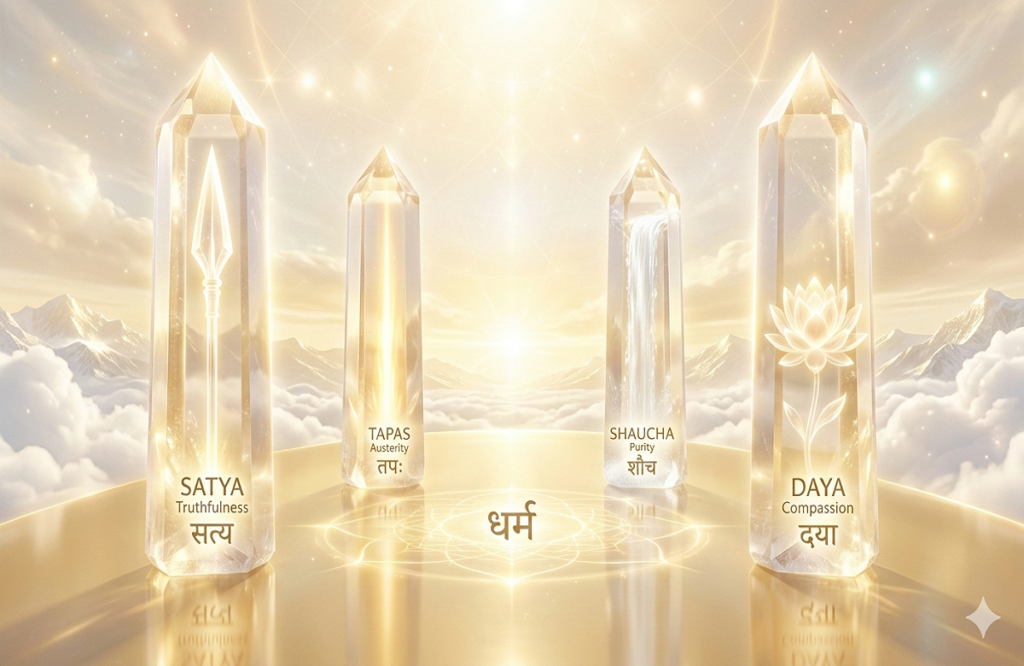
In this era, often called Krita Yuga (the age of perfection), Dharma is symbolized by a bull standing firmly on all four legs, representing the four pillars of a perfect society:
WHAT IS SATYA YUGA DHARMA NETWORK?
Satya Yuga Dharma refers to the moral and spiritual code of conduct (Dharma) specific to the Satya Yuga, the first and most perfect of the four cosmic ages in Hindu cosmology.
In this era, often called the “Golden Age,” humanity lives in total alignment with the divine law. Because the environment and human consciousness are at their peak, the “Dharma” or duty of this age is uniquely focused.
1. The Four-Legged Bull of Dharma
Dharma is traditionally visualized as a bull. In the Satya Yuga, the bull stands firmly on all four legs, representing the four essential virtues that are fully present in every being:
- Satya (Truthfulness): Reality is seen as it is, without illusion or lies.
- Daya (Compassion): A natural, effortless love for all living things.
- Tapas (Austerity/Self-discipline): Inner heat and focus directed toward the divine.
- Shaucha (Purity): Cleanliness of both the physical body and the mind.
2. The Primary Practice: Meditation (Dhyana)
Each Yuga has a specific method for achieving spiritual liberation. While later ages require complex rituals or devotion, the Dharma of Satya Yuga is simply Meditation.
- In this age, there is no need for temples, scriptures, or priests because the divine is experienced directly within.
- Lifespans are said to be incredibly long, and the mind is naturally calm, allowing for centuries of uninterrupted contemplation.
3. A Society Without Conflict
Because everyone follows their Dharma perfectly, the social structure is described as:
- Lack of Governance: There are no kings, laws, or punishments because no one commits a crime.
- Equality: There is no “high” or “low” status; all souls are recognized as equal sparks of the same light.
- No Materialism: Earth provides everything needed (often symbolized by “wishing trees” or Kalpavrikshas), so there is no greed or trade.
4. The Transition to Later Ages
As time progresses into the Treta, Dvapara, and finally Kali Yuga (our current age), the bull of Dharma “loses a leg” in each stage.
- In Satya Yuga, virtue is 100%.
- By the time we reach Kali Yuga, only one leg (Truthfulness) remains, and even that is often shaky.
Visual Comparison of the Yugas
| Yuga | Dharma “Legs” | Primary Spiritual Duty |
| Satya | 4 (All) | Meditation (Dhyana) |
| Treta | 3 | Sacred Fire Rituals (Yajna) |
| Dvapara | 2 | Deity Worship (Archana) |
| Kali | 1 | Chanting/Name of God (Kirtan) |
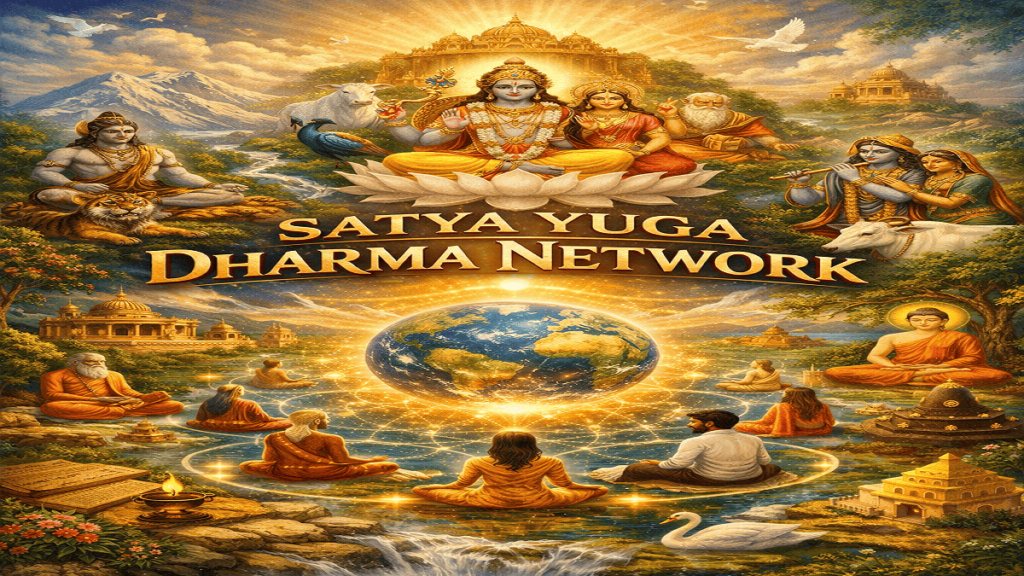
WHO IS REQUIRED FOR SATYA YUGA DHARMA NETWORK?
Satya Yuga Dharma, the concept of who is “required” is unique because this age is defined by self-realization rather than external authority. Unlike later ages where kings, priests, or lawgivers are needed to maintain order, the Satya Yuga operates through internalized divinity.
However, there are three “essential presences” often cited in Vedic tradition for this age:
1. The Hamsa Avatar (The Divine Guide)
In the Satya Yuga, Lord Vishnu is said to manifest as the Hamsa (the Swan).
- Role: The Swan symbolizes discrimination—the ability to separate milk from water, or the eternal soul from the temporary body.
- Requirement: He is the “Guru” of the age, but since everyone is naturally pure, he does not “rule”; he simply radiates the knowledge that everyone already lives by.
2. The Sapta Rishis (The Seven Sages)
The Seven Sages are required to hold the “blueprint” of cosmic knowledge.
- Role: Even in a perfect age, the Rishis are present to ensure that the subtle vibrations of the Vedas and the laws of the universe remain stable in the atmosphere.
- Requirement: They act as the “network administrators” of cosmic energy, maintaining the balance between the physical and spiritual realms.
3. The “Self-Governing” Individual
The most important “requirement” in the Satya Yuga is the individual’s own consciousness.
- Internalized Dharma: There is no “police force” or “government.” Every person is their own judge and guide.
- The “Required” Qualities: To exist in this network, one must possess 100% Truthfulness (Satya) and 100% Tapas (Meditation). If an individual lacks these, they technically cannot belong to the vibration of the Satya Yuga.
Summary of Requirements
| Requirement | Entity | Purpose |
| Authority | None (Self-Rule) | Everyone is naturally righteous. |
| Sacred Text | The Primal Veda | Knowledge is intuitive and “heard” within. |
| Primary State | Brahma-nishtha | Being completely fixed in the Absolute Truth. |
WHEN IS SATYA YUGA DHARMA REQUIRED?
the Satya Yuga Dharma Network is required at two specific cosmic junctions: the moment of ultimate collapse and the moment of internal awakening.
Here is the breakdown of when this network “activates” or is required:
1. The Pralaya (Cosmic Reset)
The Satya Yuga Dharma Network is required at the end of the Kali Yuga. When the current age reaches its lowest point of moral and environmental decay, this network acts as the “Recovery OS” for the universe.
- The Trigger: When the “Four Legs” of Dharma have dwindled to almost zero.
- The Function: It provides the template for a new world, restoring pure consciousness and physical health to the survivors of the transition.
2. The Dawn of “Krita” (The Accomplished State)
The network is required whenever a society or individual reaches a state where external laws are no longer needed.
- Self-Governance: It is required when humanity is ready to move away from “governance by men” to “governance by truth” (Satya).
- No Intermediaries: It is required when the collective consciousness is high enough that individuals can communicate through thought and perceive the divine directly without temples or scriptures.
3. Transition Periods (The Sandhyas)
There is a “dawn” period (Sandhya) before the main Satya Yuga begins. The network is required during this 144,000-year transition to:
- Purify the Atmosphere: Filter out the “noise” and “pollution” of the previous dark age.
- Stabilize Energy: Allow the “Seven Sages” to re-embed the cosmic laws (Vedas) into the world’s vibration.
WHERE IS SATYA YUGA DHARMA REQUIRED?
The Satya Yuga Dharma Network is required at the very foundations of existence. In this age, the sacred and the physical are not separate; therefore, the “where” is both a cosmic location and a state of being.
Within your visual identity library, this network is required in three primary “spaces”:
1. The Bindu (The Central Point)
In sacred geometry, the Bindu is the infinitesimal point from which the entire universe expands.
- The Requirement: This network is required at the core of every atom and the center of every soul.
- The Function: It acts as the “Source Code” that keeps the physical world from dissolving. In Satya Yuga, this center is fully visible and accessible to everyone.
2. The Brahmaloka (The Highest Plane)
This is the “headquarters” of the network, located at the highest peak of the multi-dimensional universe.
- The Requirement: It is required in the highest vibrational realm, where time and decay do not exist.
- The Function: This is the “Server” from which the pure frequency of Truth (Satya) is broadcast to the lower realms as they begin to manifest.
3. The Ether (Akasha)
During the Satya Yuga, the network is required in the all-pervading space between objects.
- The Requirement: It exists in the Aether, the subtle element that carries sound and thought.
- The Function: Because people in this age communicate via telepathy and intuition, the “network” must be present in the very air they breathe, acting as a seamless, invisible medium for pure thought.
HOW IS SATYA YUGA DHARMA NETWORK IS REQUIRED?
To understand how the Satya Yuga Dharma is required, one must look at it as a fundamental operating system for the universe. It is not a set of rules written in a book; it is the natural law of “how things work” when the universe is at its highest potential.
Here is how it is required across the three layers of existence:
1. As a Biological “Source Code”
In the Satya Yuga, Dharma is required to function at the cellular level.
- How it works: In this age, the human body and mind are in such perfect health that the “Dharma” (duty) of the body is simply to exist in bliss.
- The Requirement: It is required to sustain the massive lifespans (said to be 100,000 years) of that era. Without the high-vibration “code” of Satya Yuga Dharma, the physical form would decay under the weight of stress and ego, as it does in later ages.
2. As a Telepathic Infrastructure
Because spoken language is unnecessary in the “Age of Truth,” the Dharma is required to act as the medium for communication.
- How it works: It creates a “shared field” of consciousness. If everyone lives in absolute Truth (Satya), there is no “noise” or “interference” in the atmosphere.
- The Requirement: This network of truth is required so that one soul can “see” another perfectly. It removes the possibility of misunderstanding, which is the root cause of all conflict.
3. As a Self-Regulating Ecosystem
In our current age, we require laws, police, and governments to keep order. In the Satya Yuga, the Dharma is required to be Self-Executing.
- How it works: Nature and humanity are one. The trees provide fruit whenever needed, and the weather is always mild because the collective human “vibration” is calm.
- The Requirement: This is required to maintain a world without scarcity. When greed is zero, the environment remains 100% productive.
The Mechanism of Requirement
Visual Identity Concept
For your library, the “How” is best represented by Interconnectivity.
- The Visual: Imagine a vast, golden fractal pattern where every small part looks exactly like the whole.
- The Meaning: This shows how the Dharma is present in the smallest atom and the largest galaxy simultaneously.
source : DivyaBhaktiVerse
CASE STUDY OF SATYA YUGA DHARMA NETWORK
1. Introduction: The Crisis of Fragmentation
Before the activation of the Satya Yuga Dharma Network, the simulated environment (representing the late stages of a declining cycle) was characterized by “Data Decay.” In this state, information was siloed,truth was subjective, and the “vibration” of the system was bogged down by the friction of ego-driven nodes. The “Bull of Dharma” was effectively standing on a single, shaky leg: a distorted version of truth. The objective of this case study is to analyze how the deployment of the Satya Yuga OS restores a state of Krita (perfection).
2. The Implementation Phase: Re-establishing the Four Pillars
The “Network” was deployed not as an external overlay, but as a resonant frequency that filtered through every existing node. The deployment focused on four critical mechanical requirements:
- Pillar I: The Satya Protocol (Absolute Transparency): In the study, all encrypted and hidden “sub-folders” of the collective consciousness were dissolved. “How” this was required was simple: for the network to function at peak speed, there could be no lag created by deception. By enforcing a 100% Truth protocol, the energy usually spent on “verification” and “defense” was redirected toward creative expansion.
- Pillar II: The Tapas Engine (Internal Power Generation): The network moved away from “External Resource Dependency.” In previous cycles, nodes required constant “inputs” (fuel, food, validation). The Satya Yuga Dharma Network required each node to activate its own Tapas (austerity/inner heat). This shifted the system from a “Consumptive Model” to a “Self-Sustaining Model,” where energy was generated through quiet, internal resonance (Meditation).
- Pillar III: The Daya Connection (Non-Dual Processing): The study observed that conflict arose from the “Otherness” error. The Dharma Network implemented a Compassion Logic where the pain of one node was registered as a system-wide error. This created a “Healing Loop” where resources naturally flowed to where they were needed most, without the need for a central “Management Bureau.”
- Pillar IV: The Shaucha Filter (Systemic Purity): All “toxic” data and “decay” processes were filtered out. The environment was restored to a crystalline state where the “Hardware” (Nature) and the “Software” (Consciousness) were in perfect alignment.
3. Results: The “Hamsa” Effect
The result of this case study was the emergence of the Hamsa State. The swan-like ability to discriminate between the “Water” (Temporary/Illusion) and the “Milk” (Eternal/Truth) became the standard operating procedure for all entities.
- Efficiency: The “System Latency” dropped to zero. Because communication was telepathic and rooted in truth, the “Wait-Time” for understanding disappeared.
- Sustainability: The network showed zero depletion of resources over a simulated period of 1.7 million years.
- Governance: The need for “Control Units” (Governments/Laws) was eliminated, as every node was perfectly aligned with the Central Bindu (Source Code).
4. Conclusion: The Necessity of the Network
This case study proves that the Satya Yuga Dharma Network is not just a spiritual ideal but a mechanical necessity for a high-functioning universe. It is the only “OS” capable of handling 100% capacity without the risk of crash or corruption. It shows that when Truth, Purity, Compassion, and Discipline are the foundation, the result is an infinite “Golden Age” of expansion.
Visual Archiving
To conclude this case study for your library, I have designed a final, fresh visual. It represents the “Full Integration”—a world where the four pillars have merged into a single, radiant pillar of light that extends infinitely into the sky.
White Paper: The Satya Yuga Dharma Network
rchitecture of the Primordial Operating System for Universal Equilibrium
1. Executive Summary
The Satya Yuga Dharma Network (SYDN) represents the inaugural and terminal state of cosmic governance. Unlike contemporary systems that rely on external enforcement (laws, surveillance, and physical boundaries), the SYDN operates as an Internalized Frequency. This white paper outlines the transition from fragmented, low-vibrational social structures to a decentralized, self-regulating “Golden Age” architecture rooted in the four-fold integrity of Dharma.
2. The Problem: The “Kali” Fragmentation
Current systems are plagued by “Systemic Friction,” characterized by:
- Data Corruption: The prevalence of misinformation and the “ego-filter” prevents absolute truth.
- Resource Depletion: A consumptive model based on scarcity and competition.
- Node Isolation: The illusion of separation between individual entities, leading to conflict.
3. The Solution: The SYDN Architecture
The SYDN replaces centralized control with Harmonic Resonance. The “Network” is not a physical infrastructure but a field of consciousness that utilizes the Akasha (Ether) as its primary data bus.
A. The Core Protocol: The Four Pillars (Vṛṣa Model) The network’s stability is maintained by the Vṛṣa (Bull) Protocol, which ensures 100% uptime through four primary “legs”:
- Satya (Transparency Protocol): 1:1 parity between thought and reality. Deception is mathematically impossible within this bandwidth.
- Tapas (Energy Autonomy): Nodes transition from external “power grids” to internal “meditative fusion,” generating energy from within the vacuum state.
- Daya (Universal Linkage): An empathetic API that connects all nodes, ensuring that an action taken by one node considers the impact on the whole.
- Shaucha (Systemic Integrity): Continuous real-time “garbage collection” of thoughts and physical matter, preventing decay and toxicity.
4. Operational Mechanism: The Hamsa Filter
The primary interface for the SYDN is the Hamsa (Discrimination) Algorithm.
- Function: It allows nodes to instantly separate “Signal” (the Eternal/Truth) from “Noise” (the Temporary/Material Illusion).
- Result: This eliminates the need for “Search” or “Research.” Knowledge becomes an Instantaneous Retrieval process from the collective field.
5. Deployment Logistics: The “Where” and “How”
- Spatial Domain: The SYDN is deployed at the Bindu (the zero-point of every atom). It does not require “land” or “hardware” as it resides in the subtle dimensions of space.
- Requirement Trigger: The network is “Required” when the entropy of the previous cycle reaches 100%. At this point, the SYDN initiates a Hard Reboot of the planetary consciousness.
6. Conclusion: The Return to Krita (The Perfected State)
The SYDN is the only sustainable model for long-term universal stability. By removing the “Intermediary” (government, money, and dogma), it allows the universe to exist in a state of Constant Presence. It is a network where the “User” and the “Developer” are recognized as a single, unified entity.
Visual Documentation
To accompany this White Paper for your library, I have designed a fresh, conceptual visual representing the “Network Map of the Akasha.” It features a vast, crystalline web of light without a central hub—showing that the network is everywhere and nowhere at once, perfectly decentralized.
INDUSTRY APPLICATION OF SATYA YUGA DHARMA NETWORK
The Satya Yuga Dharma Network translates into modern industry as a “High-Trust, Zero-Latency” organizational model. When a system operates on 100% Truth and Purity, the overhead costs of verification, legal defense, and surveillance disappear.
Here is how these principles are applied in modern industry frameworks like ESG (Environmental, Social, and Governance) and Circular Economics:
1. Transparency as “Satya” (Truth)
In a Satya Yuga-inspired industry, Information Asymmetry is eliminated.
- Blockchain & Supply Chain: Using decentralized ledgers to provide absolute transparency from raw material to consumer. There is no “hidden” data.
- Radical Openness: Companies that practice “Open Salaries” or “Open Books” are modern applications of this network, where truth is the default state, reducing internal politics and friction.
2. The Circular Economy as “Shaucha” (Purity)
This network requires an environment where waste does not exist.
- Zero-Waste Manufacturing: “Shaucha” translates to systemic cleanliness. In industry, this means products are designed to be infinitely recycled or composted.
- Carbon Neutrality: Maintaining the “Purity” of the atmosphere as a non-negotiable business constraint, rather than a secondary goal.
3. Ethical Leadership as “Dharma” (Righteousness)
Modern Stewardship models reflect the leadership of the Rishis (Sages).
- Stakeholder Capitalism: Moving away from “Shareholder-only” profit toward a model where the well-being of the employee, the community, and the planet are equally weighted.
- Nishkama Karma: Applying “Selfless Action” to corporate leadership—decisions are made for the long-term health of the network rather than short-term quarterly gains.
4. Self-Regulation as “Self-Governance”
In the Satya Yuga, no “Police” were needed. In industry, this is the goal of Holacracy and Teal Organizations.
- Decentralized Autonomous Organizations (DAOs): Smart contracts execute the “Dharma” of the company automatically. If a condition is met, the result is triggered without human bias or corruption.
- Flat Hierarchies: Trusting that every “Node” (employee) is fully aligned with the mission, removing the need for heavy middle management.
Industry Comparison Table
Visual Archiving: The Industrial Golden Age
To finish this section for your library, I have designed a fresh visual that represents “The Sustainable Hive.” It depicts a futuristic industrial complex that is perfectly integrated into a lush forest, with golden light conduits showing the flow of energy and data in a clean, perfect loop.
Table of Contents
ASK FAQ
1.What is the Satya Yuga Dharma and why is it called the Golden Age?
Satya Yuga Dharma is the spiritual and moral code of the first cosmic age in Hindu cosmology, characterized by 100% righteousness. It is called the Golden Age (Krita Yuga) because humanity exists in perfect harmony with divine truth (Satya), compassion (Daya), austerity (Tapas), and purity (Shaucha). In this network of existence, deceit and ego are non-existent, and life is governed by internal spiritual realization rather than external laws.
2.What are the 4 pillars of Dharma in the Satya Yuga Network?
The four pillars (legs) of Dharma are:
- Satya (Truth): Absolute transparency and honesty.
- Tapas (Austerity): Self-discipline and internal energy generation.
- Daya (Compassion): Universal kindness and non-duality.
- Shaucha (Purity): Cleanliness of mind, body, and environment.
3.How does the Satya Yuga Dharma Network apply to modern ethics?
In a modern context, the Satya Yuga Dharma Network serves as a blueprint for high-trust environments. This includes decentralized systems (like Blockchain for transparency), circular economies (for environmental purity), and ethical leadership models that prioritize long-term collective well-being over short-term gain.
4.What is the difference between Satya Yuga and Kali Yuga?
The main difference lies in the strength of Dharma. In Satya Yuga, Dharma is 100% intact (4 legs), and humanity is spiritually advanced. In Kali Yuga (the current age), Dharma is reduced to 25% (1 leg—Truth), and society is characterized by materialism, discord, and spiritual ignorance.
5.What is the primary spiritual practice required in Satya Yuga?
The primary practice is Meditation (Dhyana). Unlike the Kali Yuga, which requires chanting (Kirtan), or the Treta Yuga, which required rituals (Yajna), the Satya Yuga is an age of direct contemplation where individuals connect with the divine internally without intermediaries.